


 本文介绍了一种新的乳腺肿块分类方法,利用Zernike矩和快速的相反权重学习规则,如OWBPP、OWBPE和OWBPI,以提升多层感知器在计算机辅助诊断系统中的性能。实验结果显示,OWBPE算法显著提高了训练速度,并实现了较高的诊断准确性。
💥💥💞💞欢迎来到本博客❤️❤️💥💥
🏆博主优势:🌞🌞🌞博客内容尽量做到思维缜密,逻辑清晰,为了方便读者。
⛳️座右铭:行百里者,半于九十。
📋📋📋本文目录如下:🎁🎁🎁
目录
💥1 概述
参考文献1:
Classification of benign and malignant masses based on Zernike moments - 百度学术 (baidu.com)
参考文献2:

Fast opposite weight learning rules with application in breast cancer diagnosis - 百度学术 (baidu.com)
摘要:对于放射科医师而言,对如肿块等乳腺异常的分类是一个具有挑战性的任务。计算机辅助诊断 (CADx) 技术可以通过协助医师将模式分类为良性和恶性类别来提高他们的表现。虽然神经网络 (NN) 例如多层感知器 (MLP) 存在缺陷,即训练时间长,但相当数量的 CADx 系统采用基于 NN 的分类器。原因是在适当训练时,它们能够提供高准确性。在本文中,我们介绍了三种新颖的学习规则,称为每个模式的相反权重反向传播 (OWBPP)、每个时代的相反权重反向传播 (OWBPE) 以及初始化时每个模式的相反权重反向传播 (OWBPI),以加速 MLP 分类器的训练过程。然后,我们使用传统的反向传播 (BP)、OWBPP、OWBPE 和 OWBPI 算法在 MLP 分类器上开发用于乳腺肿块诊断的 CADx 系统。我们定量分析每个系统的准确性和收敛速率。结果表明,所提出的 OWBPE 算法的收敛速率比传统 BP 快4倍以上。此外,使用 OWBPE 分类器的 CADx 系统的平均 ROC 曲线下面积 (Az) 为0.928,误检率 (FNR) 为9.9%,误诊率 (FPR) 为11.94%。
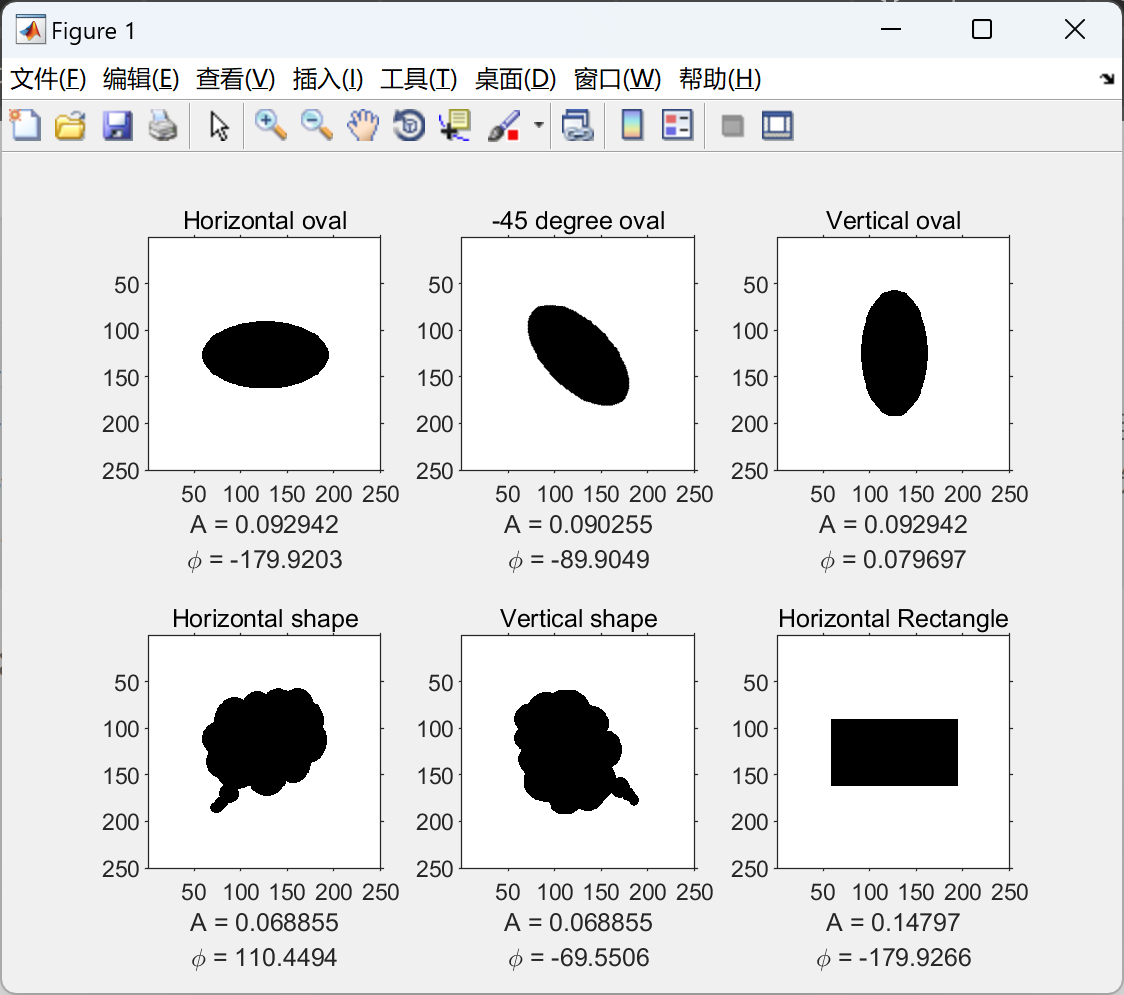
当运行主函数时,它将计算输入图像的Zernike矩,其中n=4为阶次,m=2为重复次数。由于第一行图像只是一个唯一物体(椭圆)的旋转版本,这三个图像的Zernike矩的幅度是相同的。此外,矩的相位差与图像的旋转角度成比例。预期地,两个不同形状(例如椭圆和矩形)的Zernike矩完全不同。这种行为的原因是Zernike矩在描述物体形状的能力。
📚2 运行结果
部分代码:
% A demo of how to use the Zernike moment function.
%
% Example:
% 1- calculate the Zernike moment (n,m) for an oval shape,
% 2- rotate the oval shape around its centeroid,
% 3- calculate the Zernike moment (n,m) again,
% 4- the amplitude of the moment (A) should be the same for both images
% 5- the phase (Phi) should be equal to the angle of rotation
clc; clear all; close all;
n = 4; m = 2; % Define the order and the repetition of the moment
disp('------------------------------------------------');
disp(['Calculating Zernike moments ..., n = ' num2str(n) ', m = ' num2str(m)]);
%--------------------------------------------------------------------------
% row 1
p = rgb2gray(imread('Oval_H.png'));
figure(1);subplot(2,3,1);imshow(p);
title('Horizontal oval');
p = logical(not(p));
tic
[~, AOH, PhiOH] = Zernikmoment(p,n,m); % Call Zernikemoment fuction
Elapsed_time = toc;
xlabel({['A = ' num2str(AOH)]; ['\phi = ' num2str(PhiOH)]});
p = rgb2gray(imread('Oval_45.png'));
figure(1);subplot(2,3,2);imshow(p);
title('-45 degree oval');
p = logical(not(p));
[~, AOH, PhiOH] = Zernikmoment(p,n,m); % Call Zernikemoment fuction
xlabel({['A = ' num2str(AOH)]; ['\phi = ' num2str(PhiOH)]});
p = rgb2gray(imread('Oval_V.png'));
figure(1);subplot(2,3,3);imshow(p);
title('Vertical oval');
p = logical(not(p));
[~, AOH, PhiOH] = Zernikmoment(p,n,m); % Call Zernikemoment fuction
xlabel({['A = ' num2str(AOH)]; ['\phi = ' num2str(PhiOH)]});
%--------------------------------------------------------------------------
% row 2
p = rgb2gray(imread('shape_0.png'));
figure(1);subplot(2,3,4);imshow(p);
title('Horizontal shape');
p = logical(not(p));
[~, AOH, PhiOH] = Zernikmoment(p,n,m); % Call Zernikemoment fuction
xlabel({['A = ' num2str(AOH)]; ['\phi = ' num2str(PhiOH)]});
p = rgb2gray(imread('shape_90.png'));
figure(1);subplot(2,3,5);imshow(p);
title('Vertical shape');
p = logical(not(p));
[~, AOV, PhiOV] = Zernikmoment(p,n,m); % Call Zernikemoment fuction
xlabel({['A = ' num2str(AOV)]; ['\phi = ' num2str(PhiOV)]});
p = rgb2gray(imread('Rectangular_H.png'));
figure(1);subplot(2,3,6);imshow(p);
title('Horizontal Rectangle');
p = logical(not(p));
[~, AOH, PhiOH] = Zernikmoment(p,n,m); % Call Zernikemoment fuction
xlabel({['A = ' num2str(AOH)]; ['\phi = ' num2str(PhiOH)]});
%--------------------------------------------------------------------------
% show the elapsed time
disp('Calculation is complete.');
disp(['The elapsed time per image is ' num2str(Elapsed_time) ' seconds']);
🎉3 参考文献
文章中一些内容引自网络,会注明出处或引用为参考文献,难免有未尽之处,如有不妥,请随时联系删除。
A. Tahmasbi, F. Saki, S. B. Shokouhi, Classification of Benign and Malignant Masses Based on Zernike Moments, Comput. Biol. Med., vol. 41, no. 8, pp. 726-735, 2011.
F. Saki, A. Tahmasbi, H. Soltanian-Zadeh, S. B. Shokouhi, Fast opposite weight learning rules with application in breast cancer diagnosis, Comput. Biol. Med., vol. 43, no. 1, pp. 32-41, 2013.





 扫一扫
扫一扫


 833
833

 被折叠的 条评论
为什么被折叠?
被折叠的 条评论
为什么被折叠?
 到【灌水乐园】发言





