


 本文详细介绍了栈、队列和递归的基本概念、顺序栈和链式栈的实现、双向栈和循环队列的定义与操作,以及递归在计算阶乘、汉诺塔等问题中的应用。
文章目录
1. 前言
本系列笔记基于 清华大学出版社的《数据结构:用面向对象方法与C++语言描述》第二版进行学习。
2. 概念
栈和队列是两种特殊的线性表,逻辑结构和线性表相同,但有更多使用上的限制,故又称为受限的线性表。
3. 栈
3.1 栈的定义
栈可定义为只允许在表的末端进行插入和删除的线性表。允许插入和删除的一端叫栈顶,不允许插入和删除的一端叫栈底。栈属于后进先出的线性表,进栈和出栈的顺序相反。
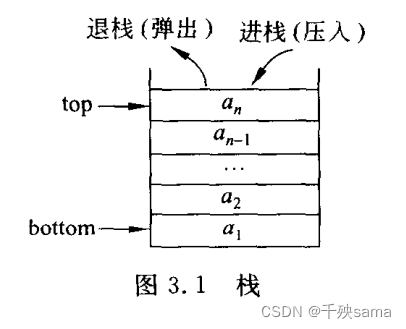
3.1.1 顺序栈定义
顺序栈是基于顺数组的存储表示实现。
3.1.2 顺序栈实现
栈的构造函数
SeqStack::SeqStack(int sz = 50) {
    top = -1;
    maxSize = sz;
    elements = new int[maxSize];
    assert(elements != NULL);
};
assert 断言,如果断言中内容不符合,则退出程序,如符合,继续执行后续语句。
3.1.3 顺序栈的进栈退栈
如图,进栈时元素进入top的位置进行存储,top上移一位(top+1),出栈时删除在top的元素,top下移一位。
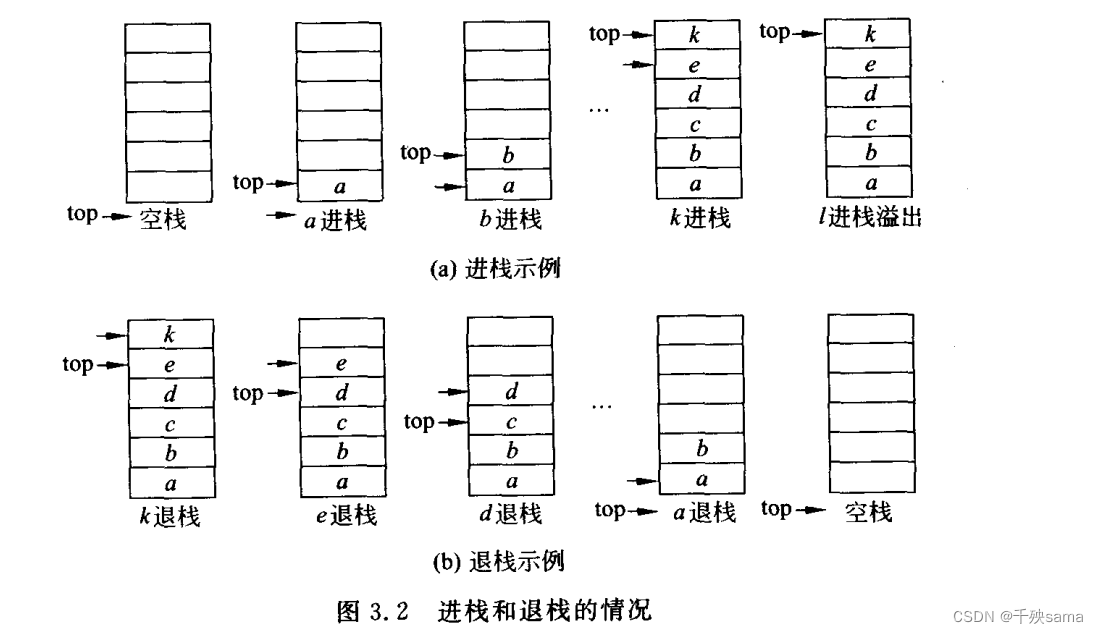
当top = maxsize - 1 时,则表示栈满,如果此时需要再入栈新元素,将进行溢出处理。
3.1.4 顺序栈的实现
#include <iostream>
#include <assert.h>

using namespace std;

const int stackIncreament = 20;

class SeqStack {
public:
    SeqStack(int sz = 50);  // 建立栈
    ~SeqStack() { delete[]elements; }
    void Push(const int& x); // 插入x到栈顶
    bool Pop(int &x);         // 出栈顶元素
    bool getTop(int& x);      // 获得栈顶元素
    bool IsEmpty()const { return (top == -1) ? true : false;}
    bool IsFull()const { return (top == maxSize - 1) ? true : false; }
    int getSize()const {return top + 1;}  // 函数返回栈中元素的个数
    void MakeEmpty() { top = -1; }      // 清空栈的内容
private:
    int* elements;          // 存放栈中元素的栈数组
    int top;                // 栈顶标识
    int maxSize;            // 栈最大可容纳元素个数
    void overflowProcess(); // 栈的溢出处理
};

SeqStack::SeqStack(int sz) {
    top = -1;
    maxSize = sz;
    elements = new int[maxSize];
    assert(elements != NULL);
};


void SeqStack::overflowProcess() {      // 溢出操作,申请新内存
    int* newArray = new int[maxSize + stackIncreament];
    if (newArray == NULL) {
        cout << "error when allocate memory" << endl; exit(1);
    }

    for (int i = 0; i <= top; i++) newArray[i] = elements[i];
    maxSize = maxSize + stackIncreament;
    delete[]elements;
    elements = newArray;
};

void SeqStack::Push(const int& x) {
    if (IsFull() == true) overflowProcess();    // 溢出处理
    top++;
    elements[top] = x;
};

bool SeqStack::Pop(int& x) {
    if (IsEmpty() == true) return false;
    x = elements[top];
    top--;
    return true;
};

bool SeqStack::getTop(int& x) {
    if (IsEmpty() == true) return false;
    x = elements[top];
    return true;
};

int main()
{

}
3.2 双向栈定义
当程序同时需要两个栈时,可以定义一个空间足够的栈,让空间的两端作为两个栈的栈底,让两个栈分别向栈的空间伸展,直到两个栈顶相遇。如b[0]和b[1]分别作为两个栈的栈底,元素入栈t[0]和t[1]分别向栈中心伸展。
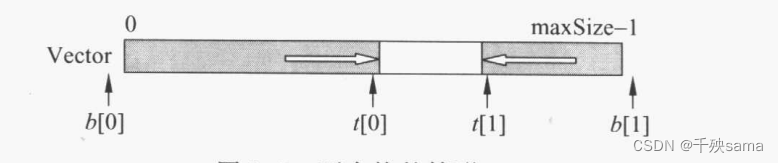
每次进栈时t[0] + 1,t[1] - 1,退栈时相反。
在双栈情形下,初始化语句 t[0] = b[0] = -1; t[1] = b[1] = maxSize,栈满时t[0]+1 == t[1]。
栈空的条件时t[0] = b[0] 或 t[1] = b[1]。
3.2.1 双向栈的插入和删除
bool push(DualStack& DS, int& x, int d) {   // d=0时在0号栈插入,d=1时在1号栈插入
    if (DS.t[0] + 1 == DS.t[1]) return false;  // 栈满
    if (d == 0) DS.t[0]++;
    else DS.t[1]--;
    DS.Vector[DS.t[d]] == x;
    return true;
}

bool Pop(DualStack& DS, int& x, int d) {// d=0时在0号栈插退栈,d=1时在1号栈退栈
    if (Ds.t[d] == DS.b[d]) return false;
    x = DS.Vector[DS.t[d]];
    if (d == 0) DS.t[0]--;
    else DS.t[1]++;
    return true;
}
3.2.2 链式栈类定义
链式栈时栈的链接存储标识。链式栈新结点的插入和栈顶结点的删除都是在链表的表头,即栈顶进行。
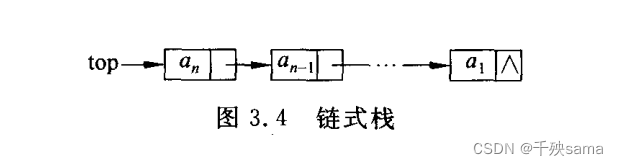
3.2.3 链式栈实现
#include <iostream>
#include<assert.h>

using namespace std;

// 使用带表头的单链表实现
struct LinkNode {
    int data;
    LinkNode* link;
    LinkNode(LinkNode* ptr = NULL) { link = ptr; }  // 仅初始化指针成员的函数
    LinkNode(const int& item, LinkNode* ptr = NULL) { data = item; link = ptr; }   // 初始化数据与指针成员函数
};

class LinkedStack {
private:
    LinkNode* top;
public:
    LinkedStack() : top(NULL) {}          // 构造函数置空栈
    ~LinkedStack() { makeEmpty(); };      // 析构函数
    void makeEmpty();                     // 清空内存
    void Push(const int& x);              // 入栈
    bool Pop(int& x);               // 出栈
    bool getTop(int& x)const;             // 获得栈顶元素
    bool IsEmpty()const { return (top == NULL) ? true : false; }
    int getSize()const;                   // 求栈的元素个数
};


void LinkedStack::makeEmpty() {
    LinkNode* p;
    while (top != NULL) {
        p = top;
        top = top->link;
        delete p;
    }
};

void LinkedStack::Push(const int& x) {
    top = new LinkNode(x, top);           // 栈顶变为新结点
    assert(top != NULL);
};

bool LinkedStack::Pop(int& x) {
    if (IsEmpty() == true) return false;
    LinkNode* p = top;                  // 暂存栈顶结点
    top = top->link;                    // 栈顶指针退到新的栈顶位置
    x = p->data;
    delete p;                           // 删除top
    return true;
};

bool LinkedStack::getTop(int& x) const {
    if (IsEmpty() == true) return false;
    x = top->data;                      // 栈不空则返回栈顶元素的值
    return true;
};

int LinkedStack::getSize()const {
    LinkNode* p = top;
    int k = 0;
    while (p != NULL) {
        p = p->link;                    // 遍历链表
        k++;
    }

    return k;
};

int main()
{

}
4. 递归
4.1 递归的概念
递归简单来说就是函数自己调用自己。
有三种情况常常用到递归:
4.1.1 定义是递归的
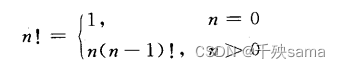
比如计算阶乘、幂函数、斐波拉契数列时,定义和计算都是递归的
long Factorial(long n){
	if(n == 0) return 1;		// 终止条件
	else return n*Factorial(n-1);	// 递归
}
如计算 Factorial(5)时,首先进入函数判断5 != 0,计算5Factorial(4),判断4 != 0,计算 4Factorial(3),此时已经有54Factorial(3),依次进行下去当Factorial(1)时,此时n==1,返回1,且不会进行递归调用函数,此时递归结束,Factorial(5)计算结果为54321。
4.1.2 数据结构是递归的
如单链表寻找最后一个结点时
LinkNode * FindRear(LinkNode *f){
	if(f == NULL) return NULL;
	else if(f->link ==NULL) return f;
	else return FindRear(f->link);
}
又如返回给定值x的结点的地址
void search(LinkNode *f,int &x{
	if(f == NULL) return NULL; // 搜索失败
	else if(f->data == x) return f;		// 符合条件
		else Search(f->link,x);			// 不符合条件,从下一个节点开始搜索
}
4.1.3 问题解法是递归的
汉诺塔问题
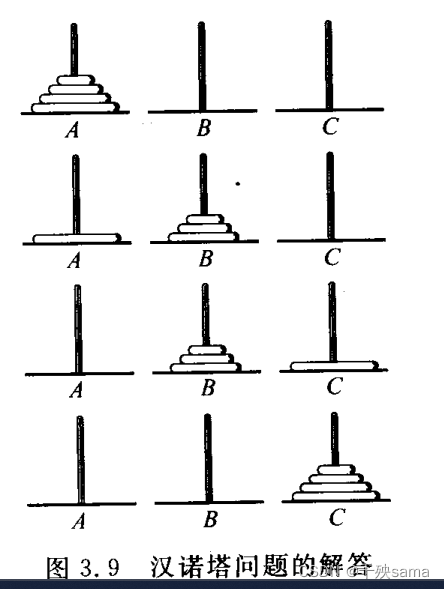
n = 1时,将A直接移动到C。否则执行以下三步:
- 用C做过渡,将A上的(n - 1)个盘子移动到B上。
- 将A柱上的最后一个盘子放在C柱上。
- 用A柱作为过渡,将B柱上的(n - 1)个盘子移动到C柱上
代码实现
#include<string.h>

using namespace std;


void Hanoi(int n, string A, string B, string C)   // A是起点,B是可以用的,C是终点
{
    if (n == 1)
        cout << " from " << A << " to " << C << endl;    // 只有一个盘子,直接移动
    else {
        Hanoi(n - 1, A, C, B);               // 将上面的n-1个盘子移动到B    此时A=1,C=0,B=N-1
        cout << " from " << A << " to " << C << endl;   // 最后一个盘子移动到C       此时A=0,C=1.B=N-1;
        Hanoi(n - 1, B, A, C);                    // 将B柱n-1 个盘子移动到C柱  此时A=0,C=N,B=0
    }
}

int main()
{
    string A = "a";
    string B = "b";
    string C = "C";
    int n = 3;
    Hanoi(n, A, B, C);

    return 0;
}
递归过程
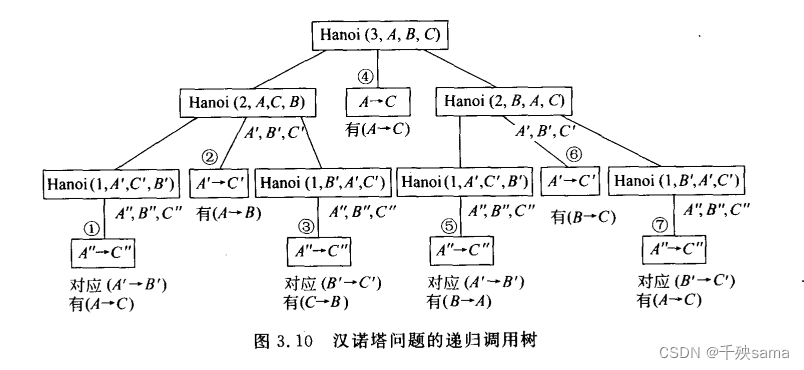
书上写得不是很好,推荐一篇博客
【看这一篇就够了】递归与汉诺塔问题(Hanoi)的超详细算法详解
5. 队列
5.1 队列的概念
只允许一端插入,在表的另一端删除。允许插入的一端叫队尾,允许删除的一端叫队头。如同售票排队一样,先进队列的先出队列。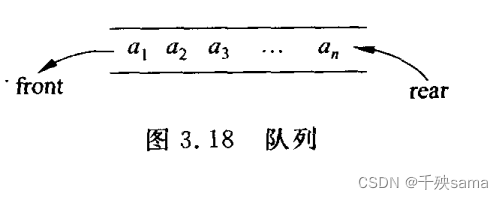
5.2 循环队列
5.2.1 循环队列的插入和删除
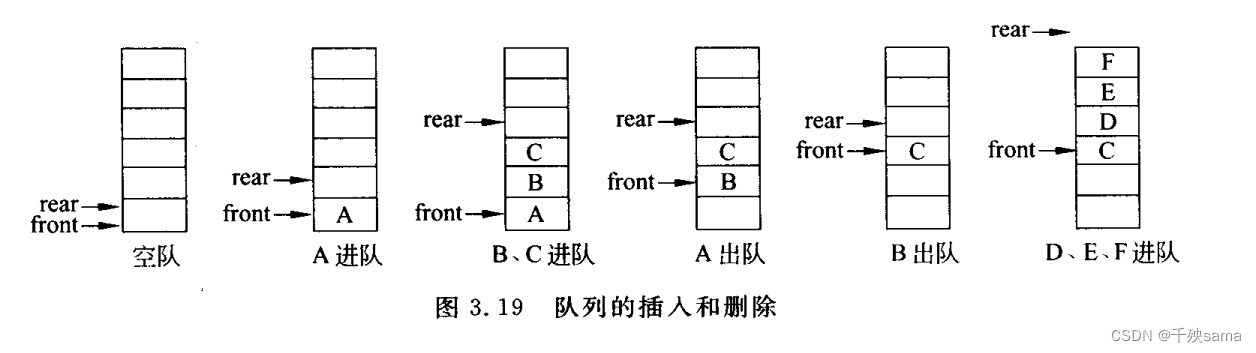
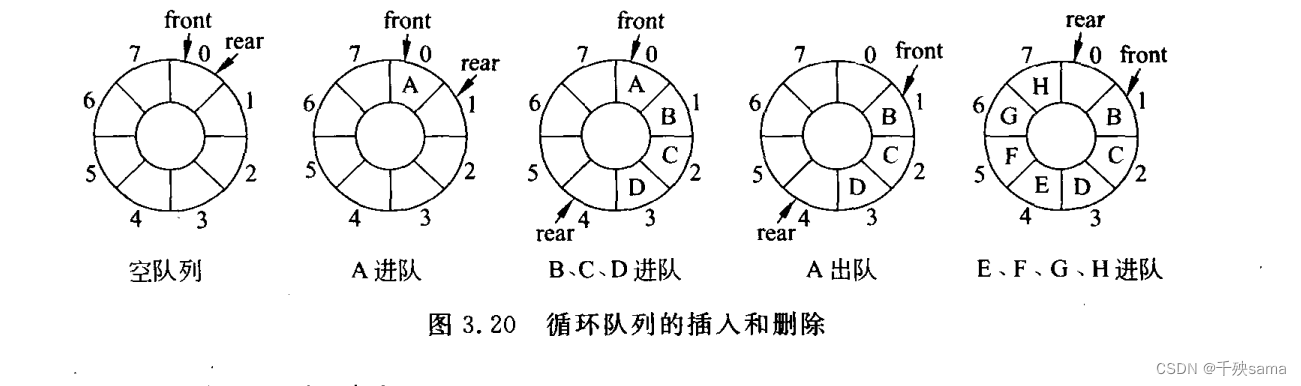
队列基于数组的存储表示称为顺序队列,利用一个一维数组进行存储,并使用rear 和 front两个指针,作为队尾和对头。初始化时front = rear = 0。加入新元素时,插入rear所指的位置,随后rear + 1,删除元素时,删除front所指的位置,随后front+1。这种队列会发生假溢出,所以使用循环队列充分利用内存空间。
队头指针进1 :front = (front+1)% maxSize;
队尾指针进1: rear = (rear+1)% maxSize;
当 front == rear 时,队为空队列,当(rear+1)%maxSize == front 时,队满。
5.2.2 循环队列的实现
#include <iostream>
#include <assert.h>

using namespace std;

class SeqQueue {
private:
    int rear;  // 队尾
    int front; // 队头
    int* elements;  // 存放数据
    int maxSize;    // 队列最大可容纳元素个数
public:
    SeqQueue(int sz = 10);                  // 构造函数
    ~SeqQueue() { delete[] elements; }      // 析构函数
    bool EnQueue(const int& x);             // 进队
    bool DeQueue(int& x);                   // 出队
    bool getFront(int& x);                  // 获得表头
    void makeEmpty() { front = rear = 0; }  // 清空
    bool IsEmpty()const { return(front == rear) ? true : false;} //判断栈为空
    bool IsFull()const { return((rear + 1) % maxSize == front) ? true : false; } // 判断栈满
    int getSize()const { return (rear - front + maxSize) % maxSize; }   // 获得队列元素
};

SeqQueue::SeqQueue(int sz):front(0),rear(0),maxSize(sz) {
    // 建立一个最大具有maxSize个元素的空队列
    elements = new int[maxSize];
    assert(elements != NULL);
};

bool SeqQueue::EnQueue(const int& x) {      // 进队
    if (IsFull() == true) return false;     // 若队列满则插入失败,返回
    elements[rear] = x;                     // 插入队尾
    rear = (rear + 1) % maxSize;            // 队尾指针+1
    return true;
}

bool SeqQueue::DeQueue(int& x) {
    if (IsEmpty() == true) return false;
    x = elements[front];                    // 获得队头元素
    front = (front + 1) % maxSize;          // 队头+1
    return true;
};

bool SeqQueue::getFront(int& x) {
    if (IsFull() == true) return false;
    x = elements[front];                    // 返回队头元素
    return true;
}

int main()
{

}
5.3 链式队列
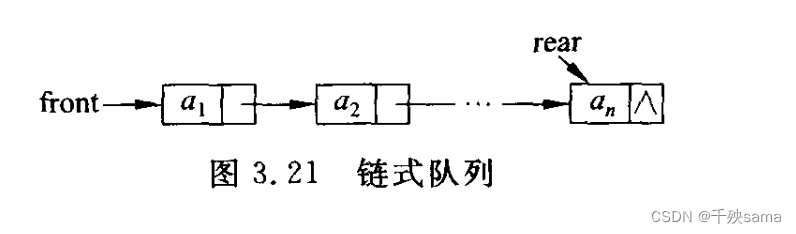
基于单链表存储的队列。队列的队头指针指向第一个结点,队尾指针指向单链表的最后一个节点。
#include <iostream>

using namespace std;


// 使用带表头的单链表实现
struct LinkNode {
    int data;
    LinkNode* link;
    LinkNode(LinkNode* ptr = NULL) { link = ptr; }  // 仅初始化指针成员的函数
    LinkNode(const int& item, LinkNode* ptr = NULL) { data = item; link = ptr; }   // 初始化数据与指针成员函数
};

class LinkedQueue {
public:
    LinkedQueue():rear(NULL),front(NULL){}
    ~LinkedQueue() { makeEmpty(); }
    void makeEmpty();
    bool EnQueue(const int& x);                     // 进栈
    bool DeQueue(int& x);                           // 出栈
    bool getFront(int x)const;                      // 查看队头
    bool IsEmpty()const { return (front == NULL) ? true : false; }      // 判断队列是否为空
    int getSize()const;                             // 获得队列元素个数
private:
    LinkNode* front, * rear;                        // 队头队尾指针
};

void LinkedQueue::makeEmpty()
{
    LinkNode* p;
    while (front != NULL) {
        p = front;
        front = front->link;
        delete p;
    }
};

bool LinkedQueue::EnQueue(const int& x)
{
    if (front == NULL) {                            // 当front队头为空时
        front = rear = new LinkNode(x);
        if (front == NULL) {
            cout << "error when enQueue!" << endl;
            return false;
        }
    }
    else {
        rear->link = new LinkNode(x);
        if (rear->link == NULL) return false;
        rear = rear->link;
    }

    return true;
}

bool LinkedQueue::DeQueue(int& x)
{
    if (IsEmpty() == true) return false;
    LinkNode* p = front;
    x = front->data;
    front = front->link;
    delete p;
    return true;
}

bool LinkedQueue::getFront(int x) const
{
    if (IsEmpty() == true) return false;
    x = front->data;
    return true;
}

int LinkedQueue::getSize() const
{
    LinkNode* p = front;
    int k = 0;
    while (p != NULL) { p = p->link; k++; }
    return k;
}


int main()
{

}
5.4 打印二项展开式
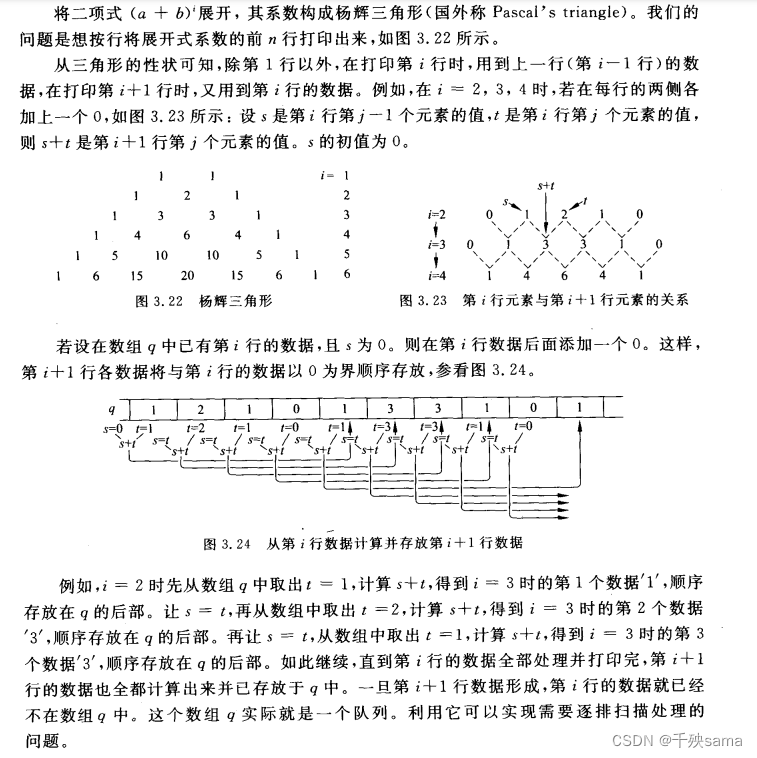
void YangVI(int n) {
    Queue q(n + 1);                         // 建立队列对象并初始化
    int  s = 0;                                    // 存放 S (s+t)^n 的s
    int k = 0;                                     // 作为每行队尾插入的0的工具人
    int t;                                            // 存放T  S (s+t)^n 的t
    int u;                                          //  暂时存放下一行的根据(s+t)算出的数据
    q.Enqueue(1); q.Enqueue(1);     // 先把第一行插入
    for (int i = 1; i <= n; i++) {
        cout << endl;
        q.EnQueue(k);                         // 在这一行的队尾插入一个0
        for (int j = 1; j <= i + 2; j++) {
            q.DeQueue(t);                   // 读取T的数据
            u = s + t;                          // 计算下一行的数据
            q.EnQueue(u);                  // 将算出的数据入队
            s = t;                                  // s变成他下一位数据
            if (j != i + 2)cout << s << " ";    // 打印除了0 的数据
        }
    }
}





 扫一扫
扫一扫


 505
505

 被折叠的 条评论
为什么被折叠?
被折叠的 条评论
为什么被折叠?
 到【灌水乐园】发言





