



Leetcode(208)——实现 Trie (前缀树)
题目
Trie(发音类似 “try”)或者说 前缀树 是一种树形数据结构,用于高效地存储和检索字符串数据集中的键。这一数据结构有相当多的应用情景,例如自动补完和拼写检查。
请你实现 Trie 类:
Trie()初始化前缀树对象。void insert(String word)向前缀树中插入字符串word。boolean search(String word)如果字符串word在前缀树中,返回true(即,在检索之前已经插入);否则,返回false。boolean startsWith(String prefix)如果之前已经插入的字符串word的前缀之一为prefix,返回true;否则,返回false。
示例:
输入
[“Trie”, “insert”, “search”, “search”, “startsWith”, “insert”, “search”]
[[], [“apple”], [“apple”], [“app”], [“app”], [“app”], [“app”]]
输出
[null, null, true, false, true, null, true]
解释
Trie trie = new Trie();
trie.insert(“apple”);
trie.search(“apple”); // 返回 True
trie.search(“app”); // 返回 False
trie.startsWith(“app”); // 返回 True
trie.insert(“app”);
trie.search(“app”); // 返回 True
提示:
- 1 <= word.length, prefix.length <= 2000
- word 和 prefix 仅由小写英文字母组成
- insert、search 和 startsWith 调用次数 总计 不超过 3∗1043 * 10^43∗104 次
题解
方法:字典树
思路
Trie,又称前缀树或字典树,是一棵有根树,其每个节点包含以下字段:
- 指向子节点的指针数组 children\textit{children}children。对于本题而言,数组长度为 262626,即小写英文字母的数量。此时 children[0]\textit{children}[0]children[0] 对应小写字母 aaa,children[1]\textit{children}[1]children[1] 对应小写字母 bbb,………,children[25]\textit{children}[25]children[25] 对应小写字母 zzz。
- 布尔字段 isEnd\textit{isEnd}isEnd,表示该节点是否为字符串的结尾。
插入字符串
我们从字典树的根开始,插入字符串。对于当前字符对应的子节点,有两种情况:
- 子节点存在。沿着指针移动到子节点,继续处理下一个字符。
- 子节点不存在。创建一个新的子节点,记录在 children\textit{children}children 数组的对应位置上,然后沿着指针移动到子节点,继续搜索下一个字符。
重复以上步骤,直到处理字符串的最后一个字符,然后将当前节点标记为字符串的结尾。
查找前缀
我们从字典树的根开始,查找前缀。对于当前字符对应的子节点,有两种情况:
- 子节点存在。沿着指针移动到子节点,继续搜索下一个字符。
- 子节点不存在。说明字典树中不包含该前缀,返回空指针。
重复以上步骤,直到返回空指针或搜索完前缀的最后一个字符。
若搜索到了前缀的末尾,就说明字典树中存在该前缀。此外,若前缀末尾对应节点的 isEnd\textit{isEnd}isEnd 为真,则说明字典树中存在该字符串。
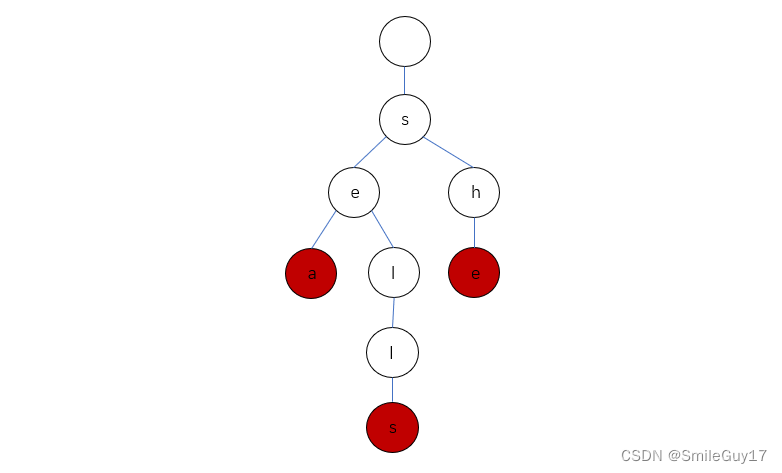
包含三个单词 “sea”,“sells”,“she” 的 Trie 会长啥样呢?
它的真实情况是这样的:
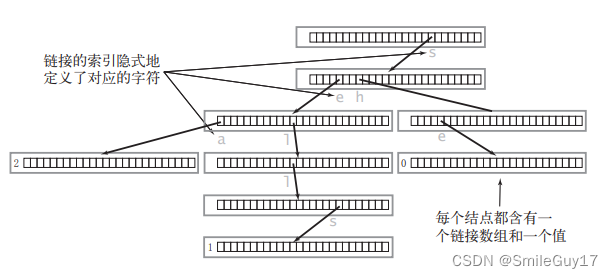
Trie 中一般都含有大量的空链接,因此在绘制一棵单词查找树时一般会忽略空链接,同时为了方便理解我们可以画成这样:
代码实现
class Trie {
private:
    vector<Trie*> children;
    bool isEnd;

    Trie* searchPrefix(string prefix) {
        Trie* node = this;
        for (char ch : prefix) {
            ch -= 'a';
            if (node->children[ch] == nullptr) {
                return nullptr;
            }
            node = node->children[ch];
        }
        return node;
    }

public:
    Trie() : children(26), isEnd(false) {}

    void insert(string word) {
        Trie* node = this;
        for (char ch : word) {
            ch -= 'a';
            if (node->children[ch] == nullptr) {
                node->children[ch] = new Trie();
            }
            node = node->children[ch];
        }
        node->isEnd = true;
    }

    bool search(string word) {
        Trie* node = this->searchPrefix(word);
        return node != nullptr && node->isEnd;
    }

    bool startsWith(string prefix) {
        return this->searchPrefix(prefix) != nullptr;
    }
};
我的非字典树实现
class Trie {
    typedef Trie* TreeNode;
    TreeNode left, right;
    string val;
    bool starts_with(string word, string prefix){
        if(word.length() <= prefix.length()) return false;
        for(auto i1 = word.begin(), i2 = prefix.begin(); i2 != prefix.end(); i2++, i1++)
            if(*i1 != *i2) return false;
        return true;
    }

public:
    Trie(): left(nullptr), right(nullptr), val("") {}
    Trie(string &word): left(nullptr), right(nullptr), val(word) {}

    void insert(string word) {
        TreeNode curr = this;
        while(curr != nullptr){
            if(word < curr->val){
                if(curr->left == nullptr) curr->left = new Trie(word);
                curr = curr->left;
            }else if(word > curr->val){
                if(curr->right == nullptr) curr->right = new Trie(word);
                curr = curr->right;
            }else return;
        }
    }

    bool search(string word) {
        TreeNode curr = this;
        while(curr != nullptr){
            if(word < curr->val){
                curr = curr->left;
            }else if(word > curr->val){
                curr = curr->right;
            }else return true;
        }
        return false;
    }

    bool startsWith(string prefix) {
        TreeNode curr = this;
        while(curr != nullptr){
            if(prefix < curr->val){
                if(starts_with(curr->val, prefix)) return true;
                curr = curr->left;
            }else if(prefix > curr->val){
                if(starts_with(curr->val, prefix)) return true;
                curr = curr->right;
            }else return true;
        }
        return false;
    }
};
/**
 * Your Trie object will be instantiated and called as such:
 * Trie* obj = new Trie();
 * obj->insert(word);
 * bool param_2 = obj->search(word);
 * bool param_3 = obj->startsWith(prefix);
 */
复杂度分析
时间复杂度:初始化为 O(1)O(1)O(1),其余操作为 O(∣S∣)O(|S|)O(∣S∣),其中 ∣S∣|S|∣S∣ 是每次插入或查询的字符串的长度。
空间复杂度:O(∣T∣⋅Σ)O(∣T∣⋅Σ)O(∣T∣⋅Σ),其中 ∣T∣|T|∣T∣ 为所有插入字符串的长度之和,Σ\SigmaΣ 为字符集的大小,本题 Σ=26\Sigma=26Σ=26。





 扫一扫
扫一扫


 579
579

 被折叠的 条评论
为什么被折叠?
被折叠的 条评论
为什么被折叠?
 到【灌水乐园】发言





