



 本文探讨了如何定义和处理语法中的特殊标记及注释,包括单行和多行注释,并展示了这些元素如何与主要的语法元素如TOKEN关联。
SPECIAL_TOKEN are special tokens, that are bound to a token; they are referred from token.specialToken fields.
For example:
Grammar define comments as SPECIAL_TOKEN.
SKIP :
{
  " "
| "\t"
| "\n"
| "\r"
}

/* COMMENTS */
SPECIAL_TOKEN :
{
  <SINGLE_LINE_COMMENT: "--" (~["\n","\r"])* ("\n"|"\r"|"\r\n")>
| <MULTI_LINE_COMMENT: "/*" (~["*"])* "*" ("*" | (~["*","/"] (~["*"])* "*"))* "/">
}


SimpleNode Input() :
{}
{
 P()
 <EOF>
 { return jjtThis; }
}

void P() :
{}
{
  ( A() | B() | C() )+
}
So for this input:
-- line comment 1
A /* field comment 1 */ B
-- line comment 2
/* field comment 2 */
C
-- line comment 3
These inputs will generate 3 TOKEN, A, B, C
A.next = B;
B.next = C;
C.next = null;
And 5 comment special tokens; the comment tokens are bound to A, B, or C
A.specialToken = "--line comment 1"
"--line comment 1".next = A
B.specialToken = "/* field comment 1 */"
"/* field comment 1 */".next = B
C.specialToken = "/* field comment 2 */"
"/* field comment 2 */".next = C
"/* field comment 2 */".specialToken = "--line comment 2"
"--line comment 2".next = "/* field comment 2 */"
But the problem is where is "--line comment 3", there is no Token after it ?
Fortunately, there is a <EOF> token at the end, <EOF>.next = "--line comment 3".
So the final token train is:
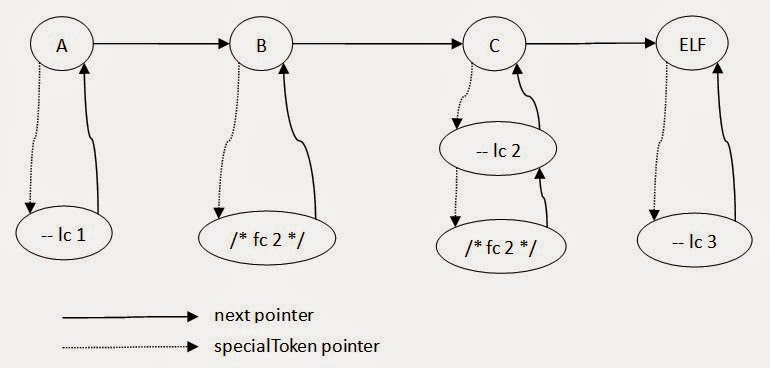
lc = line comment
fc = field comment





 扫一扫
扫一扫


 288
288

 被折叠的 条评论
为什么被折叠?
被折叠的 条评论
为什么被折叠?
 到【灌水乐园】发言





