


Power Network
| Time Limit: 2000MS | Memory Limit: 32768K | |
| Total Submissions: 24008 | Accepted: 12534 |
Description
A power network consists of nodes (power stations, consumers and dispatchers) connected by power transport lines. A node u may be supplied with an amount s(u) >= 0 of power, may produce an amount 0 <= p(u) <= p
max(u) of power, may consume an amount 0 <= c(u) <= min(s(u),c
max(u)) of power, and may deliver an amount d(u)=s(u)+p(u)-c(u) of power. The following restrictions apply: c(u)=0 for any power station, p(u)=0 for any consumer, and p(u)=c(u)=0 for any dispatcher. There is at most one power transport line (u,v) from a node u to a node v in the net; it transports an amount 0 <= l(u,v) <= l
max(u,v) of power delivered by u to v. Let Con=Σ
uc(u) be the power consumed in the net. The problem is to compute the maximum value of Con.
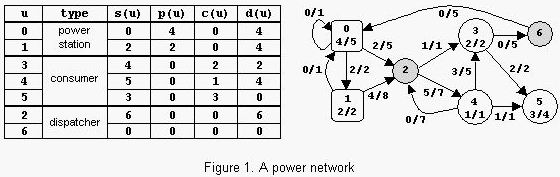
An example is in figure 1. The label x/y of power station u shows that p(u)=x and p max(u)=y. The label x/y of consumer u shows that c(u)=x and c max(u)=y. The label x/y of power transport line (u,v) shows that l(u,v)=x and l max(u,v)=y. The power consumed is Con=6. Notice that there are other possible states of the network but the value of Con cannot exceed 6.
An example is in figure 1. The label x/y of power station u shows that p(u)=x and p max(u)=y. The label x/y of consumer u shows that c(u)=x and c max(u)=y. The label x/y of power transport line (u,v) shows that l(u,v)=x and l max(u,v)=y. The power consumed is Con=6. Notice that there are other possible states of the network but the value of Con cannot exceed 6.
Input
There are several data sets in the input. Each data set encodes a power network. It starts with four integers: 0 <= n <= 100 (nodes), 0 <= np <= n (power stations), 0 <= nc <= n (consumers), and 0 <= m <= n^2 (power transport lines). Follow m data triplets (u,v)z, where u and v are node identifiers (starting from 0) and 0 <= z <= 1000 is the value of l
max(u,v). Follow np doublets (u)z, where u is the identifier of a power station and 0 <= z <= 10000 is the value of p
max(u). The data set ends with nc doublets (u)z, where u is the identifier of a consumer and 0 <= z <= 10000 is the value of c
max(u). All input numbers are integers. Except the (u,v)z triplets and the (u)z doublets, which do not contain white spaces, white spaces can occur freely in input. Input data terminate with an end of file and are correct.
Output
For each data set from the input, the program prints on the standard output the maximum amount of power that can be consumed in the corresponding network. Each result has an integral value and is printed from the beginning of a separate line.
Sample Input
2 1 1 2 (0,1)20 (1,0)10 (0)15 (1)20
7 2 3 13 (0,0)1 (0,1)2 (0,2)5 (1,0)1 (1,2)8 (2,3)1 (2,4)7
         (3,5)2 (3,6)5 (4,2)7 (4,3)5 (4,5)1 (6,0)5
         (0)5 (1)2 (3)2 (4)1 (5)4
Sample Output
15
6
Hint
The sample input contains two data sets. The first data set encodes a network with 2 nodes, power station 0 with pmax(0)=15 and consumer 1 with cmax(1)=20, and 2 power transport lines with lmax(0,1)=20 and lmax(1,0)=10. The maximum value of Con is 15. The second data set encodes the network from figure 1.
Source
第一道网络流题目,用的是EK算法。。。1600+ms,比较慢
#include <iostream>
#include <cstring>
#include <cstdio>
#include <queue>

using namespace std;

#define maxn 150
#define inf 0x3f3f3f3f

int first[maxn], top;
int next[maxn*maxn], cap[maxn*maxn],rev[maxn*maxn], to[maxn*maxn];


void add(int u, int v, int c)  //有向图
{
    to[top] = v, next[top] = first[u];
    cap[top] = c, rev[top] = top+1;
    first[u] = top++;

    to[top] = u, next[top] = first[v];
    cap[top] = 0, rev[top] = top-1;
    first[v] = top++;
}


int vis[maxn];  //遍历时检查每个点是否搜索过
int pre[maxn]; //pre[v],无权最短路中v的前一个点
int pre_edge[maxn]; //pre_edge[v],  无权最短路中连接v的边
int f[maxn]; //f[v],残余网络中到点v的最大流量

int bfs(int s, int t)  //bfs找增广路
{
    queue<int> que;
    que.push(s);
    pre[s] = -1;
    vis[s] = 1;
    f[s] = inf;

    while(!que.empty()){
        int u = que.front();
        que.pop();

        int v;
        for(int i = first[u]; i !=-1; i = next[i]){
            v = to[i];
            if(vis[v] || !cap[i]) continue;

            f[v] = min(f[u], cap[i]);
            que.push(v);
            vis[v] = 1;
            pre[v] = u, pre_edge[v] = i;
            if(v == t){
                while(v != s){
                    cap[pre_edge[v]] -= f[t];
                    cap[rev[pre_edge[v]]] += f[t];
                    v = pre[v];
                }

                return f[t];
            }
        }
    }

    return 0;
}

int ek_max_flow(int s, int t) //ek算法求最大流
{
    int ret = 0, f;
    while(1){
        memset(vis, 0, sizeof(vis));
        f = bfs(s, t); //查找增广路
        if(!f) break;
        ret += f;
    }

    return ret;
}

int value[5];

void convert(char *str)
{
    int len = strlen(str);
    int val = 0;
    int cnt = 0;
    for(int i = 1; i < len; i++){
        if(str[i] == ',' || str[i] == ')'){
            value[cnt++] = val;
            val = 0;
        }
        else
        val = val*10+str[i]-'0';
    }

    value[cnt] = val;
}

int main()
{
    int s, t;
    int n, m, np, nc;
    char str[100];
    int u,v,z;
    while(~scanf("%d%d%d%d", &n, &np, &nc, &m)){
        memset(first, -1, sizeof(first));
        top = 0;

        for(int i = 0; i < m; i++){
            scanf("%s", str);
            convert(str);
            add(value[0], value[1], value[2]);
        }

        for(int i = 0; i < np; i++){
            scanf("%s", str);
            convert(str);
            add(n+1, value[0], value[1]); //n+1为增加的超级源点
        }

        for(int i = 0; i < nc; i++){
            scanf("%s", str);
            convert(str);
            add(value[0], n+2, value[1]);   //n+2为增加的超级汇点
        }

        printf("%d\n", ek_max_flow(n+1, n+2));
    }
    return 0;
}
学完Dinic算法再来做一遍,只要63ms。。。
#include <iostream>
#include <cstring>
#include <cstdio>
#include <queue>
#include <vector>

using namespace std;

#define maxn 150
#define inf 0x3f3f3f3f

struct edge
{
    edge(int a, int b, int c){to=a; cap = b; rev = c;}
    int to, cap, rev;
};
vector<edge> g[maxn];


void add(int u, int v, int c)  //有向图
{
    g[u].push_back(edge(v, c, g[v].size()));
    g[v].push_back(edge(u, 0, g[u].size()-1));
}


int level[maxn];
void bfs(int s)
{
    memset(level, -1, sizeof(level));
    level[s] = 0;
    queue<int> que;
    que.push(s);

    while(!que.empty()){
        int u = que.front(); que.pop();
        for(int i = 0; i < g[u].size(); i++){
            int v = g[u][i].to, cap = g[u][i].cap;
            if(level[v] < 0 && cap > 0){
                level[v] = level[u]+1;
                que.push(v);
            }
        }
    }
}

int cur[maxn];
int dfs(int u, int t, int f)
{
    if(u == t) return f;

    for(int &i = cur[u]; i < g[u].size(); i++){
        int v = g[u][i].to, &cap = g[u][i].cap, rev = g[u][i].rev;
        if(level[v] == level[u]+1 && cap>0){
            int tmp = dfs(v, t, min(cap, f));
            if(tmp>0){
                cap -= tmp;
                g[v][rev].cap += tmp;
                return tmp;
            }
        }
    }

    return 0;
}

int Dinic(int s, int t)
{
    int flow = 0;
    while(1){
        bfs(s);
        if(level[t] < 0) return flow;
        int f;
        memset(cur, 0, sizeof(cur));
        while((f = dfs(s, t, 0x3f3f3f3f))) flow += f;
    }
}

int value[5];

void convert(char *str)
{
    int len = strlen(str);
    int val = 0;
    int cnt = 0;
    for(int i = 1; i < len; i++){
        if(str[i] == ',' || str[i] == ')'){
            value[cnt++] = val;
            val = 0;
        }
        else
        val = val*10+str[i]-'0';
    }

    value[cnt] = val;
}

int main()
{
    int s, t;
    int n, m, np, nc;
    char str[100];
    int u,v,z;
    while(~scanf("%d%d%d%d", &n, &np, &nc, &m)){
        for(int i = 0; i < maxn; i++) g[i].clear();
        for(int i = 0; i < m; i++){
            scanf("%s", str);
            convert(str);
            add(value[0], value[1], value[2]);
        }

        for(int i = 0; i < np; i++){
            scanf("%s", str);
            convert(str);
            add(n+1, value[0], value[1]); //n+1为增加的超级源点
        }

        for(int i = 0; i < nc; i++){
            scanf("%s", str);
            convert(str);
            add(value[0], n+2, value[1]);   //n+2为增加的超级汇点
        }

        printf("%d\n", Dinic(n+1, n+2));
    }
    return 0;
}


 299


 扫一扫


 被折叠的 条评论
为什么被折叠?
 到【灌水乐园】发言


