



学习资料:spring技术内幕、https://javadoop.com/post/spring-ioc
作者qq:767641495
一、IOC容器
IoC(Inversion of Control)是一种设计模式,是用来解耦组件复杂关系的利器,Spring的IoC是一种模式的实现。主要的两种大类的IoC容器为BeanFactory和ApplicationContext。
1、BeanFactory
BeanFactory是所有的IoC容器的基类,拥有容器最基本的功能。
它有一个很重要的实现类DefaultListableBeanFactory,被认为是一个成熟的工厂,经常被使用。
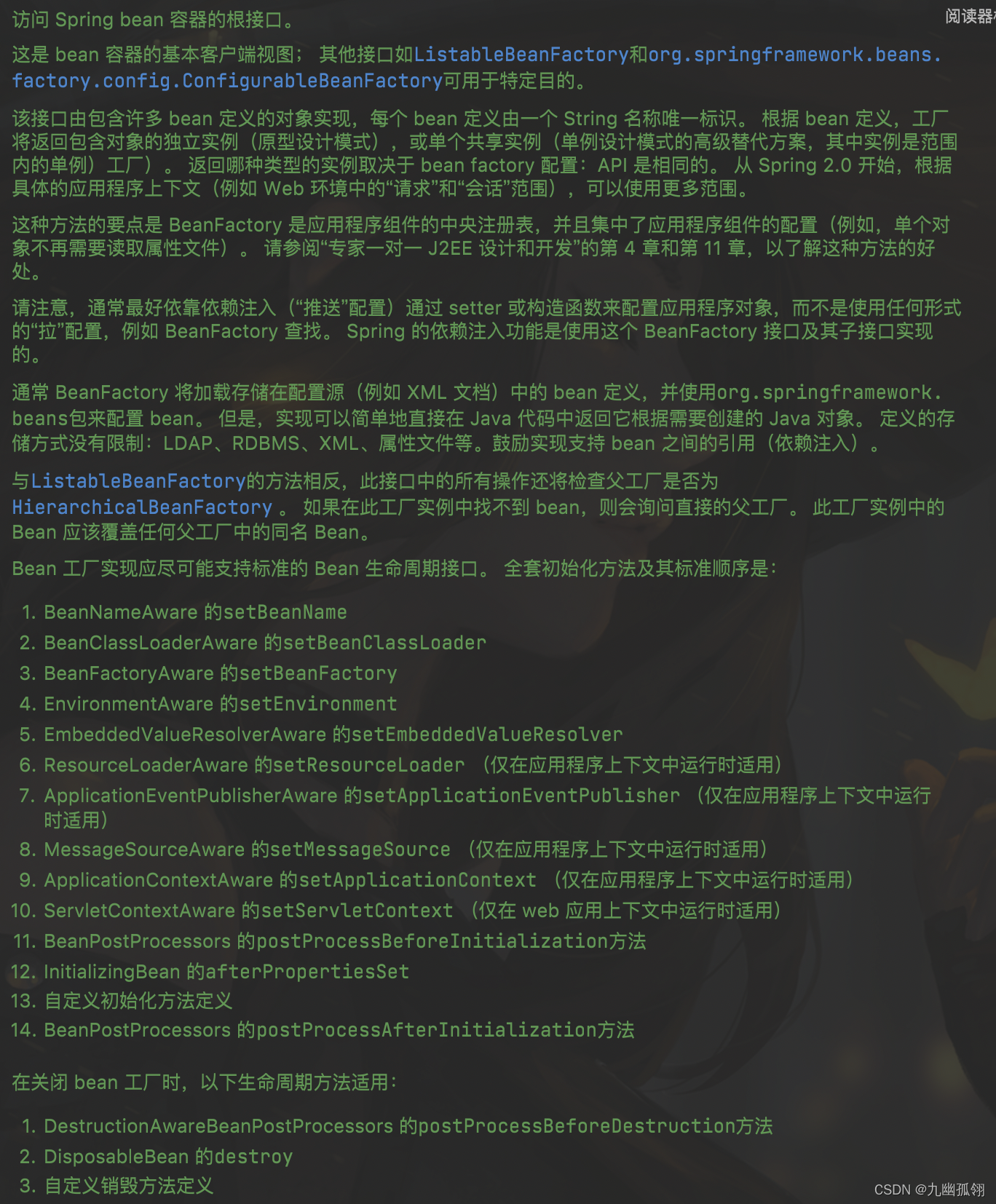
先来看看BeanFactory注释怎么说,信息量有点大,重点关注里面那个初始化顺序。
我们先从一个简单的BeanFactory的使用说起吧~
在使用一个IoC容器的时候,主要步骤为以下四步:
- 创建IoC配置文件的抽象资源,这个抽象资源包含了BeanDefinition的定义信息
- 创建一个BeanFactory
- 创建一个载入BeanDfinition的读取器,这里使用XMLBeanDefinitionReader对象来载入XML文件形式的BeanDefinition,通过一个回调配置给BeanFactory
- 从定以好的资源位置读入配置信息,具体的解析过程由XmlBeanDefinitionReader完成;完成整个载入 和注册Bean定义之后,需要的IoC容器就建立起来了。之后就可以使用IoC容器了
写一个简单的Demo可能更方便理解:
- 新建一个实体类MyUser
public class MyUser {

    private String name;

    public void setName(String name) {
        this.name = name;
    }

    @Override
    public String toString() {
        return "User{" +
                "name='" + name + '\'' +
                '}';
    }
}
- 将bean写入xml
<bean id="myUser" class="com.demo.pojo.MyUser" name="u1">
        <property name="name" value="hzh"/>
</bean>
- 写测试类
ClassPathResource res = new ClassPathResource("beans.xml");
DefaultListableBeanFactory factory = new DefaultListableBeanFactory();
XmlBeanDefinitionReader reader = new XmlBeanDefinitionReader(factory);
reader.loadBeanDefinitions(res);
MyUser user = (MyUser) factory.getBean("u1");
System.out.println(user);
仔细看这个测试类,里面的每一步都与上面讲的主要步骤对应。
2、ApplicationContext
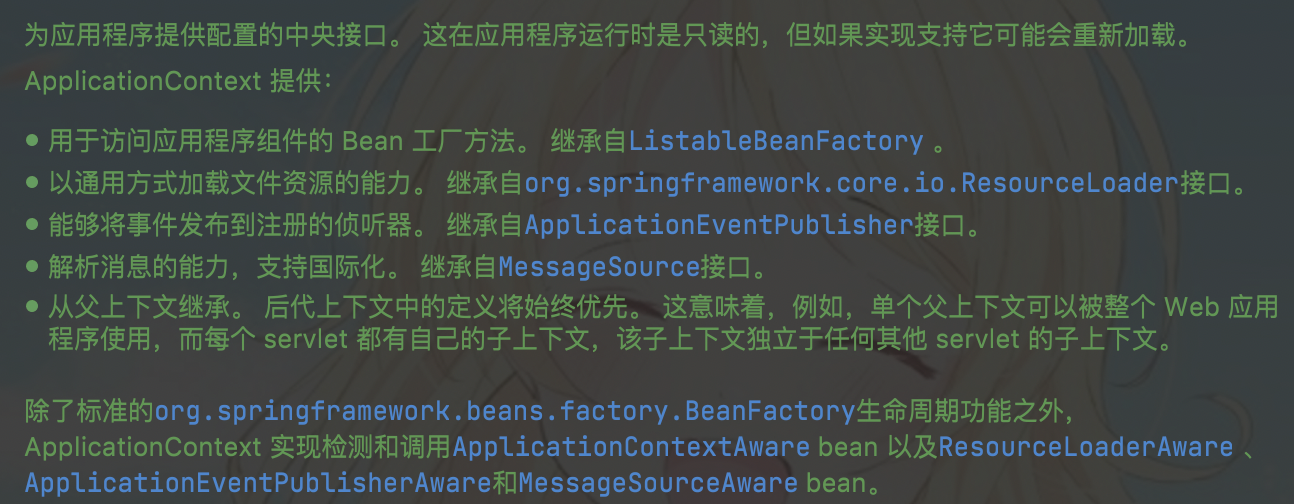
ApplicationContext是容器的高级形态,具有很多BeanFactory没有的功能。
老规矩,先上注释。

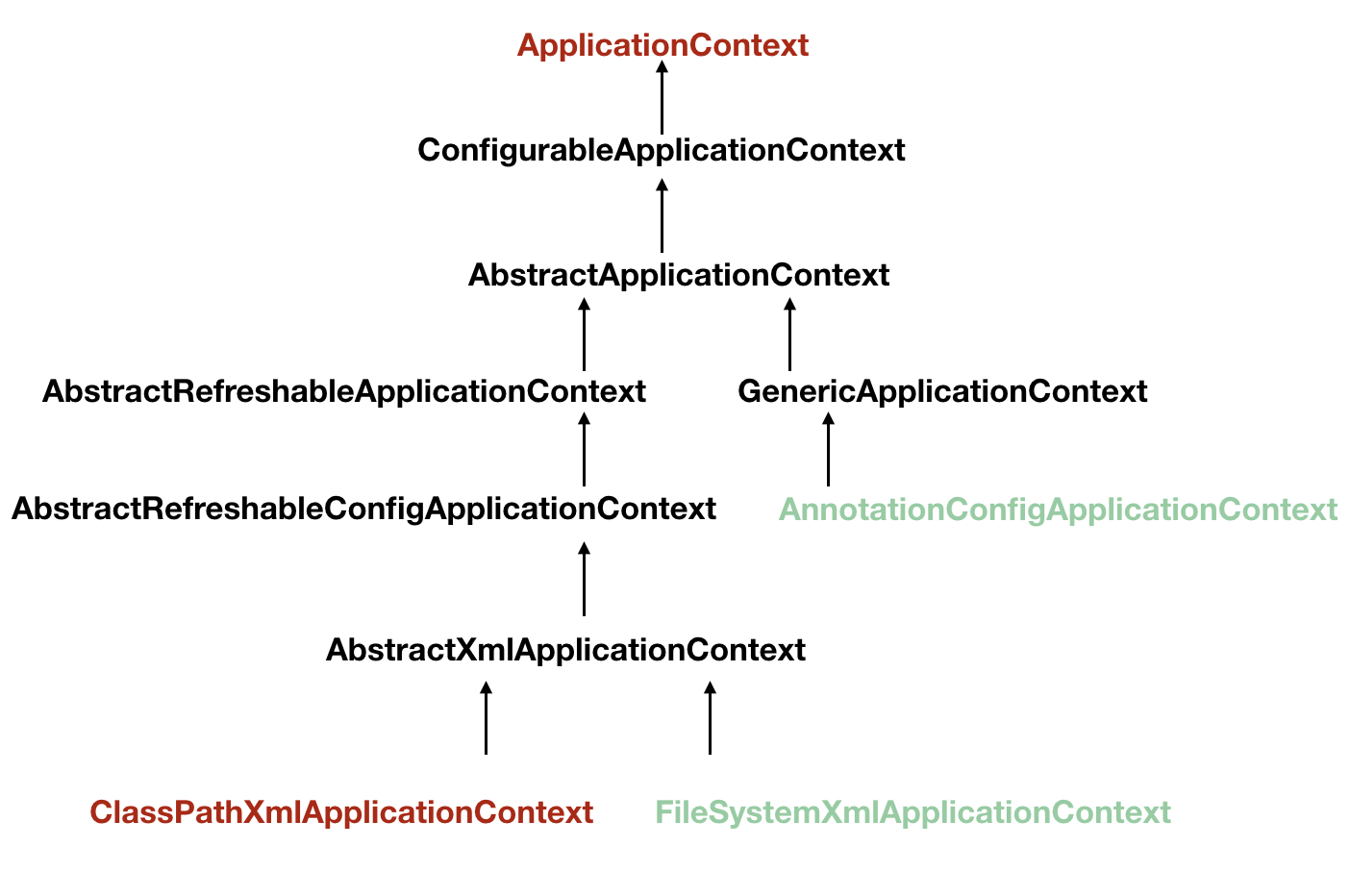
可以看到ApplicationContext中的父类以及实现类,实现类中用的比较多的就是AnnotationConfigApplicationContext,也就是基于注解的bean,也是如今springboot的使用类;还有就是传统的ClassPathXmlApplicationContext和FileSystemXmlApplicationContext这两个从xml文件中获取bean的类。
虽然ApplicationContext没有继承AutowireCapableBeanFactory,不过它通过组合的方式,可以通过getAutowireCapableBeanFactory()这个方法获取到这个工厂,实现自动装配。
沿用上面的demo,写一个新的测试类
ApplicationContext classPathXmlApplicationContext = new ClassPathXmlApplicationContext("beans.xml");
MyUser user =(MyUser) classPathXmlApplicationContext.getBean("u2");
System.out.println(user);
可以发现我们省去了新建Reader并将Reader和factory绑定的步骤,这是因为ApplicationContext实现了ResourceLoader这个接口,使得它可以直接加载资源。
3、ApplicationContext的初始化过程
大致的流程分为三个基本过程——BeanDefinition的Resource定位、载入和注册。
先简单来聊聊这三步骤:
- Resource定位:其实就是找到你定义bean信息的文件,然后封装成Resource的形式,还记得我们刚刚讲过的第一步“创建IoC配置文件的抽象资源”嘛?就是这个。Resource实现了InputStreamSource接口,而这个接口中有InputStream,也就是我们可以读取配置文件。对于各种存在形式的Resource存在了不同的继承了Resource的子类,比如ClassPathResource, ServletContextResult, FileSystemResource等。
- BeanDefinition的载入:对xml文件中的内容进行解析,封装成IoC容器内部的数据结构BeanDefinition,所谓的Bean其实就是BeanDefinition的实例。
- 向Ioc容器注册BeanDefinition:通过调用BeanDefinitionRegistry接口,将上一步获得的BeanDefinition注入到一个HashMap中去。
补充:如果IoC容器中的Bean通过设置lazyinit属性进行懒加载,那么在初始化阶段就会进行依赖注入;如果没有,是在第一次调用getBean()方法的时候,进行依赖注入的。
我们以FileSystemXmlApplicationContext为例,来完整走一遍初始化流程。
Resource定位
FileSystemXmlApplicationContext构造函数
public FileSystemXmlApplicationContext(String[] configLocations, boolean refresh, @Nullable ApplicationContext parent) throws BeansException {
        super(parent);
        this.setConfigLocations(configLocations);
        if (refresh) {
            this.refresh();
        }
}
可以看到这边先设置了配置的地址后,进行了一个refresh(),这个refresh()非常关键,是整个初始化的核心方法!这个方法是在FileSystemXmlApplicationContext的父类AbstractRefreshableApplicationContext中定义来看一下这个类的注释:
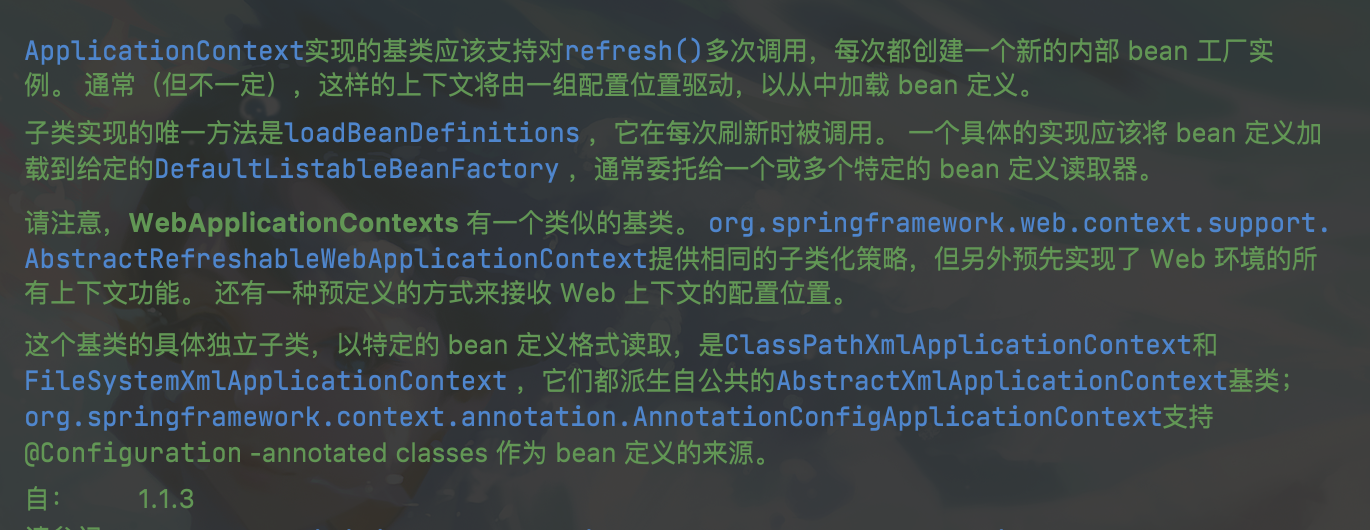
从注释中可以了解到,refresh()作用是重建一个新的内部bean工厂实例。可以看到这个抽象类要求子类实现loadBeanDefinitions方法,使用的IoC容器是DefaultListableBeanFactory,我们的FileSystemXmlApplicationContext对于的loadBeanDefinitions实现是在它的另一个父类AbstractXmlApplicationContext,对于loadBeanDefinitions的调用是在AbstractRefreshableApplicationContext中。
具体实现:
AbstractApplicationContext.java
@Override
public void refresh() throws BeansException, IllegalStateException {
  // 来个锁,避免refresh()未结束,容器启动或者销毁
	synchronized (this.startupShutdownMonitor) {
      // 准备工作,记录下容器的启动时间、标记“已启动”状态、处理配置文件中的占位符
			// Prepare this context for refreshing.
			prepareRefresh();

      // 这步比较关键,这步完成后,配置文件就会解析成一个个 Bean 定义,注册到 BeanFactory 中,
      // 当然,这里说的 Bean 还没有初始化,只是配置信息都提取出来了,
      // 注册也只是将这些信息都保存到了注册中心
			// Tell the subclass to refresh the internal bean factory.
			ConfigurableListableBeanFactory beanFactory = obtainFreshBeanFactory();

      // 设置 BeanFactory 的类加载器,添加几个 BeanPostProcessor,手动注册几个特殊的 bean
			// Prepare the bean factory for use in this context.
			prepareBeanFactory(beanFactory);

      // Bean 如果实现了BeanFactoryPostProcessor接口,那么在容器初始化以后,Spring 会负责调用里面的 postProcessBeanFactory 方法。这里是提供给子类的扩展点,到这里的时候,所有的 Bean 都加载、注册完成了,但是都还没有初始化。具体的子类可以在这步的时候添加一些特殊的 BeanFactoryPostProcessor 的实现类或做点什么
			// Allows post-processing of the bean factory in context subclasses.
			postProcessBeanFactory(beanFactory);

      // 调用 BeanFactoryPostProcessor 各个实现类的 postProcessBeanFactory(factory) 方法
			// Invoke factory processors registered as beans in the context.
			invokeBeanFactoryPostProcessors(beanFactory);

      // 注册 BeanPostProcessor 的实现类,注意看和 BeanFactoryPostProcessor 的区别
      // 此接口两个方法: postProcessBeforeInitialization 和 postProcessAfterInitialization
      // 两个方法分别在 Bean 初始化之前和初始化之后得到执行。注意,到这里 Bean 还没初始化
			// Register bean processors that intercept bean creation.
			registerBeanPostProcessors(beanFactory);

      // 初始化当前 ApplicationContext 的 MessageSource,国际化
			// Initialize message source for this context.
			initMessageSource();

      // 初始化当前 ApplicationContext 的事件广播器
			// Initialize event multicaster for this context.
			initApplicationEventMulticaster();

      // 具体的子类可以在这里初始化一些特殊的 Bean
			// Initialize other special beans in specific context subclasses.
			onRefresh();

      // 注册事件监听器,监听器需要实现 ApplicationListener 接口
			// Check for listener beans and register them.
			registerListeners();

      // 初始化所有的 singleton beans
			// Instantiate all remaining (non-lazy-init) singletons.
			finishBeanFactoryInitialization(beanFactory);

      // 最后,广播事件,ApplicationContext 初始化完成
			// Last step: publish corresponding event.
			finishRefresh();
		}
}
这个方法完整初始化了ApplicationContext,我们先把关注点放在obtainFreshBeanFactory()中,它调用了refreshBeanFactory(),而refreshBeanFactory()中调用了customizeBeanFactory()和loadBeanDefinitions()两个方法。
AbstractRefreshableApplicationContext.java
protected void customizeBeanFactory(DefaultListableBeanFactory beanFactory) {
		if (this.allowBeanDefinitionOverriding != null) {
			beanFactory.setAllowBeanDefinitionOverriding(this.allowBeanDefinitionOverriding);
		}
		if (this.allowCircularReferences != null) {
			beanFactory.setAllowCircularReferences(this.allowCircularReferences);
		}
	}

protected final void refreshBeanFactory() throws BeansException {
        if (this.hasBeanFactory()) {
            this.destroyBeans();
            this.closeBeanFactory();
        }

        try {
            DefaultListableBeanFactory beanFactory = this.createBeanFactory();
            beanFactory.setSerializationId(this.getId());
            this.customizeBeanFactory(beanFactory);
            this.loadBeanDefinitions(beanFactory);
            this.beanFactory = beanFactory;
        } catch (IOException var2) {
            throw new ApplicationContextException("I/O error parsing bean definition source for " + this.getDisplayName(), var2);
        }
    }
customizeBeanFactory()其实就是判断是否允许 Bean 定义覆盖和是否允许 Bean 间的循环依赖。BeanDefinition 的覆盖问题可能会有开发者碰到这个坑,就是在配置文件中定义 bean 时使用了相同的 id 或 name,默认情况下,allowBeanDefinitionOverriding 属性为 null,如果在同一配置文件中重复了,会抛错,但是如果不是同一配置文件中,会发生覆盖。
循环引用也很好理解:A 依赖 B,而 B 依赖 A。或 A 依赖 B,B 依赖 C,而 C 依赖 A。
默认情况下,Spring通过三级缓存机制,允许循环依赖的存在,当然如果你在 A 的构造方法中依赖 B,在 B 的构造方法中依赖 A 是不行的。
refreshBeanFactory()会先检测是否存在beanFactory,存在的话,会销毁所有bean然后关闭工厂,接着新建一个DefaultListableBeanFactory并将BeanDefinitions注入进入。也就是说所有的ApplicationContext中都有一个DefaultListableBeanFactory,之后所有的BeanFactory 相关的操作其实是委托给这个实例来处理的。
AbstractXmlApplicationContext.java
@Override
	protected void loadBeanDefinitions(DefaultListableBeanFactory beanFactory) throws BeansException, IOException {
		// Create a new XmlBeanDefinitionReader for the given BeanFactory.
		XmlBeanDefinitionReader beanDefinitionReader = new XmlBeanDefinitionReader(beanFactory);

		// Configure the bean definition reader with this context's
		// resource loading environment.
		beanDefinitionReader.setEnvironment(this.getEnvironment());
		beanDefinitionReader.setResourceLoader(this);
		beanDefinitionReader.setEntityResolver(new ResourceEntityResolver(this));

		// Allow a subclass to provide custom initialization of the reader,
		// then proceed with actually loading the bean definitions.
		initBeanDefinitionReader(beanDefinitionReader);
		loadBeanDefinitions(beanDefinitionReader);
	}
新建了一个BeanDefinitionReader将BeanDefinition载入BeanFactory
protected void loadBeanDefinitions(XmlBeanDefinitionReader reader) throws BeansException, IOException {
		Resource[] configResources = getConfigResources();
		if (configResources != null) {
			reader.loadBeanDefinitions(configResources);
		}
		String[] configLocations = getConfigLocations();
		if (configLocations != null) {
			reader.loadBeanDefinitions(configLocations);
		}
	}
获取configResources/configLocations,调用reader的loadBeanDefinitions
加载configResources是第二部分的事,后面再详细讲;先讲加载configLocations,最终会把configLocations给转换成Resource
public int loadBeanDefinitions(String location, Set<Resource> actualResources) {
		ResourceLoader resourceLoader = getResourceLoader();

		if (resourceLoader instanceof ResourcePatternResolver) {
			// Resource pattern matching available.
			Resource[] resources = ((ResourcePatternResolver) resourceLoader).getResources(location);
			int count = loadBeanDefinitions(resources);
			Collections.addAll(actualResources, resources);
			return count;
		}
		else {
			// Can only load single resources by absolute URL.
			Resource resource = resourceLoader.getResource(location);
			int count = loadBeanDefinitions(resource);
			actualResources.add(resource);
			return count;
		}
	}
getResources方法可以参考DefaultResourceLoader中的实现
public Resource getResource(String location) {
		for (ProtocolResolver protocolResolver : getProtocolResolvers()) {
			Resource resource = protocolResolver.resolve(location, this);
			return resource;
		}

		if (location.startsWith("/")) {
			return getResourceByPath(location);
		}
		else if (location.startsWith(CLASSPATH_URL_PREFIX)) {
			return new ClassPathResource(location.substring(CLASSPATH_URL_PREFIX.length()), getClassLoader());
		}
		else {
			try {
				// Try to parse the location as a URL...
				URL url = new URL(location);
				return (ResourceUtils.isFileURL(url) ? new FileUrlResource(url) : new UrlResource(url));
			}
			catch (MalformedURLException ex) {
				// No URL -> resolve as resource path.
				return getResourceByPath(location);
			}
		}
	}
可以看到,如果如果location就是一个path,会调用getResourceByPath();是URL的话,会调用URL的相关处理方法。getResourceByPath()在我们的第一个类FileSystemXmlApplicationContext中就实现过。
@Override
	protected Resource getResourceByPath(String path) {
		if (path.startsWith("/")) {
			path = path.substring(1);
		}
		return new FileSystemResource(path);
	}
至此,我们的第一小步终于完成了!
BeanDefinition的载入和解析
我们于第一步中获取到了Resource,现在我们需要做的是对Resource中的BeanDefinition的载入和解析。
接上文的“加载configResources”
@Override
	public int loadBeanDefinitions(Resource... resources) throws BeanDefinitionStoreException {
		Assert.notNull(resources, "Resource array must not be null");
		int count = 0;
		for (Resource resource : resources) {
			count += loadBeanDefinitions(resource);
		}
		return count;
	}
这里的loadBeanDefinitions(resource)在XmlBeanDefinitionReader中实现
@Override
	public int loadBeanDefinitions(Resource resource) throws BeanDefinitionStoreException {
		return loadBeanDefinitions(new EncodedResource(resource));
	}
因为这个方法中异常处理以及非空判断过多,所以我将核心代码抽出来整理了一下:
public int loadBeanDefinitions(EncodedResource encodedResource) {
		Set<EncodedResource> currentResources = this.resourcesCurrentlyBeingLoaded.get();
		currentResources = new HashSet<>(4);
		this.resourcesCurrentlyBeingLoaded.set(currentResources);
		InputStream inputStream = encodedResource.getResource().getInputStream();
		InputSource inputSource = new InputSource(inputStream);
		inputSource.setEncoding(encodedResource.getEncoding())
		return doLoadBeanDefinitions(inputSource, encodedResource.getResource());
}

protected int doLoadBeanDefinitions(InputSource inputSource, Resource resource)
{
			Document doc = doLoadDocument(inputSource, resource);
			int count = registerBeanDefinitions(doc, resource);
			return count;
}

public int registerBeanDefinitions(Document doc, Resource resource) {
		BeanDefinitionDocumentReader documentReader = createBeanDefinitionDocumentReader();
		int countBefore = getRegistry().getBeanDefinitionCount();
		documentReader.registerBeanDefinitions(doc, createReaderContext(resource));
		return getRegistry().getBeanDefinitionCount() - countBefore;
}
具体的解析是在BeanDefinitionParserDelegate类中完成的,这也是BeanDefinitionDocumentReader类的主要功能。最终,我们在XML文件中定义的BeanDefinition被解析成一棵DOM树,解析结果放入AbstractBeanDefinition对象并设置到BeanDefinitionHolder中。
BeanDefinition在IoC容器中的注册
在DefaultListableBeanFactory中实现了BeanDefinitionRegistry这个接口,这个接口的实现完成了BeanDefinition的注册,主要做的就是往DefaultListableBeanFactory中的HashMap里放数据。
@Override
	public void registerBeanDefinition(String beanName, BeanDefinition beanDefinition)
			throws BeanDefinitionStoreException {

		Assert.hasText(beanName, "Bean name must not be empty");
		Assert.notNull(beanDefinition, "BeanDefinition must not be null");

		if (beanDefinition instanceof AbstractBeanDefinition) {
			try {
				((AbstractBeanDefinition) beanDefinition).validate();
			}
			catch (BeanDefinitionValidationException ex) {
				throw new BeanDefinitionStoreException(beanDefinition.getResourceDescription(), beanName,
						"Validation of bean definition failed", ex);
			}
		}

		BeanDefinition existingDefinition = this.beanDefinitionMap.get(beanName);
		if (existingDefinition != null) {
			if (!isAllowBeanDefinitionOverriding()) {
				throw new BeanDefinitionOverrideException(beanName, beanDefinition, existingDefinition);
			}
			else if (existingDefinition.getRole() < beanDefinition.getRole()) {
				// e.g. was ROLE_APPLICATION, now overriding with ROLE_SUPPORT or ROLE_INFRASTRUCTURE
				if (logger.isInfoEnabled()) {
					logger.info("Overriding user-defined bean definition for bean '" + beanName +
							"' with a framework-generated bean definition: replacing [" +
							existingDefinition + "] with [" + beanDefinition + "]");
				}
			}
			else if (!beanDefinition.equals(existingDefinition)) {
				if (logger.isDebugEnabled()) {
					logger.debug("Overriding bean definition for bean '" + beanName +
							"' with a different definition: replacing [" + existingDefinition +
							"] with [" + beanDefinition + "]");
				}
			}
			else {
				if (logger.isTraceEnabled()) {
					logger.trace("Overriding bean definition for bean '" + beanName +
							"' with an equivalent definition: replacing [" + existingDefinition +
							"] with [" + beanDefinition + "]");
				}
			}
			this.beanDefinitionMap.put(beanName, beanDefinition);
		}
		else {
			if (hasBeanCreationStarted()) {
				// Cannot modify startup-time collection elements anymore (for stable iteration)
				synchronized (this.beanDefinitionMap) {
					this.beanDefinitionMap.put(beanName, beanDefinition);
					List<String> updatedDefinitions = new ArrayList<>(this.beanDefinitionNames.size() + 1);
					updatedDefinitions.addAll(this.beanDefinitionNames);
					updatedDefinitions.add(beanName);
					this.beanDefinitionNames = updatedDefinitions;
					removeManualSingletonName(beanName);
				}
			}
			else {
				// Still in startup registration phase
				this.beanDefinitionMap.put(beanName, beanDefinition);
				this.beanDefinitionNames.add(beanName);
				removeManualSingletonName(beanName);
			}
			this.frozenBeanDefinitionNames = null;
		}

		if (existingDefinition != null || containsSingleton(beanName)) {
			resetBeanDefinition(beanName);
		}
		else if (isConfigurationFrozen()) {
			clearByTypeCache();
		}
	}
到这里已经初始化了 Bean 容器(完成了refresh()中的obtainFreshBeanFactory()),<bean /> 配置也相应的转换为了一个个 BeanDefinition,然后注册到注册中心(HashMap),并且发送了注册事件。
prepareBeanFactory(beanFactory)
接着回到之前的refresh(),下一个方法是prepareBeanFactory(beanFactory),在这里会手动注册一些特殊的bean并进行一些配置,其中我对Aware这个bean对容器的感知类进行了一些介绍。
/**
 * Configure the factory's standard context characteristics,
 * such as the context's ClassLoader and post-processors.
 * @param beanFactory the BeanFactory to configure
 */
protected void prepareBeanFactory(ConfigurableListableBeanFactory beanFactory) {
   // 设置 BeanFactory 的类加载器,我们知道 BeanFactory 需要加载类,也就需要类加载器,
   // 这里设置为加载当前 ApplicationContext 类的类加载器
   beanFactory.setBeanClassLoader(getClassLoader());

   // 设置 BeanExpressionResolver
   beanFactory.setBeanExpressionResolver(new StandardBeanExpressionResolver(beanFactory.getBeanClassLoader()));
   //
   beanFactory.addPropertyEditorRegistrar(new ResourceEditorRegistrar(this, getEnvironment()));

   // 添加一个 BeanPostProcessor,这个 processor 比较简单:
   // 实现了 Aware 接口的 beans 在初始化的时候,这个 processor 负责回调,
   // 这个我们很常用,如我们会为了获取 ApplicationContext 而 implement ApplicationContextAware
   // 注意:它不仅仅回调 ApplicationContextAware,还会负责回调 EnvironmentAware、ResourceLoaderAware 等,看下源码就清楚了
   // aware类指的是Bean对容器的感知,即通过bean可以获取实现了对应aware接口的信息
   beanFactory.addBeanPostProcessor(new ApplicationContextAwareProcessor(this));

   // 下面几行的意思就是,如果某个 bean 依赖于以下几个接口的实现类,在自动装配的时候忽略它们,
   // Spring 会通过其他方式来处理这些依赖。
   beanFactory.ignoreDependencyInterface(EnvironmentAware.class);
   beanFactory.ignoreDependencyInterface(EmbeddedValueResolverAware.class);
   beanFactory.ignoreDependencyInterface(ResourceLoaderAware.class);
   beanFactory.ignoreDependencyInterface(ApplicationEventPublisherAware.class);
   beanFactory.ignoreDependencyInterface(MessageSourceAware.class);
   beanFactory.ignoreDependencyInterface(ApplicationContext.class);

   /**
    * 下面几行就是为特殊的几个 bean 赋值,如果有 bean 依赖了以下几个,会注入这边相应的值,
    * 之前我们说过,"当前 ApplicationContext 持有一个 BeanFactory",这里解释了第一行。
    * ApplicationContext 还继承了 ResourceLoader、ApplicationEventPublisher、MessageSource
    * 所以对于这几个依赖,可以赋值为 this,注意 this 是一个 ApplicationContext
    * 那这里怎么没看到为 MessageSource 赋值呢?那是因为 MessageSource 被注册成为了一个普通的 bean
    */
   beanFactory.registerResolvableDependency(BeanFactory.class, beanFactory);
   beanFactory.registerResolvableDependency(ResourceLoader.class, this);
   beanFactory.registerResolvableDependency(ApplicationEventPublisher.class, this);
   beanFactory.registerResolvableDependency(ApplicationContext.class, this);

   // 这个 BeanPostProcessor 也很简单,在 bean 实例化后,如果是 ApplicationListener 的子类,那么将其添加到 listener 列表中,可以理解成:注册 事件监听器
   beanFactory.addBeanPostProcessor(new ApplicationListenerDetector(this));

   // 这里涉及到特殊的 bean,名为:loadTimeWeaver
   // ltw 是 AspectJ 的概念,指的是在运行期进行织入,这个和 Spring AOP 不一样,
   if (beanFactory.containsBean(LOAD_TIME_WEAVER_BEAN_NAME)) {
      beanFactory.addBeanPostProcessor(new LoadTimeWeaverAwareProcessor(beanFactory));
      // Set a temporary ClassLoader for type matching.
      beanFactory.setTempClassLoader(new ContextTypeMatchClassLoader(beanFactory.getBeanClassLoader()));
   }

   /**
    * 从下面几行代码我们可以知道,Spring 往往很 "智能" 就是因为它会帮我们默认注册一些有用的 bean,
    * 我们也可以选择覆盖
    */

   // 如果没有定义 "environment" 这个 bean,那么 Spring 会 "手动" 注册一个
   if (!beanFactory.containsLocalBean(ENVIRONMENT_BEAN_NAME)) {
      beanFactory.registerSingleton(ENVIRONMENT_BEAN_NAME, getEnvironment());
   }
   // 如果没有定义 "systemProperties" 这个 bean,那么 Spring 会 "手动" 注册一个
   if (!beanFactory.containsLocalBean(SYSTEM_PROPERTIES_BEAN_NAME)) {
      beanFactory.registerSingleton(SYSTEM_PROPERTIES_BEAN_NAME, getEnvironment().getSystemProperties());
   }
   // 如果没有定义 "systemEnvironment" 这个 bean,那么 Spring 会 "手动" 注册一个
   if (!beanFactory.containsLocalBean(SYSTEM_ENVIRONMENT_BEAN_NAME)) {
      beanFactory.registerSingleton(SYSTEM_ENVIRONMENT_BEAN_NAME, getEnvironment().getSystemEnvironment());
   }
}
下一个重要的方法是finishBeanFactoryInitialization(beanFactory),这里初始化了所有的singleton beans。
// 初始化剩余的 singleton beans
protected void finishBeanFactoryInitialization(ConfigurableListableBeanFactory beanFactory) {

   // 初始化名字为 ConversionService 的 Bean。
   // 它用来将前端传过来的参数和后端的 controller 方法上的参数进行绑定的时候用。
   if (beanFactory.containsBean(CONVERSION_SERVICE_BEAN_NAME) &&
         beanFactory.isTypeMatch(CONVERSION_SERVICE_BEAN_NAME, ConversionService.class)) {
      beanFactory.setConversionService(
            beanFactory.getBean(CONVERSION_SERVICE_BEAN_NAME, ConversionService.class));
   }

   // Register a default embedded value resolver if no bean post-processor
   // (such as a PropertyPlaceholderConfigurer bean) registered any before:
   // at this point, primarily for resolution in annotation attribute values.
   if (!beanFactory.hasEmbeddedValueResolver()) {
      beanFactory.addEmbeddedValueResolver(new StringValueResolver() {
         @Override
         public String resolveStringValue(String strVal) {
            return getEnvironment().resolvePlaceholders(strVal);
         }
      });
   }

   // 先初始化 LoadTimeWeaverAware 类型的 Bean
   // 这是 AspectJ 相关的内容
   String[] weaverAwareNames = beanFactory.getBeanNamesForType(LoadTimeWeaverAware.class, false, false);
   for (String weaverAwareName : weaverAwareNames) {
      getBean(weaverAwareName);
   }

   // Stop using the temporary ClassLoader for type matching.
   beanFactory.setTempClassLoader(null);

   // 没什么别的目的,因为到这一步的时候,Spring 已经开始预初始化 singleton beans 了,
   // 肯定不希望这个时候还出现 bean 定义解析、加载、注册。
   beanFactory.freezeConfiguration();

   // 开始初始化
   beanFactory.preInstantiateSingletons();
}
@Override
public void preInstantiateSingletons() throws BeansException {
   if (this.logger.isDebugEnabled()) {
      this.logger.debug("Pre-instantiating singletons in " + this);
   }
   // this.beanDefinitionNames 保存了所有的 beanNames
   List<String> beanNames = new ArrayList<String>(this.beanDefinitionNames);

   // 下面这个循环,触发所有的非懒加载的 singleton beans 的初始化操作
   for (String beanName : beanNames) {

      // 合并父 Bean 中的配置,注意 <bean id="" class="" parent="" /> 中的 parent
      RootBeanDefinition bd = getMergedLocalBeanDefinition(beanName);

      // 非抽象、非懒加载的 singletons。如果配置了 'abstract = true',那是不需要初始化的
      if (!bd.isAbstract() && bd.isSingleton() && !bd.isLazyInit()) {
         // 处理 FactoryBean
         if (isFactoryBean(beanName)) {
            // FactoryBean 的话,在 beanName 前面加上 ‘&’ 符号。再调用 getBean,getBean 方法
            final FactoryBean<?> factory = (FactoryBean<?>) getBean(FACTORY_BEAN_PREFIX + beanName);
            // 判断当前 FactoryBean 是否是 SmartFactoryBean 的实现,此处忽略,直接跳过
            boolean isEagerInit;
            if (System.getSecurityManager() != null && factory instanceof SmartFactoryBean) {
               isEagerInit = AccessController.doPrivileged(new PrivilegedAction<Boolean>() {
                  @Override
                  public Boolean run() {
                     return ((SmartFactoryBean<?>) factory).isEagerInit();
                  }
               }, getAccessControlContext());
            }
            else {
               isEagerInit = (factory instanceof SmartFactoryBean &&
                     ((SmartFactoryBean<?>) factory).isEagerInit());
            }
            if (isEagerInit) {

               getBean(beanName);
            }
         }
         else {
            // 对于懒加载的 Bean,只要调用 getBean(beanName) 这个方法就可以进行预实例化
            getBean(beanName);
         }
      }
   }

   // 到这里说明所有的非懒加载的 singleton beans 已经完成了初始化
   // 如果我们定义的 bean 是实现了 SmartInitializingSingleton 接口的,那么在这里得到回调
   for (String beanName : beanNames) {
      Object singletonInstance = getSingleton(beanName);
      if (singletonInstance instanceof SmartInitializingSingleton) {
         final SmartInitializingSingleton smartSingleton = (SmartInitializingSingleton) singletonInstance;
         if (System.getSecurityManager() != null) {
            AccessController.doPrivileged(new PrivilegedAction<Object>() {
               @Override
               public Object run() {
                  smartSingleton.afterSingletonsInstantiated();
                  return null;
               }
            }, getAccessControlContext());
         }
         else {
            smartSingleton.afterSingletonsInstantiated();
         }
      }
   }
}
### 4、IoC容器的依赖注入
getBean()
首先再次强调一下,依赖注入的过程是用户第一次向IoC容器索要Bean时触发或者通过lazy-init属性进行预实例化。以AbstractBeanFactory中的getBean为例,我删除了其中一些判空和异常处理的代码。
@Override
public Object getBean(String name) throws BeansException {
   return doGetBean(name, null, null, false);
}

protected <T> T doGetBean(
			String name, @Nullable Class<T> requiredType, @Nullable Object[] args, boolean typeCheckOnly)
			throws BeansException {

		String beanName = transformedBeanName(name);
		Object bean;

  	// 从缓存中拿bean,拿不到就创建
    // 这里说下 args ,虽然看上去一点不重要。前面我们一路进来的时候都是 getBean(beanName),
    // 所以 args 传参其实是 null 的,但是如果 args 不为空的时候,那么意味着调用方不是希望获取 Bean,而是创建 Bean
		// Eagerly check singleton cache for manually registered singletons.
		Object sharedInstance = getSingleton(beanName);
		if (sharedInstance != null && args == null) {
			bean = getObjectForBeanInstance(sharedInstance, name, beanName, null);
		}

		else {
			// Fail if we're already creating this bean instance:
			// We're assumably within a circular reference.
			if (isPrototypeCurrentlyInCreation(beanName)) {
				throw new BeanCurrentlyInCreationException(beanName);
			}

      // 取不到bean就从双亲factory那里去递归取
			// Check if bean definition exists in this factory.
			BeanFactory parentBeanFactory = getParentBeanFactory();
			if (parentBeanFactory != null && !containsBeanDefinition(beanName)) {
				// Not found -> check parent.
				String nameToLookup = originalBeanName(name);
				if (parentBeanFactory instanceof AbstractBeanFactory) {
					return ((AbstractBeanFactory) parentBeanFactory).doGetBean(
							nameToLookup, requiredType, args, typeCheckOnly);
				}
				else if (args != null) {
					// Delegation to parent with explicit args.
					return (T) parentBeanFactory.getBean(nameToLookup, args);
				}
				else if (requiredType != null) {
					// No args -> delegate to standard getBean method.
					return parentBeanFactory.getBean(nameToLookup, requiredType);
				}
				else {
					return (T) parentBeanFactory.getBean(nameToLookup);
				}
			}

			if (!typeCheckOnly) {
				markBeanAsCreated(beanName);
			}

			try {
        // 根据beanName拿到BeanDefinition
				RootBeanDefinition mbd = getMergedLocalBeanDefinition(beanName);
				checkMergedBeanDefinition(mbd, beanName, args);

        // 递归获取依赖bean
				// Guarantee initialization of beans that the current bean depends on.
				String[] dependsOn = mbd.getDependsOn();
				if (dependsOn != null) {
					for (String dep : dependsOn) {
						if (isDependent(beanName, dep)) {
							throw new BeanCreationException(mbd.getResourceDescription(), beanName,
									"Circular depends-on relationship between '" + beanName + "' and '" + dep + "'");
						}
						registerDependentBean(dep, beanName);
						try {
							getBean(dep);
						}
						catch (NoSuchBeanDefinitionException ex) {
							throw new BeanCreationException(mbd.getResourceDescription(), beanName,
									"'" + beanName + "' depends on missing bean '" + dep + "'", ex);
						}
					}
				}

        // 真正创建singleton bean的实例,调用ObjectFactory的createBean方法
				// Create bean instance.
				if (mbd.isSingleton()) {
					sharedInstance = getSingleton(beanName, () -> {
						try {
							return createBean(beanName, mbd, args);
						}
						catch (BeansException ex) {
							// Explicitly remove instance from singleton cache: It might have been put there
							// eagerly by the creation process, to allow for circular reference resolution.
							// Also remove any beans that received a temporary reference to the bean.
							destroySingleton(beanName);
							throw ex;
						}
					});
					bean = getObjectForBeanInstance(sharedInstance, name, beanName, mbd);
				}

        // 创建Prototype类型的bean
				else if (mbd.isPrototype()) {
					// It's a prototype -> create a new instance.
					Object prototypeInstance = null;
					try {
						beforePrototypeCreation(beanName);
						prototypeInstance = createBean(beanName, mbd, args);
					}
					finally {
						afterPrototypeCreation(beanName);
					}
					bean = getObjectForBeanInstance(prototypeInstance, name, beanName, mbd);
				}

				else {
					String scopeName = mbd.getScope();
					Scope scope = this.scopes.get(scopeName);
					try {
						Object scopedInstance = scope.get(beanName, () -> {
							beforePrototypeCreation(beanName);
							try {
								return createBean(beanName, mbd, args);
							}
							finally {
								afterPrototypeCreation(beanName);
							}
						});
						bean = getObjectForBeanInstance(scopedInstance, name, beanName, mbd);
					}
				}
			}
			catch (BeansException ex) {
				cleanupAfterBeanCreationFailure(beanName);
				throw ex;
			}
		}

		// 对Bean的类型检查
		// Check if required type matches the type of the actual bean instance.
		if (requiredType != null && !requiredType.isInstance(bean)) {
			try {
				T convertedBean = getTypeConverter().convertIfNecessary(bean, requiredType);
				if (convertedBean == null) {
					throw new BeanNotOfRequiredTypeException(name, requiredType, bean.getClass());
				}
				return convertedBean;
			}
		}
		return (T) bean;
	}
createBean()
getBean后会调用createBean(),createBean()的实现在AbstractAutowireCapableBeanFactory中,Bean对象会根据BeanDefinition生成。从类名也可以发现,这个是通过@Autowired 注解注入属性值的地方。
protected Object doCreateBean(String beanName, RootBeanDefinition mbd, @Nullable Object[] args)
			throws BeanCreationException {

		// Instantiate the bean.
		BeanWrapper instanceWrapper = null;
		if (mbd.isSingleton()) {
			instanceWrapper = this.factoryBeanInstanceCache.remove(beanName);
		}
		if (instanceWrapper == null) {
			instanceWrapper = createBeanInstance(beanName, mbd, args);
		}
		Object bean = instanceWrapper.getWrappedInstance();
		Class<?> beanType = instanceWrapper.getWrappedClass();
		if (beanType != NullBean.class) {
			mbd.resolvedTargetType = beanType;
		}

		// Allow post-processors to modify the merged bean definition.
		synchronized (mbd.postProcessingLock) {
			if (!mbd.postProcessed) {
				try {
					applyMergedBeanDefinitionPostProcessors(mbd, beanType, beanName);
				}
				catch (Throwable ex) {
					throw new BeanCreationException(mbd.getResourceDescription(), beanName,
							"Post-processing of merged bean definition failed", ex);
				}
				mbd.postProcessed = true;
			}
		}

		// Eagerly cache singletons to be able to resolve circular references
		// even when triggered by lifecycle interfaces like BeanFactoryAware.
		boolean earlySingletonExposure = (mbd.isSingleton() && this.allowCircularReferences &&
				isSingletonCurrentlyInCreation(beanName));
		if (earlySingletonExposure) {
			if (logger.isTraceEnabled()) {
				logger.trace("Eagerly caching bean '" + beanName +
						"' to allow for resolving potential circular references");
			}
			addSingletonFactory(beanName, () -> getEarlyBeanReference(beanName, mbd, bean));
		}

		// Initialize the bean instance.
		Object exposedObject = bean;
		try {
			populateBean(beanName, mbd, instanceWrapper);
			exposedObject = initializeBean(beanName, exposedObject, mbd);
		}
		catch (Throwable ex) {
			if (ex instanceof BeanCreationException && beanName.equals(((BeanCreationException) ex).getBeanName())) {
				throw (BeanCreationException) ex;
			}
			else {
				throw new BeanCreationException(
						mbd.getResourceDescription(), beanName, "Initialization of bean failed", ex);
			}
		}

		if (earlySingletonExposure) {
			Object earlySingletonReference = getSingleton(beanName, false);
			if (earlySingletonReference != null) {
				if (exposedObject == bean) {
					exposedObject = earlySingletonReference;
				}
				else if (!this.allowRawInjectionDespiteWrapping && hasDependentBean(beanName)) {
					String[] dependentBeans = getDependentBeans(beanName);
					Set<String> actualDependentBeans = new LinkedHashSet<>(dependentBeans.length);
					for (String dependentBean : dependentBeans) {
						if (!removeSingletonIfCreatedForTypeCheckOnly(dependentBean)) {
							actualDependentBeans.add(dependentBean);
						}
					}
					if (!actualDependentBeans.isEmpty()) {
						throw new BeanCurrentlyInCreationException(beanName,
								"Bean with name '" + beanName + "' has been injected into other beans [" +
								StringUtils.collectionToCommaDelimitedString(actualDependentBeans) +
								"] in its raw version as part of a circular reference, but has eventually been " +
								"wrapped. This means that said other beans do not use the final version of the " +
								"bean. This is often the result of over-eager type matching - consider using " +
								"'getBeanNamesForType' with the 'allowEagerInit' flag turned off, for example.");
					}
				}
			}
		}

		// Register bean as disposable.
		try {
			registerDisposableBeanIfNecessary(beanName, bean, mbd);
		}
		catch (BeanDefinitionValidationException ex) {
			throw new BeanCreationException(
					mbd.getResourceDescription(), beanName, "Invalid destruction signature", ex);
		}

		return exposedObject;
	}
createBeanInstance()
真正创建Bean实例的方法
protected BeanWrapper createBeanInstance(String beanName, RootBeanDefinition mbd, @Nullable Object[] args) {
		// Make sure bean class is actually resolved at this point.
		Class<?> beanClass = resolveBeanClass(mbd, beanName);

    // 工厂方法实例化
		if (beanClass != null && !Modifier.isPublic(beanClass.getModifiers()) && !mbd.isNonPublicAccessAllowed()) {
			throw new BeanCreationException(mbd.getResourceDescription(), beanName,
					"Bean class isn't public, and non-public access not allowed: " + beanClass.getName());
		}


		Supplier<?> instanceSupplier = mbd.getInstanceSupplier();
		if (instanceSupplier != null) {
			return obtainFromSupplier(instanceSupplier, beanName);
		}

		if (mbd.getFactoryMethodName() != null) {
			return instantiateUsingFactoryMethod(beanName, mbd, args);
		}

		// Shortcut when re-creating the same bean...
		boolean resolved = false;
		boolean autowireNecessary = false;
		if (args == null) {
			synchronized (mbd.constructorArgumentLock) {
				if (mbd.resolvedConstructorOrFactoryMethod != null) {
					resolved = true;
					autowireNecessary = mbd.constructorArgumentsResolved;
				}
			}
		}
		if (resolved) {
			if (autowireNecessary) {
				return autowireConstructor(beanName, mbd, null, null);
			}
			else {
				return instantiateBean(beanName, mbd);
			}
		}

  	// 构造器实例化
		// Candidate constructors for autowiring?
		Constructor<?>[] ctors = determineConstructorsFromBeanPostProcessors(beanClass, beanName);
		if (ctors != null || mbd.getResolvedAutowireMode() == AUTOWIRE_CONSTRUCTOR ||
				mbd.hasConstructorArgumentValues() || !ObjectUtils.isEmpty(args)) {
			return autowireConstructor(beanName, mbd, ctors, args);
		}

		// Preferred constructors for default construction?
		ctors = mbd.getPreferredConstructors();
		if (ctors != null) {
			return autowireConstructor(beanName, mbd, ctors, null);
		}

    // 默认构造函数实例化
		// No special handling: simply use no-arg constructor.
		return instantiateBean(beanName, mbd);
	}
protected BeanWrapper instantiateBean(final String beanName, final RootBeanDefinition mbd) {
   try {
      Object beanInstance;
      final BeanFactory parent = this;
      if (System.getSecurityManager() != null) {
         beanInstance = AccessController.doPrivileged(new PrivilegedAction<Object>() {
            @Override
            public Object run() {

               return getInstantiationStrategy().instantiate(mbd, beanName, parent);
            }
         }, getAccessControlContext());
      }
      else {
         // 实例化
         beanInstance = getInstantiationStrategy().instantiate(mbd, beanName, parent);
      }
      // 包装一下,返回
      BeanWrapper bw = new BeanWrapperImpl(beanInstance);
      initBeanWrapper(bw);
      return bw;
   }
   catch (Throwable ex) {
      throw new BeanCreationException(
            mbd.getResourceDescription(), beanName, "Instantiation of bean failed", ex);
   }
}
@Override
public Object instantiate(RootBeanDefinition bd, String beanName, BeanFactory owner) {

   // 如果不存在方法覆写,那就使用 java 反射进行实例化,否则使用 CGLIB,方法覆写
   // 注意,spring新版本里反过来,优先使用CGLIB,若不通过配置指定,不使用java反射
   if (bd.getMethodOverrides().isEmpty()) {
      Constructor<?> constructorToUse;
      synchronized (bd.constructorArgumentLock) {
         constructorToUse = (Constructor<?>) bd.resolvedConstructorOrFactoryMethod;
         if (constructorToUse == null) {
            final Class<?> clazz = bd.getBeanClass();
            if (clazz.isInterface()) {
               throw new BeanInstantiationException(clazz, "Specified class is an interface");
            }
            try {
               if (System.getSecurityManager() != null) {
                  constructorToUse = AccessController.doPrivileged(new PrivilegedExceptionAction<Constructor<?>>() {
                     @Override
                     public Constructor<?> run() throws Exception {
                        return clazz.getDeclaredConstructor((Class[]) null);
                     }
                  });
               }
               else {
                  constructorToUse = clazz.getDeclaredConstructor((Class[]) null);
               }
               bd.resolvedConstructorOrFactoryMethod = constructorToUse;
            }
            catch (Throwable ex) {
               throw new BeanInstantiationException(clazz, "No default constructor found", ex);
            }
         }
      }
      // 利用构造方法进行实例化
      return BeanUtils.instantiateClass(constructorToUse);
   }
   else {
      // 存在方法覆写,利用 CGLIB 来完成实例化,需要依赖于 CGLIB 生成子类,这里就不展开了。
      // tips: 因为如果不使用 CGLIB 的话,存在 override 的情况 JDK 并没有提供相应的实例化支持
      return instantiateWithMethodInjection(bd, beanName, owner);
   }
}
和AOP一样,具体对Bean的实例化有两种方法。一种是CGLIB,在SimpleInstantiationStrategy类中;一种是通过JVM反射,使用BeanUtils。
populateBean()
依赖注入核心函数,在之前的AbstractAutowireCapableBeanFactory类中,
其中有对Autowired的处理
protected void populateBean(String beanName, RootBeanDefinition mbd, @Nullable BeanWrapper bw) {
		if (bw == null) {
			if (mbd.hasPropertyValues()) {
				throw new BeanCreationException(
						mbd.getResourceDescription(), beanName, "Cannot apply property values to null instance");
			}
			else {
				// Skip property population phase for null instance.
				return;
			}
		}

    // 到这步的时候,bean 实例化完成(通过工厂方法或构造方法),但是还没开始属性设值
		// Give any InstantiationAwareBeanPostProcessors the opportunity to modify the
		// state of the bean before properties are set. This can be used, for example,
		// to support styles of field injection.
		if (!mbd.isSynthetic() && hasInstantiationAwareBeanPostProcessors()) {
			for (BeanPostProcessor bp : getBeanPostProcessors()) {
				if (bp instanceof InstantiationAwareBeanPostProcessor) {
					InstantiationAwareBeanPostProcessor ibp = (InstantiationAwareBeanPostProcessor) bp;
					if (!ibp.postProcessAfterInstantiation(bw.getWrappedInstance(), beanName)) {
						return;
					}
				}
			}
		}

		PropertyValues pvs = (mbd.hasPropertyValues() ? mbd.getPropertyValues() : null);

    // 自动装配代码
		int resolvedAutowireMode = mbd.getResolvedAutowireMode();
		if (resolvedAutowireMode == AUTOWIRE_BY_NAME || resolvedAutowireMode == AUTOWIRE_BY_TYPE) {
			MutablePropertyValues newPvs = new MutablePropertyValues(pvs);
      // 通过名字找到所有属性值,如果是 bean 依赖,先初始化依赖的 bean。记录依赖关系
			// Add property values based on autowire by name if applicable.
			if (resolvedAutowireMode == AUTOWIRE_BY_NAME) {
				autowireByName(beanName, mbd, bw, newPvs);
			}
      // 通过类型装配
			// Add property values based on autowire by type if applicable.
			if (resolvedAutowireMode == AUTOWIRE_BY_TYPE) {
				autowireByType(beanName, mbd, bw, newPvs);
			}
			pvs = newPvs;
		}

		boolean hasInstAwareBpps = hasInstantiationAwareBeanPostProcessors();
		boolean needsDepCheck = (mbd.getDependencyCheck() != AbstractBeanDefinition.DEPENDENCY_CHECK_NONE);

		PropertyDescriptor[] filteredPds = null;
		if (hasInstAwareBpps) {
			if (pvs == null) {
				pvs = mbd.getPropertyValues();
			}
			for (BeanPostProcessor bp : getBeanPostProcessors()) {
				if (bp instanceof InstantiationAwareBeanPostProcessor) {
					InstantiationAwareBeanPostProcessor ibp = (InstantiationAwareBeanPostProcessor) bp;
					PropertyValues pvsToUse = ibp.postProcessProperties(pvs, bw.getWrappedInstance(), beanName);
					if (pvsToUse == null) {
						if (filteredPds == null) {
							filteredPds = filterPropertyDescriptorsForDependencyCheck(bw, mbd.allowCaching);
						}
            // 这里有个非常有用的 BeanPostProcessor 进到这里: AutowiredAnnotationBeanPostProcessor,对采用 @Autowired、@Value 注解的依赖进行设值
						pvsToUse = ibp.postProcessPropertyValues(pvs, filteredPds, bw.getWrappedInstance(), beanName);
						if (pvsToUse == null) {
							return;
						}
					}
					pvs = pvsToUse;
				}
			}
		}
		if (needsDepCheck) {
			if (filteredPds == null) {
				filteredPds = filterPropertyDescriptorsForDependencyCheck(bw, mbd.allowCaching);
			}
			checkDependencies(beanName, mbd, filteredPds, pvs);
		}

		if (pvs != null) {
			applyPropertyValues(beanName, mbd, bw, pvs);
		}
	}
调用applyPropertyValues具体对属性解析然后注入
protected void applyPropertyValues(String beanName, BeanDefinition mbd, BeanWrapper bw, PropertyValues pvs) {
		if (pvs.isEmpty()) {
			return;
		}

		if (System.getSecurityManager() != null && bw instanceof BeanWrapperImpl) {
			((BeanWrapperImpl) bw).setSecurityContext(getAccessControlContext());
		}

		MutablePropertyValues mpvs = null;
		List<PropertyValue> original;

		if (pvs instanceof MutablePropertyValues) {
			mpvs = (MutablePropertyValues) pvs;
			if (mpvs.isConverted()) {
				// Shortcut: use the pre-converted values as-is.
				try {
					bw.setPropertyValues(mpvs);
					return;
				}
				catch (BeansException ex) {
					throw new BeanCreationException(
							mbd.getResourceDescription(), beanName, "Error setting property values", ex);
				}
			}
			original = mpvs.getPropertyValueList();
		}
		else {
			original = Arrays.asList(pvs.getPropertyValues());
		}

		TypeConverter converter = getCustomTypeConverter();
		if (converter == null) {
			converter = bw;
		}
		BeanDefinitionValueResolver valueResolver = new BeanDefinitionValueResolver(this, beanName, mbd, converter);

		// Create a deep copy, resolving any references for values.
		List<PropertyValue> deepCopy = new ArrayList<>(original.size());
		boolean resolveNecessary = false;
		for (PropertyValue pv : original) {
			if (pv.isConverted()) {
				deepCopy.add(pv);
			}
			else {
				String propertyName = pv.getName();
				Object originalValue = pv.getValue();
				if (originalValue == AutowiredPropertyMarker.INSTANCE) {
					Method writeMethod = bw.getPropertyDescriptor(propertyName).getWriteMethod();
					if (writeMethod == null) {
						throw new IllegalArgumentException("Autowire marker for property without write method: " + pv);
					}
					originalValue = new DependencyDescriptor(new MethodParameter(writeMethod, 0), true);
				}
				Object resolvedValue = valueResolver.resolveValueIfNecessary(pv, originalValue);
				Object convertedValue = resolvedValue;
				boolean convertible = bw.isWritableProperty(propertyName) &&
						!PropertyAccessorUtils.isNestedOrIndexedProperty(propertyName);
				if (convertible) {
					convertedValue = convertForProperty(resolvedValue, propertyName, bw, converter);
				}
				// Possibly store converted value in merged bean definition,
				// in order to avoid re-conversion for every created bean instance.
				if (resolvedValue == originalValue) {
					if (convertible) {
						pv.setConvertedValue(convertedValue);
					}
					deepCopy.add(pv);
				}
				else if (convertible && originalValue instanceof TypedStringValue &&
						!((TypedStringValue) originalValue).isDynamic() &&
						!(convertedValue instanceof Collection || ObjectUtils.isArray(convertedValue))) {
					pv.setConvertedValue(convertedValue);
					deepCopy.add(pv);
				}
				else {
					resolveNecessary = true;
					deepCopy.add(new PropertyValue(pv, convertedValue));
				}
			}
		}
		if (mpvs != null && !resolveNecessary) {
			mpvs.setConverted();
		}

		// Set our (possibly massaged) deep copy.
		try {
			bw.setPropertyValues(new MutablePropertyValues(deepCopy));
		}
		catch (BeansException ex) {
			throw new BeanCreationException(
					mbd.getResourceDescription(), beanName, "Error setting property values", ex);
		}
	}
可以看到上方实际上是在BeanDefinitionValueResolver中对BeanDefinition进行解析的,最后在BeanWrapper的实现类中将对象的深拷贝通过set注入进去。
BeanDefinitionValueResolver.java
private Object resolveReference(Object argName, RuntimeBeanReference ref) {
		try {
			Object bean;
			Class<?> beanType = ref.getBeanType();
			if (ref.isToParent()) {
				BeanFactory parent = this.beanFactory.getParentBeanFactory();
				if (parent == null) {
					throw new BeanCreationException(
							this.beanDefinition.getResourceDescription(), this.beanName,
							"Cannot resolve reference to bean " + ref +
									" in parent factory: no parent factory available");
				}
				if (beanType != null) {
					bean = parent.getBean(beanType);
				}
				else {
					bean = parent.getBean(String.valueOf(doEvaluate(ref.getBeanName())));
				}
			}
			else {
				String resolvedName;
				if (beanType != null) {
					NamedBeanHolder<?> namedBean = this.beanFactory.resolveNamedBean(beanType);
					bean = namedBean.getBeanInstance();
					resolvedName = namedBean.getBeanName();
				}
				else {
					resolvedName = String.valueOf(doEvaluate(ref.getBeanName()));
					bean = this.beanFactory.getBean(resolvedName);
				}
				this.beanFactory.registerDependentBean(resolvedName, this.beanName);
			}
			if (bean instanceof NullBean) {
				bean = null;
			}
			return bean;
		}
		catch (BeansException ex) {
			throw new BeanCreationException(
					this.beanDefinition.getResourceDescription(), this.beanName,
					"Cannot resolve reference to bean '" + ref.getBeanName() + "' while setting " + argName, ex);
		}
	}

private Object resolveManagedArray(Object argName, List<?> ml, Class<?> elementType) {
		Object resolved = Array.newInstance(elementType, ml.size());
		for (int i = 0; i < ml.size(); i++) {
			Array.set(resolved, i, resolveValueIfNecessary(new KeyedArgName(argName, i), ml.get(i)));
		}
		return resolved;
	}

private List<?> resolveManagedList(Object argName, List<?> ml) {
		List<Object> resolved = new ArrayList<>(ml.size());
		for (int i = 0; i < ml.size(); i++) {
			resolved.add(resolveValueIfNecessary(new KeyedArgName(argName, i), ml.get(i)));
		}
		return resolved;
	}
这里列举了对另一个bean的引用方法的解析以及几类数据结构的解析方法,可以看到几类数据结构的注入方法中调用了resolveValueIfNecessary。
@Nullable
	public Object resolveValueIfNecessary(Object argName, @Nullable Object value) {
		// We must check each value to see whether it requires a runtime reference
		// to another bean to be resolved.
		if (value instanceof RuntimeBeanReference) {
			RuntimeBeanReference ref = (RuntimeBeanReference) value;
			return resolveReference(argName, ref);
		}
		else if (value instanceof RuntimeBeanNameReference) {
			String refName = ((RuntimeBeanNameReference) value).getBeanName();
			refName = String.valueOf(doEvaluate(refName));
			if (!this.beanFactory.containsBean(refName)) {
				throw new BeanDefinitionStoreException(
						"Invalid bean name '" + refName + "' in bean reference for " + argName);
			}
			return refName;
		}
		else if (value instanceof BeanDefinitionHolder) {
			// Resolve BeanDefinitionHolder: contains BeanDefinition with name and aliases.
			BeanDefinitionHolder bdHolder = (BeanDefinitionHolder) value;
			return resolveInnerBean(argName, bdHolder.getBeanName(), bdHolder.getBeanDefinition());
		}
		else if (value instanceof BeanDefinition) {
			// Resolve plain BeanDefinition, without contained name: use dummy name.
			BeanDefinition bd = (BeanDefinition) value;
			String innerBeanName = "(inner bean)" + BeanFactoryUtils.GENERATED_BEAN_NAME_SEPARATOR +
					ObjectUtils.getIdentityHexString(bd);
			return resolveInnerBean(argName, innerBeanName, bd);
		}
		else if (value instanceof DependencyDescriptor) {
			Set<String> autowiredBeanNames = new LinkedHashSet<>(4);
			Object result = this.beanFactory.resolveDependency(
					(DependencyDescriptor) value, this.beanName, autowiredBeanNames, this.typeConverter);
			for (String autowiredBeanName : autowiredBeanNames) {
				if (this.beanFactory.containsBean(autowiredBeanName)) {
					this.beanFactory.registerDependentBean(autowiredBeanName, this.beanName);
				}
			}
			return result;
		}
		else if (value instanceof ManagedArray) {
			// May need to resolve contained runtime references.
			ManagedArray array = (ManagedArray) value;
			Class<?> elementType = array.resolvedElementType;
			if (elementType == null) {
				String elementTypeName = array.getElementTypeName();
				if (StringUtils.hasText(elementTypeName)) {
					try {
						elementType = ClassUtils.forName(elementTypeName, this.beanFactory.getBeanClassLoader());
						array.resolvedElementType = elementType;
					}
					catch (Throwable ex) {
						// Improve the message by showing the context.
						throw new BeanCreationException(
								this.beanDefinition.getResourceDescription(), this.beanName,
								"Error resolving array type for " + argName, ex);
					}
				}
				else {
					elementType = Object.class;
				}
			}
			return resolveManagedArray(argName, (List<?>) value, elementType);
		}
		else if (value instanceof ManagedList) {
			// May need to resolve contained runtime references.
			return resolveManagedList(argName, (List<?>) value);
		}
		else if (value instanceof ManagedSet) {
			// May need to resolve contained runtime references.
			return resolveManagedSet(argName, (Set<?>) value);
		}
		else if (value instanceof ManagedMap) {
			// May need to resolve contained runtime references.
			return resolveManagedMap(argName, (Map<?, ?>) value);
		}
		else if (value instanceof ManagedProperties) {
			Properties original = (Properties) value;
			Properties copy = new Properties();
			original.forEach((propKey, propValue) -> {
				if (propKey instanceof TypedStringValue) {
					propKey = evaluate((TypedStringValue) propKey);
				}
				if (propValue instanceof TypedStringValue) {
					propValue = evaluate((TypedStringValue) propValue);
				}
				if (propKey == null || propValue == null) {
					throw new BeanCreationException(
							this.beanDefinition.getResourceDescription(), this.beanName,
							"Error converting Properties key/value pair for " + argName + ": resolved to null");
				}
				copy.put(propKey, propValue);
			});
			return copy;
		}
		else if (value instanceof TypedStringValue) {
			// Convert value to target type here.
			TypedStringValue typedStringValue = (TypedStringValue) value;
			Object valueObject = evaluate(typedStringValue);
			try {
				Class<?> resolvedTargetType = resolveTargetType(typedStringValue);
				if (resolvedTargetType != null) {
					return this.typeConverter.convertIfNecessary(valueObject, resolvedTargetType);
				}
				else {
					return valueObject;
				}
			}
			catch (Throwable ex) {
				// Improve the message by showing the context.
				throw new BeanCreationException(
						this.beanDefinition.getResourceDescription(), this.beanName,
						"Error converting typed String value for " + argName, ex);
			}
		}
		else if (value instanceof NullBean) {
			return null;
		}
		else {
			return evaluate(value);
		}
	}
可以看到这个方法里对各种类型的数据结构都进行了解析。解析完成后就要注入了是在BeanWrapper的实现类BeanWrapperImpl中完成注入的,新版本可以参考AbstractNestablePropertyAccessor的processKeyedProperty的方法。
@SuppressWarnings("unchecked")
	private void processKeyedProperty(PropertyTokenHolder tokens, PropertyValue pv) {
		Object propValue = getPropertyHoldingValue(tokens);
		PropertyHandler ph = getLocalPropertyHandler(tokens.actualName);
		if (ph == null) {
			throw new InvalidPropertyException(
					getRootClass(), this.nestedPath + tokens.actualName, "No property handler found");
		}
		Assert.state(tokens.keys != null, "No token keys");
		String lastKey = tokens.keys[tokens.keys.length - 1];

		if (propValue.getClass().isArray()) {
			Class<?> requiredType = propValue.getClass().getComponentType();
			int arrayIndex = Integer.parseInt(lastKey);
			Object oldValue = null;
			try {
				if (isExtractOldValueForEditor() && arrayIndex < Array.getLength(propValue)) {
					oldValue = Array.get(propValue, arrayIndex);
				}
				Object convertedValue = convertIfNecessary(tokens.canonicalName, oldValue, pv.getValue(),
						requiredType, ph.nested(tokens.keys.length));
				int length = Array.getLength(propValue);
				if (arrayIndex >= length && arrayIndex < this.autoGrowCollectionLimit) {
					Class<?> componentType = propValue.getClass().getComponentType();
					Object newArray = Array.newInstance(componentType, arrayIndex + 1);
					System.arraycopy(propValue, 0, newArray, 0, length);
					setPropertyValue(tokens.actualName, newArray);
					propValue = getPropertyValue(tokens.actualName);
				}
				Array.set(propValue, arrayIndex, convertedValue);
			}
			catch (IndexOutOfBoundsException ex) {
				throw new InvalidPropertyException(getRootClass(), this.nestedPath + tokens.canonicalName,
						"Invalid array index in property path '" + tokens.canonicalName + "'", ex);
			}
		}

		else if (propValue instanceof List) {
			Class<?> requiredType = ph.getCollectionType(tokens.keys.length);
			List<Object> list = (List<Object>) propValue;
			int index = Integer.parseInt(lastKey);
			Object oldValue = null;
			if (isExtractOldValueForEditor() && index < list.size()) {
				oldValue = list.get(index);
			}
			Object convertedValue = convertIfNecessary(tokens.canonicalName, oldValue, pv.getValue(),
					requiredType, ph.nested(tokens.keys.length));
			int size = list.size();
			if (index >= size && index < this.autoGrowCollectionLimit) {
				for (int i = size; i < index; i++) {
					try {
						list.add(null);
					}
					catch (NullPointerException ex) {
						throw new InvalidPropertyException(getRootClass(), this.nestedPath + tokens.canonicalName,
								"Cannot set element with index " + index + " in List of size " +
								size + ", accessed using property path '" + tokens.canonicalName +
								"': List does not support filling up gaps with null elements");
					}
				}
				list.add(convertedValue);
			}
			else {
				try {
					list.set(index, convertedValue);
				}
				catch (IndexOutOfBoundsException ex) {
					throw new InvalidPropertyException(getRootClass(), this.nestedPath + tokens.canonicalName,
							"Invalid list index in property path '" + tokens.canonicalName + "'", ex);
				}
			}
		}

		else if (propValue instanceof Map) {
			Class<?> mapKeyType = ph.getMapKeyType(tokens.keys.length);
			Class<?> mapValueType = ph.getMapValueType(tokens.keys.length);
			Map<Object, Object> map = (Map<Object, Object>) propValue;
			// IMPORTANT: Do not pass full property name in here - property editors
			// must not kick in for map keys but rather only for map values.
			TypeDescriptor typeDescriptor = TypeDescriptor.valueOf(mapKeyType);
			Object convertedMapKey = convertIfNecessary(null, null, lastKey, mapKeyType, typeDescriptor);
			Object oldValue = null;
			if (isExtractOldValueForEditor()) {
				oldValue = map.get(convertedMapKey);
			}
			// Pass full property name and old value in here, since we want full
			// conversion ability for map values.
			Object convertedMapValue = convertIfNecessary(tokens.canonicalName, oldValue, pv.getValue(),
					mapValueType, ph.nested(tokens.keys.length));
			map.put(convertedMapKey, convertedMapValue);
		}

		else {
			throw new InvalidPropertyException(getRootClass(), this.nestedPath + tokens.canonicalName,
					"Property referenced in indexed property path '" + tokens.canonicalName +
					"' is neither an array nor a List nor a Map; returned value was [" + propValue + "]");
		}
	}
在Bean的创建和对象依赖注人的过程中,需要依据BeanDefinition中的信息来递归地完
成依赖注入。从上面的几个递归过程中可以看到,这些递归都是以getBean为入口的。
递归是在上下文体系中查找需要的Bean和创建Bean的递归调用,另一个递归是在依赖注人
时,通过递归调用容器的getBean方法,得到当前Bean的依赖Bean,同时也触发对依赖Bean
的创建和注入。在对Bean的属性进行依赖注入时,解析的过程也是一个递归的过程。这样,
根据依赖关系,一层一层地完成Bean的创建和注入,直到最后完成当前Bean的创建。有了这
个顶层Bean的创建和对它的属性依赖注人的完成,意味着和当前Bean相关的整个依赖链的注
入也完成了。
在Bean创建和依赖注入完成以后,在IoC容器中建立起一系列依靠依赖关系联系起来的
Bean,这个Bean己经不是简单的Java对象了。该Bean系列以及Bean之间的依赖关系建立完
成以后,通过IoC容器的相关接口方法,就可以非常方便地供上层应用使用了。
5、IoC基本实现原理总结
- 资源定位:BeanFactory通过ResourceLoader去定位Resource,ApplicationContext因为实现了资源定位接口,可以直接定位Resource。通过Resource接口可以获取在xml或yml等文件中配置bean信息的IO流。
- 容器初始化:通过refresh()方法,对容器进行初始化。通过BeanDefinitionReader读取解析Resource中的BeanDefinition信息并建立IoC内部的AbstractBeanDefinition,在注册的时候,这些信息会被维护在一个HashMap中。最后注入设置过懒加载的Bean。
- 依赖注入:当用户第一次向IoC容器请求Bean时,执行依赖注入,递归地将Bean依赖的Bean进行创建和注入。





 扫一扫
扫一扫


 250
250

 被折叠的 条评论
为什么被折叠?
被折叠的 条评论
为什么被折叠?
 到【灌水乐园】发言





