



 本文介绍了C++中线程同步的基本概念,并通过实例详细解析了互斥锁、条件变量和信号量等线程同步机制的使用方法。
一 创建线程
#include <thread>
int num = 0;
void showNum(string str)
{
	while (num < 10)
	{
		cout << str << "num:" << num << endl;
		num++;
	}
}

int main()
{
	thread t1(showNum, "线程一");//第一个参数是执行的函数,后面都是要执行函数的参数

	//t1.detach();// 与主线程分离
	//t2.detach();

	t1.join();//主线程等待子线程执行完

	system("pause");
	return 0;
}
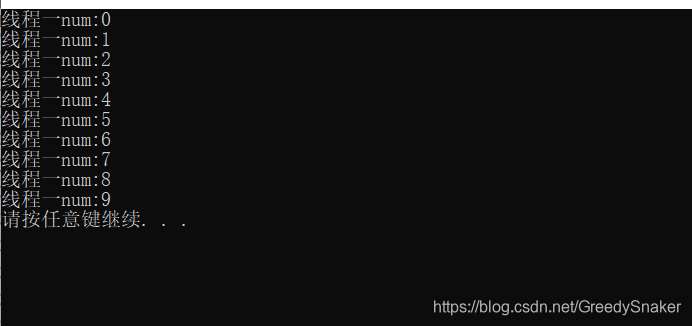
结果
二 线程安全与同步
#include <thread>
int num = 0;
void showNum(string str)
{
	while (num < 10)
	{
		cout << str << "num:" << num << endl;
		num++;
	}
}

int main()
{
	thread t1(showNum, "线程一");
	thread t2(showNum, "线程二");

	//t1.detach();// 与主线程分离
	//t2.detach();

	t1.join();//主线程等待子线程执行完
	t2.join();
	system("pause");
	return 0;
}
结果
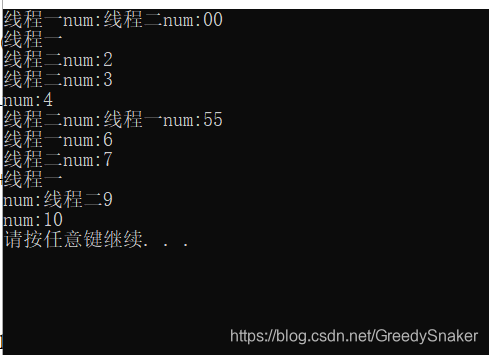
如图,结果乱七八糟
解决方法
1 互斥锁
#include <thread>
#include <mutex>

mutex mx;
int num = 0;

void showNum(string str)
{
	while (num < 10)
	{
		mx.lock();
		cout << str << "num:" << num << endl;
		num++;
		mx.unlock();
	}
}

int main()
{
	thread t1(showNum, "线程一");
	thread t2(showNum, "线程二");

	//t1.detach();// 与主线程分离
	//t2.detach();

	t1.join();//主线程等待子线程执行完
	t2.join();
	system("pause");
	return 0;
}
结果
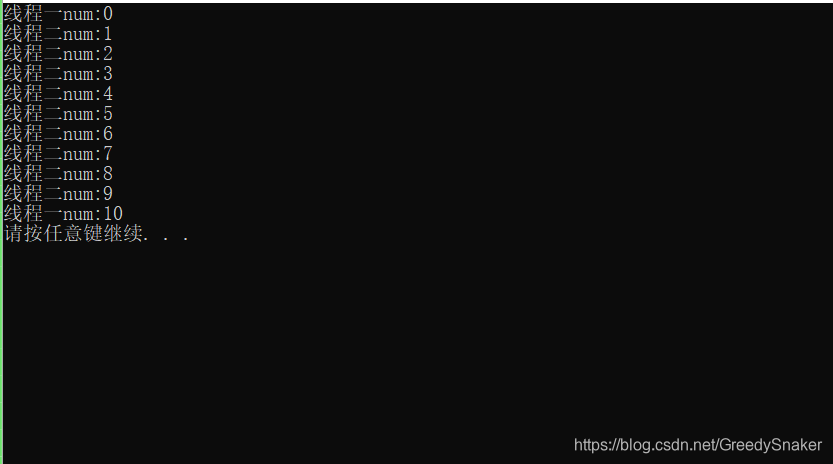
结果正确
三种加锁方式
void showNum(string str)
{
	while (num < 10)//第一种加锁方式
	{
		mx.lock();
		cout << str << "num:" << num << endl;
		num++;
		mx.unlock();
	}

	//	while (num < 10)//第二种加锁方式
	//	{
	//		lock_guard<mutex> guard(mx);
	//		cout << str << "num:" << num << endl;
	//		num++;
	//
	//	}

	//	while (num < 10) //第三种加锁方式
	//	{
	//		unique_lock<mutex> ul(mx);
	//		cv.wait(ul);
	//		cout << str << "num:" << num << endl;
	//		cv.notify_one();
	//	}
}
这三种方式都是一样的效果 第一种手动加锁,解锁;
第二种和第三种都是再构造里加锁,再析构里解锁;但是第二种参数较少,所以为了更多的控制所以出了第三种方式
2 条件变量
此时我们将加数字与打印分成两个线程
#include <thread>
#include <mutex>

mutex mx;
int num = 0;
condition_variable cv;

void showNum(string str)
{
	while (num < 10)
	{
		unique_lock<mutex> ul(mx);
		cv.wait(ul);
		cout << str << "num:" << num << endl;
		cv.notify_one();
	}

}

void numPlus()
{
	while (num < 10)
	{
		unique_lock<mutex> ul(mx);
		num++;
		cv.notify_one();
		cv.wait(ul);
	}
}

int main()
{
	thread t1(showNum, "线程一");
	thread t2(numPlus);

	//t1.detach();// 与主线程分离
	//t2.detach();

	t1.join();//主线程等待子线程执行完
	t2.join();

	system("pause");
	return 0;
}
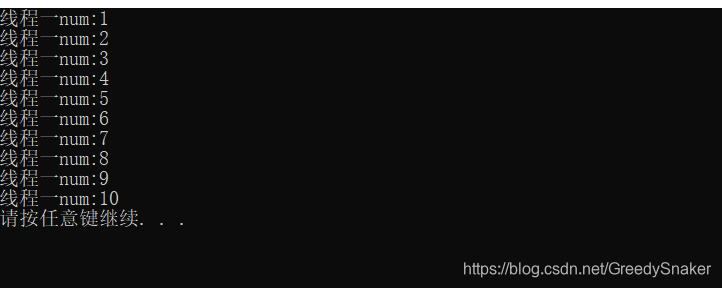
结果
3 信号量
信号量(semaphore)是一种同步机制,但在C++11中并没有原生提供该机制,那么就需要自己去实现。信号量可以想象成一种跨线程安全的资源的计数,包括两个基本操作:
post,每调用一次post,这种资源就多一个;
wait,每调用一次wait,这种资源便消耗掉一个。如果当前没有这种资源,那么就阻塞等待,直至有其他线程post,该线程才会wakeup。
class Semaphore
{
private:
	int count;//资源数量
	mutex m;
	condition_variable cv;
public:
	Semaphore(int count_) : count(count_) {}

	// post操作:上锁,资源加1,唤醒一个线程
	void post()
	{
		{
			unique_lock<mutex> loc(m);
			count++;
		}
		cv.notify_one();
	}

	// wait操作:上锁,资源为0,阻塞,否则资源减一
	void wait()
	{
		unique_lock<mutex> loc(m);
		if (count == 0)
		{
			cv.wait(loc);
		}
		count--;
	}
};
使用
class Semaphore
{
private:
	int count;//资源数量
	mutex m;
	condition_variable cv;
public:
	Semaphore(int count_) : count(count_) {}

	// post操作:上锁,资源加1,唤醒一个线程
	void post()
	{
		{
			unique_lock<mutex> loc(m);
			count++;
		}
		cv.notify_one();
	}

	// wait操作:上锁,资源为0,阻塞,否则资源减一
	void wait()
	{
		unique_lock<mutex> loc(m);
		if (count == 0)
		{
			cv.wait(loc);
		}
		count--;
	}
};

Semaphore s(0);
Semaphore s2(0);
int num = 0;

void showNum(string str)
{
	while (num < 10)
	{
		s.wait();//阻塞
		cout << str << "num:" << num << endl;
		s2.post();
	}

}

void numPlus()
{
	while (num < 10)
	{
		s.post();//唤醒
		num++;
		s2.wait();

	}
}

int main()
{
	thread t1(showNum, "线程一");
	thread t2(numPlus);

	//t1.detach();// 与主线程分离
	//t2.detach();

	t1.join();//主线程等待子线程执行完
	t2.join();

	system("pause");
	return 0;
}
结果
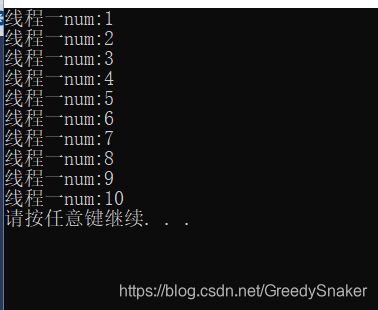
这里使用了两个信号量来保证有序打印





 扫一扫
扫一扫


 647
647


 到【灌水乐园】发言



