



 本文介绍了三种不同的算法来寻找数组中的第K大元素:排序、堆和快速选择。通过对比不同方法的时间和空间复杂度,帮助读者理解各种算法的特点及其适用场景。
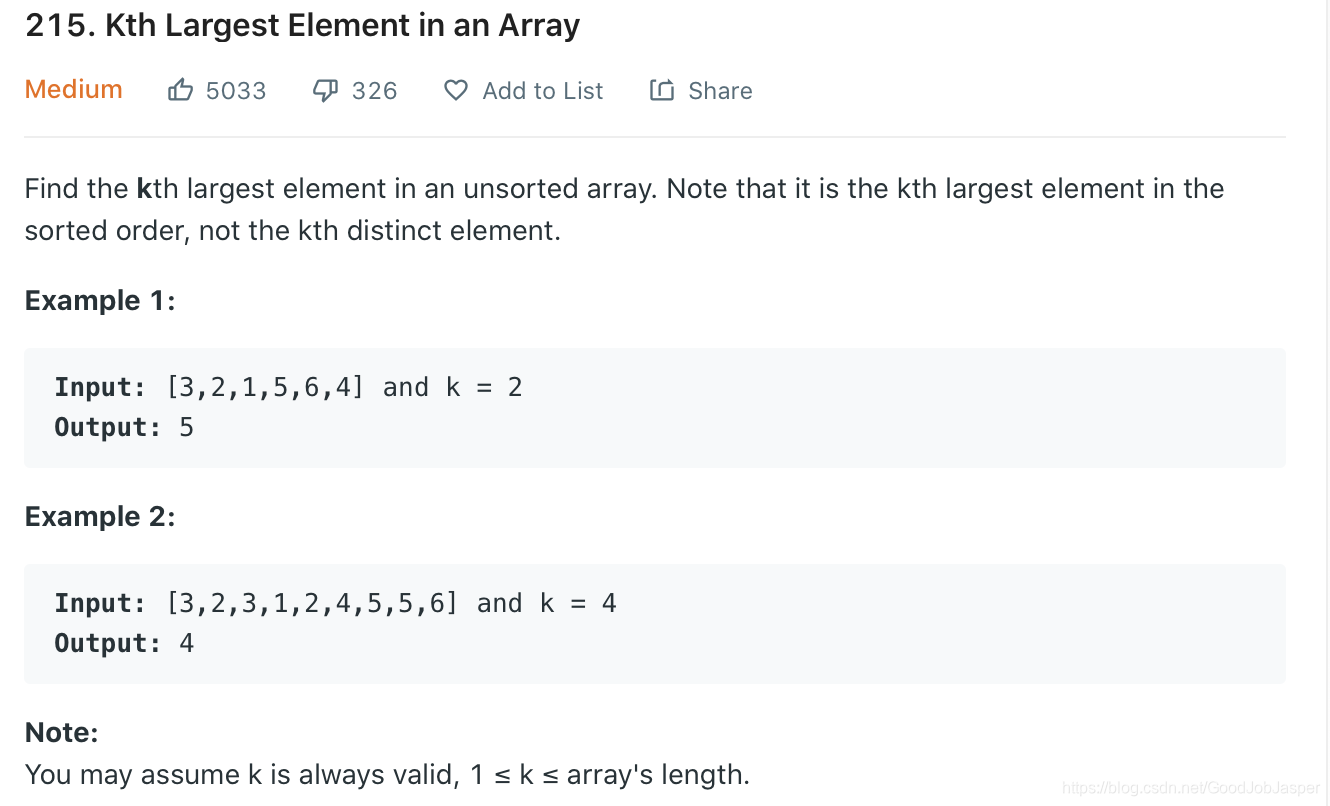
方法1: sort。时间复杂nlogn,空间复杂1.
class Solution {
    public int findKthLargest(int[] nums, int k) {
        Arrays.sort(nums);
        return nums[nums.length-k];
    }
}
方法2: heap。时间复杂nlogk,空间复杂k。
class Solution {
    public int findKthLargest(int[] nums, int k) {
        PriorityQueue<Integer> heap = new PriorityQueue<Integer>();
        for(int num : nums){
            heap.offer(num);
            if(heap.size() > k) heap.poll();
        }
        return heap.poll();
    }
}
方法3: quick select。这个方法其实和快速排序还是挺像的,但是快排时间复杂nlogn,但是quick select时间复杂n。具体解释直接看lc官方解答3,讲地很清楚。
class Solution {
    int[] nums;

    public void swap(int a, int b){
        int temp = nums[a];
        nums[a] = nums[b];
        nums[b] = temp;
    }

    public int partition(int left, int right, int pivot_index){
        int pivot = nums[pivot_index];
        swap(pivot_index, right);
        int store_index = left;
        for(int i = left; i <= right; i++){
            if(nums[i] < pivot){
                swap(store_index, i);
                store_index++;
            }
        }
        swap(store_index, right);
        return store_index;
    }

    public int quickSelect(int left, int right, int k_smallest){
        if(left == right) return nums[left];

        Random random = new Random();
        int pivot_index = left + random.nextInt(right - left);
        pivot_index = partition(left, right, pivot_index);
        if(k_smallest == pivot_index)
            return nums[k_smallest];
        else if(k_smallest < pivot_index)
            return quickSelect(left, pivot_index - 1, k_smallest);
        return quickSelect(pivot_index + 1, right, k_smallest);
    }

    public int findKthLargest(int[] nums, int k) {
        this.nums = nums;
        int size = nums.length;
        return quickSelect(0, size - 1, size - k);
    }
}





 扫一扫
扫一扫


 880
880

 被折叠的 条评论
为什么被折叠?
被折叠的 条评论
为什么被折叠?
 到【灌水乐园】发言





