



 本文详细介绍了如何解决POJ2528问题,即通过贴报纸算法优化来求解最后能看见多少张贴纸。文章讨论了如何避免内存溢出,通过映射和构建树状结构来高效解决问题。
poj 2528
For each input data set print the number of visible posters after all the posters are placed.
The picture below illustrates the case of the sample input.
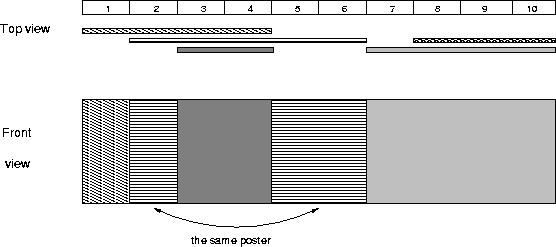
The picture below illustrates the case of the sample input.
Sample Input
1
5
1 4
2 6
8 10
3 4
7 10
Sample Output
4
题意:贴报纸,可以互相覆盖,求最后能看见多少。
数据很大,不离散会超出内存。将浪费的部分去掉,将出现过的所有点其映射到相距更近的点上。
#include<iostream>
#include<cstdio>
#include<cstring>
#include<string>
#include<algorithm>
using namespace std;
typedef long long ll;
#define N 100005
#define mod 258280327
#define MIN 0
#define MAX 1000001

int l[N],r[N];
int x[N];
int has[10000005];

struct node
{
    int le,re;
    bool covered;
} pnode[10*N];

void build(int i,int l,int r)
{
    pnode[i].le = l;
    pnode[i].re = r;
    pnode[i].covered = false;
    if(l == r)
        return;

    build(2 * i,l,(l+r)/2);
    build(2*i+1,(l+r)/2+1,r);
}

bool insert(int i,int l,int r,int a,int b)//是否可见
{
    if(pnode[i].covered == true)//如果要找的已经被覆盖
        return false;
    if(l == a && r == b)
    {
        pnode[i].covered = true;
        return true;
    }

    bool ans;
    int mid = (l + r)>>1;
    if (mid >= b)
        ans = insert(i*2,l, mid,  a, b);
    else if (mid < a)
        ans = insert(i*2+1,mid+1, r, a, b);
    else
    {
        bool x1 = insert(i*2,l, mid, a, mid);
        bool x2 = insert(i*2+1,mid+1, r, mid+1, b);
        ans = x1 || x2;
    }

    if(pnode[i*2].covered == true && pnode[i*2+1].covered == true)
        pnode[i].covered = true;
    return ans;
}


int main()
{
    int T,n,tot;
    scanf("%d",&T);

    while(T--)
    {
        scanf("%d",&n);
        tot = 0;
        for(int i = 1; i <= n; i++)
        {
            scanf("%d%d",&l[i],&r[i]);
            x[tot++] = l[i];
            x[tot++] = r[i];
        }

        sort(x,x+tot);
        tot = unique(x,x+tot)-x;
        int all=1;
        for(int i = 0;i < tot;i++)
        {
            has[x[i]] = all;
            if(i < tot - 1)
            {
                if(x[i+1] - x[i] == 1)
                    all++;
                else
                    all+=2;
            }
        }

        build(1,1,all);
        int num = 0;

        for(int i = n;i >=1;i--)
        {
            if(insert(1,1,all,has[l[i]],has[r[i]]))
                num ++;
        }

        printf("%d\n",num);

    }
    return 0;
}





 扫一扫
扫一扫


 501
501

 被折叠的 条评论
为什么被折叠?
被折叠的 条评论
为什么被折叠?
 到【灌水乐园】发言





