深度卷积对抗神经网络 基础 第七部分 StyleGAN

【深度学习】StyleGAN 2018 论文,A Style-Based Generator Architecture for Generative Adversarial Networks 我们提出了一种替代的生成对抗网络生成器架构,借鉴了风格转移文献。这种新架构导致了高级属性(例如,在人脸上训练时的姿势和身份)与生成图像中的随机变化(例如,雀斑,头发)的自动学习无监督分离,并且它实现了直观的、特定尺度的合成控制。新的生成器在传统分布质量指标方面改进了现有技术水平,导致了明显更好的插值特性,并且还更好地解开了潜在的变化因素。为了量化插值质量和解缠度,我们提出了两种新的自动方法,适用于任何生成器架构。最后,我们引入了一个新的、高度多样化和高质量的人脸数据集。 阅读详情

深度卷积对抗神经网络 基础 第七部分 StyleGAN

深度卷积神经网络模型已经应用在非常多的领域,但是其总包含了很多潜在的问题,比如说训练速度过慢,生成器与判别器的进化程度不平衡等等。那么,随着各种方法和算法的普及和进化,其解决的方法也越来越多,那么styleGAN就是其中的一个非常有趣的模型,

2018 年 12 月,Nvidia 研究人员分发了一份预印本以及介绍 StyleGAN 的配套软件,这是一种用于生成无限数量(通常令人信服)的假人脸肖像的 GAN 。StyleGAN 能够在 Nvidia 的商用 GPU 处理器上运行。

发展现状

  • 稳定性 Stability 方面:longer training and better images
    • 通过Batch standard deviation 来加强diversity。
    • 通过加强1-Lipschitz continuity来加强收敛稳定性。
    • 通过将不同生成器生成的结果进行加权平均,移动平均的方式来进行。
  • 容量 Capacity 方面: larger models and higher resolution images
    • 更高的分辨率
    • 更加细节的图片
  • 多样性 Diversity: increasing variety in generated images

StyleGAN

Style在这里指的是特性化,包括早期的特征比如说脸型等等,以及后期的特征比如说头发的精细度等等。

传统的生成器一般如下所示,主要是输入一个噪声向量,模型通过这个输入来生成一些图片。

image-20230131193814915

但是相反地,对于Style-Based 的生成器,其将噪声信号输入后,需要先进入一个特征匹配神经网络,然后输出一个中间噪声向量,其指定了所有的特征,并且尽量地去除特征之间的耦合并输入到生成器中。
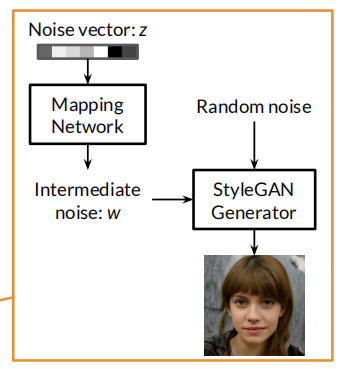
image-20230131194007127

渐进增长 Progressive Growing

通过卷积和反卷积的方式去增加和减少像素数量,通过这样的方式去定义多个生成器和鉴别器,这样渐进型的训练方式可以加强信息的稳定性。
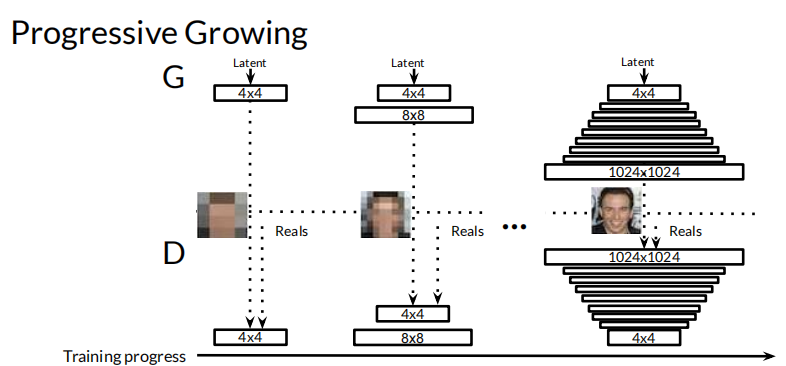
image-20230131194153656

噪声匹配网络 Noise Mapping Network

噪声匹配网络会将初始网络的复杂纠缠特征转换输出为可靠的,可解耦的,存在对应关系的噪声向量。我其实暂时也不太理解为什么或者如何可以进行解耦的操作,但是通过一些全连接层FC便可以实现。

image-20230131200005747

自适应实例规范化 Adaptive Instance Normalization (AdaIN)

Adaptive Instance Normalization是一种将内容特征的均值和方差与样式特征的均值和方差对齐的归一化方法。

Instance Normalization normalizes the input to a single style specified by the affine parameters. Adaptive Instance Normaliation is an extension. In AdaIN, we receive a content input x and a style input y, and we simply align the channel-wise mean and variance of x to match those of y. Unlike Batch Normalization, Instance Normalization or Conditional Instance Normalization, AdaIN has no learnable affine parameters. Instead, it adaptively computes the affine parameters from the style input:
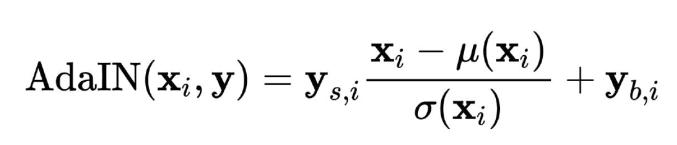
image-20230131231737254

其主要通过归一化方法来进行,其将噪声信息转化为特征信息并输入到模型中,并且其和batch normalization也不同,其主要对每一个实例进行正交归一化。个人理解中,其主要就是进行了输入图像数据和特征数据的对其工作。
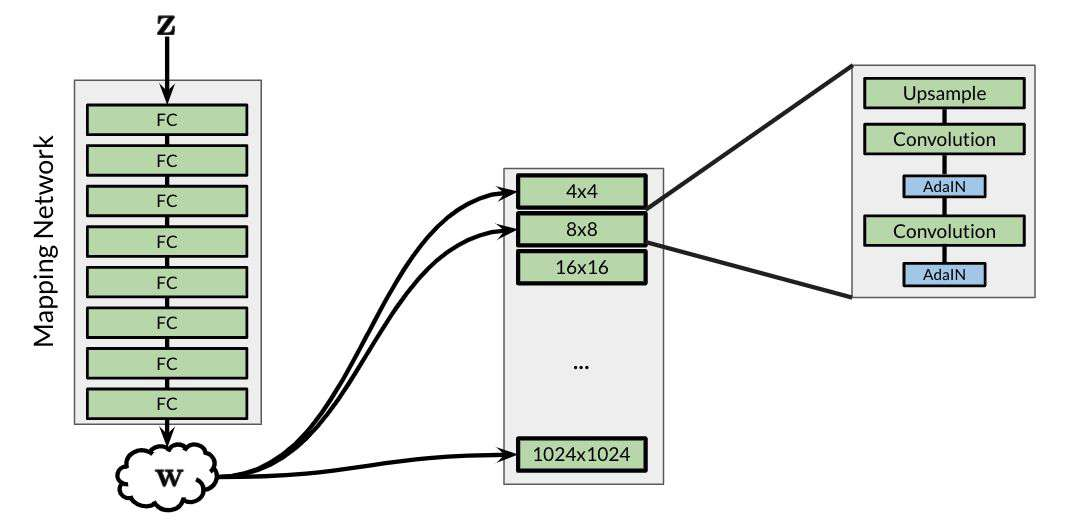
image-20230131232625265

而越早的生成器决定一些比较大的特征,比如说脸型,头型。而越晚的生成器则主要生成一些细节的特征,比如说头发的疏密,毛孔的大小之类的。

特征混合 & 随机噪声 Style Mixing & Stochastic Noise

Style Mixing 指的是将多个随机噪声混合地输入到每个生成器中,然后通过渐进地放入不同噪声的方式去得到特征的混合,但是又不会太过突兀,而是保留了多方的特征,并生成相对可观的结果。

而当upsample的时候,加入随机噪声会增加生成图片的微小细节变化。

最后的模型结构

最后的模型结构如下图所示,具体的结构和训练步骤如下所示:

  1. 生成一个高维度随机噪声z,并准备好训练的图片集
  2. 噪声通过多个全连接层来进行特征的提取和识别,并输出解除纠缠特性的噪声w
  3. 将两个或者多个噪声输入到多层的生成器中去逐渐生成最后的高分辨率图片
  4. 通过卷积操作将生成好的图片逐渐地与训练的图片集进行比较,并给出每一层的反馈。
  5. 通过多次优化迭代,寻找到最好的神经网络卷积层参数,使得分数最高,或者损失最低。
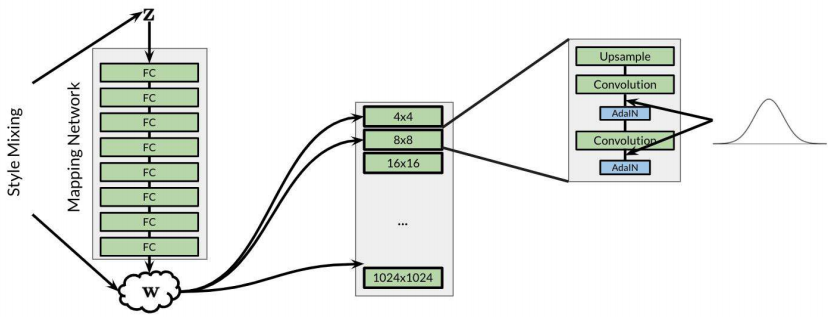
image-20230131234515695

参考文献 Reference

1. StyleGAN and Advancements

adain: adaptive instance normalization

batch norm

instance norm

2. (Optional) Components of StyleGAN2

Open Lab

3. Instructions

Please note that this is an optional notebook that is meant to introduce more advanced concepts, if you’re up for a challenge. So, don’t worry if you don’t completely follow every step! We provide external resources for extra base knowledge required to grasp some components of the advanced material.

In this notebook, you’re going to learn about StyleGAN2, from the paper Analyzing and Improving the Image Quality of StyleGAN (Karras et al., 2019), and how it builds on StyleGAN. This is the V2 of StyleGAN, so be prepared for even more extraordinary outputs.

4. (Optional) The StyleGAN Paper

Amazed by StyleGAN’s capabilities? Take a look at the original paper! Note that it may take a few extra moments to load because of the high-resolution images.

A Style-Based Generator Architecture for Generative Adversarial Networks (Karras, Laine, and Aila, 2019): https://arxiv.org/abs/1812.04948

5. (Optional) StyleGAN Walkthrough and Beyond

Want another explanation of StyleGAN? This article provides a great walkthrough of StyleGAN and even discusses StyleGAN’s successor: StyleGAN2!

GAN — StyleGAN & StyleGAN2 (Hui, 2020): https://medium.com/@jonathan_hui/gan-stylegan-stylegan2-479bdf256299

6. Works Cited

All of the resources cited in Course 2 Week 3, in one place. You are encouraged to explore these papers/sites if they interest you! They are listed in the order they appear in the lessons.

From the videos:

  • Generative Adversarial Networks (Goodfellow et al., 2014): https://arxiv.org/abs/1406.2661
  • Unsupervised Representation Learning with Deep Convolutional Generative Adversarial Networks (Radford, Metz, and Chintala, 2016): https://arxiv.org/abs/1511.06434
  • Coupled Generative Adversarial Networks (Liu and Tuzel, 2016): https://arxiv.org/abs/1606.07536
  • Progressive Growing of GANs for Improved Quality, Stability, and Variation (Karras, Aila, Laine, and Lehtinen, 2018): https://arxiv.org/abs/1710.10196
  • A Style-Based Generator Architecture for Generative Adversarial Networks (Karras, Laine, and Aila, 2019): https://arxiv.org/abs/1812.04948
  • The Unusual Effectiveness of Averaging in GAN Training (Yazici et al., 2019): https://arxiv.org/abs/1806.04498v2
  • Progressive Growing of GANs for Improved Quality, Stability, and Variation (Karras, Aila, Laine, and Lehtinen, 2018): https://arxiv.org/abs/1710.10196
  • StyleGAN - Official TensorFlow Implementation (Karras et al., 2019): https://github.com/NVlabs/stylegan
  • StyleGAN Faces Training (Branwen, 2019): https://www.gwern.net/images/gan/2019-03-16-stylegan-facestraining.mp4
  • Facebook AI Proposes Group Normalization Alternative to Batch Normalization (Peng, 2018): https://medium.com/syncedreview/facebook-ai-proposes-group-normalization-alternative-to-batch-normalization-fb0699bffae7

噪声图noisemap 用于实现贴图流动效果的噪声图noiseMap,用于为图片提供有区别的uv偏移 立即下载

相关推荐

CNN卷积神经网络总结

文章中,总结了CNN的大致流程,并对概念做出图示的讲解。

StyleGAN2代码PyTorch版逐行学习(上)

超长代码笔记

qq_43522986的博客 1万+

睿尔曼超轻量仿人机械臂-ROS第一篇 启动机械臂的Moveit

本文主要讲述了睿尔曼六轴机械臂在ROS中的功能包配置,及如何根据文件启动Moveit做仿真。

realman_Rop的博客 7492

深度学习07-深度卷积生成对抗网络(DCGAN)

GAN(Generative Adversarial Network)是一种生成模型,由两个神经网络组成:生成器(Generator)和判别器(Discriminator)。GAN的基本思想是通过让生成器和判别器相互对抗来学习生成真实样本的能力。生成器的作用是将一个随机噪声向量作为输入,通过一系列的神经网络层逐渐将其转化为一个与真实样本相似的输出。生成器的目标是尽量使生成的样本被判别器误认为是真实样本,从而欺骗判别器。生成器的训练目标是最小化生成样本与真实样本之间的差异。

liaomin416100569的专栏 7105

PLC编程进阶:结构体(UDT)与功能块(FB)的模块化实践指南

本文深入探讨了PLC编程中实现模块化的核心方法,重点解析了结构体(UDT)与功能块(FB)的协同应用。通过将零散数据封装为UDT,并将控制逻辑打包为可复用的FB,能够构建出结构清晰、易于维护和调试的PLC程序。文章结合拧紧枪、电机控制等实战案例,提供了从设计原则到分层架构的完整实践指南,旨在帮助工程师将混乱的‘面条式’代码改造为高效的‘正规军’。

s3t4u的博客 222

深入解析CAN2.0A与CAN2.0B协议:帧格式与通信机制对比

本文深入对比了CAN2.0A与CAN2.0B协议的核心差异,重点解析了11位标准帧与29位扩展帧的帧格式、标识符长度及通信机制。文章阐述了CAN2.0B向下兼容的特性,并探讨了在汽车电子、工业控制等复杂网络中,如何根据项目需求、兼容性及实时性要求,在标准帧与扩展帧之间做出合理选择。

weixin_29163797的博客 397

gan处理自己的数据集_使用StyleGAN训练自己的数据集.md

1 数据准备执行StyleGAN的最大难点在于准备数据集,不像其他的GAN可以接受文件夹输入,它只能接收.tfrecords作为输入,它将每张图片不同分辨率存储为数组。因此,输入文件必须是完美正态分布的,通过特定的dataset_tools.py工具将图片转成.tfrecords,这会导致实际存储尺寸达到原图的19倍。注意:StyleGAN的数据集必须由相同的方式组成,$512\times 512...

weixin_39715538的博客 6869

GitLab中国区注册终极解决方案:绕过+86手机验证的实战技巧(2023最新)

本文详细解析了GitLab中国区注册时绕过+86手机验证的三种实战技巧,包括开发者工具调试方案、使用国际号码的变通方案以及本地化部署替代方案。通过技术分析和实践验证,帮助开发者顺利注册GitLab账号,提升团队协作效率。

rl6adventurer的博客 1510

对抗神经网络之对抗卷积神经网络[2]

上一篇博文[1]简单介绍了对抗网络的理论和大概流程。其中所谓的对抗网络可以归结为unsupervised learning 或者 generative model。从无监督学习来进行feature representation,有k-means聚类算法,auto-encoders[2],以及09年的Deep belief networks等等。

一个想要改变世界的IT slave的专栏 1万+

Abaqus小白必看:用Micromechanics Plugin轻松搞定RVE周期性边界条件(附避坑指南)

本文为Abaqus初学者提供了使用官方Micromechanics Plugin插件高效实现复合材料代表性体积单元分析的完整指南。文章详细讲解了从插件安装、模型准备、周期性边界条件自动设置到结果验证的全流程,并重点分享了处理复杂模型和避免常见错误的实用技巧,帮助用户大幅提升RVE分析效率与准确性。

weixin_28363123的博客 808

Unity零基础到入门 ☀️| 【UI系统学习】轻松学会 Unity 的 UGUI基础控件的使用(包括一个简易血条、蓝条设计)

Unity,UGUI。本篇博客来挑几种Unity中最常用的UI控件如何使用和使用技巧,包括一个简易血条蓝条的小实例

努力前行,总会成为自己心中的那道光 2万+

Python深度学习:从入门到实战

亲爱的读者,欢迎您翻开这本书。我们即将探索的,是深度学习的宇宙——一个由数据、算法与算力构筑的奇妙世界。它既是严谨的科学,也是创造的艺术,更是一条通往未来智慧的修行之路。本书将带您从最基础的数学原理出发,亲手搭建神经网络,驾驭Transformer等前沿模型,最终将智慧转化为现实世界的价值。请放下畏惧,保持好奇。这不仅是一次知识的学习,更是一场思维的远行。来,随我一起,开启这趟非凡的旅程吧。

weixin_45747731的博客 450

JMeter 中实现 100 个用户在 3 秒内并发登录

通过以上配置,你可以在 JMeter 中实现 100 个用户在 3 秒内并发登录

南开大学 | 10 年 + 软件研发与测试实战 | 现任企业质控负责人 | 专注端到端交付质量 1684

DCGAN - 深度卷积生成对抗网络:基于卷积神经网络的GAN

深度卷积生成对抗网络(DCGAN,Deep Convolutional Generative Adversarial Network)是生成对抗网络(GAN)的一种扩展,它通过使用卷积神经网络(CNN)来实现生成器和判别器的构建。与标准的GAN相比,DCGAN通过引入卷积层来改善图像生成质量,使得生成器能够生成更清晰、更高分辨率的图像。DCGAN提出了一种通过卷积结构来提高图像生成效果的策略,并在多个领域,包括图像生成、风格迁移、图像修复等任务中,取得了显著的成果。本文将深入探讨DCGAN的工作原理、架构、

池央的博客 3673

基于MATLAB的导弹轨迹和撞击位置仿真

本文将介绍如何使用MATLAB进行导弹轨迹和撞击位置的仿真,提高导弹的精确打击能力。首先,我们需要确定导弹的初始位置和速度,以及导弹所受到的外部环境因素如重力、空气阻力等。在MATLAB中,可以通过ODE求解器来模拟导弹的运动轨迹。最后,我们通过控制器输出的控制信号来控制导弹的姿态。通过对导弹的运动轨迹和姿态进行仿真,可以更好地预测和规划导弹的运动轨迹,提高其精确打击能力。在实际作战中,为了提高导弹精确打击能力,需要对导弹的撞击位置进行预测和规划。我们可以通过控制导弹的姿态来实现撞击目标的精确命中。

CyberLynxO的博客 1985

深度学习工具包 DeepLearningToolbox

深度学习工具包Deprecation notice.-----This toolbox is outdated and no longer maintained.There are much better tools available for deep learning than this toolbox, e.g. [Theano](http://deeplearning.net/software/theano/), [torch](http://torch.ch/) or [tensorflow](http://www.tensorflow.org/)I would suggest you use one of the tools mentioned above rather than use this toolbox.Best, Rasmus.DeepLearnToolbox================A Matlab toolbox for Deep Learning.Deep Learning is a new subfield of machine learning that focuses on learning deep hierarchical models of data.It is inspired by the human brain's apparent deep (layered, hierarchical) architecture.A good overview of the theory of Deep Learning theory is[Learning Deep Architectures for AI](http://www.iro.umontreal.ca/~bengioy/papers/ftml_book.pdf)For a more informal introduction, see the following videos by Geoffrey Hinton and Andrew Ng.* [The Next Generation of Neural Networks](http://www.youtube.com/watch?v=AyzOUbkUf3M) (Hinton, 2007)* [Recent Developments in Deep Learning](http://www.youtube.com/watch?v=VdIURAu1-aU) (Hinton, 2010)* [Unsupervised Feature Learning and Deep Learning](http://www.youtube.com/watch?v=ZmNOAtZIgIk) (Ng, 2011)If you use this toolbox in your research please cite [Prediction as a candidate for learning deep hierarchical models of data](http://www2.imm.dtu.dk/pubdb/views/publication_details.php?id=6284)```@MASTERSTHESIS\{IMM2012-06284, author = "R. B. Palm", title = "Prediction as a candidate for learning deep hierarchical models of data", year = "2012",}```Contact: rasmusbergpalm at gmail dot comDirectories included in the toolbox-----------------------------------`NN/` - A library for Feedforward Backpropagation Neural Networks`CNN/` - A library for Convolutional Neural Networks`DBN/` - A library for Deep Belief Networks`SAE/` - A library for Stacked Auto-Encoders`CAE/` - A library for Convolutional Auto-Encoders`util/` - Utility functions used by the libraries`data/` - Data used by the examples`tests/` - unit tests to verify toolbox is workingFor references on each library check REFS.mdSetup-----1. Download.2. addpath(genpath('DeepLearnToolbox'));Example: Deep Belief Network---------------------```matlabfunction test_example_DBNload mnist_uint8;train_x = double(train_x) / 255;test_x = double(test_x) / 255;train_y = double(train_y);test_y = double(test_y);%% ex1 train a 100 hidden unit RBM and visualize its weightsrand('state',0)dbn.sizes = [100];opts.numepochs = 1;opts.batchsize = 100;opts.momentum = 0;opts.alpha = 1;dbn = dbnsetup(dbn, train_x, opts);dbn = dbntrain(dbn, train_x, opts);figure; visualize(dbn.rbm{1}.W'); % Visualize the RBM weights%% ex2 train a 100-100 hidden unit DBN and use its weights to initialize a NNrand('state',0)%train dbndbn.sizes = [100 100];opts.numepochs = 1;opts.batchsize = 100;opts.momentum = 0;opts.alpha = 1;dbn = dbnsetup(dbn, train_x, opts);dbn = dbntrain(dbn, train_x, opts);%unfold dbn to nnnn = dbnunfoldtonn(dbn, 10);nn.activation_function = 'sigm';%train nnopts.numepochs = 1;opts.batchsize = 100;nn = nntrain(nn, train_x, train_y, opts);[er, bad] = nntest(nn, test_x, test_y);assert(er < 0.10, 'Too big error');```Example: Stacked Auto-Encoders---------------------```matlabfunction test_example_SAEload mnist_uint8;train_x = double(train_x)/255;test_x = double(test_x)/255;train_y = double(train_y);test_y = double(test_y);%% ex1 train a 100 hidden unit SDAE and use it to initialize a FFNN% Setup and train a stacked denoising autoencoder (SDAE)rand('state',0)sae = saesetup([784 100]);sae.ae{1}.activation_function = 'sigm';sae.ae{1}.learningRate = 1;sae.ae{1}.inputZeroMaskedFraction = 0.5;opts.numepochs = 1;opts.batchsize = 100;sae = saetrain(sae, train_x, opts);visualize(sae.ae{1}.W{1}(:,2:end)')% Use the SDAE to initialize a FFNNnn = nnsetup([784 100 10]);nn.activation_function = 'sigm';nn.learningRate = 1;nn.W{1} = sae.ae{1}.W{1};% Train the FFNNopts.numepochs = 1;opts.batchsize = 100;nn = nntrain(nn, train_x, train_y, opts);[er, bad] = nntest(nn, test_x, test_y);assert(er < 0.16, 'Too big error');```Example: Convolutional Neural Nets---------------------```matlabfunction test_example_CNNload mnist_uint8;train_x = double(reshape(train_x',28,28,60000))/255;test_x = double(reshape(test_x',28,28,10000))/255;train_y = double(train_y');test_y = double(test_y');%% ex1 Train a 6c-2s-12c-2s Convolutional neural network %will run 1 epoch in about 200 second and get around 11% error. %With 100 epochs you'll get around 1.2% errorrand('state',0)cnn.layers = { struct('type', 'i') %input layer struct('type', 'c', 'outputmaps', 6, 'kernelsize', 5) %convolution layer struct('type', 's', 'scale', 2) %sub sampling layer struct('type', 'c', 'outputmaps', 12, 'kernelsize', 5) %convolution layer struct('type', 's', 'scale', 2) %subsampling layer};cnn = cnnsetup(cnn, train_x, train_y);opts.alpha = 1;opts.batchsize = 50;opts.numepochs = 1;cnn = cnntrain(cnn, train_x, train_y, opts);[er, bad] = cnntest(cnn, test_x, test_y);%plot mean squared errorfigure; plot(cnn.rL);assert(er<0.12, 'Too big error');```Example: Neural Networks---------------------```matlabfunction test_example_NNload mnist_uint8;train_x = double(train_x) / 255;test_x = double(test_x) / 255;train_y = double(train_y);test_y = double(test_y);% normalize[train_x, mu, sigma] = zscore(train_x);test_x = normalize(test_x, mu, sigma);%% ex1 vanilla neural netrand('state',0)nn = nnsetup([784 100 10]);opts.numepochs = 1; % Number of full sweeps through dataopts.batchsize = 100; % Take a mean gradient step over this many samples[nn, L] = nntrain(nn, train_x, train_y, opts);[er, bad] = nntest(nn, test_x, test_y);assert(er < 0.08, 'Too big error');%% ex2 neural net with L2 weight decayrand('state',0)nn = nnsetup([784 100 10]);nn.weightPenaltyL2 = 1e-4; % L2 weight decayopts.numepochs = 1; % Number of full sweeps through dataopts.batchsize = 100; % Take a mean gradient step over this many samplesnn = nntrain(nn, train_x, train_y, opts);[er, bad] = nntest(nn, test_x, test_y);assert(er < 0.1, 'Too big error');%% ex3 neural net with dropoutrand('state',0)nn = nnsetup([784 100 10]);nn.dropoutFraction = 0.5; % Dropout fraction opts.numepochs = 1; % Number of full sweeps through dataopts.batchsize = 100; % Take a mean gradient step over this many samplesnn = nntrain(nn, train_x, train_y, opts);[er, bad] = nntest(nn, test_x, test_y);assert(er < 0.1, 'Too big error');%% ex4 neural net with sigmoid activation functionrand('state',0)nn = nnsetup([784 100 10]);nn.activation_function = 'sigm'; % Sigmoid activation functionnn.learningRate = 1; % Sigm require a lower learning rateopts.numepochs = 1; % Number of full sweeps through dataopts.batchsize = 100; % Take a mean gradient step over this many samplesnn = nntrain(nn, train_x, train_y, opts);[er, bad] = nntest(nn, test_x, test_y);assert(er < 0.1, 'Too big error');%% ex5 plotting functionalityrand('state',0)nn = nnsetup([784 20 10]);opts.numepochs = 5; % Number of full sweeps through datann.output = 'softmax'; % use softmax outputopts.batchsize = 1000; % Take a mean gradient step over this many samplesopts.plot = 1; % enable plottingnn = nntrain(nn, train_x, train_y, opts);[er, bad] = nntest(nn, test_x, test_y);assert(er < 0.1, 'Too big error');%% ex6 neural net with sigmoid activation and plotting of validation and training error% split training data into training and validation datavx = train_x(1:10000,:);tx = train_x(10001:end,:);vy = train_y(1:10000,:);ty = train_y(10001:end,:);rand('state',0)nn = nnsetup([784 20 10]); nn.output = 'softmax'; % use softmax outputopts.numepochs = 5; % Number of full sweeps through dataopts.batchsize = 1000; % Take a mean gradient step over this many samplesopts.plot = 1; % enable plottingnn = nntrain(nn, tx, ty, opts, vx, vy); % nntrain takes validation set as last two arguments (optionally)[er, bad] = nntest(nn, test_x, test_y);assert(er < 0.1, 'Too big error');```[![Bitdeli Badge](https://d2weczhvl823v0.cloudfront.net/rasmusbergpalm/deeplearntoolbox/trend.png)](https://bitdeli.com/free "Bitdeli Badge")

深度卷积对抗神经网络 基础 第二部分 DC-GANs

DC-GANs (DC-GANs Deep convolutional GAN)是基于GANs的一种专门对图片生成的一种模型,其通过卷积操作来进行图片的一些基本操作来实现模型的功能。

Delay_coder的博客 1262

Devexpress16.2.6破解工具

Devexpress16.2.6破解工具Devexpress16.2.6破解工具Devexpress16.2.6破解工具Devexpress16.2.6破解工具

styleGAN&扩散模型相关参考文献

styleGAN&扩散模型相关参考文献

zjn1174962912的博客 674

蓝牙模块HM-10手册

蓝牙模块HM-10手册,该手册对蓝牙模块HM-10进行了详细的介绍和使用方法以及一些AT指令。

jdk-8u144-linux-x64.tar.gz.

该资源为搭建Linux系统Java环境用,资源的后缀为tar.gz格式的压缩包

深度卷积对抗神经网络 进阶 第一部分 GANs 在数据增强和隐私领域的应用 GANs for Data Augmentation and Privacy

深度卷积对抗神经网络 进阶 第一部分 GANs 在数据增强和隐私领域的应用 GauGans

Delay_coder的博客 887

深度卷积对抗神经网络 基础 第五部分 Inception-v3 architecture GANs

深度卷积对抗神经网络 基础 第五部分 Inception-v3 architecture GANs

Delay_coder的博客 960

深度卷积对抗神经网络 基础 第三部分 (WGAN-GP)

比如说,**模式奔溃**,指的是生成器的学习效率远高于辨别器的时候,那么学习一段时间过后,辨别器便无法再继续提供有用的损失信息,以至于生成器无法得到参考而塌陷到一个局部最小点中去。而**梯度消失**指的是当损失趋于无限大或者无限小时,损失函数的值变化基本可以视为忽略,那么梯度就会消失,进而停止学习或者学习效率基本为零。

Delay_coder的博客 1765
上一篇: 深度卷积对抗神经网络 基础 第六部分 缺点和偏见 GANs Disadvantages and Bias
下一篇: 深度卷积对抗神经网络 进阶 第一部分 GANs 在数据增强和隐私领域的应用 GANs for Data Augmentation and Privacy
Volavion
博客等级 码龄9年 3788粉丝 36原创
评论
成就一亿技术人!
拼手气红包6.0元
还能输入1000个字符
 
 条评论被折叠 查看
添加红包

请填写红包祝福语或标题

个

红包个数最小为10个

元

红包金额最低5元

当前余额3.43元 前往充值 >
需支付:10.00元
成就一亿技术人!
领取后你会自动成为博主和红包主的粉丝 规则
hope_wisdom
发出的红包

打赏作者

Volavion

你的鼓励将是我创作的最大动力

¥1 ¥2 ¥4 ¥6 ¥10 ¥20
扫码支付:¥1
获取中
扫码支付

您的余额不足,请更换扫码支付或充值

打赏作者

实付元
使用余额支付
点击重新获取
扫码支付
钱包余额 0

抵扣说明:

1.余额是钱包充值的虚拟货币,按照1:1的比例进行支付金额的抵扣。
2.余额无法直接购买下载,可以购买VIP、付费专栏及课程。

余额充值