



我们常常在事务注解中,定义rollbackFor 为事务定义异常的类型。
@Transactional(rollbackFor = Exception.class)
public Result<Boolean> updateArticle(Long articleId, ArticleCreateRequest request)         // TODO code.
}
Spring(6.2.7)
一、实现逻辑类(RuleBasedTransactionAttribute)
1. 异常回滚入口: RuleBasedTransactionAttribute#rollbackOn
public class RuleBasedTransactionAttribute extends DefaultTransactionAttribute implements Serializable {

	@Override
	public boolean rollbackOn(Throwable ex) {
		RollbackRuleAttribute winner = null;
		int deepest = Integer.MAX_VALUE;

        // 1. 检查是否有显式配置的回滚规则
		if (this.rollbackRules != null) {
			for (RollbackRuleAttribute rule : this.rollbackRules) {
				int depth = rule.getDepth(ex);
                // 2. 检查异常是否匹配回滚规则
				if (depth >= 0 && depth < deepest) {
					deepest = depth;
					winner = rule;  // 匹配则回滚
				}
			}
		}

		// User superclass behavior (rollback on unchecked) if no rule matches.
		if (winner == null) {
            // 3. 没有匹配规则时使用默认行为
			return super.rollbackOn(ex);
		}

		return !(winner instanceof NoRollbackRuleAttribute);
	}
}
2. 回滚规则解析: RollbackRuleAttribute#getDepth
public class RollbackRuleAttribute implements Serializable{


   public int getDepth(Throwable exception) {
        // 递归调用
		return getDepth(exception.getClass(), 0);
	}


	private int getDepth(Class<?> exceptionType, int depth) {
		if (this.exceptionType != null) {
           // 1. 检查当前异常类是否匹配规则
			if (this.exceptionType.equals(exceptionType)) {
				// Found it!
				return depth;
			}
		}
         // 2. 根据名称匹配
		else if (exceptionType.getName().contains(this.exceptionPattern)) {
			// Found it!
			return depth;
		}
		// If we've gone as far as we can go and haven't found it...
        // 3. 递归检查父类 (RuntimeException->Exception->Throwable)
		if (exceptionType == Throwable.class) {
          // 没有找到.
			return -1;
		}
         // 递归
		return getDepth(exceptionType.getSuperclass(), depth + 1);
	}
}
3. 默认回滚规则: DefaultTransactionAttribute#rollbackOn
public class DefaultTransactionAttribute extends DefaultTransactionDefinition implements TransactionAttribute {

   	@Override
	public boolean rollbackOn(Throwable ex) {
		return (ex instanceof RuntimeException || ex instanceof Error);
	}
}
4. rollback 调用流程图解
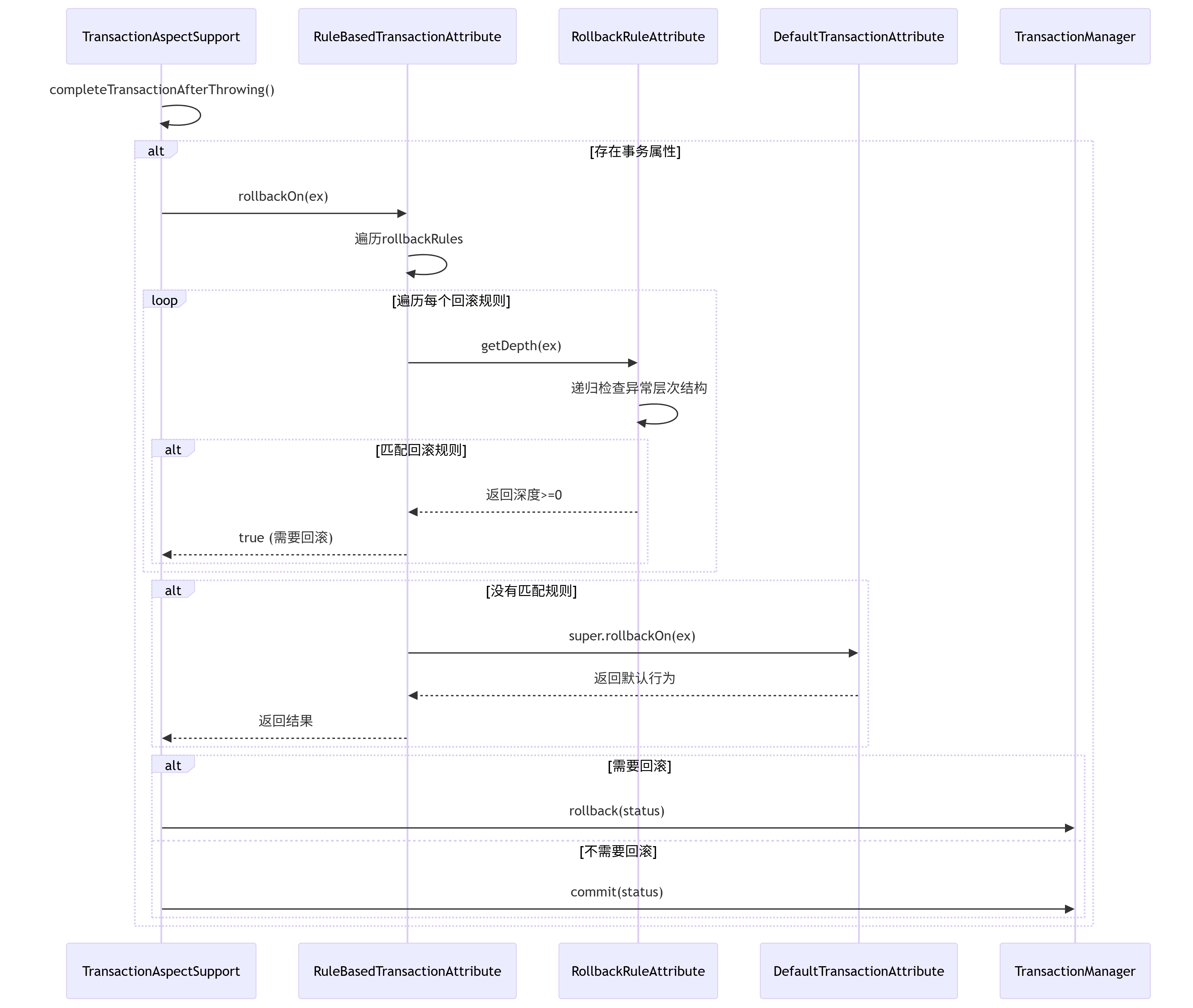
二、具体代码实现逻辑
1. 事务属性解析(注解 --->规则)
SpringTransactionAnnotationParser#parseTransactionAnnotation
public class SpringTransactionAnnotationParser implements TransactionAnnotationParser, Serializable {

protected TransactionAttribute parseTransactionAnnotation(AnnotationAttributes attributes) {
		RuleBasedTransactionAttribute rbta = new RuleBasedTransactionAttribute();

		Propagation propagation = attributes.getEnum("propagation");
		rbta.setPropagationBehavior(propagation.value());
		Isolation isolation = attributes.getEnum("isolation");
		rbta.setIsolationLevel(isolation.value());

		rbta.setTimeout(attributes.getNumber("timeout").intValue());
		String timeoutString = attributes.getString("timeoutString");
		Assert.isTrue(!StringUtils.hasText(timeoutString) || rbta.getTimeout() < 0,
				"Specify 'timeout' or 'timeoutString', not both");
		rbta.setTimeoutString(timeoutString);

		rbta.setReadOnly(attributes.getBoolean("readOnly"));
		rbta.setQualifier(attributes.getString("value"));
		rbta.setLabels(Set.of(attributes.getStringArray("label")));

		List<RollbackRuleAttribute> rollbackRules = new ArrayList<>();
         // 解析 rollbackFor 配置
		for (Class<?> rbRule : attributes.getClassArray("rollbackFor")) {
			rollbackRules.add(new RollbackRuleAttribute(rbRule));
		}
		for (String rbRule : attributes.getStringArray("rollbackForClassName")) {
			rollbackRules.add(new RollbackRuleAttribute(rbRule));
		}
        // 解析 noRollbackFor 配置
		for (Class<?> rbRule : attributes.getClassArray("noRollbackFor")) {
			rollbackRules.add(new NoRollbackRuleAttribute(rbRule));
		}
		for (String rbRule : attributes.getStringArray("noRollbackForClassName")) {
			rollbackRules.add(new NoRollbackRuleAttribute(rbRule));
		}
		rbta.setRollbackRules(rollbackRules);

		return rbta;
	}
}
2. 异常处理核心
TransactionAspectSupport#completeTransactionAfterThrowing
protected void completeTransactionAfterThrowing(@Nullable TransactionInfo txInfo, Throwable ex) {
		if (txInfo != null && txInfo.getTransactionStatus() != null) {
			if (logger.isTraceEnabled()) {
				logger.trace("Completing transaction for [" + txInfo.getJoinpointIdentification() +
						"] after exception: " + ex);
			}
             // 检查是否需要回滚
			if (txInfo.transactionAttribute != null && txInfo.transactionAttribute.rollbackOn(ex)) {
				try {
            // 执行回滚
					txInfo.getTransactionManager().rollback(txInfo.getTransactionStatus());
				}
				catch (TransactionSystemException ex2) {
                     // 记录日志并处理回滚失败
					logger.error("Application exception overridden by rollback exception", ex);
					ex2.initApplicationException(ex);
					throw ex2;
				}
				catch (RuntimeException | Error ex2) {
					logger.error("Application exception overridden by rollback exception", ex);
					throw ex2;
				}
			}
			else {
				// We don't roll back on this exception.
				// Will still roll back if TransactionStatus.isRollbackOnly() is true.
				try {
                    // 提交事务(即使有异常)
					txInfo.getTransactionManager().commit(txInfo.getTransactionStatus());
				}
				catch (TransactionSystemException ex2) {
					logger.error("Application exception overridden by commit exception", ex);
					ex2.initApplicationException(ex);
					throw ex2;
				}
				catch (RuntimeException | Error ex2) {
					logger.error("Application exception overridden by commit exception", ex);
					throw ex2;
				}
			}
		}
	}
3. 回滚规则匹配:递归调用,异常继承
RollbackRuleAttribute#getDepth
	private int getDepth(Class<?> exceptionType, int depth) {
		if (this.exceptionType != null) {
			if (this.exceptionType.equals(exceptionType)) {
				// Found it!
				return depth;
			}
		}
		else if (exceptionType.getName().contains(this.exceptionPattern)) {
			// Found it!
			return depth;
		}
		// If we've gone as far as we can go and haven't found it...
		if (exceptionType == Throwable.class) {
			return -1;
		}
		return getDepth(exceptionType.getSuperclass(), depth + 1);
	}
4. 实际回滚操作:
AbstractPlatformTransactionManager#processRollback
public abstract class AbstractPlatformTransactionManager
		implements PlatformTransactionManager, ConfigurableTransactionManager, Serializable {

private void processRollback(DefaultTransactionStatus status, boolean unexpected) {
		try {
			boolean unexpectedRollback = unexpected;
			boolean rollbackListenerInvoked = false;

			try {
				triggerBeforeCompletion(status);
                // 嵌套事务回滚处理
				if (status.hasSavepoint()) {
					if (status.isDebug()) {
						logger.debug("Rolling back transaction to savepoint");
					}
					this.transactionExecutionListeners.forEach(listener -> listener.beforeRollback(status));
					rollbackListenerInvoked = true;
					status.rollbackToHeldSavepoint();
				}
                // 新事务回滚
				else if (status.isNewTransaction()) {
					if (status.isDebug()) {
						logger.debug("Initiating transaction rollback");
					}
					this.transactionExecutionListeners.forEach(listener -> listener.beforeRollback(status));
					rollbackListenerInvoked = true;
					doRollback(status);
				}
				else {
					// Participating in larger transaction
                   // 参与现有事务
					if (status.hasTransaction()) {
						if (status.isLocalRollbackOnly() || isGlobalRollbackOnParticipationFailure()) {
							if (status.isDebug()) {
								logger.debug("Participating transaction failed - marking existing transaction as rollback-only");
							}
							doSetRollbackOnly(status);
						}
						else {
							if (status.isDebug()) {
								logger.debug("Participating transaction failed - letting transaction originator decide on rollback");
							}
						}
					}
					else {
						logger.debug("Should roll back transaction but cannot - no transaction available");
					}
					// Unexpected rollback only matters here if we're asked to fail early
					if (!isFailEarlyOnGlobalRollbackOnly()) {
						unexpectedRollback = false;
					}
				}
			}
			catch (RuntimeException | Error ex) {
				triggerAfterCompletion(status, TransactionSynchronization.STATUS_UNKNOWN);
				if (rollbackListenerInvoked) {
					this.transactionExecutionListeners.forEach(listener -> listener.afterRollback(status, ex));
				}
				throw ex;
			}

			triggerAfterCompletion(status, TransactionSynchronization.STATUS_ROLLED_BACK);
			if (rollbackListenerInvoked) {
				this.transactionExecutionListeners.forEach(listener -> listener.afterRollback(status, null));
			}

			// Raise UnexpectedRollbackException if we had a global rollback-only marker
			if (unexpectedRollback) {
				throw new UnexpectedRollbackException(
						"Transaction rolled back because it has been marked as rollback-only");
			}
		}
		finally {
			cleanupAfterCompletion(status);
		}
	}
}
三、rollbackFor = Exception.class 的特殊处理
当配置 @Transactional(rollbackFor = Exception.class) 时:
1、规则创建:
RollbackRuleAttribute rule = new RollbackRuleAttribute(Exception.class);
2、异常匹配:
- 任何
Exception的子类都会匹配(深度 >= 0) - 包括
SQLException、IOException等受检异常 - 也包括
RuntimeException及其子类
3、覆盖默认行为:
- 默认只回滚
RuntimeException和Error - 此配置覆盖了默认行为
4、与 noRollbackFor 交互:
@Transactional( rollbackFor = Exception.class, noRollbackFor = BusinessException.class )
BusinessException不会触发回滚。- 其他
Exception子类都会触发回滚
四、代码例子:
@Service
public class OrderService {

    @Autowired
    private OrderRepository orderRepository;

    @Autowired
    private PaymentService paymentService;

    // 配置对所有Exception回滚
    @Transactional(rollbackFor = Exception.class)
    public void processOrder(Order order) throws PaymentException {
        // 保存订单
        orderRepository.save(order);

        try {
            // 支付操作(可能抛出受检异常)
            paymentService.processPayment(order);
        } catch (PaymentException ex) {
            // 记录日志但继续处理
            log.error("支付处理失败", ex);
        }

        // 发送通知(可能抛出IOException)
        sendOrderConfirmation(order);
    }

    private void sendOrderConfirmation(Order order) throws IOException {
        // 发送邮件或短信
        if (someErrorCondition) {
            throw new IOException("通知发送失败");
        }
    }
}
代码解析:
1.PaymentException 场景
- 匹配
rollbackFor = Exception.class→ 触发回滚 sendOrderConfirmation()抛出IOException- 支付失败 ->捕获异常 ->继续执行
2.数据库操作失败:
orderRepository.save()抛出DataAccessException(RuntimeException)- 匹配回滚规则-> 触发回滚
五、实现原理绘制
1、规则解析:
- Spring 在启动时解析
@Transactional注解 - 将
rollbackFor转换为RollbackRuleAttribute集合
2、异常匹配:
- 出现异常时,递归检查异常继承层次
- 深度 ≥ 0 表示匹配成功
3、回滚规则:
RuleBasedTransactionAttribute整合所有规则- 按顺序检查直到找到匹配规则
- 没有匹配时使用默认行为(RuntimeException|Error)
4、实际回滚:
- 根据事务状态决定回滚方式
- 新事务:完整回滚
- 嵌套事务:回滚到保存点
- 参与事务:标记为仅回滚
5、JDBC 实现:
- 最终调用
Connection.rollback() - 由具体事务管理器(如
DataSourceTransactionManager)实现
六、注意重要注意事项
1、Error 处理:
rollbackFor = Exception.class不包含 Error- Error 会触发回滚(默认行为)
- 如需包含 Error:
@Transactional(rollbackFor = {Exception.class, Error.class})
2、异常继承:
- Spring 5.2+ 支持接口异常匹配
- 例如:
class CustomException implements MyBusinessException - 配置
rollbackFor = MyBusinessException.class会匹配
3、性能考虑:
- 深度递归可能影响性能
- 避免过于宽泛的规则(如
rollbackFor = Throwable.class)(不建议 ×) - 精确指定需要回滚的异常类型
注意版本差异,spring 每个版本的实现都略有不同。





 扫一扫
扫一扫


 1498
1498

 被折叠的 条评论
为什么被折叠?
被折叠的 条评论
为什么被折叠?
 到【灌水乐园】发言





