


一、事务传播机制(Propagation)
1.Spring 定义了7中事务传播机制
目录
1. 拦截器: TransactionInterceptor
2. 事务管理器:PlatformTransactionManager
3. 事务逻辑执行:TransactionAspectSupport#invokeWithinTransaction
3. 回滚核心逻辑(DataSourceTransactionManager)
spring版本说明: 6.2.7
@Transactional(rollbackFor = Exception.class, propagation = Propagation.REQUIRES_NEW) 配置.
| 传播行为类型 | 说明 |
| REQUIRED (默认) | 存在事务则加入,不存在则创建新事务 |
| REQUIRES_NEW | 始终创建新事务,挂起当前事务(若存在) |
| SUPPORTS | 存在事务则加入,不存在则以非事务运行 |
| MANDATORY | 必须存在事务,否则抛出IllegalTransactionStateException |
| NOT_SUPPORTED | 以非事务方式执行,挂起当前事务(若存在) |
| NEVER | 必须在非事务环境下执行,否则抛出异常 |
| NESTED | 嵌套事务(基于保存点),外层回滚会导致内层回滚,内层回滚不影响外层 |
二、 实现类和调研流程
1. 拦截器: TransactionInterceptor
public class TransactionInterceptor extends TransactionAspectSupport implements MethodInterceptor, Serializable{

}
主要方法:
TransactionInterceptor#invoke
	@Override
	@Nullable
	public Object invoke(MethodInvocation invocation) throws Throwable {
		// Work out the target class: may be {@code null}.
		// The TransactionAttributeSource should be passed the target class
		// as well as the method, which may be from an interface.
		Class<?> targetClass = (invocation.getThis() != null ? AopUtils.getTargetClass(invocation.getThis()) : null);

		// Adapt to TransactionAspectSupport's invokeWithinTransaction...
		return invokeWithinTransaction(invocation.getMethod(), targetClass, invocation::proceed);
	}
2. 事务管理器:PlatformTransactionManager
public interface PlatformTransactionManager extends TransactionManager {


	TransactionStatus getTransaction(@Nullable TransactionDefinition definition) throws TransactionException;


	void commit(TransactionStatus status) throws TransactionException;


	void rollback(TransactionStatus status) throws TransactionException;

}
3. 事务逻辑执行:TransactionAspectSupport#invokeWithinTransaction
	protected Object invokeWithinTransaction(Method method, @Nullable Class<?> targetClass,
			final InvocationCallback invocation) throws Throwable {

		// If the transaction attribute is null, the method is non-transactional.
		TransactionAttributeSource tas = getTransactionAttributeSource();
		final TransactionAttribute txAttr = (tas != null ? tas.getTransactionAttribute(method, targetClass) : null);
		final TransactionManager tm = determineTransactionManager(txAttr, targetClass);

		if (this.reactiveAdapterRegistry != null && tm instanceof ReactiveTransactionManager rtm) {
			boolean isSuspendingFunction = KotlinDetector.isSuspendingFunction(method);
			boolean hasSuspendingFlowReturnType = isSuspendingFunction &&
					COROUTINES_FLOW_CLASS_NAME.equals(new MethodParameter(method, -1).getParameterType().getName());

			ReactiveTransactionSupport txSupport = this.transactionSupportCache.computeIfAbsent(method, key -> {
				Class<?> reactiveType =
						(isSuspendingFunction ? (hasSuspendingFlowReturnType ? Flux.class : Mono.class) : method.getReturnType());
				ReactiveAdapter adapter = this.reactiveAdapterRegistry.getAdapter(reactiveType);
				if (adapter == null) {
					throw new IllegalStateException("Cannot apply reactive transaction to non-reactive return type [" +
							method.getReturnType() + "] with specified transaction manager: " + tm);
				}
				return new ReactiveTransactionSupport(adapter);
			});

			return txSupport.invokeWithinTransaction(method, targetClass, invocation, txAttr, rtm);
		}

		PlatformTransactionManager ptm = asPlatformTransactionManager(tm);
		final String joinpointIdentification = methodIdentification(method, targetClass, txAttr);

		if (txAttr == null || !(ptm instanceof CallbackPreferringPlatformTransactionManager cpptm)) {
			// Standard transaction demarcation with getTransaction and commit/rollback calls.
			TransactionInfo txInfo = createTransactionIfNecessary(ptm, txAttr, joinpointIdentification);

			Object retVal;
			try {
				// This is an around advice: Invoke the next interceptor in the chain.
				// This will normally result in a target object being invoked.
				retVal = invocation.proceedWithInvocation();
			}
			catch (Throwable ex) {
				// target invocation exception
				completeTransactionAfterThrowing(txInfo, ex);
				throw ex;
			}
			finally {
				cleanupTransactionInfo(txInfo);
			}

			if (retVal != null && txAttr != null) {
				TransactionStatus status = txInfo.getTransactionStatus();
				if (status != null) {
					if (retVal instanceof Future<?> future && future.isDone()) {
						try {
							future.get();
						}
						catch (ExecutionException ex) {
							Throwable cause = ex.getCause();
							Assert.state(cause != null, "Cause must not be null");
							if (txAttr.rollbackOn(cause)) {
								status.setRollbackOnly();
							}
						}
						catch (InterruptedException ex) {
							Thread.currentThread().interrupt();
						}
					}
					else if (vavrPresent && VavrDelegate.isVavrTry(retVal)) {
						// Set rollback-only in case of Vavr failure matching our rollback rules...
						retVal = VavrDelegate.evaluateTryFailure(retVal, txAttr, status);
					}
				}
			}

			commitTransactionAfterReturning(txInfo);
			return retVal;
		}

		else {
			Object result;
			final ThrowableHolder throwableHolder = new ThrowableHolder();

			// It's a CallbackPreferringPlatformTransactionManager: pass a TransactionCallback in.
			try {
				result = cpptm.execute(txAttr, status -> {
					TransactionInfo txInfo = prepareTransactionInfo(ptm, txAttr, joinpointIdentification, status);
					try {
						Object retVal = invocation.proceedWithInvocation();
						if (retVal != null && vavrPresent && VavrDelegate.isVavrTry(retVal)) {
							// Set rollback-only in case of Vavr failure matching our rollback rules...
							retVal = VavrDelegate.evaluateTryFailure(retVal, txAttr, status);
						}
						return retVal;
					}
					catch (Throwable ex) {
						if (txAttr.rollbackOn(ex)) {
							// A RuntimeException: will lead to a rollback.
							if (ex instanceof RuntimeException runtimeException) {
								throw runtimeException;
							}
							else {
								throw new ThrowableHolderException(ex);
							}
						}
						else {
							// A normal return value: will lead to a commit.
							throwableHolder.throwable = ex;
							return null;
						}
					}
					finally {
						cleanupTransactionInfo(txInfo);
					}
				});
			}
			catch (ThrowableHolderException ex) {
				throw ex.getCause();
			}
			catch (TransactionSystemException ex2) {
				if (throwableHolder.throwable != null) {
					logger.error("Application exception overridden by commit exception", throwableHolder.throwable);
					ex2.initApplicationException(throwableHolder.throwable);
				}
				throw ex2;
			}
			catch (Throwable ex2) {
				if (throwableHolder.throwable != null) {
					logger.error("Application exception overridden by commit exception", throwableHolder.throwable);
				}
				throw ex2;
			}

			// Check result state: It might indicate a Throwable to rethrow.
			if (throwableHolder.throwable != null) {
				throw throwableHolder.throwable;
			}
			return result;
		}
	}
三、异常回滚实现原理
1. 回滚条件判断
TransactionAspectSupport#completeTransactionAfterThrowing
protected void completeTransactionAfterThrowing(@Nullable TransactionInfo txInfo, Throwable ex) {
		if (txInfo != null && txInfo.getTransactionStatus() != null) {
			if (logger.isTraceEnabled()) {
				logger.trace("Completing transaction for [" + txInfo.getJoinpointIdentification() +
						"] after exception: " + ex);
			}
			if (txInfo.transactionAttribute != null && txInfo.transactionAttribute.rollbackOn(ex)) {
				try {
					txInfo.getTransactionManager().rollback(txInfo.getTransactionStatus());
				}
				catch (TransactionSystemException ex2) {
					logger.error("Application exception overridden by rollback exception", ex);
					ex2.initApplicationException(ex);
					throw ex2;
				}
				catch (RuntimeException | Error ex2) {
					logger.error("Application exception overridden by rollback exception", ex);
					throw ex2;
				}
			}
			else {
				// We don't roll back on this exception.
				// Will still roll back if TransactionStatus.isRollbackOnly() is true.
				try {
					txInfo.getTransactionManager().commit(txInfo.getTransactionStatus());
				}
				catch (TransactionSystemException ex2) {
					logger.error("Application exception overridden by commit exception", ex);
					ex2.initApplicationException(ex);
					throw ex2;
				}
				catch (RuntimeException | Error ex2) {
					logger.error("Application exception overridden by commit exception", ex);
					throw ex2;
				}
			}
		}
	}
2. 回滚规则
-
默认规则:回滚
RuntimeException和Error -
DefaultTransactionAttribute#rollbackOn
-
@Override public boolean rollbackOn(Throwable ex) { return (ex instanceof RuntimeException || ex instanceof Error); } -
自定义规则:通过
@Transactional注解配置: -
@Transactional(rollbackFor = Exception.class, propagation = Propagation.REQUIRED)
    public boolean executeCompensation(String transactionId, String errorMessage) {
}
3. 回滚核心逻辑(DataSourceTransactionManager)
DataSourceTransactionManager#doRollback
    protected void doRollback(DefaultTransactionStatus status) {
        DataSourceTransactionObject txObject = (DataSourceTransactionObject)status.getTransaction();
        Connection con = txObject.getConnectionHolder().getConnection();
        if (status.isDebug()) {
            this.logger.debug("Rolling back JDBC transaction on Connection [" + String.valueOf(con) + "]");
        }

        try {
            con.rollback();
        } catch (SQLException ex) {
            throw this.translateException("JDBC rollback", ex);
        }
}四、事务传播机制图解(REQUIRES_NEW)
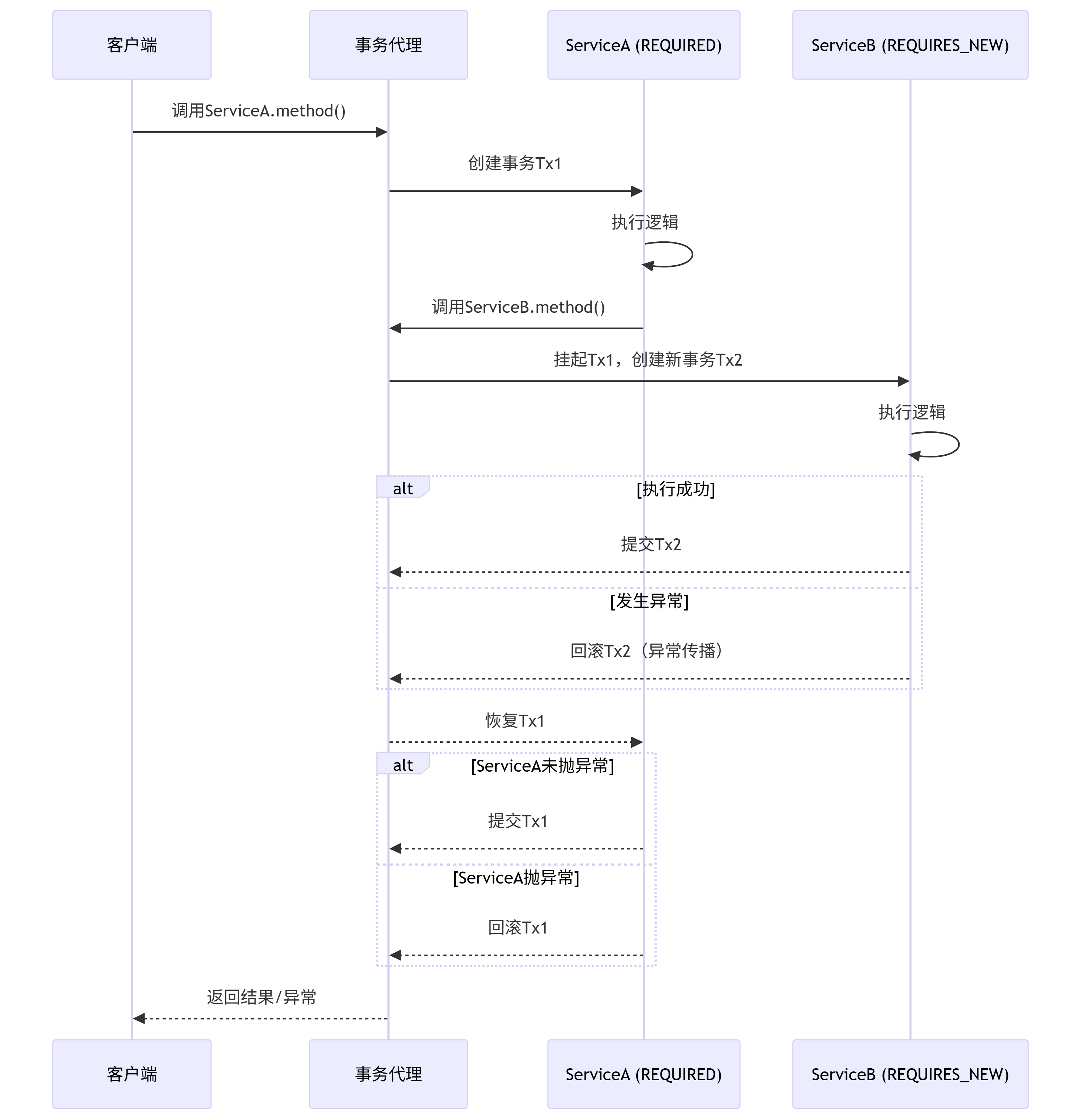
序列图
五、代码栗子
@Service
public class OrderService {
    @Autowired
    private UserService userService;

    // 外层事务(默认REQUIRED)
    @Transactional(rollbackFor = Exception.class)
    public void placeOrder(Order order) {
        saveOrder(order);       // 保存订单
        try {
            userService.updateUser(order.getUserId()); // 调用内层事务
        } catch (Exception e) {
            // 处理异常(内层事务回滚不影响外层)
        }
    }
}

@Service
public class UserService {
    // 内层事务(始终新事务)
    @Transactional(propagation = Propagation.REQUIRES_NEW)
    public void updateUser(Long userId) {
        updateUserStats(userId); // 更新用户统计
        if (someErrorCondition) {
            throw new BusinessException("业务异常"); // 触发回滚
        }
    }
}
六、回顾
-
传播机制调用:
-
通过
TransactionInterceptor拦截@Transactional方法 -
由
PlatformTransactionManager根据传播行为管理事务边界
-
-
异常回滚:
-
默认回滚
RuntimeException和Error -
可通过
rollbackFor/noRollbackFor自定义 -
最终由事务管理器调用JDBC/JPA的rollback()
-
-
事务嵌套:
-
REQUIRES_NEW会挂起当前事务并创建独立事务 -
NESTED使用保存点实现部分回滚
-
重要提示:事务生效需满足:
方法必须是
public调用必须来自代理对象(类内部调用不生效)
异常需抛出到事务拦截器(被catch的异常不会触发回滚)
但对于跨库调用的事务来说,那就要使用分布式事务了,如Seata(AT,TCC), RocketMQ 本地消息表机制来实现了。





 扫一扫
扫一扫


 2195
2195

 被折叠的 条评论
为什么被折叠?
被折叠的 条评论
为什么被折叠?
 到【灌水乐园】发言





