


提示:文章写完后,目录可以自动生成,如何生成可参考右边的帮助文档
前言
记录yolov8快速添加cbam注意力机制
一、修改tasks
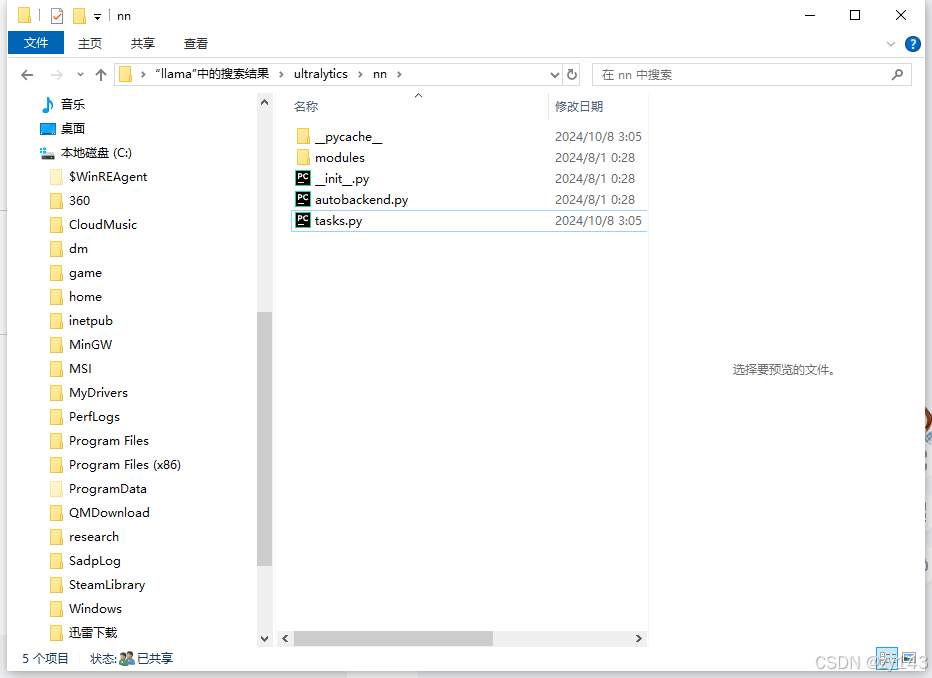
路径如上,将tasks.py替换为
# Ultralytics YOLO 🚀, AGPL-3.0 license
import contextlib
from copy import deepcopy
from pathlib import Path
import torch
import torch.nn as nn
from ultralytics.nn.modules import (
AIFI,
C1,
C2,
C3,
C3TR,
ELAN1,
OBB,
PSA,
SPP,
SPPELAN,
SPPF,
AConv,
ADown,
Bottleneck,
BottleneckCSP,
C2f,
C2fAttn,
C2fCIB,
C3Ghost,
C3x,
CBFuse,
CBLinear,
Classify,
Concat,
Conv,
Conv2,
ConvTranspose,
CBAM,
Detect,
DWConv,
DWConvTranspose2d,
Focus,
GhostBottleneck,
GhostConv,
HGBlock,
HGStem,
ImagePoolingAttn,
Pose,
RepC3,
RepConv,
RepNCSPELAN4,
RepVGGDW,
ResNetLayer,
RTDETRDecoder,
SCDown,
Segment,
WorldDetect,
v10Detect,
)
from ultralytics.utils import DEFAULT_CFG_DICT, DEFAULT_CFG_KEYS, LOGGER, colorstr, emojis, yaml_load
from ultralytics.utils.checks import check_requirements, check_suffix, check_yaml
from ultralytics.utils.loss import (
E2EDetectLoss,
v8ClassificationLoss,
v8DetectionLoss,
v8OBBLoss,
v8PoseLoss,
v8SegmentationLoss,
)
from ultralytics.utils.ops import make_divisible
from ultralytics.utils.plotting import feature_visualization
from ultralytics.utils.torch_utils import (
fuse_conv_and_bn,
fuse_deconv_and_bn,
initialize_weights,
intersect_dicts,
model_info,
scale_img,
time_sync,
)
try:
import thop
except ImportError:
thop = None
class BaseModel(nn.Module):
"""The BaseModel class serves as a base class for all the models in the Ultralytics YOLO family."""
def forward(self, x, *args, **kwargs):
"""
Forward pass of the model on a single scale. Wrapper for `_forward_once` method.
Args:
x (torch.Tensor | dict): The input image tensor or a dict including image tensor and gt labels.
Returns:
(torch.Tensor): The output of the network.
"""
if isinstance(x, dict): # for cases of training and validating while training.
return self.loss(x, *args, **kwargs)
return self.predict(x, *args, **kwargs)
def predict(self, x, profile=False, visualize=False, augment=False, embed=None):
"""
Perform a forward pass through the network.
Args:
x (torch.Tensor): The input tensor to the model.
profile (bool): Print the computation time of each layer if True, defaults to False.
visualize (bool): Save the feature maps of the model if True, defaults to False.
augment (bool): Augment image during prediction, defaults to False.
embed (list, optional): A list of feature vectors/embeddings to return.
Returns:
(torch.Tensor): The last output of the model.
"""
if augment:
return self._predict_augment(x)
return self._predict_once(x, profile, visualize, embed)
def _predict_once(self, x, profile=False, visualize=False, embed=None):
"""
Perform a forward pass through the network.
Args:
x (torch.Tensor): The input tensor to the model.
profile (bool): Print the computation time of each layer if True, defaults to False.
visualize (bool): Save the feature maps of the model if True, defaults to False.
embed (list, optional): A list of feature vectors/embeddings to return.
Returns:
(torch.Tensor): The last output of the model.
"""
y, dt, embeddings = [], [], [] # outputs
for m in self.model:
if m.f != -1: # if not from previous layer
x = y[m.f] if isinstance(m.f, int) else [x if j == -1 else y[j] for j in m.f] # from earlier layers
if profile:
self._profile_one_layer(m, x, dt)
x = m(x) # run
y.append(x if m.i in self.save else None) # save output
if visualize:
feature_visualization(x, m.type, m.i, save_dir=visualize)
if embed and m.i in embed:
embeddings.append(nn.functional.adaptive_avg_pool2d(x, (1, 1)).squeeze(-1).squeeze(-1)) # flatten
if m.i == max(embed):
return torch.unbind(torch.cat(embeddings, 1), dim=0)
return x
def _predict_augment(self, x):
"""Perform augmentations on input image x and return augmented inference."""
LOGGER.warning(
f"WARNING ⚠️ {self.__class__.__name__} does not support 'augment=True' prediction. "
f"Reverting to single-scale prediction."
)
return self._predict_once(x)
def _profile_one_layer(self, m, x, dt):
"""
Profile the computation time and FLOPs of a single layer of the model on a given input. Appends the results to
the provided list.
Args:
m (nn.Module): The layer to be profiled.
x (torch.Tensor): The input data to the layer.
dt (list): A list to store the computation time of the layer.
Returns:
None
"""
c = m == self.model[-1] and isinstance(x, list) # is final layer list, copy input as inplace fix
flops = thop.profile(m, inputs=[x.copy() if c else x], verbose=False)[0] / 1e9 * 2 if thop else 0 # GFLOPs
t = time_sync()
for _ in range(10):
m(x.copy() if c else x)
dt.append((time_sync() - t) * 100)
if m == self.model[0]:
LOGGER.info(f"{'time (ms)':>10s} {'GFLOPs':>10s} {'params':>10s} module")
LOGGER.info(f"{dt[-1]:10.2f} {flops:10.2f} {m.np:10.0f} {m.type}")
if c:
LOGGER.info(f"{sum(dt):10.2f} {'-':>10s} {'-':>10s} Total")
def fuse(self, verbose=True):
"""
Fuse the `Conv2d()` and `BatchNorm2d()` layers of the model into a single layer, in order to improve the
computation efficiency.
Returns:
(nn.Module): The fused model is returned.
"""
if not self.is_fused():
for m in self.model.modules():
if isinstance(m, (Conv, Conv2, DWConv)) and hasattr(m, "bn"):
if isinstance(m, Conv2):
m.fuse_convs()
m.conv = fuse_conv_and_bn(m.conv, m.bn) # update conv
delattr(m, "bn") # remove batchnorm
m.forward = m.forward_fuse # update forward
if isinstance(m, ConvTranspose) and hasattr(m, "bn"):
m.conv_transpose = fuse_deconv_and_bn(m.conv_transpose, m.bn)
delattr(m, "bn") # remove batchnorm
m.forward = m.forward_fuse # update forward
if isinstance(m, RepConv):
m.fuse_convs()
m.forward = m.forward_fuse # update forward
if isinstance(m, RepVGGDW):
m.fuse()
m.forward = m.forward_fuse
self.info(verbose=verbose)
return self
def is_fused(self, thresh=10):
"""
Check if the model has less than a certain threshold of BatchNorm layers.
Args:
thresh (int, optional): The threshold number of BatchNorm layers. Default is 10.
Returns:
(bool): True if the number of BatchNorm layers in the model is less than the threshold, False otherwise.
"""
bn = tuple(v for k, v in nn.__dict__.items() if "Norm" in k) # normalization layers, i.e. BatchNorm2d()
return sum(isinstance(v, bn) for v in self.modules()) < thresh # True if < 'thresh' BatchNorm layers in model
def info(self, detailed=False, verbose=True, imgsz=640):
"""
Prints model information.
Args:
detailed (bool): if True, prints out detailed information about the model. Defaults to False
verbose (bool): if True, prints out the model information. Defaults to False
imgsz (int): the size of the image that the model will be trained on. Defaults to 640
"""
return model_info(self, detailed=detailed, verbose=verbose, imgsz=imgsz)
def _apply(self, fn):
"""
Applies a function to all the tensors in the model that are not parameters or registered buffers.
Args:
fn (function): the function to apply to the model
Returns:
(BaseModel): An updated BaseModel object.
"""
self = super()._apply(fn)
m = self.model[-1] # Detect()
if isinstance(m, Detect): # includes all Detect subclasses like Segment, Pose, OBB, WorldDetect
m.stride = fn(m.stride)
m.anchors = fn(m.anchors)
m.strides = fn(m.strides)
return self
def load(self, weights, verbose=True):
"""
Load the weights into the model.
Args:
weights (dict | torch.nn.Module): The pre-trained weights to be loaded.
verbose (bool, optional): Whether to log the transfer progress. Defaults to True.
"""
model = weights["model"] if isinstance(weights, dict) else weights # torchvision models are not dicts
csd = model.float().state_dict() # checkpoint state_dict as FP32
csd = intersect_dicts(csd, self.state_dict()) # intersect
self.load_state_dict(csd, strict=False) # load
if verbose:
LOGGER.info(f"Transferred {len(csd)}/{len(self.model.state_dict())} item 最低0.47元/天 解锁文章






 扫一扫
扫一扫


 8119
8119


 到【灌水乐园】发言



