CSI-reference-signals(物理结构)

Overview

与LTE中的CSI-RS类似,在NR中引入CSI-RS(Channel-state information RS)的目的是对信道状态进行评估,UE基于信令配置的CSI-RS参数对CSI-RS进行测量评估从而得到下行信道状态信息并反馈给基站并应用于链路自适应算法中。
N.B. 需要注意的是,LTE中存在Cell-specific RS,所有属于某个cell的UE都可以通过测量CRS来获取下行信道质量;而在NR中,没有了CRS的概念,对下行信道的测量只能通过UE-specific的CSI-RS进行。
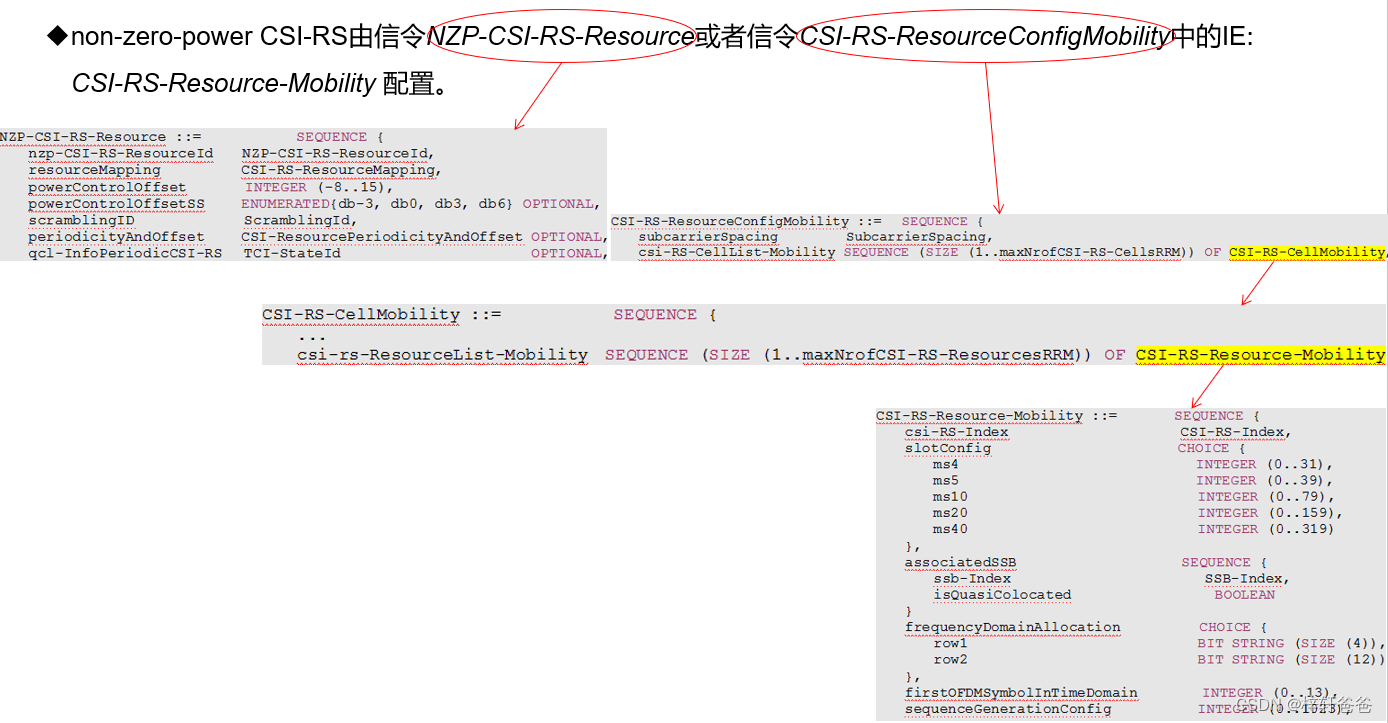
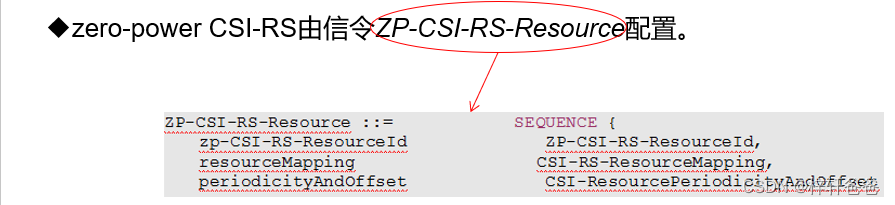
CSI-RS分为zero-power(ZP)和non-zero-power(NZP)两种CSI-RS:
  • NZP CSI-RS用于UE专有的下行信道测量。
  • ZP CSI-RS使用于多小区之间CSI-RS的协作传输,简单点说就是为了避免与其他小区的CSI-RS传输的冲撞,将一个小区的下行数据传输中的一些REs设置为ZP CSI-RS(即该RE上为0功率传输), 这样就避开了CSI-RS传输的互相干扰,提高了对下行信道评估的准确性。


Sequence generation
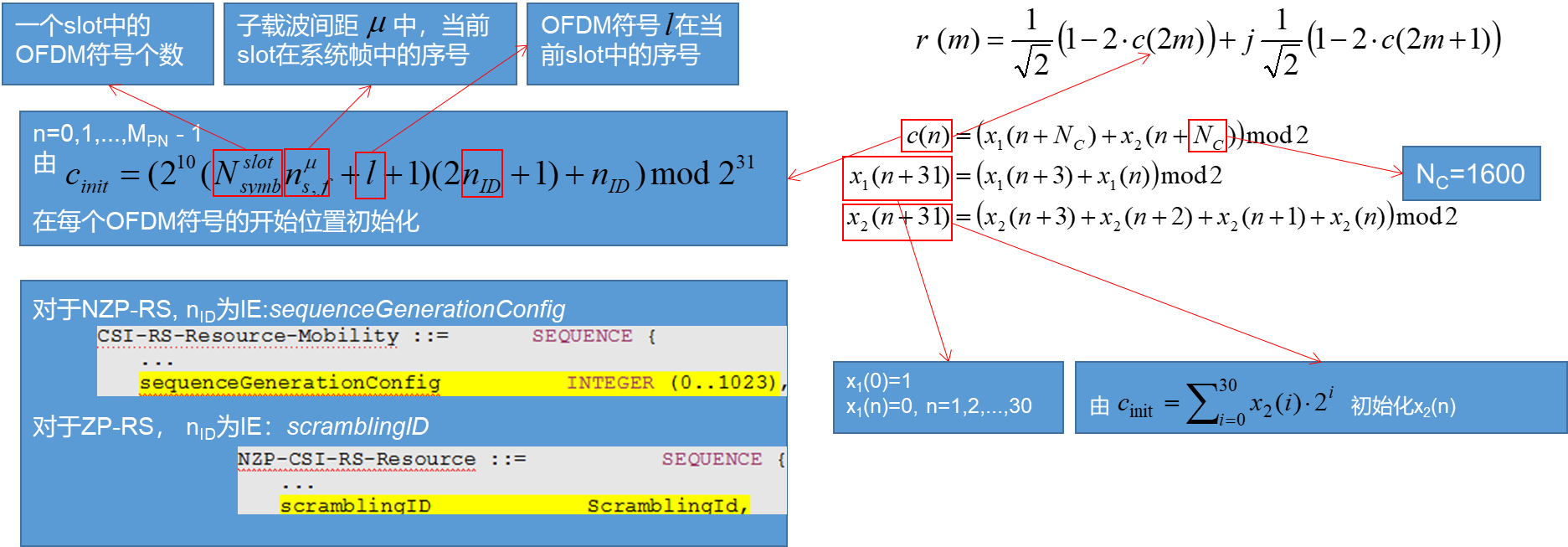
参考信号序列r(m)定义如下:
Mapping to physical resources
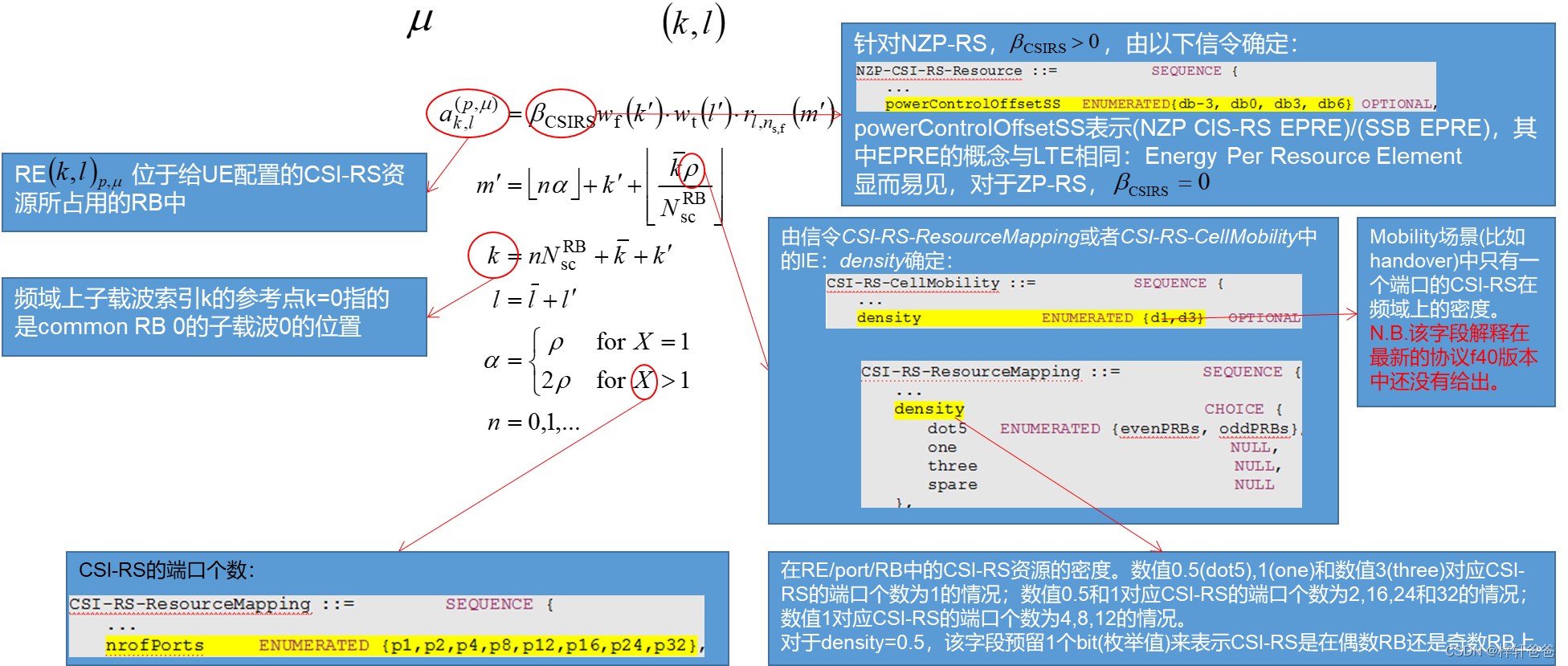
对于每个CSI-RS,序列r(m)按照如下公式映射到RE\left ( k,l \right )_{p,\mu} (该符号的意思是在天线端口p,子载波间距配置\mu中的RE位置\left ( k,l \right ))上:


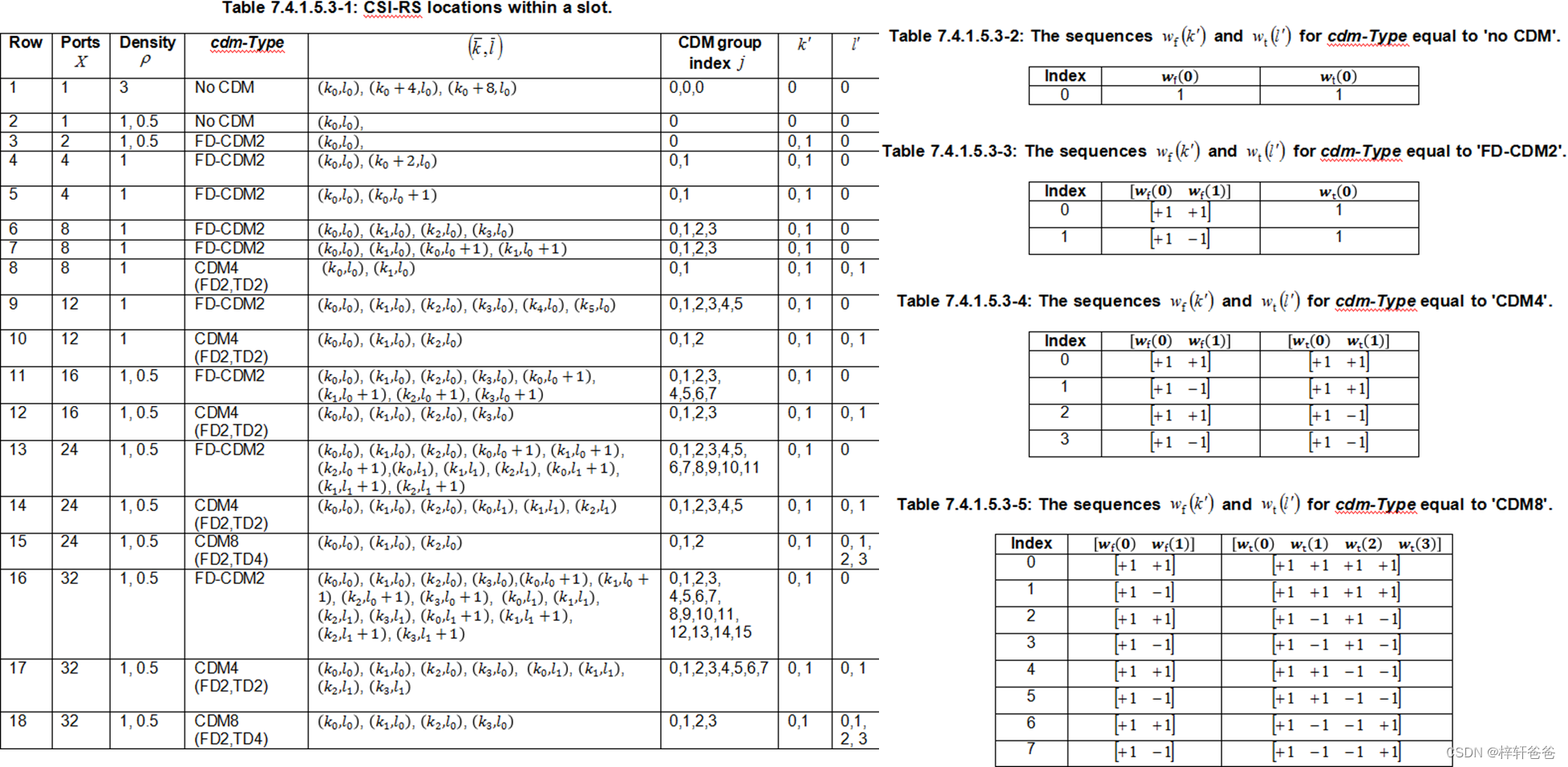
以上公式中的{k},'{l},'w_{f}({k}'),w_{t}({l}') 由Table 7.4.1.5.3-1到7.4.1.5.3-6给出:


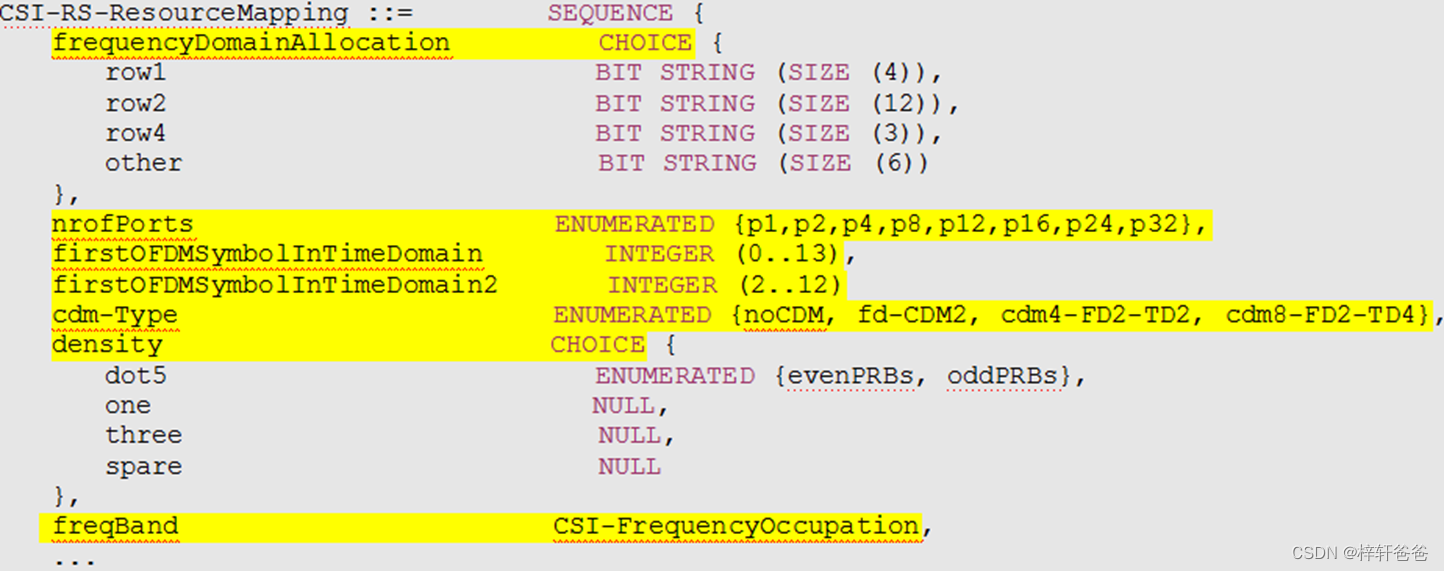
下面来解释以下上面图表中各个参数的含义:
这些参数都是通过信令CSI-RS-ResourceMapping配置的,信令内容如下:
 
下面我们就来具体介绍每个IE的含义和用法:
cdm-Type(码分复用类型):cdm-Type由CSI-RS-ResourceMapping中的cdm-Type字段确定:

 

### CSI-RS Configuration and Usage in LTE Network In Long Term Evolution (LTE) networks, Channel State Information Reference Signals (CSI-RS) play a crucial role in providing channel state feedback from user equipment (UE) to the evolved NodeB (eNodeB). These reference signals enable more accurate link adaptation and beamforming operations. The most commonly used antenna configuration for multi-user MIMO systems as of 2013 was 2 x 2 MIMO[^1]. However, with advancements in technology, configurations have expanded beyond this initial setup. For advanced applications such as those involving CSI-RS, larger antenna arrays can be utilized up to an 8 x 8 configuration specified by 3GPP standards. #### Key Aspects of CSI-RS Configuration - **Resource Allocation**: CSI-RS are transmitted on specific resource elements within subframes designated by higher layers. - **Periodicity and Subframe Offset**: The periodicity at which these signals are sent varies depending upon system requirements; it could range between every few milliseconds or less frequently based on traffic conditions. - **Spatial Orthogonality**: To ensure that multiple users do not interfere with each other when using similar resources simultaneously, spatial orthogonality must be maintained through proper allocation across different antennas. ```python # Example Python code snippet demonstrating how one might configure basic parameters related to CSI-RS transmission timing csi_rs_periodicity = 'subframe_5' # Define periodocity e.g., every fifth sub-frame offset_from_start_of_frame = 2 # Set offset value relative to start frame boundary ``` #### Practical Implications Using sophisticated setups like large-scale MIMO configurations allows operators to achieve better spectral efficiency while supporting enhanced services over wireless links. This includes improved throughput performance under challenging propagation environments where traditional methods may struggle due to interference issues.
评论
成就一亿技术人!
拼手气红包6.0元
还能输入1000个字符
 
红包 添加红包
表情包 插入表情
 条评论被折叠 查看
添加红包

请填写红包祝福语或标题

红包个数最小为10个

红包金额最低5元

当前余额3.43前往充值 >
需支付:10.00
成就一亿技术人!
领取后你会自动成为博主和红包主的粉丝 规则
hope_wisdom
发出的红包
实付
使用余额支付
点击重新获取
扫码支付
钱包余额 0

抵扣说明:

1.余额是钱包充值的虚拟货币,按照1:1的比例进行支付金额的抵扣。
2.余额无法直接购买下载,可以购买VIP、付费专栏及课程。

余额充值