


 本文探讨了3DLUTs在图像处理中的应用及其学习过程,并对比分析了HDRNet等深度学习图像增强方法。从曝光补偿到色调映射等相机图像流程增强手段,再到基于学习的图像增强技术,文章全面解析了图像处理的关键技术。
3D LUT
提升感知质量(perceptual quality)是数码相机图像处理不可缺少的,一般通过级联的模块例如曝光补偿(exposure compensation), 色调/饱和度调整(hue/saturation adjustment), 颜色空间转换和修改(color space conversion and manipulation), 色调映射(tone mapping), 伽马校正(gamma correction)
- 数据集
MIT-Adobe FiveK dataset
基于深度学习的增强方法可以分为两类
- 学习一个像素到像素的映射(pixel-to-pixel mapping) or 预测一个像素级的变换(pixel-wise transformations)
- 预测一系列预定义增强操作的概率和/或映射曲线的参数
The networks take down-sampled low-resolution (LR) images as input to predict which ones of the pre-defined operators and/or mapping curves should be used to enhance the given high-resolution (HR) source images
按照以前的方法,网络采用低分辨率(LR)的输入预测哪个预定义的操作和/或映射曲线应该被应用在高分辨率(HR)的源图像上
- framework
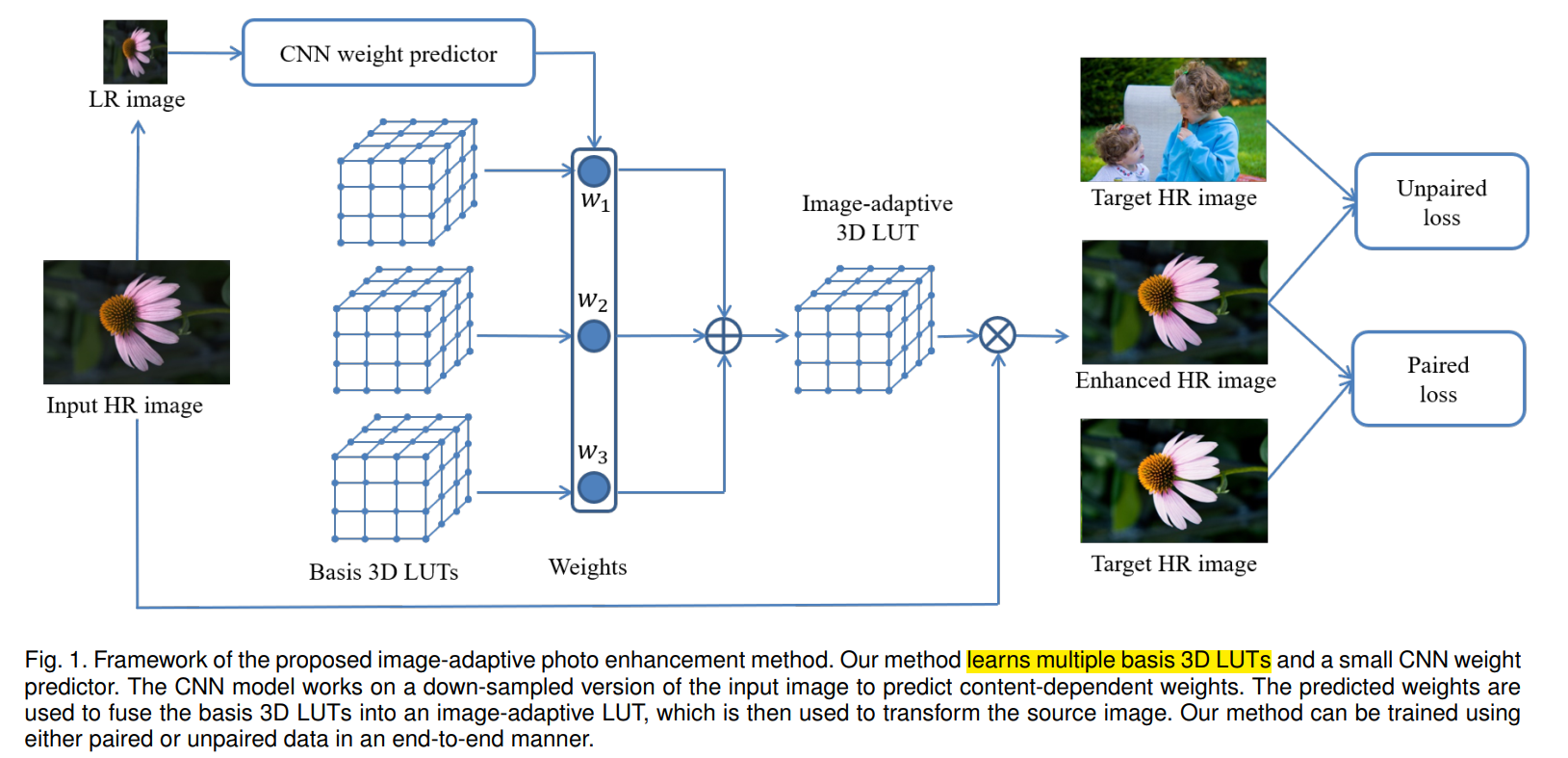
3D LUTs 怎么学习的?
- 相机图像流程增强(enhancement in camera imaging pipeline)
- exposure correction [13, 14]
- color constancy [15, 16]
- constrast enhancement [17, 18]
- color manipulation [19, 20]
- tone mapping [21, 22]
按照文献[1] 大部分操作在实际应用中都可以使用相同的技术, 例如1D or 3D LUT
- 后期调整增强(enhancement in photo reto
 最低0.47元/天 解锁文章






 扫一扫
扫一扫


 1319
1319

 被折叠的 条评论
为什么被折叠?
被折叠的 条评论
为什么被折叠?
 到【灌水乐园】发言





