



花费了比较长的时间,解决了编译过程中遇到的许多问题后,终于把这个开源的工程编译好了,运行post build 脚本将需要的链接文件拷贝好。正当我以为没有任何问题了,双击可执行程序运行。
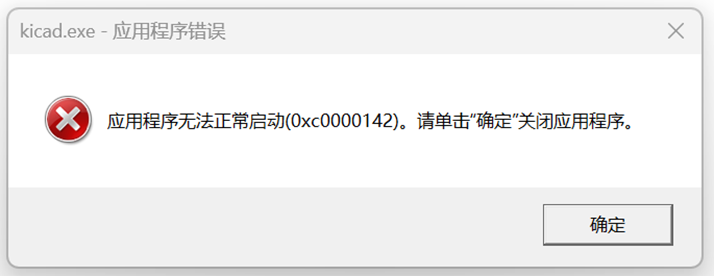
结果运行起来的时候报错了,提示无法正常启动,根据这个这个报错的提示,网上搜了一下,都说是缺少dll库导致的,于是将post build脚本又运行了一遍,重新双击打开可执行程序,还是报一样的错。
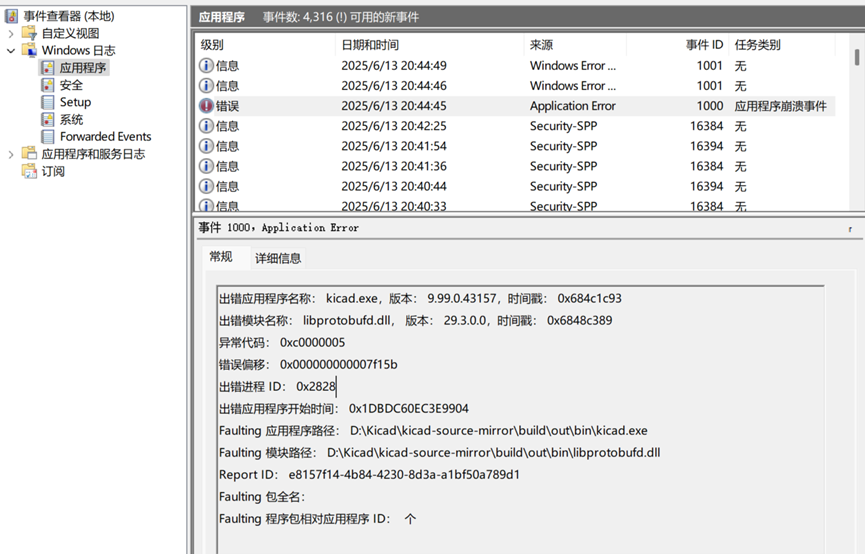
那么是缺少那个dll库导致的呢?于是我打开系统的事件查看器,从里面找到了应用程序错误事件,点击看到了详细信息,从描述来看出错的模块是libprotobufd.dll,是在运行这个dll的过程中出现的异常,并非缺少dll导致。
{
    // Use IntelliSense to learn about possible attributes.
    // Hover to view descriptions of existing attributes.
    // For more information, visit: https://go.microsoft.com/fwlink/?linkid=830387
    "version": "0.2.0",
    "configurations": [
        {
            "name": "(msvc) launch",
            "type": "cppvsdbg",
            "request": "launch",
            "program": "D:\\Kicad\\kicad-source-mirror\\build\\out\\bin\\kicad.exe"
        }

    ]
}
为了进一步弄清楚这个库出错的原因和位置,于是在vscode编辑器中将C/C++相关的插件安装上,设置好debug条件,运行debug功能后,跳转到了出现异常的代码位置。
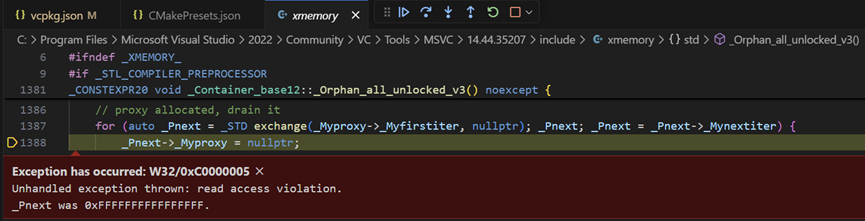
从给的错误信息可以看出来_Pnext是一个非法值,那么这个值为什么是一个非法值,目前猜测它是一个空指针,或者指向的内存不对,目前只是有这样一个概念,带着这样的疑惑继续分析原因。
_EXPORT_STD template <class _Ty, class _Other = _Ty>
_CONSTEXPR20 _Ty exchange(_Ty& _Val, _Other&& _New_val)
    noexcept(conjunction_v<is_nothrow_move_constructible<_Ty>, is_nothrow_assignable<_Ty&, _Other>>) {
    // assign _New_val to _Val, return previous _Val
    _Ty _Old_val = static_cast<_Ty&&>(_Val);
    _Val         = static_cast<_Other&&>(_New_val);
    return _Old_val;
}
exchange的作用是将第一个参数设置成第二个参数的值,然后返回第一个参数的值,所以auto _Pnext = _STD exchange(_Myproxy->_Myfirstiter, nullptr)可以理解为:
_Pnext = _Myproxy->_Myfirstiter;
_Myproxy->_Myfirstiter = nullptr;
上述只是简单理解这个函数的功能,这样看这里也没有问题
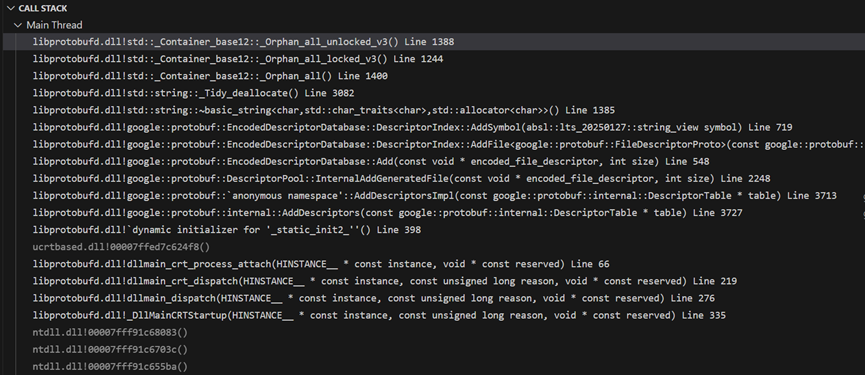
到了这里我们还是无法知道_Pnext指向的区域为什么变成非法的,还有就是_Pnext到底指向的是什么,也就是它到底是什么,怎么来的,于是根据发生异常的调用栈进一步追踪,看一下具体是怎么发生的。根据调用栈我们看到了一个明显的可能有问题的地方那就是std::string::~basic_string(),这里先猜测string对象析构的时候发生了异常,析构的时候一般会去释放资源,是不是释放的资源出来问题,所以才导致的异常。
bool EncodedDescriptorDatabase::DescriptorIndex::AddSymbol(
    absl::string_view symbol) {
  SymbolEntry entry = {static_cast<int>(all_values_.size() - 1),
                       EncodeString(symbol)};
  std::string entry_as_string = entry.AsString(*this);

  // We need to make sure not to violate our map invariant.

  // If the symbol name is invalid it could break our lookup algorithm (which
  // relies on the fact that '.' sorts before all other characters that are
  // valid in symbol names).
  if (!ValidateSymbolName(symbol)) {
    ABSL_LOG(ERROR) << "Invalid symbol name: " << entry_as_string;
    return false;
  }

  auto iter = FindLastLessOrEqual(&by_symbol_, entry);
  if (!CheckForMutualSubsymbols(entry_as_string, &iter, by_symbol_.end(),
                                *this)) {
    return false;
  }

  // Same, but on by_symbol_flat_
  auto flat_iter =
      FindLastLessOrEqual(&by_symbol_flat_, entry, by_symbol_.key_comp());
  if (!CheckForMutualSubsymbols(entry_as_string, &flat_iter,
                                by_symbol_flat_.end(), *this)) {
    return false;
  }

  // OK, no conflicts.

  // Insert the new symbol using the iterator as a hint, the new entry will
  // appear immediately before the one the iterator is pointing at.
  by_symbol_.insert(iter, entry);

  return true;
}
于是继续追踪代码里面是哪个执行造成的,还是根据前面的调用栈,我们看到执行完AddSymbol后,会调用~basic_string(),那么根据上面的代码来看,应该是entry_as_string这个对象的使用有问题。
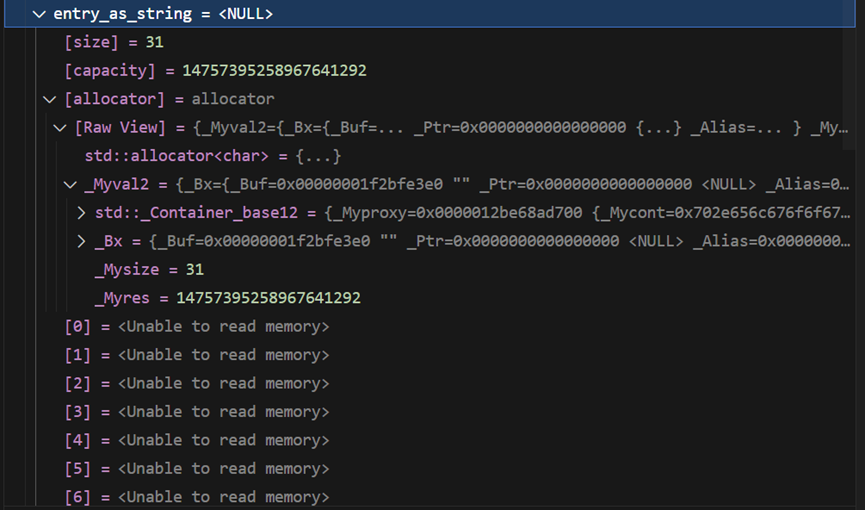
根据debug信息,看到entry_as_string的内存有问题,到这来还不知道是因为被释放了,还是本身创建出来的就有问题,继续追踪这个是怎么创建出来的。
std::string AsString(const DescriptorIndex& index) const {
      auto p = package(index);
      return absl::StrCat(p, p.empty() ? "" : ".", symbol(index));
    }
std::string StrCat(const AlphaNum& a, const AlphaNum& b, const AlphaNum& c) {
  std::string result;
  // Use uint64_t to prevent size_t overflow. We assume it is not possible for
  // in memory strings to overflow a uint64_t.
  constexpr uint64_t kMaxSize = uint64_t{std::numeric_limits<size_t>::max()};
  const uint64_t result_size = static_cast<uint64_t>(a.size()) +
                               static_cast<uint64_t>(b.size()) +
                               static_cast<uint64_t>(c.size());
  ABSL_INTERNAL_CHECK(result_size <= kMaxSize, "size_t overflow");
  strings_internal::STLStringResizeUninitialized(
      &result, static_cast<size_t>(result_size));
  char* const begin = &result[0];
  char* out = begin;
  out = Append(out, a);
  out = Append(out, b);
  out = Append(out, c);
  assert(out == begin + result.size());
  return result;
}
这里重点是std::string result;这个result有问题,但是有实在看不出代码哪里有问题,于是只能继续debug,进入这个函数后一步步运行,看一下具体是哪里出了问题。
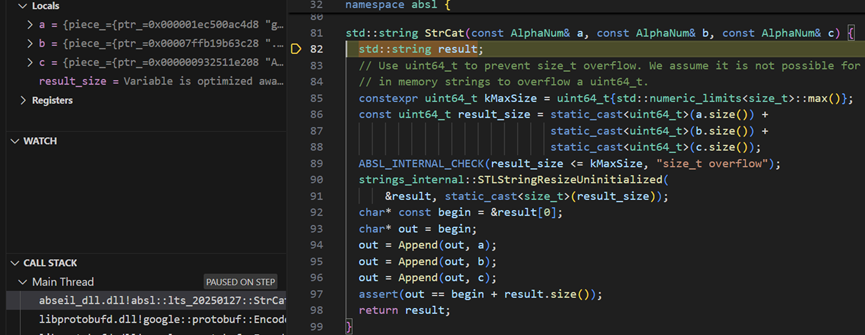
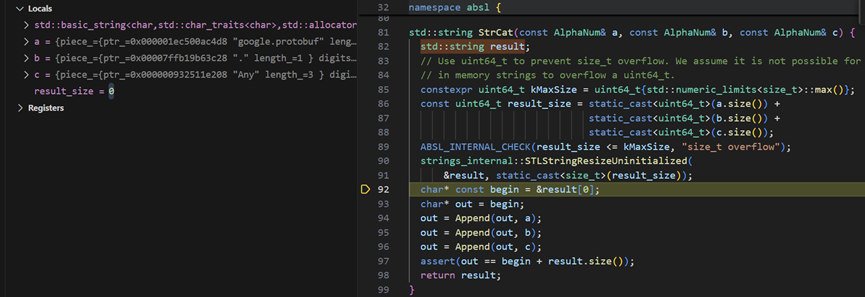
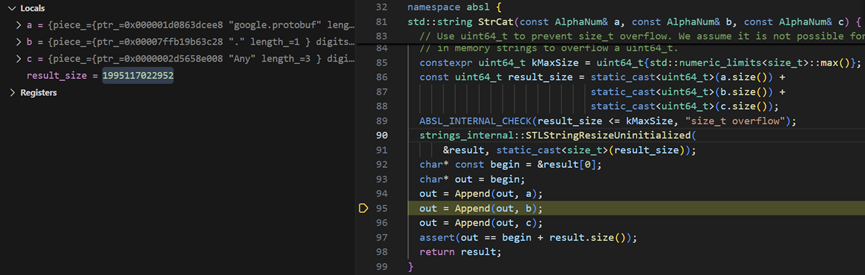
在运行的过程中,这个result的就没有显示出来,它的内存是什么,指向哪里根本不知道。
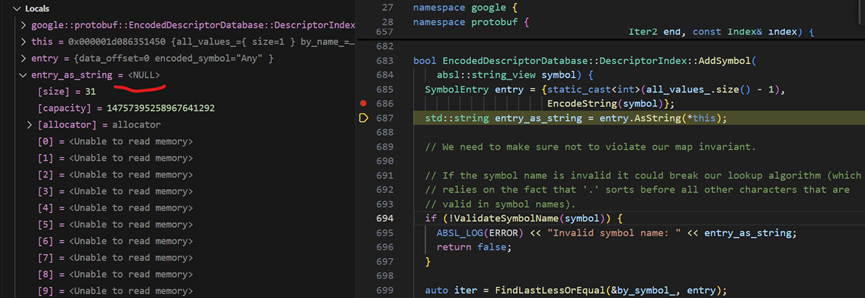
只知道这个函数返回的时候,entry_as_string指向了一个错误的内存,最终导致崩溃,目前从debug的过程来看不出具体是什么原因导致的问题。
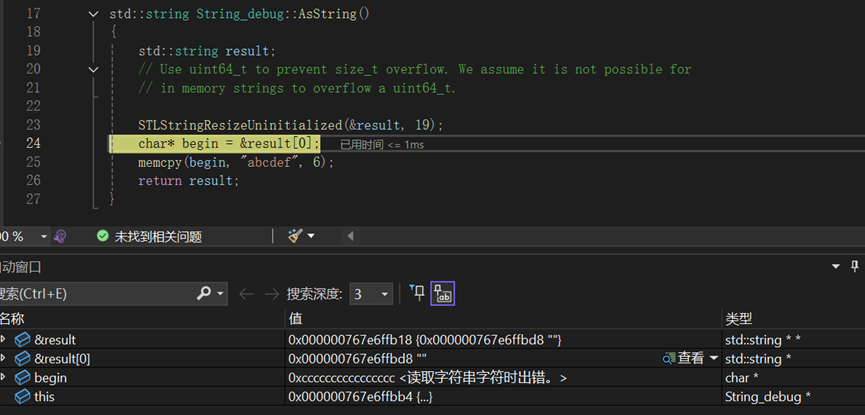
于是写了一段类似的测试代码,看看能不能复现到这样的问题,也可以对比这个过程中有哪些不一样,看看能不能找出根本原因。
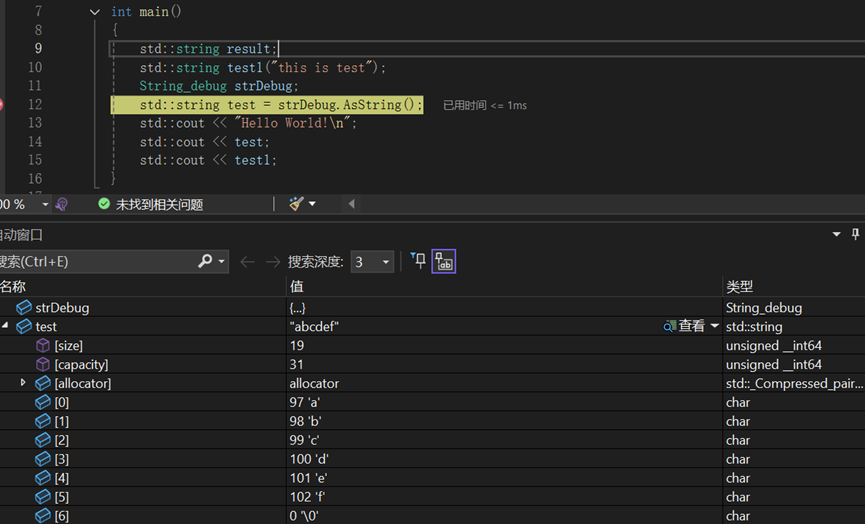
测试代码在运行的过程中没有出错,只能看到它们不一样的地方
| 异常代码 | 测试代码 | |
| 1 | std::string result 没有跑构造函数 | std::string result 正常跑构造函数 |
| 2 | debug过程没有显示result的信息 | debug过程会显示result的信息 |
| 3 | 函数里面的begin、out等变量也没有信息 | 函数里面的begin指向和显示没有问题 |
目前猜测可能是std::string StrCat(const AlphaNum& a, const AlphaNum& b, const AlphaNum& c) 函数里面的代码被优化了导致的。





 扫一扫
扫一扫


 2662
2662

 被折叠的 条评论
为什么被折叠?
被折叠的 条评论
为什么被折叠?
 到【灌水乐园】发言





