


 本文档详细介绍了如何使用TensorFlow 2.2实现Faster R-CNN算法,包括网络结构、前向传播、反向传播及关键代码解读。跟随步骤,理解Faster R-CNN将有助于深化深度学习理解。
tf2.2实现Faster R-CNN,全网最好的代码实现,没有之一,进行了详细的代码标注解释。每行代码基本都有注释。
Faster R-CNN输入深度学习中中上等难度的代码,搞懂了Faster R-CNN,深度学习基本上没有多大问题了。
代码来源:
tf2.2实现Faster R-CNN
1 Faster R-CNN介绍
看懂了下面的三个资料就懂了Faster R-CNN了。
1、这个特别好 https://blog.youkuaiyun.com/happyday_d/article/details/85870358
2、https://blog.youkuaiyun.com/weixin_44791964/article/details/108513563
3、https://blog.youkuaiyun.com/xiaotiig/article/details/115859891
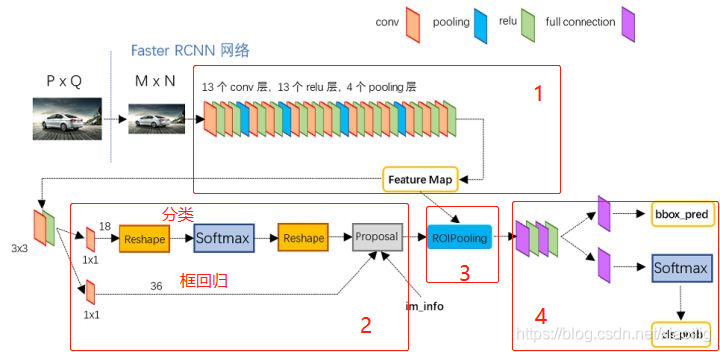
就是这样一个结构,分为4个部分
(1)就是普通的分类卷积网络,最基本的结构,输入600600,得到一个38381024的卷积层;
(2)rpn层,得到38389=12996的先验框,这里还要加入一些粗调,得到300个建议框。
(3)roipooling层,就是根据建议框截切共享特征层,得到14141024大小的一个个卷积层。
(4)将1414*1024的卷积层进行卷积或者神经元计算,得到输出的值,这一部分就是一个普通的分类模型,只不过得到的是两部分,一个是分类,一个是应该偏移的量。当然这里也加入了一些粗调的操作。
2 前向传播,反向传播
请先看readme的介绍,再执行代码,不要着急
2.1 前向传播
前向传播流程
1 选择预测的类型,图片、视频
2 前向传播代码的实现
3 得到12996(38389)行4列未经任何筛选的先验框
4 经过建议框的筛选,得到300个框
(1)根据先验框,模型到rpn层得到的框的粗调值,进行粗调(解码),得到应该标注的12996个框的置信度和位置。
(2)先从12996个框中,安置信度从大到小取出12000个框,只看一个类的置信度,即看是不是前景,不区分具体的类
(3)然后经过非极大值抑制得到最多300个建议框
5 进行最后的精调层,得到最终的框
(1)对建议框的置信度进行筛选,删除所有20个类都小于0.5置信度的框
(2)根据建议框,最后模型得到的值,进行精调(解码),得到应该标注的框,左上角和右下角坐标。
(3)对同一类的框进行非极大抑制,得到最终的框。
2.2 反向传播
注意:我们训练的是得到偏移量和类别,而不是框的具体位置和偏移量
1 先对原始图像进行了数据增强,得到预处理后的图像数据和标注框数据,左上角和右下角坐标,和类别
2 根据真实值和先验框,进行编码,得到我们想要的rpn层应该得到的偏移量(A),也就是粗调结果。再跟rpn本身得到的偏移量(B)对比,让rpn本身得到的偏移量(B)向我们想要的偏移量(A)靠近。
3 根据真实值和建议框,进行编码,得到我们想要的模型精调层应该得到的偏移量(C),也就是精调结果。
再跟模型最后精调层本身得到的偏移量(D)对比,让模型最后精调层本身得到的偏移量(D)向我们想要的偏移量(C)靠近。
4 共4个损失值,
(1)计算rpn层得到的偏移量和我们要的偏移量之间的损失值;
(2)背景与前景0和1之间的类的损失值;
(3)精调层得到的偏移量和我们要的偏移量之间的损失值;
(4)精调层得到的类的损失值.
3 注意
(1)用置信度进行分类
(2)用iou进行非极大抑制
(3)一共进行了4次筛选过滤
(4)训练包括4个框:先验框,建议框,预测框,真实框
预测包括3个框:先验框,建议框,预测框
(5)每次模型得到的类是一个置信度,得到的框的4个值,不是框的坐标,而是相对于先验框的微调值,为了区分,我们通过rpn获得的叫粗调值,粗调值对先验框进行调整;最后模型得到的叫精调值,精调值对建议框进行调整。
(6)编码就是根据真实框和模型的先验框或建议框得到偏移值(对应训练过程),解码就是将偏移值变成预测框(对应预测过程)。
4 疑惑
(1)utils中的decode_boxes()为什么要乘以4,数量级变换是干什么?
(2)frcnn第223行,将x,y,宽高互换是为什么?
5 代码
自己注释难免有误,欢迎交流
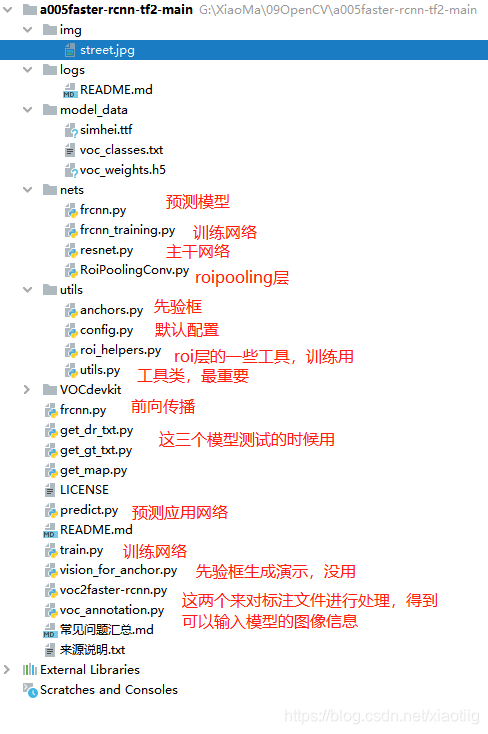
完整代码放到了百度网盘:
链接:https://pan.baidu.com/s/1MYmiQGSX9R-LvHuBIbmBpg
提取码:mpyf
复制这段内容后打开百度网盘手机App,操作更方便哦–来自百度网盘超级会员V1的分享
resnet.py的代码
#-------------------------------------------------------------#
#   ResNet50的网络部分
#-------------------------------------------------------------#
from __future__ import print_function

from tensorflow.keras import layers
from tensorflow.keras.initializers import RandomNormal
from tensorflow.keras.layers import (Activation, Add, AveragePooling2D, Conv2D, BatchNormalization,
                                     MaxPooling2D, TimeDistributed,
                                     ZeroPadding2D)


def identity_block(input_tensor, kernel_size, filters, stage, block):
    """
    构建identity——block结构
    """

    filters1, filters2, filters3 = filters

    conv_name_base = 'res' + str(stage) + block + '_branch'
    bn_name_base = 'bn' + str(stage) + block + '_branch'

    x = Conv2D(filters1, (1, 1), kernel_initializer=RandomNormal(stddev=0.02), name=conv_name_base + '2a')(input_tensor)
    x = BatchNormalization(trainable=False, name=bn_name_base + '2a')(x)
    x = Activation('relu')(x)

    x = Conv2D(filters2, kernel_size, padding='same', kernel_initializer=RandomNormal(stddev=0.02), name=conv_name_base + '2b')(x)
    x = BatchNormalization(trainable=False, name=bn_name_base + '2b')(x)
    x = Activation('relu')(x)

    x = Conv2D(filters3, (1, 1), kernel_initializer=RandomNormal(stddev=0.02), name=conv_name_base + '2c')(x)
    x = BatchNormalization(trainable=False, name=bn_name_base + '2c')(x)

    x = layers.add([x, input_tensor])
    x = Activation('relu')(x)
    return x


def conv_block(input_tensor, kernel_size, filters, stage, block, strides=(2, 2)):
    """
    构建conv_block结构
    """

    filters1, filters2, filters3 = filters

    conv_name_base = 'res' + str(stage) + block + '_branch'
    bn_name_base = 'bn' + str(stage) + block + '_branch'

    x = Conv2D(filters1, (1, 1), strides=strides, kernel_initializer=RandomNormal(stddev=0.02),
               name=conv_name_base + '2a')(input_tensor)
    x = BatchNormalization(trainable=False, name=bn_name_base + '2a')(x)
    x = Activation('relu')(x)

    x = Conv2D(filters2, kernel_size, padding='same', kernel_initializer=RandomNormal(stddev=0.02),
               name=conv_name_base + '2b')(x)
    x = BatchNormalization(trainable=False, name=bn_name_base + '2b')(x)
    x = Activation('relu')(x)

    x = Conv2D(filters3, (1, 1), kernel_initializer=RandomNormal(stddev=0.02), name=conv_name_base + '2c')(x)
    x = BatchNormalization(trainable=False, name=bn_name_base + '2c')(x)

    shortcut = Conv2D(filters3, (1, 1), strides=strides, kernel_initializer=RandomNormal(stddev=0.02),
                      name=conv_name_base + '1')(input_tensor)
    shortcut = BatchNormalization(trainable=False, name=bn_name_base + '1')(shortcut)

    x = layers.add([x, shortcut])
    x = Activation('relu')(x)
    return x

def ResNet50(inputs):
    """
    构建获得共享特征层的模型
    """
    #-----------------------------------#
    #   假设输入进来的图片是600,600,3
    #  https://blog.youkuaiyun.com/weixin_44791964/article/details/102790260?ops_request_misc=%257B%2522request%255Fid%2522%253A
    #  %2522162279667116780366569459%2522%252C%2522scm%2522%253A%252220140713.130102334.pc%255Fblog.%2522%257D&request_id
    #  =162279667116780366569459&biz_id=0&utm_medium=distribute.pc_search_result.none-task-blog-2~blog~first_rank_v2~rank_v29-1-102790260.
    #  pc_v2_rank_blog_default&utm_term=resnet&spm=1018.2226.3001.4450
    #-----------------------------------#
    img_input = inputs

    # 600,600,3 -> 300,300,64
    x = ZeroPadding2D((3, 3))(img_input)
    x = Conv2D(64, (7, 7), strides=(2, 2), name='conv1')(x)
    x = BatchNormalization(trainable=False, name='bn_conv1')(x)
    x = Activation('relu')(x)

    # 300,300,64 -> 150,150,64
    x = MaxPooling2D((3, 3), strides=(2, 2), padding="same")(x)

    # 150,150,64 -> 150,150,256
    x = conv_block(x, 3, [64, 64, 256], stage=2, block='a', strides=(1, 1))
    x = identity_block(x, 3, [64, 64, 256], stage=2, block='b')
    x = identity_block(x, 3, [64, 64, 256], stage=2, block='c')

    # 150,150,256 -> 75,75,512
    x = conv_block(x, 3, [128, 128, 512], stage=3, block='a')
    x = identity_block(x, 3, [128, 128, 512], stage=3, block='b')
    x = identity_block(x, 3, [128, 128, 512], stage=3, block='c')
    x = identity_block(x, 3, [128, 128, 512], stage=3, block='d')

    # 75,75,512 -> 38,38,1024
    x = conv_block(x, 3, [256, 256, 1024], stage=4, block='a')
    x = identity_block(x, 3, [256, 256, 1024], stage=4, block='b')
    x = identity_block(x, 3, [256, 256, 1024], stage=4, block='c')
    x = identity_block(x, 3, [256, 256, 1024], stage=4, block='d')
    x = identity_block(x, 3, [256, 256, 1024], stage=4, block='e')
    x = identity_block(x, 3, [256, 256, 1024], stage=4, block='f')

    # 最终获得一个38,38,1024的共享特征层
    return x

def identity_block_td(input_tensor, kernel_size, filters, stage, block):
    """
    最后的精调层用
    """
    nb_filter1, nb_filter2, nb_filter3 = filters
    conv_name_base = 'res' + str(stage) + block + '_branch'
    bn_name_base = 'bn' + str(stage) + block + '_branch'

    #  https://blog.youkuaiyun.com/u011913417/article/details/110875054   TimeDistributed的解释
    x = TimeDistributed(Conv2D(nb_filter1, (1, 1), kernel_initializer='normal'), name=conv_name_base + '2a')(input_tensor)
    x = TimeDistributed(BatchNormalization(trainable=False), name=bn_name_base + '2a')(x)
    x = Activation('relu')(x)

    x = TimeDistributed(Conv2D(nb_filter2, (kernel_size, kernel_size), kernel_initializer='normal',padding='same'), name=conv_name_base + '2b')(x)
    x = TimeDistributed(BatchNormalization(trainable=False), name=bn_name_base + '2b')(x)
    x = Activation('relu')(x)

    x = TimeDistributed(Conv2D(nb_filter3, (1, 1), kernel_initializer='normal'), name=conv_name_base + '2c')(x)
    x = TimeDistributed(BatchNormalization(trainable=False), name=bn_name_base + '2c')(x)

    x = Add()([x, input_tensor])
    x = Activation('relu')(x)

    return x

def conv_block_td(input_tensor, kernel_size, filters, stage, block, strides=(2, 2)):
    """
    最后的精调层用
    """
    nb_filter1, nb_filter2, nb_filter3 = filters
    conv_name_base = 'res' + str(stage) + block + '_branch'
    bn_name_base = 'bn' + str(stage) + block + '_branch'

    x = TimeDistributed(Conv2D(nb_filter1, (1, 1), strides=strides, kernel_initializer='normal'), name=conv_name_base + '2a')(input_tensor)
    x = TimeDistributed(BatchNormalization(trainable=False), name=bn_name_base + '2a')(x)
    x = Activation('relu')(x)

    x = TimeDistributed(Conv2D(nb_filter2, (kernel_size, kernel_size), padding='same', kernel_initializer='normal'), name=conv_name_base + '2b')(x)
    x = TimeDistributed(BatchNormalization(trainable=False), name=bn_name_base + '2b')(x)
    x = Activation('relu')(x)

    x = TimeDistributed(Conv2D(nb_filter3, (1, 1), kernel_initializer='normal'), name=conv_name_base + '2c')(x)
    x = TimeDistributed(BatchNormalization(trainable=False), name=bn_name_base + '2c')(x)

    shortcut = TimeDistributed(Conv2D(nb_filter3, (1, 1), strides=strides, kernel_initializer='normal'), name=conv_name_base + '1')(input_tensor)
    shortcut = TimeDistributed(BatchNormalization(trainable=False), name=bn_name_base + '1')(shortcut)

    x = Add()([x, shortcut])
    x = Activation('relu')(x)
    return x


def classifier_layers(x):
    """

    """
    # num_rois, 14, 14, 1024 -> num_rois, 7, 7, 2048
    x = conv_block_td(x, 3, [512, 512, 2048], stage=5, block='a', strides=(2, 2))
    # num_rois, 7, 7, 2048 -> num_rois, 7, 7, 2048
    x = identity_block_td(x, 3, [512, 512, 2048], stage=5, block='b')
    # num_rois, 7, 7, 2048 -> num_rois, 7, 7, 2048
    x = identity_block_td(x, 3, [512, 512, 2048], stage=5, block='c')
    # num_rois, 7, 7, 2048 -> num_rois, 1, 1, 2048
    x = TimeDistributed(AveragePooling2D((7, 7)), name='avg_pool')(x)

    return x
utils.py代码:
import math

import numpy as np
import tensorflow as tf
from PIL import Image


class BBoxUtility(object):
    def __init__(self, overlap_threshold=0.7, ignore_threshold=0.3, rpn_pre_boxes=12000, rpn_nms=0.7, classifier_nms=0.3, top_k=300):
        self.overlap_threshold  = overlap_threshold
        self.ignore_threshold   = ignore_threshold
        self.rpn_pre_boxes      = rpn_pre_boxes

        self.rpn_nms            = rpn_nms
        self.classifier_nms     = classifier_nms
        self.top_k              = top_k

    def iou(self, box):
        """
        输入:一个真实框的左上角和右下角坐标
        输出:计算出每个真实框与所有的先验框的iou
        """
        # 判断真实框与先验框的重合情况
        # self.priors比如是12996个先验框
        inter_upleft = np.maximum(self.priors[:, :2], box[:2])
        inter_botright = np.minimum(self.priors[:, 2:4], box[2:])

        inter_wh = inter_botright - inter_upleft
        inter_wh = np.maximum(inter_wh, 0)
        inter = inter_wh[:, 0] * inter_wh[:, 1]
        # 真实框的面积
        area_true = (box[2] - box[0]) * (box[3] - box[1])
        # 先验框的面积
        area_gt = (self.priors[:, 2] - self.priors[:, 0])*(self.priors[:, 3] - self.priors[:, 1])
        # 计算iou
        union = area_true + area_gt - inter

        iou = inter / union
        #print("iou的结果:")
        #print(iou)
        #print(iou.shape)

        return iou

    def encode_ignore_box(self, box, return_iou=True):
        """
        输入:真实的一个框5列,左上角和右下角坐标,还有类
        输出:编码好的框,还有要忽略的先验框
        """
        iou = self.iou(box)
        ignored_box = np.zeros((self.num_priors, 1))
        #---------------------------------------------------#
        #   找到处于忽略门限值范围内的先验框
        #---------------------------------------------------#
        assign_mask_ignore = (iou > self.ignore_threshold) & (iou < self.overlap_threshold)
        ignored_box[:, 0][assign_mask_ignore] = iou[assign_mask_ignore]

        encoded_box = np.zeros((self.num_priors, 4 + return_iou))
        #---------------------------------------------------#
        #   找到每一个真实框,重合程度较高的先验框
        #---------------------------------------------------#
        assign_mask = iou > self.overlap_threshold
        if not assign_mask.any():
            assign_mask[iou.argmax()] = True
        if return_iou:
            encoded_box[:, -1][assign_mask] = iou[assign_mask]

        assigned_priors = self.priors[assign_mask]
        #---------------------------------------------#
        #   逆向编码,将真实框转化为FRCNN预测结果的格式
        #   先计算真实框的中心与长宽
        #---------------------------------------------#
        # 这里要进行编码,就是要得到,rpn层应该得到的粗调的结果,这个结果是我们想得到的,这里也是相当于真实值
        box_center = 0.5 * (box[:2] + box[2:])
        box_wh = box[2:] - box[:2]
        #---------------------------------------------#
        #   再计算重合度较高的先验框的中心与长宽
        #---------------------------------------------#
        assigned_priors_center = 0.5 * (assigned_priors[:, :2] +
                                        assigned_priors[:, 2:4])
        assigned_priors_wh = (assigned_priors[:, 2:4] -
                              assigned_priors[:, :2])

        #------------------------------------------------#
        #   逆向求取efficientdet应该有的预测结果
        #   先求取中心的预测结果,再求取宽高的预测结果
        #------------------------------------------------#
        encoded_box[:, :2][assign_mask] = box_center - assigned_priors_center
        encoded_box[:, :2][assign_mask] /= assigned_priors_wh

        encoded_box[:, 2:4][assign_mask] = np.log(box_wh / assigned_priors_wh)

        return encoded_box.ravel(), ignored_box.ravel()

    def assign_boxes(self, boxes, anchors):
        """
        输入:真实框的小数坐标,左上角和右下角;还有比如(12996,4)的先验框
        输出:还有编码好的先验框,还标注好正负样本,数量和anchors的数量一致
        """
        self.num_priors = len(anchors)
        self.priors = anchors
        #---------------------------------------------------#
        #   assignment分为2个部分
        #   :4      的内容为网络应该有的回归预测结果
        #   4       的内容为先验框是否包含物体,默认为背景
        #---------------------------------------------------#
        assignment = np.zeros((self.num_priors, 4 + 1))
        assignment[:, 4] = 0.0
        # 如果真实框数量为0,直接返回0
        if len(boxes) == 0:
            return assignment

        #---------------------------------------------------#
        #   对每一个真实框都进行iou计算
        #---------------------------------------------------#
        # 对每一行都应用encode_ignore_box方法,就是每个框都这样计算,编码好的框,还有要忽略的先验框
        apply_along_axis_boxes = np.apply_along_axis(self.encode_ignore_box, 1, boxes[:, :4])
        # 编码好的框
        encoded_boxes = np.array([apply_along_axis_boxes[i, 0] for i in range(len(apply_along_axis_boxes))])
        # 需要忽略的框
        ingored_boxes = np.array([apply_along_axis_boxes[i, 1] for i in range(len(apply_along_axis_boxes))])

        #---------------------------------------------------#
        #   在reshape后,获得的ingnored_boxes的shape为:
        #   [num_true_box, num_priors, 1] 其中1为iou
        #---------------------------------------------------#
        ingored_boxes = ingored_boxes.reshape(-1, self.num_priors, 1)
        ignore_iou = ingored_boxes[:, :, 0].max(axis=0)
        # 看对所有真实框而言最大的IOU,如果不大于0,就忽略
        ignore_iou_mask = ignore_iou > 0

        # 直接就是忽略的样本-1是忽略,
        assignment[:, 4][ignore_iou_mask] = -1

        #---------------------------------------------------#
        #   在reshape后,获得的encoded_boxes的shape为:
        #   [num_true_box, num_priors, 4+1]
        #   4是编码后的结果,1为iou
        #---------------------------------------------------#
        # -1维是真实框的数量
        encoded_boxes = encoded_boxes.reshape(-1, self.num_priors, 5)

        #---------------------------------------------------#
        #   [num_priors]求取每一个先验框重合度最大的真实框
        #---------------------------------------------------#
        best_iou = encoded_boxes[:, :, -1].max(axis=0)
        best_iou_idx = encoded_boxes[:, :, -1].argmax(axis=0)
        best_iou_mask = best_iou > 0
        best_iou_idx = best_iou_idx[best_iou_mask]

        #---------------------------------------------------#
        #   计算一共有多少先验框满足需求
        #---------------------------------------------------#
        assign_num = len(best_iou_idx)

        # 将编码后的真实框取出
        encoded_boxes = encoded_boxes[:, best_iou_mask, :]
        assignment[:, :4][best_iou_mask] = encoded_boxes[best_iou_idx,np.arange(assign_num),:4]
        #----------------------------------------------------------#
        #   4代表为当前先验框是否包含目标
        #----------------------------------------------------------#
        assignment[:, 4][best_iou_mask] = 1
        return assignment

    def decode_boxes(self, mbox_loc, mbox_priorbox):
        """
        解码
        输入模型预测得到的预测值,还有先验框的左上角和右下角坐标
        输出应该标注的框的左上角和右下角坐标
        """
        # 获得先验框的宽与高
        prior_width = mbox_priorbox[:, 2] - mbox_priorbox[:, 0]
        prior_height = mbox_priorbox[:, 3] - mbox_priorbox[:, 1]

        # 获得先验框的中心点
        prior_center_x = 0.5 * (mbox_priorbox[:, 2] + mbox_priorbox[:, 0])
        prior_center_y = 0.5 * (mbox_priorbox[:, 3] + mbox_priorbox[:, 1])

        # 真实框距离先验框中心的xy轴偏移情况
        # 这里除以4才能对比,具体还没搞清楚,因为不除以4,有3.2等0-4之间的值,需要把它们限制在0-1之间才能对比
        decode_bbox_center_x = mbox_loc[:, 0] * prior_width / 4
        decode_bbox_center_x += prior_center_x
        decode_bbox_center_y = mbox_loc[:, 1] * prior_height / 4
        decode_bbox_center_y += prior_center_y

        # 真实框的宽与高的求取
        decode_bbox_width = np.exp(mbox_loc[:, 2] / 4)
        decode_bbox_width *= prior_width
        decode_bbox_height = np.exp(mbox_loc[:, 3] / 4)
        decode_bbox_height *= prior_height

        # 获取真实框的左上角与右下角
        decode_bbox_xmin = decode_bbox_center_x - 0.5 * decode_bbox_width
        decode_bbox_ymin = decode_bbox_center_y - 0.5 * decode_bbox_height
        decode_bbox_xmax = decode_bbox_center_x + 0.5 * decode_bbox_width
        decode_bbox_ymax = decode_bbox_center_y + 0.5 * decode_bbox_height

        # 真实框的左上角与右下角进行堆叠
        decode_bbox = np.concatenate((decode_bbox_xmin[:, None],
                                      decode_bbox_ymin[:, None],
                                      decode_bbox_xmax[:, None],
                                      decode_bbox_ymax[:, None]), axis=-1)
        # 防止超出0与1
        decode_bbox = np.minimum(np.maximum(decode_bbox, 0.0), 1.0)
        return decode_bbox

    def detection_out_rpn(self, predictions, mbox_priorbox):
        """
        预测值和先验框进行比较
        """
        #---------------------------------------------------#
        #   获得种类的置信度
        #---------------------------------------------------#
        #print("看看输入的predictions是什么:")
        #print(predictions)
        #print(len(predictions))

        mbox_conf = predictions[0]
        #print("看看这个置信度:")
        #print(mbox_conf)
        #print(mbox_conf.shape)

        #---------------------------------------------------#
        #   mbox_loc是回归预测结果
        #---------------------------------------------------#
        mbox_loc = predictions[1]


        #print("看看mbox_loc是啥玩意:")
        #print(mbox_loc)
        #print(mbox_loc.shape)
        #---------------------------------------------------#
        #   获得网络的先验框
        #---------------------------------------------------#
        mbox_priorbox = mbox_priorbox
        #print("看看先验框")
        #print(mbox_priorbox)
        #print(mbox_priorbox.shape)      (1,12996,4)


        results = []
        # 对每一张图片进行处理,由于在predict.py的时候,我们只输入一张图片,所以for i in range(len(mbox_loc))只进行一次
        for i in range(len(mbox_loc)):
            #--------------------------------#
            #   利用回归结果对先验框进行解码
            #--------------------------------#
            decode_bbox = self.decode_boxes(mbox_loc[i], mbox_priorbox)
            #print("输出decode_bbox")
            #print(decode_bbox)
            #print(decode_bbox.shape)
            #print("输出完毕")
            #  输入为38*38时,decode_bbox的形状为(12996,4) 38*38*9=12996,值全部为小数

            #--------------------------------#
            #   取出12996个先验框内包含物体的概率
            #--------------------------------#
            c_confs = mbox_conf[i, :, 0]
            # https://blog.youkuaiyun.com/qq_38486203/article/details/80967696
            # 从大到小进行排序,存的是索引位置
            argsort_index = np.argsort(c_confs)[::-1]
            # 取出前12000个框
            c_confs = c_confs[argsort_index[:self.rpn_pre_boxes]]
            # 得到解码好的12000个框,
            decode_bbox = decode_bbox[argsort_index[:self.rpn_pre_boxes], :]
            #print("看看这里是不是选出来了12000个置信度高的框")
            #print(decode_bbox.shape)
            # 这里的形状为(12000, 4)

            # 进行iou的非极大抑制,最后最多出来300个框,得到300个框的索引位置
            # 参数:框坐标,置信度,最多个数,iou阈值
            idx = tf.image.non_max_suppression(decode_bbox, c_confs, self.top_k, iou_threshold=self.rpn_nms).numpy()
            #print("非极大抑制结果:")
            #print(idx)
            #print(idx.shape)

            # 取出在非极大抑制中效果较好的内容,最多300个框,可能不到300个
            good_boxes = decode_bbox[idx]
            # 取出置信度
            confs = c_confs[idx][:, None]
            #print("取出筛选后剩下300个框的置信度:")
            #print(confs)
            #print(confs.shape)

            # 进行拼接
            c_pred = np.concatenate((confs, good_boxes), axis=1)
            # 安置信度从大到小进行排序,得到索引
            argsort = np.argsort(c_pred[:, 0])[::-1]
            # 进行排序
            c_pred = c_pred[argsort]
            # 得到结果
            results.append(c_pred)
            #print("看看返回了啥东东:")
            #print(np.array(results).shape)       (1, 300, 5)

        return np.array(results)

    def detection_out_classifier(self, predictions, proposal_box, config, confidence):
        """
        输入是最后模型得到的需要精调的结果,包括各类的置信度和精调值,进行精调(解码),默认配置,置信度0.5
        predictions列表有2个值,(1, 300, 21)和(1, 300, 80);proposal_box(1, 300, 4)

        """
        #---------------------------------------------------#
        #   获得种类的置信度
        #---------------------------------------------------#
        proposal_conf = predictions[0]      # (1, 300, 21)
        #print("proposal_conf是什么:")
        #print(proposal_conf)
        #print(proposal_conf.shape)

        #---------------------------------------------------#
        #   proposal_loc是回归预测结果
        #---------------------------------------------------#
        proposal_loc = predictions[1]     # (1, 300, 80)
        #print("proposal是某东东:")
        #print(proposal_loc)
        #print("输入进最后这个函数的框:")
        #print(proposal_loc.shape)
        #print(np.max(np.max(proposal_loc[0],axis=1)))


        results = []
        # 对每一张图片进行处理,由于在predict.py的时候,我们只输入一张图片,所以for i in range(len(mbox_loc))只进行一次
        for i in range(len(proposal_conf)):
            proposal_pred = []
            # 建议框的宽,高
            proposal_box[i, :, 2] = proposal_box[i, :, 2] - proposal_box[i, :, 0]
            proposal_box[i, :, 3] = proposal_box[i, :, 3] - proposal_box[i, :, 1]
            # 对每个建议框进行处理
            for j in range(proposal_conf[i].shape[0]):
                # 如果这个建议框的所有类的置信度都小于一个置信度阈值,那就删除
                if np.max(proposal_conf[i][j, :-1]) < confidence:
                    continue
                # 否则,得到这个框最大执行度的类别
                label = np.argmax(proposal_conf[i][j, :-1])
                # 得到这个框最大置信度的置信度值
                score = np.max(proposal_conf[i][j, :-1])
                # 得到这个框的建议框坐标
                (x, y, w, h) = proposal_box[i, j, :]

                # 这里乘4,要得到这个建议框应该取20个位置中的哪4个位置
                (tx, ty, tw, th) = proposal_loc[i][j, 4*label: 4*(label+1)]
                # 除以之前标准化的值
                tx /= config.classifier_regr_std[0]
                ty /= config.classifier_regr_std[1]
                tw /= config.classifier_regr_std[2]
                th /= config.classifier_regr_std[3]
                # 建议框的中心
                cx = x + w/2.
                cy = y + h/2.
                # 对建议框进行精调,得到最终的要在图片上标注的位置

                cx1 = tx * w + cx
                cy1 = ty * h + cy
                w1 = math.exp(tw) * w
                h1 = math.exp(th) * h

                # 左上角和右下角坐标
                x1 = cx1 - w1/2.
                y1 = cy1 - h1/2.

                x2 = cx1 + w1/2
                y2 = cy1 + h1/2
                # 经过第3次筛选,进行添加到列表中
                proposal_pred.append([x1,y1,x2,y2,score,label])

            # 类的数目
            num_classes = np.shape(proposal_conf)[-1]
            proposal_pred = np.array(proposal_pred)
            #print("看看最后有几个符合要求的:")
            #print(proposal_pred.shape)
            good_boxes = []
            # 如果最后有存在目标的框
            if len(proposal_pred)!=0:
                # 对每个类进行非极大抑制,取出同一类iou较大的框
                for c in range(num_classes):
                    mask = proposal_pred[:, -1] == c
                    # 如果有这个类
                    if len(proposal_pred[mask]) > 0:
                        boxes_to_process = proposal_pred[:, :4][mask]
                        confs_to_process = proposal_pred[:, 4][mask]
                        idx = tf.image.non_max_suppression(boxes_to_process, confs_to_process, self.top_k, iou_threshold=self.classifier_nms).numpy()

                        # 取出在非极大抑制中效果较好的内容
                        good_boxes.extend(proposal_pred[mask][idx])
            #print("经过第4次非极大抑制")
            #print(len(good_boxes))
            #print(good_boxes)
            results.append(good_boxes)

        return results





 扫一扫
扫一扫


 1万+
1万+


 到【灌水乐园】发言



