


| Decibels: dB, dBA, dBC, dBV, dBm and dBi? What are they all? How are they related to loudness, to phons and to sones? This page describes and compares them all and gives sound file examples. A related page allows you to measure your hearing response and to compare with standard hearing curves. This is a background page to the multimedia chapters Sound and Quantifying Sound.
Definition and examplesThe decibel ( dB) is used to measure sound level, but it is also widely used in electronics, signals and communication. The dB is a logarithmic unit used to describe a ratio. The ratio may be power, sound pressure, voltage or intensity or several other things. Later on we relate dB to the phon and the sone (units related to loudness). But first, to get a taste for logarithmic units, let's look at some numbers. (If you have forgotten, go to What is a logarithm?)For instance, suppose we have two loudspeakers, the first playing a sound with power P1, and another playing a louder version of the same sound with power P2, but everything else (how far away, frequency) kept the same. The difference in decibels between the two is defined to be 10 log (P2/P1) dB where the log is to base 10. If the second produces twice as much power than the first, the difference in dB is10 log (P2/P1) = 10 log 2 = 3 dB. as is shown on the graph, which plots 10 log (P2/P1) against P2/P1. To continue the example, if the second had 10 times the power of the first, the difference in dB would be10 log (P2/P1) = 10 log 10 = 10 dB. If the second had a million times the power of the first, the difference in dB would be10 log (P2/P1) = 10 log 1,000,000 = 60 dB. This example shows one feature of decibel scales that is useful in discussing sound: they can describe very big ratios using numbers of modest size. But note that the decibel describes a ratio: so far we have not said what power either of the speakers radiates, only the ratio of powers. (Note also the factor 10 in the definition, which puts the 'deci' in decibel). |

20 log (p2/p1) dB = 10 log (p22/p12) dB = 10 log (P2/P1) dB where again the log is to base 10.
What happens when you halve the sound power? The log of 2 is 0.3, so the log of 1/2 is -0.3. So, if you halve the power, you reduce the power and the sound level by 3 dB. Halve it again (down to 1/4 of the original power) and you reduce the level by another 3 dB. If you keep on halving the power, you have these ratios.

What happens if I add two identical sounds? Do I double the intensity (increase of 3 dB)? Or do I double the pressure (increase of 6 dB)? This is a frequently asked question, and it is a little subtle, so it is here on our FAQ.
Sound files to show the size of a decibel
We saw above that halving the power reduces the sound pressure by root 2 and the sound level by 3 dB. That is exactly what we have done in the first graphic and sound file below.
|
| The first sample of sound is white noise (a mix of all audible frequencies, just as white light is a mix of all visible frequencies). The second sample is the same noise, with the voltage reduced by a factor of the square root of 2. The reciprocal of the square root of 2 is approximately 0.7, so -3 dB corresponds to reducing the voltage or the pressure to 70% of its original value. The green line shows the voltage as a function of time. The red line shows a continuous exponential decay with time. Note that the voltage falls by 50% for every second sample. Note, too, that a doubling of the power does not make a huge difference to the loudness. We'll discuss this further below, but it's a useful thing to remember when choosing sound reproduction equipment.Sound files and flash animation by John Tann and George Hatsidimitris. If this animation doesn't work, or if you want .wav files, go to No flash version |
|
| One decibel is close to the Just Noticeable Difference (JND) for sound level. As you listen to these files, you will notice that the last is quieter than the first, but it is rather less clear to the ear that the second of any pair is quieter than its predecessor. 10*log10(1.26) = 1, so to increase the sound level by 1 dB, the power must be increased by 26%, or the voltage by 12%. |
|
| You may notice that the last is quieter than the first, but it is difficult to notice the difference between successive pairs. 10*log10(1.07) = 0.3, so to increase the sound level by 0.3 dB, the power must be increased by 7%, or the voltage by 3.5%. |
Standard reference levels ("absolute" sound level)
 We said above that the decibel is a ratio. So, when it is used to give the sound level for a single sound rather than a ratio, a reference level must be chosen. For sound pressure level, the reference level (for air) is usually chosen as 20 micropascals (20 μPa), or 0.02 mPa. (This is very low: it is 2 ten billionths of an atmosphere. Nevertheless, this is about the limit of sensitivity of the human ear, in its most sensitive range of frequency. Usually this sensitivity is only found in rather young people or in people who have not been exposed to loud music or other loud noises. Personal music systems with in-ear speakers ('walkmans') are capable of very high sound levels in the ear, and are believed by some to be responsible for much of the
hearing loss in young adults in developed countries.)
So if you read of a sound pressure level of 86 dB, it means that
20 log (p2/p1) = 86 dB
where p 1 is the sound pressure of the reference level, and p 2 that of the sound in question. Divide both sides by 20:log (p2/p1) = 4.3
p2/p1 = 104.3
4 is the log of 10 thousand, 0.3 is the log of 2, so this sound has a sound pressure 20 thousand times greater than that of the reference level (p 2/p 1 = 20,000). 86 dB is a loud but not dangerous level of sound, if it is not maintained for very long.What does 0 dB mean? This level occurs when the measured intensity is equal to the reference level. i.e., it is the sound level corresponding to 0.02 mPa. In this case we have
sound level = 20 log (pmeasured/preference) = 20 log 1 = 0 dB
Remember that decibels measure a ratio. 0 dB occurs when you take the log of a ratio of 1 (log 1 = 0). So 0 dB does not mean no sound, it means a sound level where the sound pressure is equal to that of the reference level. This is a small pressure, but not zero. It is also possible to have negative sound levels: - 20 dB would mean a sound with pressure 10 times smaller than the reference pressure, ie 2 μPa.Not all sound pressures are equally loud. This is because the human ear does not respond equally to all frequencies: we are much more sensitive to sounds in the frequency range about 1 kHz to 4 kHz (1000 to 4000 vibrations per second) than to very low or high frequency sounds. For this reason, sound meters are usually fitted with a filter whose response to frequency is a bit like that of the human ear. (More about these filters below.) If the "A weighting filter" is used, the sound pressure level is given in units of dB(A) or dBA. Sound pressure level on the dBA scale is easy to measure and is therefore widely used. It is still different from loudness, however, because the filter does not respond in quite the same way as the ear. To determine the loudness of a sound, one needs to consult some curves representing the frequency response of the human ear, given below. (Alternatively, you can measure your own hearing response.)
Logarithmic response, psychophysical measures, sones and phons
- Why do we use decibels? The ear is capable of hearing a very large range of sounds: the ratio of the sound pressure that causes permanent damage from short exposure to the limit that (undamaged) ears can hear is more than a million. To deal with such a range, logarithmic units are useful: the log of a million is 6, so this ratio represents a difference of 120 dB. Psychologists also say that our sense of hearing is roughly logarithmic (see under sones below). In other words, they think that you have to increase the sound intensity by the same factor to have the same increase in loudness. Whether you agree or not is up to you, because this is a rather subjective question. (Listen to the sound files linked above.)
The filters used for dBA and dBC
-
The most widely used sound level filter is the A scale, which roughly corresponds to the inverse of the 40 dB (at 1 kHz) equal-loudness curve. Using this filter, the sound level meter is thus less sensitive to very high and very low frequencies. Measurements made on this scale are expressed as dBA. The C scale is practically linear over several octaves and is thus suitable for subjective measurements only for very high sound levels. Measurements made on this scale are expressed as dBC. There is also a (rarely used) B weighting scale, intermediate between A and C. The figure below shows the response of the A filter (left) and C filter, with gains in dB given with respect to 1 kHz. (For an introduction to filters, see
RC filters, integrators and differentiators.)
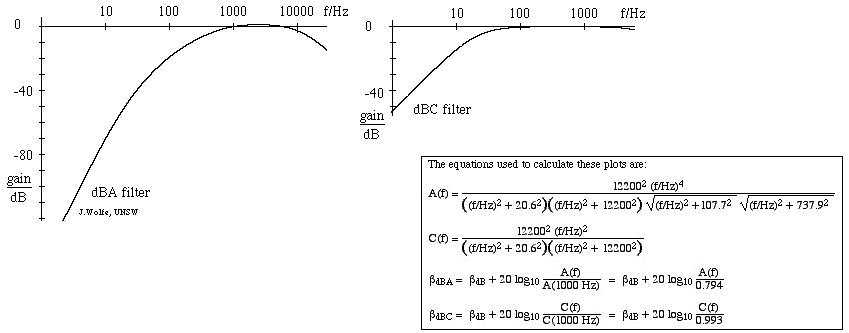
On the music acoustics and speech acoustics sites, we plot the sound spectra in dB. The reason for this common practice is that the range of measured sound pressures is large.
Loudness, phons and sones
-
The
phon is a unit that is related to dB by the
psychophysically measured frequency response of the ear. At 1 kHz, readings in phons and dB are, by definition, the same. For all other frequencies, the phon scale is determined by the results of experiments in which volunteers were asked to adjust the loudness of a signal at a given frequency until they judged its loudness to equal that of a 1 kHz signal. To convert from dB to phons, you need a graph of such results. Such a graph depends on sound level: it becomes flatter at high sound levels.

This graph, courtesy of Lindosland, shows the 2003 data from the International Standards Organisation for curves of equal loudness determined experimentally. Plots of equal loudness as a function of frequency are often generically called Fletcher-Munson curves after the original work by Fletcher, H. and Munson, W.A. (1933) J.Acoust.Soc.Am. 6:59.
The sone is derived from psychophysical measurements which involved volunteers adjusting sounds until they judge them to be twice as loud. This allows one to relate perceived loudness to phons. A sone is defined to be equal to 40 phons. Experimentally it was found that a 10 dB increase in sound level corresponds approximately to a perceived doubling of loudness. So that approximation is used in the definition of the phon: 0.5 sone = 30 phon, 1 sone = 40 phon, 2 sone = 50 phon, 4 sone = 60 phon, etc.

Wouldn't it be great to be able to convert from dB (which can be measured by an instrument) to sones (which approximate loudness as perceived by people)? This is usually done using tables that you can find in acoustics handbooks. However, if you don't mind a rather crude approximation, you can say that the A weighting curve approximates the human frequency response at low to moderate sound levels, so dBA is very roughly the same as phons. Then use the logarithmic relation between sones and phons described above.
Recording level and decibels
-
Meters measuring recording or output level on audio electronic gear (mixing consoles etc) are almost always recording the AC rms voltage (see links to find out about
AC and
rms). For a given resistor R, the power P is V
2/R, so
-
difference in voltage level = 20 log (V
2/V
1) dB = 10 log (V
2
2/V
1
2) dB = 10 log (P
2/P
1) dB, or
absolute voltage level = 20 log (V/Vref)
The obvious level to choose is one volt rms, and in this case the level is written as dBV. This is rational, and also convenient with modern analog-digital cards whose maximum range is often about one volt rms. So one has to remember to the keep the level in negative dBV (less than one volt) to avoid clipping the peaks of the signal, but not too negative (so your signal is still much bigger than the background noise).
Sometimes you will see dBm. This used to mean decibels of electrical power, with respect to one milliwatt, and sometimes it still does. However, it's complicated for historical reasons. In the mid twentieth century, many audio lines had a nominal impedance of 600 Ω. If the impedance is purely resisitive, and if you set V2/600 Ω = 1 mW, then you get V = 0.775 volts. So, providing you were using a 600 Ω load, 1 mW of power was 0 dBm was 0.775 V, and so you calibrated your level meters thus. The problem arose because, once a level meter that measures voltage is calibrated like this, it will read 0 dBm at 0.775 V even if it is not connected to 600 Ω So, perhaps illogically, dBm will sometimes mean dB with respect to 0.775 V. (When I was a boy, calculators were expensive so I used dad's old slide rule, which had the factor 0.775 marked on the cursor window to facilitate such calculations.)
How to convert dBV or dBm into dB of sound level? There is no simple way. It depends on how you convert the electrical power into sound power. Even if your electrical signal is connected directly to a loudspeaker, the conversion will depend on the efficiency and impedance of your loudspeaker. And of course there may be a power amplifier, and various acoustic complications between where you measure the dBV on the mixing desk and where your ears are in the sound field.
-
difference in voltage level = 20 log (V
2/V
1) dB = 10 log (V
2
2/V
1
2) dB = 10 log (P
2/P
1) dB, or
Intensity, radiation and dB

|
Pressure, intensity and specific impedance
-
For acoustic waves, the specific acoustic impedance z is defined as the ratio of the acoustic pressure p to the particle velocity u, z = p/u . In
Acoustic impedance, intensity and power, we show how to relate RMS acoustic pressure p and intensity I:
- I = p 2/z
dBi and radiation that varies with direction
-
Radiation that varies in direction is called
anisotropic. For many cases in communication, isotropic radiation is wasteful: why emit a substantial fraction of power upwards if the receiver is, like you, relatively close to ground level. For sound of short wavelength (including most of the important range for speech), a megaphone can help make your voice more anisotropic. For radio, a wide range of designs allows antennae to be highly anisotropic for both transmission and reception.
So, when you interested in emission in (or reception from) a particular direction, you want the ratio of intensity measured in that direction, at a given distance, to be higher than that measured at the same distance from an isotropic radiator (or received by an isotropic receiver). This ratio is called the gain; express the ratio in dB and you have the gain in dBi for that radiator. This unit is mainly used for antennae, either transmitting and receiving, but it is sometimes used for sound sources (and directional microphones).
Example problems
-
A few people have written asking for examples in using dB in calculations. So...
- All else equal, how much louder is loudspeaker driven (in its linear range) by a 100 W amplifier than by a 10 W amplifier?
The powers differ by a factor of ten, which, as we saw above, is 10 dB. All else equal here means that the frequency responses are equal and that the same input signal is used, etc. So the frequency dependence should be the same. 10 dB corresponds to 10 phons. To get a perceived doubling of loudness, you need an increase of 10 phons. So the speaker driven by the 100 W amplifier is twice as loud as when driven by the 10 W, assuming you stay in the linear range and don't distort or destroy the speaker. (The 100 W amplifier produces twice as many sones as does the 10 W.)
- I am standing at a distance R from a small source of sound (size much less than R), at ground level out in the open where reflections may be neglected. The sound level is L. If I now move to a distance nR (n a number, and nR still much greater than the size of the source), what will be the new sound level?
First, note that the neglect of reflections is very important. This calculation will not work inside a room, where reflections from the wall (collectively producing reverberation) make the calculation quite difficult. Out in the open, the sound intensity is proportional to 1/r2, where r is the distance from the source. (The constant of proportionality depends on how well the ground reflects, and doesn't concern us here, because it will cancel in the calculation.) So, if we increase r from R to nR, we decrease the intensity from I to I/n 2.
The difference in decibels between the two signals of intensity I 2 and I 1 is defined above to be
- ΔL = 10 log (I 2/I 1) = 10 log ((I/n 2)/I) = 10 log (1/n 2) = −10 log (n 2) = −20 log n.
For example, if n is 2 (ie if we go twice as far away), the intensity is reduced by a factor of four and sound level falls from L to (L − 6dB).
- If, in ideal quiet conditions, a young person can hear a 1 kHz tone at 0 dB emitted by a loudspeaker (perhaps a softspeaker?), by how much must the power of the loudspeaker be increased to raise the sound to 110 dB (a dangerously loud but survivable level)?
The difference in decibels between the two signals of power P2 and P1 is defined above to be
-
ΔL = 10 log (P
2/P
1) dB so, raising 10 to the power of these two equal quantities:
10 L/10 = P 2/P 1 so:
P 2/P 1 = 10 110/10 = 10 11 = one hundred thousand million.
-
ΔL = 10 log (P
2/P
1) dB so, raising 10 to the power of these two equal quantities:
- An amplifier has an input of 10 mV and and output of 2 V. What is its voltage gain in dB?
Voltage, like pressure, appears squared in expressions for power or intensity. (The power dissipated in a resistor R is V2/R.) So, by convention, we define:
-
gain = 20 log (V
out/V
in)
= 20 log (2V/10mV)
= 46 dB
(In the acoustic cases given above, we saw that the pressure ratio, expressed in dB, was the same as the power ratio: that was the reason for the factor 20 when defining dB for pressure. It is worth noting that, in the voltage gain example, the power gain of the ampifier is unlikely to equal the voltage gain, which is defined by the convention used here. The power is proportional to the square of the voltage in a given resistor. However, the input and output impedances of amplifiers are often quite different. For instance, a buffer amplifier or emitter follower has a voltage gain of about 1, but a large current gain.)
-
gain = 20 log (V
out/V
in)

 2458


 扫一扫


 被折叠的 条评论
为什么被折叠?
 到【灌水乐园】发言


