


 本文详细解析了Android系统中Crash处理的流程,包括AppErrors.handleAppCrashLocked方法的具体实现,以及ActivityManagerService如何处理崩溃的应用程序。重点介绍了不同情况下系统如何决定重启或终止进程。


极力推荐Android 开发大总结文章:欢迎收藏
Android 开发技术文章大总结
本篇文章主要介绍 Android 开发中的部分知识点,通过阅读本篇文章,您将收获以下内容:
九、 AppErrors.handleAppCrashLocked()
十、UIHandler
十一、 killProcess
十二、小结

本篇文章续接 深入理解 Android 9.0 Crash 机制(一),Crash 之前详细步骤请看上篇文章。
九、 AppErrors.handleAppCrashLocked()
AppErrors.java
1.当同一进程在时间间隔小于1分钟时连续两次Crash,则执行的情况下:
对于非persistent进程:
- [9.1] mStackSupervisor.handleAppCrashLocked(app);
- [9.2] removeProcessLocked(app, false, false, “crash”);
- [9.3] mStackSupervisor.resumeTopActivitiesLocked();
对于persistent进程,则只执行
- [9.3] mStackSupervisor.resumeTopActivitiesLocked();
2.否则执行
- [9.4] mStackSupervisor.finishTopCrashedActivitiesLocked(app, reason);
    boolean handleAppCrashLocked(ProcessRecord app, String reason,
            String shortMsg, String longMsg, String stackTrace, AppErrorDialog.Data data) {
        final long now = SystemClock.uptimeMillis();
        final boolean showBackground = Settings.Secure.getInt(mContext.getContentResolver(),
                Settings.Secure.ANR_SHOW_BACKGROUND, 0) != 0;

        final boolean procIsBoundForeground =
            (app.curProcState == ActivityManager.PROCESS_STATE_BOUND_FOREGROUND_SERVICE);

        Long crashTime;
        Long crashTimePersistent;
        boolean tryAgain = false;

        if (!app.isolated) {
            crashTime = mProcessCrashTimes.get(app.info.processName, app.uid);
            crashTimePersistent = mProcessCrashTimesPersistent.get(app.info.processName, app.uid);
        } else {
            crashTime = crashTimePersistent = null;
        }

        // Bump up the crash count of any services currently running in the proc.
         //运行在当前进程中的所有服务的crash次数操作
        for (int i = app.services.size() - 1; i >= 0; i--) {
            // list 所有的Service
            ServiceRecord sr = app.services.valueAt(i);
            // Service 一会自动起来 重置count 为1,否则+1
            if (now > sr.restartTime + ProcessList.MIN_CRASH_INTERVAL) {
                sr.crashCount = 1;
            } else {
                sr.crashCount++;
            }
            // 允许重启正在Crash的服务以及 前台Service,wallpapers 等
            if (sr.crashCount < mService.mConstants.BOUND_SERVICE_MAX_CRASH_RETRY
                    && (sr.isForeground || procIsBoundForeground)) {
                tryAgain = true;
            }
        }
        //当同一个进程,连续两次crash的时间间隔小于1分钟时,则认为crash太过于频繁
        if (crashTime != null && now < crashTime + ProcessList.MIN_CRASH_INTERVAL) {

            Slog.w(TAG, "Process " + app.info.processName
                    + " has crashed too many times: killing!");
            EventLog.writeEvent(EventLogTags.AM_PROCESS_CRASHED_TOO_MUCH,
                    app.userId, app.info.processName, app.uid);
              //【见小节9.1】
            mService.mStackSupervisor.handleAppCrashLocked(app);
            if (!app.persistent) {

                //不再重启非persistent进程,除非用户显式地调用
                EventLog.writeEvent(EventLogTags.AM_PROC_BAD, app.userId, app.uid,
                        app.info.processName);
                if (!app.isolated) {
                    //将当前app加入到mBadProcesses
                    mBadProcesses.put(app.info.processName, app.uid,
                            new BadProcessInfo(now, shortMsg, longMsg, stackTrace));
                    mProcessCrashTimes.remove(app.info.processName, app.uid);
                }
                app.bad = true;
                app.removed = true;
                //移除非persistent 进程的所有服务,保证不再重启【见小节9.2】
                mService.removeProcessLocked(app, false, tryAgain, "crash");
                 //恢复最顶部的Activity【见小节9.3】
                mService.mStackSupervisor.resumeFocusedStackTopActivityLocked();
                if (!showBackground) {
                    return false;
                }
            }
            mService.mStackSupervisor.resumeFocusedStackTopActivityLocked();
        } else {
             //此处reason="force-crash"【见小节9.4】
            final TaskRecord affectedTask =
                    mService.mStackSupervisor.finishTopRunningActivityLockedfinishTopRunningActivityLocked(app, reason);
            if (data != null) {
                data.task = affectedTask;
            }
            if (data != null && crashTimePersistent != null
                    && now < crashTimePersistent + ProcessList.MIN_CRASH_INTERVAL) {
                data.repeating = true;
            }
        }

        if (data != null && tryAgain) {
            data.isRestartableForService = true;
        }

        //当桌面Home 进程 应用crash,并且被三方app所取代,那么需要清空桌面应用的偏爱选项。
        final ArrayList<ActivityRecord> activities = app.activities;
        if (app == mService.mHomeProcess && activities.size() > 0
                && (mService.mHomeProcess.info.flags & ApplicationInfo.FLAG_SYSTEM) == 0) {
            for (int activityNdx = activities.size() - 1; activityNdx >= 0; --activityNdx) {
                final ActivityRecord r = activities.get(activityNdx);
                if (r.isActivityTypeHome()) {
                    Log.i(TAG, "Clearing package preferred activities from " + r.packageName);
                    try {
                         //清空偏爱应用
                        ActivityThread.getPackageManager()
                                .clearPackagePreferredActivities(r.packageName);
                    } catch (RemoteException c) {
                        // pm is in same process, this will never happen.
                    }
                }
            }
        }

        if (!app.isolated) {
             //无法记录孤立进程的crash时间点,由于他们并没有一个固定身份.
            mProcessCrashTimes.put(app.info.processName, app.uid, now);
            mProcessCrashTimesPersistent.put(app.info.processName, app.uid, now);
        }
         //当app存在crash的handler,那么交给其处理
        if (app.crashHandler != null) mService.mHandler.post(app.crashHandler);
        return true;
    }
9.1 ASS.handleAppCrashLocked
ActivityStackSupervisor.java
   void handleAppCrashLocked(ProcessRecord app) {
        for (int displayNdx = mActivityDisplays.size() - 1; displayNdx >= 0; --displayNdx) {
            final ActivityDisplay display = mActivityDisplays.valueAt(displayNdx);
            for (int stackNdx = display.getChildCount() - 1; stackNdx >= 0; --stackNdx) {
                final ActivityStack stack = display.getChildAt(stackNdx);
                //调用ActivityStack【见小节9.1.1】
                stack.handleAppCrashLocked(app);
            }
        }
    }
9.1.1 AS.handleAppCrashLocked
ActivityStack.java
    void handleAppCrashLocked(ProcessRecord app) {
        for (int taskNdx = mTaskHistory.size() - 1; taskNdx >= 0; --taskNdx) {
            final ArrayList<ActivityRecord> activities = mTaskHistory.get(taskNdx).mActivities;
            for (int activityNdx = activities.size() - 1; activityNdx >= 0; --activityNdx) {
                final ActivityRecord r = activities.get(activityNdx);
                if (r.app == app) {
                    Slog.w(TAG, "  Force finishing activity "
                            + r.intent.getComponent().flattenToShortString());
                    // Force the destroy to skip right to removal.
                    r.app = null;
                    mWindowManager.prepareAppTransition(TRANSIT_CRASHING_ACTIVITY_CLOSE,
                            false /* alwaysKeepCurrent */);
                    //结束当前activity
                    finishCurrentActivityLocked(r, FINISH_IMMEDIATELY, false,
                            "handleAppCrashedLocked");
                }
            }
        }
    }
这里的mTaskHistory数据类型为ArrayList,记录着所有先前的后台activities。遍历所有activities,找到位于该ProcessRecord的所有ActivityRecord,并结束该Acitivity。
9.2 AMS.removeProcessLocked
ActivityManagerService.java
    @GuardedBy("this")
    boolean removeProcessLocked(ProcessRecord app,
            boolean callerWillRestart, boolean allowRestart, String reason) {
        final String name = app.processName;
        final int uid = app.uid;
        if (DEBUG_PROCESSES) Slog.d(TAG_PROCESSES,
            "Force removing proc " + app.toShortString() + " (" + name + "/" + uid + ")");

        ProcessRecord old = mProcessNames.get(name, uid);
        if (old != app) {
            // This process is no longer active, so nothing to do.
            Slog.w(TAG, "Ignoring remove of inactive process: " + app);
            return false;
        }
        //从mProcessNames移除该进程
        removeProcessNameLocked(name, uid);
        if (mHeavyWeightProcess == app) {
            mHandler.sendMessage(mHandler.obtainMessage(CANCEL_HEAVY_NOTIFICATION_MSG,
                    mHeavyWeightProcess.userId, 0));
            mHeavyWeightProcess = null;
        }
        boolean needRestart = false;
        if ((app.pid > 0 && app.pid != MY_PID) || (app.pid == 0 && app.pendingStart)) {
            int pid = app.pid;
            if (pid > 0) {
                synchronized (mPidsSelfLocked) {
                    mPidsSelfLocked.remove(pid);
                    mHandler.removeMessages(PROC_START_TIMEOUT_MSG, app);
                }
                mBatteryStatsService.noteProcessFinish(app.processName, app.info.uid);
                if (app.isolated) {
                    mBatteryStatsService.removeIsolatedUid(app.uid, app.info.uid);
                    getPackageManagerInternalLocked().removeIsolatedUid(app.uid);
                }
            }
            boolean willRestart = false;
              //对于非孤立的persistent进程设置成可重启flags
            if (app.persistent && !app.isolated) {
                if (!callerWillRestart) {
                    willRestart = true;
                } else {
                    needRestart = true;
                }
            }
              // 杀进程【9.2.1】
            app.kill(reason, true);
              //移除进程并清空该进程相关联的activity/service等组件 【9.2.2】
            handleAppDiedLocked(app, willRestart, allowRestart);
            if (willRestart) {
                //此处willRestart=false,不进入该分支
                removeLruProcessLocked(app);
                addAppLocked(app.info, null, false, null /* ABI override */);
            }
        } else {
            mRemovedProcesses.add(app);
        }

        return needRestart;
    }
mProcessNames数据类型为ProcessMap,这是以进程名为key,记录着所有的ProcessRecord信息mPidsSelfLocked数据类型为SparseArray,这是以pid为key,记录着所有的ProcessRecord信息。该对象的同步保护是通过自身锁,而非全局ActivityManager锁。
9.2.1 app.kill
ProcessRecord.java]
void kill(String reason, boolean noisy) {
        //通过am 杀进程
        if (!killedByAm) {

            // 如果不想让am kill 当前进程,可以在这地方跳过
            if (!mService.mAmsExt.shouldKilledByAm(this.processName, reason)) {
                return;
            }

            Trace.traceBegin(Trace.TRACE_TAG_ACTIVITY_MANAGER, "kill");
            if (mService != null && (noisy || info.uid == mService.mCurOomAdjUid)) {
                mService.reportUidInfoMessageLocked(TAG,
                        "Killing " + toShortString() + " (adj " + setAdj + "): " + reason,
                        info.uid);
            }
            if (pid > 0) {
                EventLog.writeEvent(EventLogTags.AM_KILL, userId, pid, processName, setAdj, reason);
                // pid > 0 杀进程以及所在的进程组
                Process.killProcessQuiet(pid);
                ActivityManagerService.killProcessGroup(uid, pid);
            } else {
                pendingStart = false;
            }
            if (!persistent) {
                killed = true;
                killedByAm = true;
            }
            Trace.traceEnd(Trace.TRACE_TAG_ACTIVITY_MANAGER);
        }
    }
此处reason为“crash”.
9.2.2 handleAppDiedLocked
ActivityManagerService.java
  // 通过AM 移除当前存在的进程,不存在,则清除当前进程包含的所有内容
    @GuardedBy("this")
    private final void handleAppDiedLocked(ProcessRecord app,
            boolean restarting, boolean allowRestart) {
        int pid = app.pid;
        final boolean clearLaunchStartTime = !restarting && app.removed && app.foregroundActivities;
        //清除应用中service/receiver/ContentProvider信息
        boolean kept = cleanUpApplicationRecordLocked(app, restarting, allowRestart, -1,
                false /*replacingPid*/);
        if (!kept && !restarting) {
            // 根据LRU 算法移除 app 进程
            removeLruProcessLocked(app);
            if (pid > 0) {
            //从list 移除对应的pid
                ProcessList.remove(pid);
            }
        }

        if (mProfileProc == app) {
            clearProfilerLocked();
        }

        //清除应用中activity相关信息
        boolean hasVisibleActivities = mStackSupervisor.handleAppDiedLocked(app);

        app.clearRecentTasks();

        app.activities.clear();

        if (app.instr != null) {
            Slog.w(TAG, "Crash of app " + app.processName
                  + " running instrumentation " + app.instr.mClass);
            Bundle info = new Bundle();
            info.putString("shortMsg", "Process crashed.");
            finishInstrumentationLocked(app, Activity.RESULT_CANCELED, info);
        }

        mWindowManager.deferSurfaceLayout();
        try {
            if (!restarting && hasVisibleActivities
                    && !mStackSupervisor.resumeFocusedStackTopActivityLocked()) {
                // If there was nothing to resume, and we are not already restarting this process, but
                // there is a visible activity that is hosted by the process...  then make sure all
                // visible activities are running, taking care of restarting this process.

                mStackSupervisor.ensureActivitiesVisibleLocked(null, 0, !PRESERVE_WINDOWS);
            }
        } finally {
            mWindowManager.continueSurfaceLayout();
        }

        // TODO (b/67683350)
        // When an app process is removed, activities from the process may be relaunched. In the
        // case of forceStopPackageLocked the activities are finished before any window is drawn,
        // and the launch time is not cleared. This will be incorrectly used to calculate launch
        // time for the next launched activity launched in the same windowing mode.
        if (clearLaunchStartTime) {
            final LaunchTimeTracker.Entry entry = mStackSupervisor
                    .getLaunchTimeTracker().getEntry(mStackSupervisor.getWindowingMode());
            if (entry != null) {
                entry.mLaunchStartTime = 0;
            }
        }
    }
9.3 ASS.resumeFocusedStackTopActivityLocked
ActivityStackSupervisor.java
    boolean resumeFocusedStackTopActivityLocked() {
        return resumeFocusedStackTopActivityLocked(null, null, null);
    }

    boolean resumeFocusedStackTopActivityLocked(
            ActivityStack targetStack, ActivityRecord target, ActivityOptions targetOptions) {

        if (!readyToResume()) {
            return false;
        }

        if (targetStack != null && isFocusedStack(targetStack)) {
            //【见小节9.3.1】
            return targetStack.resumeTopActivityUncheckedLocked(target, targetOptions);
        }

        final ActivityRecord r = mFocusedStack.topRunningActivityLocked();
        if (r == null || !r.isState(RESUMED)) {
            mFocusedStack.resumeTopActivityUncheckedLocked(null, null);
        } else if (r.isState(RESUMED)) {
            // Kick off any lingering app transitions form the MoveTaskToFront operation.
            mFocusedStack.executeAppTransition(targetOptions);
        }

        return false;
    }
9.3.1 AS.resumeTopActivityLocked
ActivityStack.java
  //确保 top Activity 在resumed 状态
    // 最好使用ActivityStackSupervisor#ActivityStackSupervisor#resumeFocusedStackTopActivityLockedActivityStackSupervisor#resumeFocusedStackTopActivityLocked 待替此方法
    boolean resumeTopActivityUncheckedLocked(ActivityRecord prev, ActivityOptions options) {
        if (mStackSupervisor.inResumeTopActivity) {
            // Don't even start recursing.
            return false;
        }

        boolean result = false;
        try {
            // Protect against recursion.
            mStackSupervisor.inResumeTopActivity = true;
            result = resumeTopActivityInnerLocked(prev, options);

            // When resuming the top activity, it may be necessary to pause the top activity (for
            // example, returning to the lock screen. We suppress the normal pause logic in
            // {@link #resumeTopActivityUncheckedLocked}, since the top activity is resumed at the
            // end. We call the {@link ActivityStackSupervisor#checkReadyForSleepLocked} again here
            // to ensure any necessary pause logic occurs. In the case where the Activity will be
            // shown regardless of the lock screen, the call to
            // {@link ActivityStackSupervisor#checkReadyForSleepLocked} is skipped.
            final ActivityRecord next = topRunningActivityLocked(true /* focusableOnly */);
            if (next == null || !next.canTurnScreenOn()) {
                checkReadyForSleep();
            }
        } finally {
            mStackSupervisor.inResumeTopActivity = false;
        }

        return result;
    }
9.4 finishTopCrashedActivitiesLocked
ActivityStackSupervisor.java
     //Finish the topmost activities in all stacks that belong to the crashed app
    TaskRecord finishTopCrashedActivitiesLocked(ProcessRecord app, String reason) {
        TaskRecord finishedTask = null;
        ActivityStack focusedStack = getFocusedStack();
        for (int displayNdx = mActivityDisplays.size() - 1; displayNdx >= 0; --displayNdx) {
            final ActivityDisplay display = mActivityDisplays.valueAt(displayNdx);
            // It is possible that request to finish activity might also remove its task and stack,
            // so we need to be careful with indexes in the loop and check child count every time.
            for (int stackNdx = 0; stackNdx < display.getChildCount(); ++stackNdx) {
                final ActivityStack stack = display.getChildAt(stackNdx);
                ////此处reason= "force-crash" 见小节9.4.1
                final TaskRecord t = stack.finishTopCrashedActivityLocked(app, reason);
                if (stack == focusedStack || finishedTask == null) {
                    finishedTask = t;
                }
            }
        }
        return finishedTask;
    }
9.4.1AS.finishTopCrashedActivityLocked
ActivityStack.java
   /**
     * Finish the topmost activity that belongs to the crashed app. We may also finish the activity
     * that requested launch of the crashed one to prevent launch-crash loop.
     */
    final TaskRecord finishTopCrashedActivityLocked(ProcessRecord app, String reason) {
        ActivityRecord r = topRunningActivityLocked();
        TaskRecord finishedTask = null;
        if (r == null || r.app != app) {
            return null;
        }
        Slog.w(TAG, "  Force finishing activity "
                + r.intent.getComponent().flattenToShortString());
        finishedTask = r.getTask();
        int taskNdx = mTaskHistory.indexOf(finishedTask);
        final TaskRecord task = finishedTask;
        int activityNdx = task.mActivities.indexOf(r);
        mWindowManager.prepareAppTransition(TRANSIT_CRASHING_ACTIVITY_CLOSE,
                false /* alwaysKeepCurrent */);
        // 见小结 9.4.2
        finishActivityLocked(r, Activity.RESULT_CANCELED, null, reason, false);
        finishedTask = task;
        // Also terminate any activities below it that aren't yet
        // stopped, to avoid a situation where one will get
        // re-start our crashing activity once it gets resumed again.
        --activityNdx;
        if (activityNdx < 0) {
            do {
                --taskNdx;
                if (taskNdx < 0) {
                    break;
                }
                activityNdx = mTaskHistory.get(taskNdx).mActivities.size() - 1;
            } while (activityNdx < 0);
        }
        if (activityNdx >= 0) {
            r = mTaskHistory.get(taskNdx).mActivities.get(activityNdx);
            if (r.isState(RESUMED, PAUSING, PAUSED)) {
                if (!r.isActivityTypeHome() || mService.mHomeProcess != r.app) {
                    Slog.w(TAG, "  Force finishing activity "
                            + r.intent.getComponent().flattenToShortString());
                    finishActivityLocked(r, Activity.RESULT_CANCELED, null, reason, false);
                }
            }
        }
        return finishedTask;
    }
9.4.2 AS.finishActivityLocked
ActivityStack.java
 /**
     * See {@link #finishActivityLocked(ActivityRecord, int, Intent, String, boolean, boolean)}
     */
    final boolean finishActivityLocked(ActivityRecord r, int resultCode, Intent resultData,
            String reason, boolean oomAdj) {
        return finishActivityLocked(r, resultCode, resultData, reason, oomAdj, !PAUSE_IMMEDIATELY);
    }

    /**
     * @return Returns true if this activity has been removed from the history
     * list, or false if it is still in the list and will be removed later.
     */
    final boolean finishActivityLocked(ActivityRecord r, int resultCode, Intent resultData,
            String reason, boolean oomAdj, boolean pauseImmediately) {
        if (r.finishing) {
            Slog.w(TAG, "Duplicate finish request for " + r);
            return false;
        }

        mWindowManager.deferSurfaceLayout();
        try {
             //设置finish状态的activity不可见
            r.makeFinishingLocked();
            final TaskRecord task = r.getTask();
            EventLog.writeEvent(EventLogTags.AM_FINISH_ACTIVITY,
                    r.userId, System.identityHashCode(r),
                    task.taskId, r.shortComponentName, reason);
            final ArrayList<ActivityRecord> activities = task.mActivities;
            final int index = activities.indexOf(r);
            if (index < (activities.size() - 1)) {
                task.setFrontOfTask();
                if ((r.intent.getFlags() & Intent.FLAG_ACTIVITY_CLEAR_WHEN_TASK_RESET) != 0) {
                    // If the caller asked that this activity (and all above it)
                    // be cleared when the task is reset, don't lose that information,
                    // but propagate it up to the next activity.
                    ActivityRecord next = activities.get(index+1);
                    next.intent.addFlags(Intent.FLAG_ACTIVITY_CLEAR_WHEN_TASK_RESET);
                }
            }
              //暂停key的分发事件
            r.pauseKeyDispatchingLocked();

            adjustFocusedActivityStack(r, "finishActivity");

            finishActivityResultsLocked(r, resultCode, resultData);

            final boolean endTask = index <= 0 && !task.isClearingToReuseTask();
            final int transit = endTask ? TRANSIT_TASK_CLOSE : TRANSIT_ACTIVITY_CLOSE;
            if (mResumedActivity == r) {
                if (DEBUG_VISIBILITY || DEBUG_TRANSITION) Slog.v(TAG_TRANSITION,
                        "Prepare close transition: finishing " + r);
                if (endTask) {
                    mService.mTaskChangeNotificationController.notifyTaskRemovalStarted(
                            task.taskId);
                }
                mWindowManager.prepareAppTransition(transit, false);

                // Tell window manager to prepare for this one to be removed.
                r.setVisibility(false);

                if (mPausingActivity == null) {
                    if (DEBUG_PAUSE) Slog.v(TAG_PAUSE, "Finish needs to pause: " + r);
                    if (DEBUG_USER_LEAVING) Slog.v(TAG_USER_LEAVING,
                            "finish() => pause with userLeaving=false");
                    //回调activity的onPause方法
                    startPausingLocked(false, false, null, pauseImmediately);

                    /// M: onBeforeActivitySwitch @{
                    ActivityRecord nextResumedActivity =
                            mStackSupervisor.getFocusedStack().topRunningActivityLocked();
                    if (nextResumedActivity != null) {
                        mService.mAmsExt.onBeforeActivitySwitch(
                                mService.mLastResumedActivity,
                                nextResumedActivity, true, nextResumedActivity.getActivityType());
                    }
                    /// M: onBeforeActivitySwitch @}
                }

                if (endTask) {
                    mService.getLockTaskController().clearLockedTask(task);
                }
            } else if (!r.isState(PAUSING)) {
                // If the activity is PAUSING, we will complete the finish once
                // it is done pausing; else we can just directly finish it here.
                if (DEBUG_PAUSE) Slog.v(TAG_PAUSE, "Finish not pausing: " + r);
                if (r.visible) {
                    prepareActivityHideTransitionAnimation(r, transit);
                }

                final int finishMode = (r.visible || r.nowVisible) ? FINISH_AFTER_VISIBLE
                        : FINISH_AFTER_PAUSE;
                final boolean removedActivity = finishCurrentActivityLocked(r, finishMode, oomAdj,
                        "finishActivityLocked") == null;

                // The following code is an optimization. When the last non-task overlay activity
                // is removed from the task, we remove the entire task from the stack. However,
                // since that is done after the scheduled destroy callback from the activity, that
                // call to change the visibility of the task overlay activities would be out of
                // sync with the activitiy visibility being set for this finishing activity above.
                // In this case, we can set the visibility of all the task overlay activities when
                // we detect the last one is finishing to keep them in sync.
                if (task.onlyHasTaskOverlayActivities(true /* excludeFinishing */)) {
                    for (ActivityRecord taskOverlay : task.mActivities) {
                        if (!taskOverlay.mTaskOverlay) {
                            continue;
                        }
                        prepareActivityHideTransitionAnimation(taskOverlay, transit);
                    }
                }
                return removedActivity;
            } else {
                if (DEBUG_PAUSE) Slog.v(TAG_PAUSE, "Finish waiting for pause of: " + r);
            }

            return false;
        } finally {
            mWindowManager.continueSurfaceLayout();
        }
    }
十、UIHandler
通过mUiHandler发送message,且消息的msg.waht=SHOW_ERROR_MSG,接下来进入UiHandler来看看handleMessage的处理过程。
ActivityManagerService.java
final class UiHandler extends Handler {
    public void handleMessage(Message msg) {
        switch (msg.what) {
        case SHOW_ERROR_MSG: {
           HashMap<String, Object> data = (HashMap<String, Object>) msg.obj;
           synchronized (ActivityManagerService.this) {
               ProcessRecord proc = (ProcessRecord)data.get("app");
               AppErrorResult res = (AppErrorResult) data.get("result");
              、
               boolean isBackground = (UserHandle.getAppId(proc.uid)
                       >= Process.FIRST_APPLICATION_UID
                       && proc.pid != MY_PID);
                ...

               if (mShowDialogs && !mSleeping && !mShuttingDown) {
                   //创建提示crash对话框,等待用户选择,5分钟操作等待。
                   Dialog d = new AppErrorDialog(mContext,
                           ActivityManagerService.this, res, proc);
                   d.show();
                   proc.crashDialog = d;
               } else {
                   //当处于sleep状态,则默认选择退出。
                   if (res != null) {
                       res.set(0);
                   }
               }
           }
        } break;
        ...
    }
}
在发生Crash时,默认系统会弹出提示crash的对话框,并阻塞等待用户选择是“退出”或 “退出并报告”,当用户不做任何选择时5min超时后,默认选择“退出”,当手机休眠时也默认选择“退出”。到这里也并没有真正结束,在小节2.uncaughtException中在finnally语句块还有一个杀进程的动作。
十一 、 killProcess
Process.killProcess(Process.myPid());
System.exit(10);
通过finnally语句块保证能执行并彻底杀掉Crash进程。当Crash进程被杀后,并没有完全结束,还有Binder死亡通知的流程还没有处理完成
十二、小结
当进程抛出未捕获异常时,则系统会处理该异常并进入Crash处理流程。
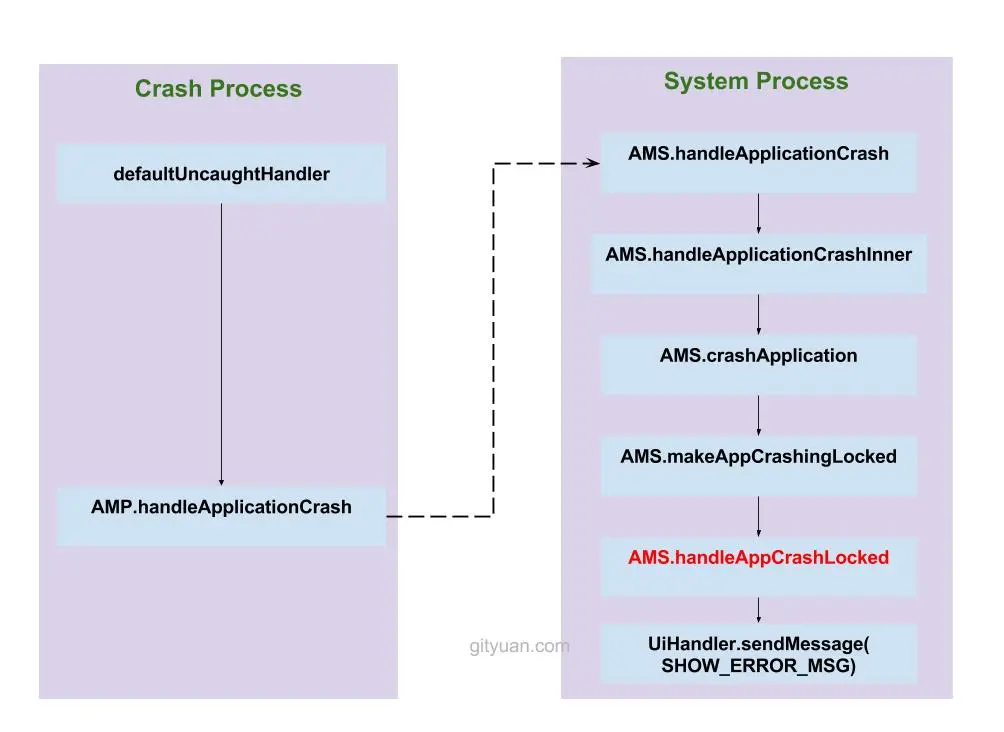
Crash处理流程
其中最为核心的工作图中红色部分AMS.handleAppCrashLocked的主要功能:
- 当同一进程1分钟之内连续两次
Crash,则执行的情况下:
对于非persistent进程:
-ASS.handleAppCrashLocked, 直接结束该应用所有activity
AMS.removeProcessLocked,杀死该进程以及同一个进程组下的所有进
-ASS.resumeTopActivitiesLocked,恢复栈顶第一个非finishing状态的activity
对于persistent进程,则只执行
ASS.resumeTopActivitiesLocked,恢复栈顶第一个非finishing状态的activity
2.否则,当进程没连续频繁crash
ASS.finishTopRunningActivityLocked,执行结束栈顶正在运行activity
另外,AMS.handleAppCrashLocked,该方法内部主要调用链,如下:
AMS.handleAppCrashLocked
   ASS.handleAppCrashLocked
       AS.handleAppCrashLocked
           AS.finishCurrentActivityLocked
   AMS.removeProcessLocked
       ProcessRecord.kill
       AMS.handleAppDiedLocked
           ASS.handleAppDiedLocked
               AMS.cleanUpApplicationRecordLocked
               AS.handleAppDiedLocked
                   AS.removeHistoryRecordsForAppLocked

   ASS.resumeTopActivitiesLocked
       AS.resumeTopActivityLocked
           AS.resumeTopActivityInnerLocked
   ASS.finishTopRunningActivityLocked
       AS.finishTopRunningActivityLocked
           AS.finishActivityLocked


长按识别二维码,领福利
至此,本篇已结束,如有不对的地方,欢迎您的建议与指正。同时期待您的关注,感谢您的阅读,谢谢!

如有侵权,请联系小编,小编对此深感抱歉,届时小编会删除文章,立即停止侵权行为,请您多多包涵。

小礼物走一走,来简书关注我





 扫一扫
扫一扫


 1万+
1万+

 被折叠的 条评论
为什么被折叠?
被折叠的 条评论
为什么被折叠?
 到【灌水乐园】发言





