


理论部分请看自适应矩形卷积(ARConv):突破传统卷积限制的创新设计_arconv routing function-优快云博客
ARConv相比传统的模块,在传入输入X时还需要再传入一个迭代的轮数,因此其他即插即用的模块,与yolov13结合需要更多的调整,本文将重点讲解需额外调整的内容,全部实现代码见文末百度网盘连接
目录
一、如何传递epoch
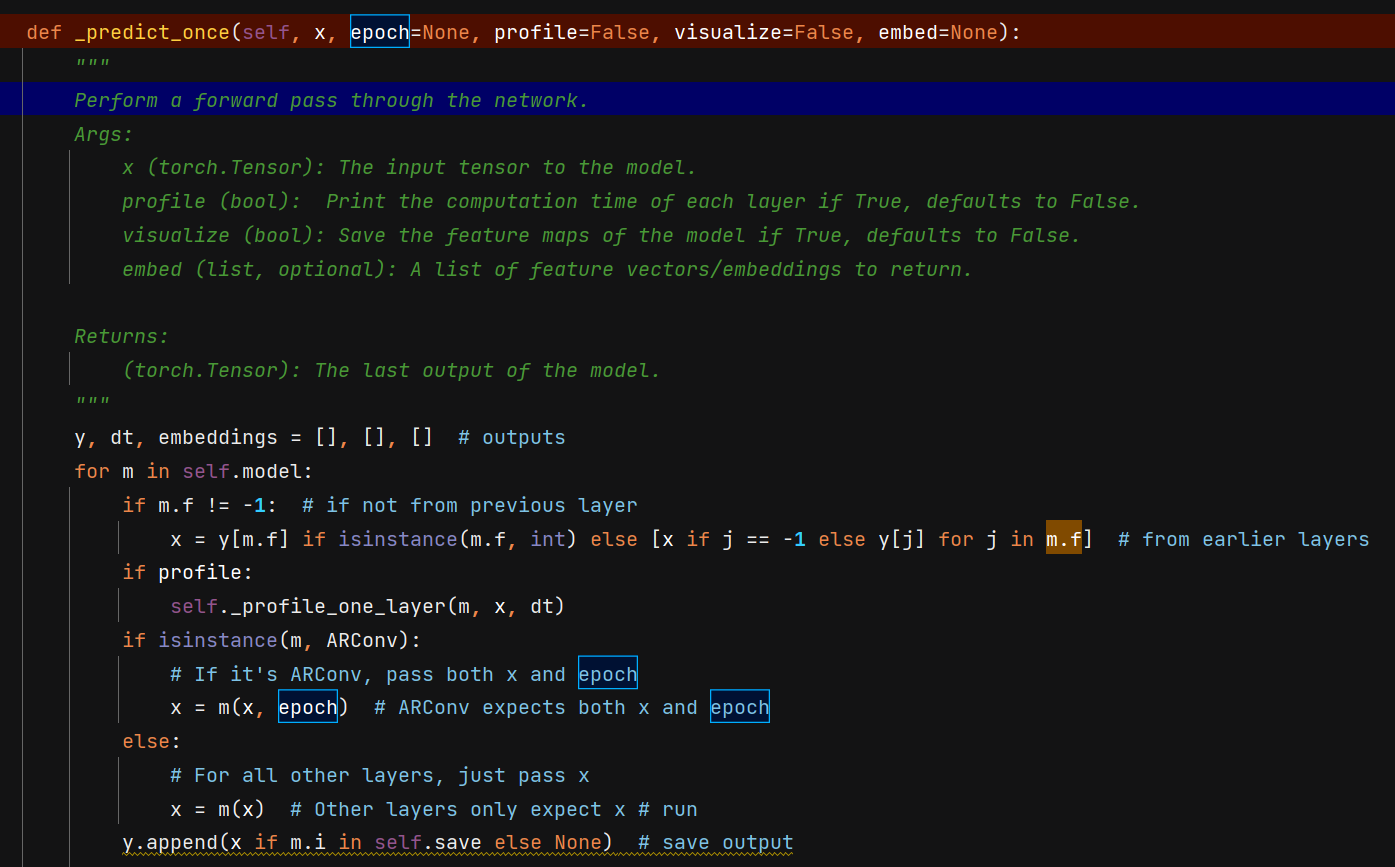
定位到ultralytics/nn/tasks.py中函数_predict_once
增加epoch输入
    def _predict_once(self, x, epoch=None, profile=False, visualize=False, embed=None):
        """
        Perform a forward pass through the network.

        Args:
            x (torch.Tensor): The input tensor to the model.
            profile (bool):  Print the computation time of each layer if True, defaults to False.
            visualize (bool): Save the feature maps of the model if True, defaults to False.
            embed (list, optional): A list of feature vectors/embeddings to return.

        Returns:
            (torch.Tensor): The last output of the model.
        """
        y, dt, embeddings = [], [], []  # outputs
        for m in self.model:
            if m.f != -1:  # if not from previous layer
                x = y[m.f] if isinstance(m.f, int) else [x if j == -1 else y[j] for j in m.f]  # from earlier layers
            if profile:
                self._profile_one_layer(m, x, dt)
            if isinstance(m, ARConv):
                # If it's ARConv, pass both x and epoch
                x = m(x, epoch)  # ARConv expects both x and epoch
            else:
                # For all other layers, just pass x
                x = m(x)  # Other layers only expect x # run
            y.append(x if m.i in self.save else None)  # save output
            if visualize:
                feature_visualization(x, m.type, m.i, save_dir=visualize)
            if embed and m.i in embed:
                embeddings.append(nn.functional.adaptive_avg_pool2d(x, (1, 1)).squeeze(-1).squeeze(-1))  # flatten
                if m.i == max(embed):
                    return torch.unbind(torch.cat(embeddings, 1), dim=0)
        return x
如下图
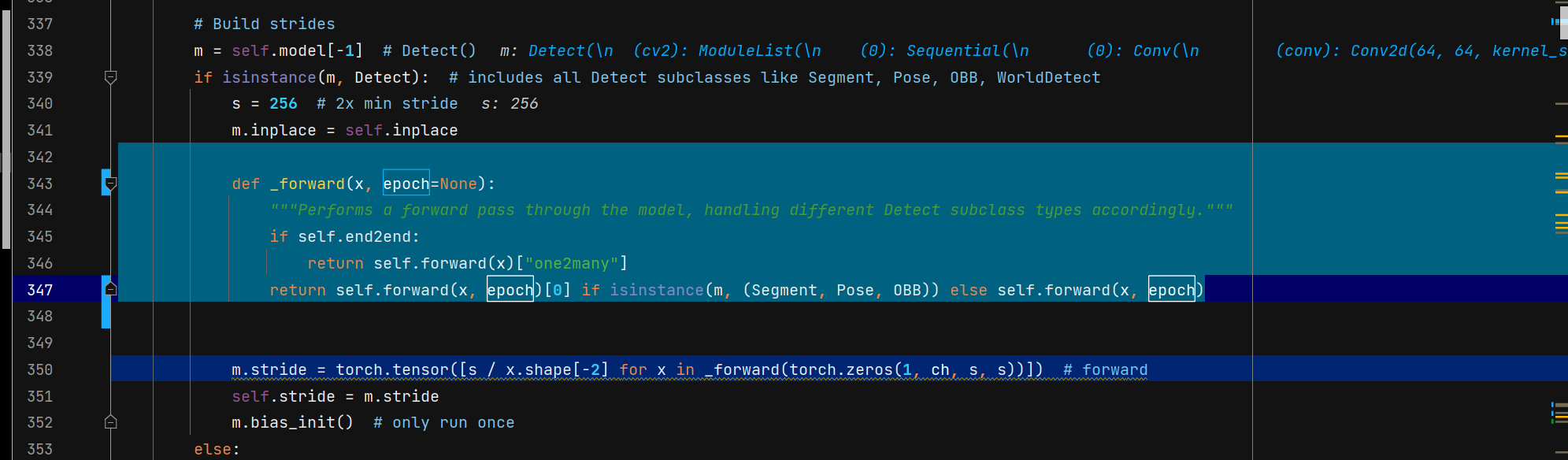
定位到ultralytics/nn/tasks.py,DetectionModel类的__init__函数
增加epoch输入
            def _forward(x, epoch=None):
                """Performs a forward pass through the model, handling different Detect subclass types accordingly."""
                if self.end2end:
                    return self.forward(x)["one2many"]
                return self.forward(x, epoch)[0] if isinstance(m, (Segment, Pose, OBB)) else self.forward(x, epoch)
如下图
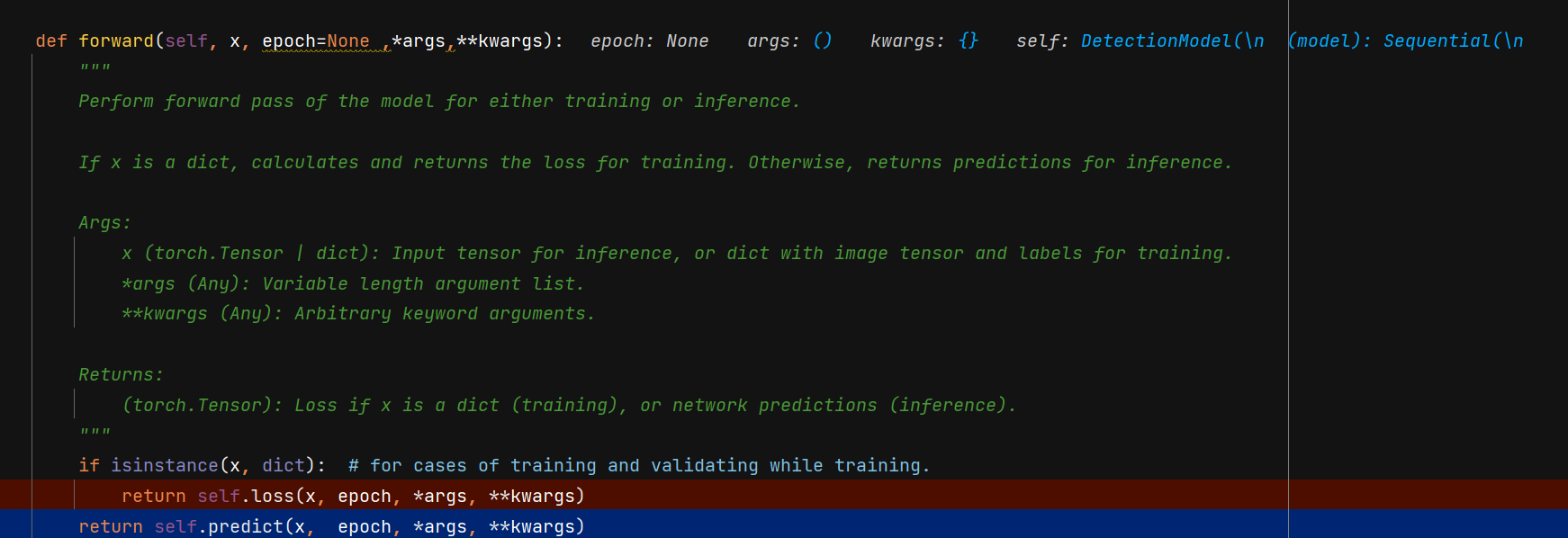
定位到ultralytics/nn/tasks.py,BaseModel类的forward函数、增加epoch输入
    def forward(self, x, epoch=None ,*args,**kwargs):
        """
        Perform forward pass of the model for either training or inference.

        If x is a dict, calculates and returns the loss for training. Otherwise, returns predictions for inference.

        Args:
            x (torch.Tensor | dict): Input tensor for inference, or dict with image tensor and labels for training.
            *args (Any): Variable length argument list.
            **kwargs (Any): Arbitrary keyword arguments.

        Returns:
            (torch.Tensor): Loss if x is a dict (training), or network predictions (inference).
        """
        if isinstance(x, dict):  # for cases of training and validating while training.
            return self.loss(x, epoch, *args, **kwargs)
        return self.predict(x,  epoch, *args, **kwargs)
如下图
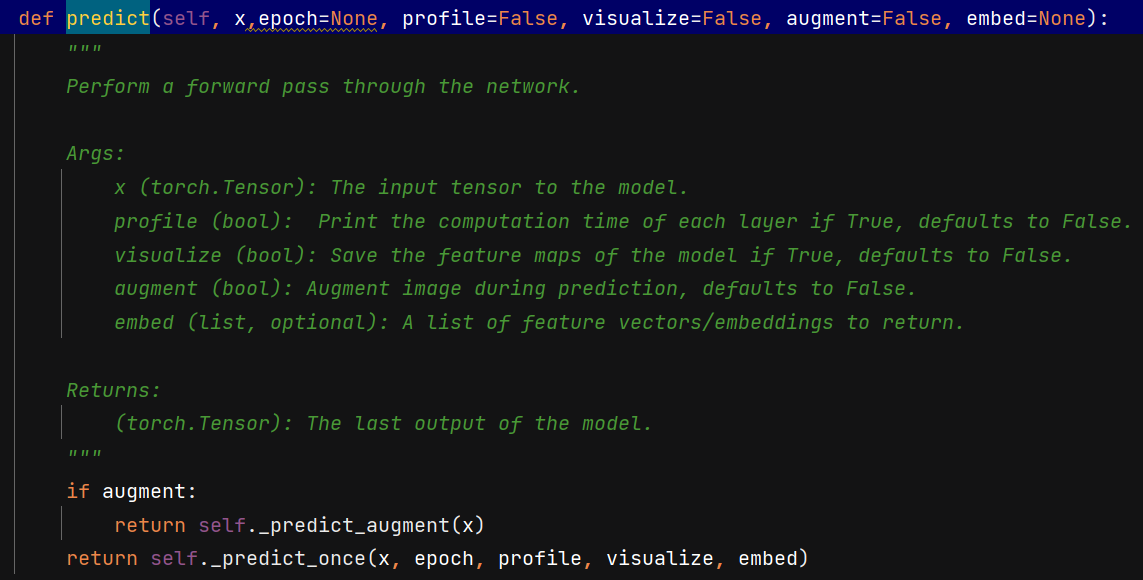
定位到ultralytics/nn/tasks.py,BaseModel类的predict函数、增加epoch输入
    def predict(self, x,epoch=None, profile=False, visualize=False, augment=False, embed=None):
        """
        Perform a forward pass through the network.

        Args:
            x (torch.Tensor): The input tensor to the model.
            profile (bool):  Print the computation time of each layer if True, defaults to False.
            visualize (bool): Save the feature maps of the model if True, defaults to False.
            augment (bool): Augment image during prediction, defaults to False.
            embed (list, optional): A list of feature vectors/embeddings to return.

        Returns:
            (torch.Tensor): The last output of the model.
        """
        if augment:
            return self._predict_augment(x)
        return self._predict_once(x, epoch, profile, visualize, embed)
如下图
二、添加arconv模块
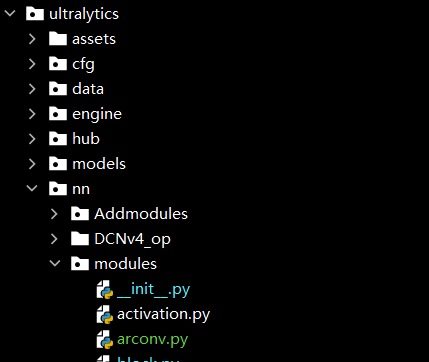
arconv.py代码如下
import torch
import torch.nn as nn


class ARConv(nn.Module):
    def __init__(self, inc, outc, kernel_size=3, padding=1, stride=1, l_max=9, w_max=9, flag=False, modulation=True):
        super(ARConv, self).__init__()
        self.lmax = l_max
        self.wmax = w_max
        self.inc = inc
        self.outc = outc
        self.kernel_size = kernel_size
        self.padding = padding
        self.stride = stride
        self.zero_padding = nn.ZeroPad2d(padding)
        self.flag = flag
        self.modulation = modulation
        self.i_list = [33, 35, 53, 37, 73, 55, 57, 75, 77]
        self.convs = nn.ModuleList(
            [
                nn.Conv2d(inc, outc, kernel_size=(i // 10, i % 10), stride=(i // 10, i % 10), padding=0)
                for i in self.i_list
            ]
        )
        self.m_conv = nn.Sequential(
            nn.Conv2d(inc, outc, kernel_size=3, padding=1, stride=stride),
            nn.LeakyReLU(),
            nn.Dropout2d(0.3),
            nn.Conv2d(outc, outc, kernel_size=3, padding=1, stride=stride),
            nn.LeakyReLU(),
            nn.Dropout2d(0.3),
            nn.Conv2d(outc, outc, kernel_size=3, padding=1, stride=stride),
            nn.Tanh()
        )
        self.b_conv = nn.Sequential(
            nn.Conv2d(inc, outc, kernel_size=3, padding=1, stride=stride),
            nn.LeakyReLU(),
            nn.Dropout2d(0.3),
            nn.Conv2d(outc, outc, kernel_size=3, padding=1, stride=stride),
            nn.LeakyReLU(),
            nn.Dropout2d(0.3),
            nn.Conv2d(outc, outc, kernel_size=3, padding=1, stride=stride)
        )
        self.p_conv = nn.Sequential(
            nn.Conv2d(inc, inc, kernel_size=3, padding=1, stride=stride),
            nn.BatchNorm2d(inc),
            nn.LeakyReLU(),
            nn.Dropout2d(0),
            nn.Conv2d(inc, inc, kernel_size=3, padding=1, stride=stride),
            nn.BatchNorm2d(inc),
            nn.LeakyReLU(),
        )
        self.l_conv = nn.Sequential(
            nn.Conv2d(inc, 1, kernel_size=3, padding=1, stride=stride),
            nn.BatchNorm2d(1),
            nn.LeakyReLU(),
            nn.Dropout2d(0),
            nn.Conv2d(1, 1, 1),
            nn.BatchNorm2d(1),
            nn.Sigmoid()
        )
        self.w_conv = nn.Sequential(
            nn.Conv2d(inc, 1, kernel_size=3, padding=1, stride=stride),
            nn.BatchNorm2d(1),
            nn.LeakyReLU(),
            nn.Dropout2d(0),
            nn.Conv2d(1, 1, 1),
            nn.BatchNorm2d(1),
            nn.Sigmoid()
        )
        self.dropout1 = nn.Dropout(0.3)
        self.dropout2 = nn.Dropout2d(0.3)
        # self.hook_handles = []
        # self.hook_handles.append(self.m_conv[0].register_full_backward_hook(self._set_lr))
        # self.hook_handles.append(self.m_conv[1].register_full_backward_hook(self._set_lr))
        # self.hook_handles.append(self.b_conv[0].register_full_backward_hook(self._set_lr))
        # self.hook_handles.append(self.b_conv[1].register_full_backward_hook(self._set_lr))
        # self.hook_handles.append(self.p_conv[0].register_full_backward_hook(self._set_lr))
        # self.hook_handles.append(self.p_conv[1].register_full_backward_hook(self._set_lr))
        # self.hook_handles.append(self.l_conv[0].register_full_backward_hook(self._set_lr))
        # self.hook_handles.append(self.l_conv[1].register_full_backward_hook(self._set_lr))
        # self.hook_handles.append(self.w_conv[0].register_full_backward_hook(self._set_lr))
        # self.hook_handles.append(self.w_conv[1].register_full_backward_hook(self._set_lr))

        self.reserved_NXY = nn.Parameter(torch.tensor([3, 3], dtype=torch.int32), requires_grad=False)

    # @staticmethod
    # def _set_lr(module, grad_input, grad_output):
    #     grad_input = tuple(g * 0.1 if g is not None else None for g in grad_input)
    #     grad_output = tuple(g * 0.1 if g is not None else None for g in grad_output)
    #     return grad_input
    #
    # def remove_hooks(self):
    #     for handle in self.hook_handles:
    #         handle.remove()  # 移除钩子函数
    #     self.hook_handles.clear()  # 清空句柄列表

    def forward(self, x, epoch):
        hw_range = [1, 18]
        assert isinstance(hw_range, list) and len(
            hw_range) == 2, "hw_range should be a list with 2 elements, represent the range of h w"
        scale = hw_range[1] // 9
        if hw_range[0] == 1 and hw_range[1] == 3:
            scale = 1
        m = self.m_conv(x)
        bias = self.b_conv(x)
        offset = self.p_conv(x * 100)
        l = self.l_conv(offset) * (hw_range[1] - 1) + 1  # b, 1, h, w
        w = self.w_conv(offset) * (hw_range[1] - 1) + 1  # b, 1, h, w
        if isinstance(epoch, int) and self.training and epoch <= 100 :

            mean_l = l.mean(dim=0).mean(dim=1).mean(dim=1)
            mean_w = w.mean(dim=0).mean(dim=1).mean(dim=1)
            N_X = int(mean_l // scale)
            N_Y = int(mean_w // scale)

            def phi(x):
                if x % 2 == 0:
                    x -= 1
                return x

            N_X, N_Y = phi(N_X), phi(N_Y)
            N_X, N_Y = max(N_X, 3), max(N_Y, 3)
            N_X, N_Y = min(N_X, 7), min(N_Y, 7)
            if epoch == 100:
                self.reserved_NXY = self.reserved_NXY = nn.Parameter(
                    torch.tensor([N_X, N_Y], dtype=torch.int32, device=x.device),
                    requires_grad=False
                )

        else:
            N_X = self.reserved_NXY[0]
            N_Y = self.reserved_NXY[1]

        N = N_X * N_Y
        l = l.repeat([1, N, 1, 1])
        w = w.repeat([1, N, 1, 1])
        offset = torch.cat((l, w), dim=1)

        dtype = offset.data.type()
        if self.padding:
            x = self.zero_padding(x)
        p = self._get_p(offset, dtype, N_X, N_Y)  # (b, 2*N, h, w)
        p = p.contiguous().permute(0, 2, 3, 1)  # (b, h, w, 2*N)
        q_lt = p.detach().floor()
        q_rb = q_lt + 1
        q_lt = torch.cat(
            [
                torch.clamp(q_lt[..., :N], 0, x.size(2) - 1),
                torch.clamp(q_lt[..., N:], 0, x.size(3) - 1),
            ],
            dim=-1,
        ).long()
        q_rb = torch.cat(
            [
                torch.clamp(q_rb[..., :N], 0, x.size(2) - 1),
                torch.clamp(q_rb[..., N:], 0, x.size(3) - 1),
            ],
            dim=-1,
        ).long()
        q_lb = torch.cat([q_lt[..., :N], q_rb[..., N:]], dim=-1)
        q_rt = torch.cat([q_rb[..., :N], q_lt[..., N:]], dim=-1)
        # clip p
        p = torch.cat(
            [
                torch.clamp(p[..., :N], 0, x.size(2) - 1),
                torch.clamp(p[..., N:], 0, x.size(3) - 1),
            ],
            dim=-1,
        )
        # bilinear kernel (b, h, w, N)
        g_lt = (1 + (q_lt[..., :N].type_as(p) - p[..., :N])) * (
                1 + (q_lt[..., N:].type_as(p) - p[..., N:])
        )
        g_rb = (1 - (q_rb[..., :N].type_as(p) - p[..., :N])) * (
                1 - (q_rb[..., N:].type_as(p) - p[..., N:])
        )
        g_lb = (1 + (q_lb[..., :N].type_as(p) - p[..., :N])) * (
                1 - (q_lb[..., N:].type_as(p) - p[..., N:])
        )
        g_rt = (1 - (q_rt[..., :N].type_as(p) - p[..., :N])) * (
                1 + (q_rt[..., N:].type_as(p) - p[..., N:])
        )
        # (b, c, h, w, N)
        x_q_lt = self._get_x_q(x, q_lt, N)
        x_q_rb = self._get_x_q(x, q_rb, N)
        x_q_lb = self._get_x_q(x, q_lb, N)
        x_q_rt = self._get_x_q(x, q_rt, N)
        # (b, c, h, w, N)
        x_offset = (
                g_lt.unsqueeze(dim=1) * x_q_lt
                + g_rb.unsqueeze(dim=1) * x_q_rb
                + g_lb.unsqueeze(dim=1) * x_q_lb
                + g_rt.unsqueeze(dim=1) * x_q_rt
        )
        x_offset = self._reshape_x_offset(x_offset, N_X, N_Y)
        x_offset = self.dropout2(x_offset)
        x_offset = self.convs[self.i_list.index(N_X * 10 + N_Y)](x_offset)
        out = x_offset * m + bias
        return out

    def _get_p_n(self, N, dtype, n_x, n_y):
        p_n_x, p_n_y = torch.meshgrid(
            torch.arange(-(n_x - 1) // 2, (n_x - 1) // 2 + 1),
            torch.arange(-(n_y - 1) // 2, (n_y - 1) // 2 + 1),
        )
        p_n = torch.cat([torch.flatten(p_n_x), torch.flatten(p_n_y)], 0)
        p_n = p_n.view(1, 2 * N, 1, 1).type(dtype)
        return p_n

    def _get_p_0(self, h, w, N, dtype):
        p_0_x, p_0_y = torch.meshgrid(
            torch.arange(1, h * self.stride + 1, self.stride),
            torch.arange(1, w * self.stride + 1, self.stride),
        )
        p_0_x = torch.flatten(p_0_x).view(1, 1, h, w).repeat(1, N, 1, 1)
        p_0_y = torch.flatten(p_0_y).view(1, 1, h, w).repeat(1, N, 1, 1)
        p_0 = torch.cat([p_0_x, p_0_y], 1).type(dtype)
        return p_0

    def _get_p(self, offset, dtype, n_x, n_y):
        N, h, w = offset.size(1) // 2, offset.size(2), offset.size(3)
        L, W = offset.split([N, N], dim=1)
        L = L / n_x
        W = W / n_y
        offsett = torch.cat([L, W], dim=1)
        p_n = self._get_p_n(N, dtype, n_x, n_y)
        p_n = p_n.repeat([1, 1, h, w])
        p_0 = self._get_p_0(h, w, N, dtype)
        p = p_0 + offsett * p_n
        return p

    def _get_x_q(self, x, q, N):
        b, h, w, _ = q.size()
        padded_w = x.size(3)
        c = x.size(1)
        x = x.contiguous().view(b, c, -1)
        index = q[..., :N] * padded_w + q[..., N:]
        index = (
            index.contiguous()
                .unsqueeze(dim=1)
                .expand(-1, c, -1, -1, -1)
                .contiguous()
                .view(b, c, -1)
        )
        x_offset = x.gather(dim=-1, index=index).contiguous().view(b, c, h, w, N)
        return x_offset

    @staticmethod
    def _reshape_x_offset(x_offset, n_x, n_y):
        b, c, h, w, N = x_offset.size()
        x_offset = torch.cat([x_offset[..., s:s + n_y].contiguous().view(b, c, h, w * n_y) for s in range(0, N, n_y)],
                             dim=-1)
        x_offset = x_offset.contiguous().view(b, c, h * n_x, w * n_y)
        return x_offset
三、注册ARConv
定位到ultralytics/nn/tasks.py
导入模块


四、配置模型yaml
nc: 80 # number of classes scales: # model compound scaling constants, i.e. 'model=yolov13n.yaml' will call yolov13.yaml with scale 'n' # [depth, width, max_channels] n: [0.50, 0.25, 1024] # Nano s: [0.50, 0.50, 1024] # Small l: [1.00, 1.00, 512] # Large x: [1.00, 1.50, 512] # Extra Large backbone: # [from, repeats, module, args] - [-1, 1, Conv, [64, 3, 2]] # 0-P1/2 - [-1, 1, ARConv, [128, 3, 2, 1, 2]] # 1-P2/4 - [-1, 2, DSC3k2, [256, False, 0.25]] - [-1, 1, Conv, [256, 3, 2, 1, 4]] # 3-P3/8 - [-1, 2, DSC3k2, [512, False, 0.25]] - [-1, 1, DSConv, [512, 3, 2]] # 5-P4/16 - [-1, 4, A2C2f, [512, True, 4]] - [-1, 1, DSConv, [1024, 3, 2]] # 7-P5/32 - [-1, 4, A2C2f, [1024, True, 1]] # 8 head: - [[4, 6, 8], 2, HyperACE, [512, 8, True, True, 0.5, 1, "both"]] - [-1, 1, nn.Upsample, [None, 2, "nearest"]] - [ 9, 1, DownsampleConv, []] - [[6, 9], 1, FullPAD_Tunnel, []] #12 - [[4, 10], 1, FullPAD_Tunnel, []] #13 - [[8, 11], 1, FullPAD_Tunnel, []] #14 - [-1, 1, nn.Upsample, [None, 2, "nearest"]] - [[-1, 12], 1, Concat, [1]] # cat backbone P4 - [-1, 2, DSC3k2, [512, True]] # 17 - [[-1, 9], 1, FullPAD_Tunnel, []] #18 - [17, 1, nn.Upsample, [None, 2, "nearest"]] - [[-1, 13], 1, Concat, [1]] # cat backbone P3 - [-1, 2, DSC3k2, [256, True]] # 21 - [10, 1, Conv, [256, 1, 1]] - [[21, 22], 1, FullPAD_Tunnel, []] #23 - [-1, 1, Conv, [256, 3, 2]] - [[-1, 18], 1, Concat, [1]] # cat head P4 - [-1, 2, DSC3k2, [512, True]] # 26 - [[-1, 9], 1, FullPAD_Tunnel, []] - [26, 1, Conv, [512, 3, 2]] - [[-1, 14], 1, Concat, [1]] # cat head P5 - [-1, 2, DSC3k2, [1024,True]] # 30 (P5/32-large) - [[-1, 11], 1, FullPAD_Tunnel, []] - [[23, 27, 31], 1, Detect, [nc]] # Detect(P3, P4, P5)
五、执行训练脚本
import warnings

warnings.filterwarnings('ignore')
from ultralytics import YOLO

if __name__ == '__main__':
    model = YOLO(r'yolov13.yaml')  # 续训yaml文件的地方改为lats.pt的地址,需要注意的是如果你设置训练200轮次模型训练了200轮次是没有办法进行续训的.
    # 如何切换模型版本, 上面的ymal文件可以改为 yolov13s.yaml就是使用的v13s,
    # 类似某个改进的yaml文件名称为yolov13-XXX.yaml那么如果想使用其它版本就把上面的名称改为yolov13l-XXX.yaml即可(改的是上面YOLO中间的名字不是配置文件的)!
    # model.load('yolov13n.pt') # 是否加载预训练权重,科研不建议大家加载否则很难提升精度
    model.train(data=r"/mnt/gluster/home/huzheng/projects/2023_NP/ipc_sdk_tools/AI_Training/yolov5/data/sleep.yaml",  # 数据集的地址也可以填写官方的但是会进行下载ultralytics/cfg/datasets/coco128.yaml
                # 如果大家任务是其它的'ultralytics/cfg/default.yaml'找到这里修改task可以改成detect, segment, classify, pose
                task='detect',
                cache=False,
                imgsz=640,
                epochs=150,
                single_cls=True,  # 是否是单类别检测
                batch=1,
                close_mosaic=0,
                workers=0,
                device='0',
                optimizer='SGD',  # using SGD 优化器 默认为auto建议大家使用固定的.
                # resume=, # 续训的话这里填写True
                amp=True,  # 如果出现训练损失为Nan可以关闭amp
                project='runs/train',
                name='exp',
                )
六、结果展示







 扫一扫
扫一扫


 623
623

 被折叠的 条评论
为什么被折叠?
被折叠的 条评论
为什么被折叠?
 到【灌水乐园】发言





