
【FF-A】第十四章 Setup and discovery interfaces

本文档详细介绍了FF-A(Firmware Framework Architecture)中的Setup和Discovery接口,包括FFA_VERSION、FFA_FEATURES等接口的使用、功能和兼容性要求。FF-A是一个在ARM TrustZone环境中用于安全软件的框架,这些接口用于不同组件间版本的探测和兼容性检查,确保安全分区的正确运行。

快速链接:
.
👉👉👉 个人博客笔记导读目录(全部) 👈👈👈

Chapter 14 Setup and discovery interfaces

14.1 Compliance requirements

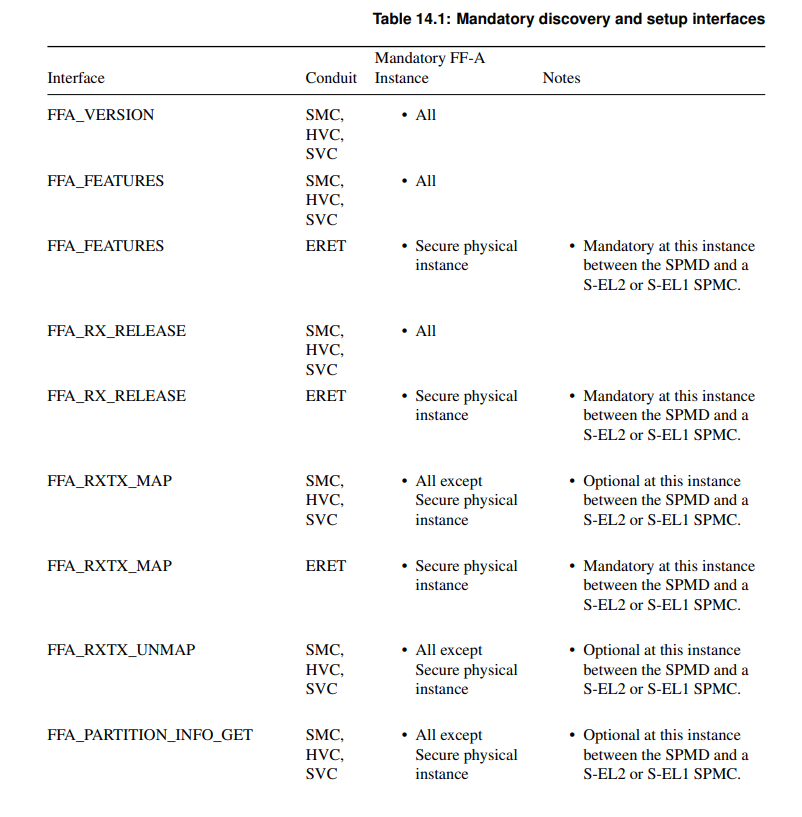
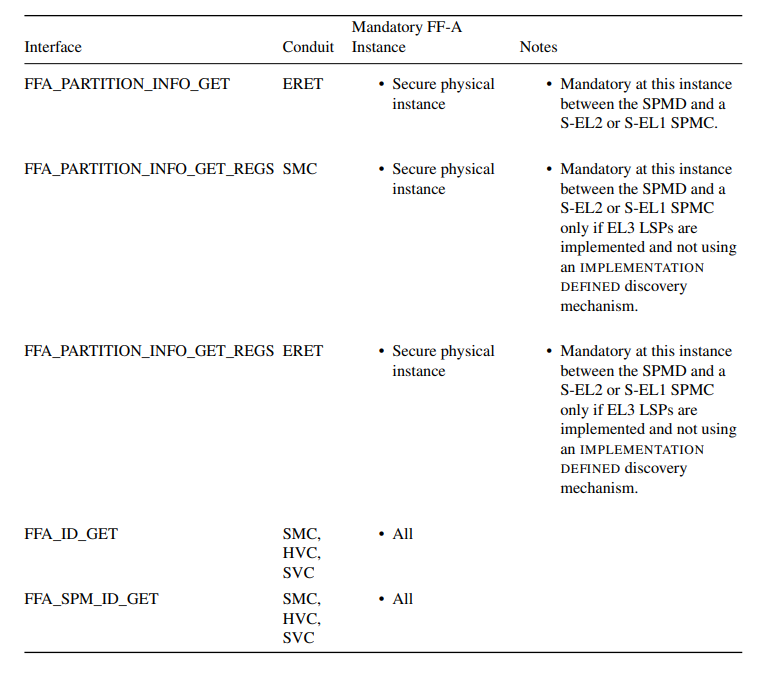
表14.1:发现和设置接口

该表列出了在给定的FF-A实例中必须使用特定导管实现的发现和设置接口。

  1. 在表中未列出但在相应接口描述中列出的接口和导管组合是可选的。
  2. 在表14.1和相应接口描述中均未列出的接口和导管组合不受支持。
    在这里插入图片描述
    在这里插入图片描述

14.2 FFA_VERSION

Description

FFA_VERSION函数

  • 返回FF-A实例中Firmware Framework实现的版本,如14.2.1概述中所述。
  • 表14.3列出了有效的FF-A实例和导管。
  • 该函数的语法在表14.4中描述。
基于可靠性评估序贯蒙特卡洛模拟法的配电网可靠性评估研究(Matlab代码实现)内容概要:本文围绕“基于可靠性评估序贯蒙特卡洛模拟法的配电网可靠性评估研究”,介绍了利用Matlab代码实现配电网可靠性的仿真分析方法。重点采用序贯蒙特卡洛模拟法对配电网进行长时间段的状态抽样与统计,通过模拟系统元件的故障与修复过程,评估配电网的关键可靠性指标,如系统停电频率、停电持续时间、负荷点可靠性等。该方法能够有效处理复杂网络结构与设备时序特性,提升评估精度,适用于含分布式电源、电动汽车等新型负荷接入的现代配电网。文中提供了完整的Matlab实现代码与案例分析,便于复现和扩展应用。; 适合人群:具备电力系统基础知识和Matlab编程能力的高校研究生、科研人员及电力行业技术人员,尤其适合从事配电网规划、运行与可靠性分析相关工作的人员; 使用场景及目标:①掌握序贯蒙特卡洛模拟法在电力系统可靠性评估中的基本原理与实现流程;②学习如何通过Matlab构建配电网仿真模型并进行状态转移模拟;③应用于含新能源接入的复杂配电网可靠性定量评估与优化设计; 阅读建议:建议结合文中提供的Matlab代码逐段调试运行,理解状态抽样、故障判断、修复逻辑及指标统计的具体实现方式,同时可扩展至不同网络结构或加入更多不确定性因素进行深化研究。
### ROS2 Built-in Interfaces Documentation and Usage In the context of ROS2, built-in interfaces play a crucial role in facilitating communication between nodes through standardized message types. The `builtin_interfaces` package provides fundamental data structures that are essential across various parts of ROS2 systems[^1]. #### Key Features of Builtin Interfaces The primary purpose of `builtin_interfaces` is to define common datatypes used throughout ROS2. These include: - **Time**: Represents time with nanosecond precision. - **Duration**: Used for representing durations or timeouts. These definitions ensure consistency when handling temporal information within different components of ROS2 applications. #### Using Time Messages To work with timestamps effectively, developers can utilize the following methods provided by `builtin_interfaces/msg/Time`: ```cpp // C++ example showing how to use Time messages from builtin_interfaces #include "rclcpp/rclcpp.hpp" #include "builtin_interfaces/msg/time.hpp" int main(int argc, char * argv[]) { rclcpp::init(argc, argv); auto node = rclcpp::Node::make_shared("time_example_node"); // Create an instance of Time message type builtin_interfaces::msg::Time current_time; // Set seconds and nanoseconds fields manually current_time.sec = static_cast<int32_t>(std::chrono::system_clock::now().time_since_epoch().count() / 1e9); current_time.nanosec = static_cast<uint32_t>((std::chrono::system_clock::now().time_since_epoch().count() % 1000000000)); RCLCPP_INFO(node->get_logger(), "Current system time: sec=%d nsec=%u", current_time.sec, current_time.nanosec); rclcpp::shutdown(); return 0; } ``` This code snippet demonstrates creating and populating a `Time` object using standard library functions alongside ROS2-specific constructs[^2]. #### Handling Duration Messages Similarly, working with intervals requires understanding the structure offered under `builtin_interfaces/msg/Duration`. Here’s another practical application scenario involving duration manipulation: ```cpp // Example demonstrating usage of Duration messages from builtin_interfaces #include "rclcpp/rclcpp.hpp" #include "builtin_interfaces/msg/duration.hpp" void set_duration(builtin_interfaces::msg::Duration &duration_msg, int64_t ns) { duration_msg.sec = static_cast<int32_t>(ns / 1&#39;000&#39;000&#39;000L); // Convert nanoseconds into whole seconds duration_msg.nanosec = static_cast<uint32_t>(ns % 1&#39;000&#39;000&#39;000L); // Remaining part as fractional second (nanoseconds) } int main() { // Initialize ROS client library... // Define some timeout period expressed in nanoseconds const int64_t TIMEOUT_NS = 5_000_000; // Five milliseconds // Prepare corresponding Duration message container builtin_interfaces::msg::Duration my_timeout{}; // Populate it via helper function defined above set_duration(my_timeout, TIMEOUT_NS); // Use this value wherever needed inside your program logic... return EXIT_SUCCESS; } ``` By leveraging these utilities, programmers gain more control over timing aspects while ensuring compatibility among diverse software modules operating on top of ROS2 infrastructure[^3]. --related questions-- 1. How does one integrate custom message types with existing ones like those found in `builtin_interfaces`? 2. What other core packages besides `builtin_interfaces` form the backbone of inter-node communications in ROS2? 3. Can you provide examples where precise timestamp management becomes critical during real-world robotics operations? 4. Are there any performance implications associated with frequent conversions between native C++ chrono representations and their equivalents available through `builtin_interfaces`?
评论
添加红包

请填写红包祝福语或标题

红包个数最小为10个

红包金额最低5元

当前余额3.43前往充值 >
需支付:10.00
成就一亿技术人!
领取后你会自动成为博主和红包主的粉丝 规则
hope_wisdom
发出的红包

打赏作者

Arm精选

你的鼓励将是我创作的最大动力

¥1 ¥2 ¥4 ¥6 ¥10 ¥20
扫码支付:¥1
获取中
扫码支付

您的余额不足,请更换扫码支付或充值

打赏作者

实付
使用余额支付
点击重新获取
扫码支付
钱包余额 0

抵扣说明:

1.余额是钱包充值的虚拟货币,按照1:1的比例进行支付金额的抵扣。
2.余额无法直接购买下载,可以购买VIP、付费专栏及课程。

余额充值