
ImageNet Classification with Deep Convolutional Neural Networks 论文解读

本文介绍了深度学习在ILSVRC图像识别挑战赛中的应用,使用包含1.2M样本的Imagenet数据集,通过五层卷积和三层全连接的神经网络结构,实现了显著的识别效果改进。文中详细讨论了网络架构、训练方法及如何减少过拟合。
部署运行你感兴趣的模型镜像

这个论文应该算是把深度学习应用到图片识别(ILSVRC,ImageNet large-scale Visual Recognition Challenge)上的具有重大意义的一篇文章。因为在之前,人们一直质疑深度学习的强大有能力。

大家看看它的引用数目就知道它很厉害了,,9000多的引用。。

作者为:Hinton的学生与Hioton: 

Krizhevsky A
Sutskever I
Hinton GE


要想训练好一个深层的神经网络,需要 :很大的 datasets, 很强大的硬件,很好的抵制overfitting的机制等。

文章用的dataset: Imagenet 数据集的一个subset, 包括:1.2M个样本,1000个种类。另外还有,50000的validation 数据集,150000的测试集。

ILSVRC是从2010年开始的,在2010年时,比赛的test dataset是公开的,以后的都不是公开的。这个挑战赛的常用的两个誤差标准:一个是top-1 error,一个是top-5 error,(这个在之前写的文章里都有提及到了)


网络的结构:

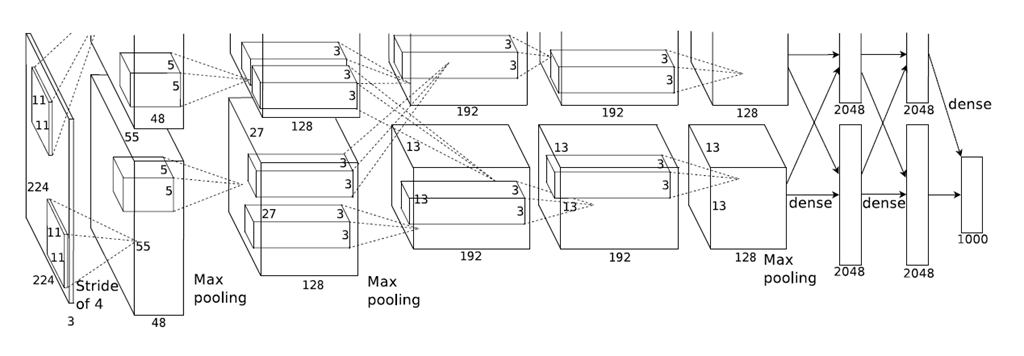
整体是这样的,
image


224*224*3的输入, 后面5个卷积层,再后面三个全连接层,最后一个softmax层分类。

具体参数吧,图上写的很清楚的:你看看啊,输入层为 224*224*3, 第一层的卷积核大小为11*11*3,共96个,然后第二层的卷积层的输入为 55*55*48(是从上面96个卷积核生成的feature maps 中选择了一半),第二层的卷积核为:5*5*48,共256个,,等 。。。。后面的看看论文,里面有。。

不过要说明一点的是:对于选择不同的feature作为输入时,会根据是不是在同一个GPU进行选择,文章说明这一点了,可能目的为了用双GPU训练时,实现起来简单一些,且速度快一些吧。


结构相对几点重要的地方:

第一,使用的激活函数为:Rectified Linear Units(ReLUs). 可以很好地提高学习速度,因为这个激活函数为non-saturating function.

第二,训练在多块GPU上,不过它怎么实现的吧,看着的有点乱。。。不很明白,可能没有编程的原因,应该是这样的。

第三点,使用了 Local Response Normalization, (我的翻译为:局部响应标准化),公式是这样的:

image

公式怎么来的,没有说啊。不过它的目的就是在相对的局位置上,在相邻有不同的卷积核(文中也说了,这个卷积核的排序为任意且的训练之间就是选择了的哦)之间进行相互的一个侧向抑制。这么做的原因是因为:在现实中,动物的神经元之间就会有一个侧向抑制。参数的选择吧,要自己来调整。。

第四点,重叠pooling,这个不解释,就是在pooling的时候会发生重叠。


降低Overfitting的方法

第一点,也是常用的方法:人为扩大训练样本。

文中的方法1:在256*256的大样本中,选择5个224*224的patches(左上,左下,右上,右上,中间),再加上水平翻转,共10个了吧。

方法2: altering the intensities of the RGB channels in training images. 文中的方法是什么通过PCA(主成份分析)的方法啥的,反正看了一会没有看懂,也就不看了吧。

第二点: dropout机制, dropout的概率为0.5,有作用。。简单地说,就是在训练网络过程中,让一些的neunon的不起作用,这样训练出来的神经网络应该说是很均匀,不过过度依赖某些的units,  采用dropout时,注意一点:在测试的时候注意把进行dropout机制的那些神经元的输出乘以0.5.


其它细节:

batch sizes为:128,

采用梯度下降法训练,权值更新公式:

image

等。。。

说一点:学习速率的改变方法:初始化为0.01,在训练过程中,当网络的validation error 不再下降时,把学习速率缩小10倍,如此反复进行3次就可以啦。


最后结果表明:效果很不错。

最后加一句,文中的原话:

Another way to probe the network’s visual knowledge is to consider the feature activations induced by an image at the last, 4096-dimensional hidden layer.

您可能感兴趣的与本文相关的镜像

Qwen-Image

Qwen-Image

图片生成
Qwen

Qwen-Image是阿里云通义千问团队于2025年8月发布的亿参数图像生成基础模型,其最大亮点是强大的复杂文本渲染和精确图像编辑能力,能够生成包含多行、段落级中英文文本的高保真图像

### ImageNet Classification Using Deep Convolutional Neural Networks Paper Implementation and Explanation #### Overview of the Approach The approach described involves utilizing a deep convolutional neural network (ConvNet) for classifying images from the ImageNet dataset. When an unseen image enters this system, it undergoes forward propagation within the ConvNet structure. The outcome is a set of probabilities corresponding to different classes that the input could belong to[^1]. These probabilities result from computations involving optimized weights derived during training. #### Training Process Insights Training plays a crucial role in ensuring accurate classifications by optimizing these weights so they can effectively categorize previously seen data points accurately. A sufficiently large training set enhances generalization capabilities; thus, when presented with entirely novel inputs post-training phase completion, the model should still perform reliably well at assigning appropriate labels based on learned features rather than memorized instances. #### Historical Context and Impact In 2012, a groundbreaking paper titled "ImageNet Classification with Deep Convolutional Neural Networks" was published, marking significant advancements in computer vision technology. This work introduced innovations such as deeper architectures compared to earlier models along with improved techniques like ReLU activation functions which accelerated learning processes significantly over traditional methods used before then[^2]. #### Detailed Architecture Review For those interested in delving deeper into recent developments surrounding CNNs up until around 2019, surveys provide comprehensive reviews covering various aspects including architectural improvements made since AlexNet's introduction back in 2012[^3]. Such resources offer valuable insights not only regarding specific design choices but also broader trends shaping modern approaches towards building efficient yet powerful visual recognition systems capable of handling complex tasks efficiently while maintaining high accuracy levels across diverse datasets similar or even larger scale versions of what existed originally within ImageNet itself. ```python import torch from torchvision import models # Load pretrained ResNet-50 model trained on ImageNet model = models.resnet50(pretrained=True) # Set evaluation mode model.eval() def predict_image(image_tensor): """Predicts the class label given an image tensor.""" with torch.no_grad(): outputs = model(image_tensor.unsqueeze(0)) _, predicted_class = torch.max(outputs.data, 1) return predicted_class.item() ```
评论
添加红包

请填写红包祝福语或标题

红包个数最小为10个

红包金额最低5元

当前余额3.43前往充值 >
需支付:10.00
成就一亿技术人!
领取后你会自动成为博主和红包主的粉丝 规则
hope_wisdom
发出的红包
实付
使用余额支付
点击重新获取
扫码支付
钱包余额 0

抵扣说明:

1.余额是钱包充值的虚拟货币,按照1:1的比例进行支付金额的抵扣。
2.余额无法直接购买下载,可以购买VIP、付费专栏及课程。

余额充值


