
【论文阅读一】Adaptive Cross-Modal Few-shot Learning

1、introduction

这篇文章提出了一种将语义与视觉知识相结合的自适应的cross-modal。视觉和语义特征空间根据定义具有不同的结构。对于某些概念,视觉特征可能比文本特征更丰富,更具辨别力。但当视觉信息在图像分类中受到限制时,语义表示(从无监督的文本语料库中学习)可以提供强大的先验知识和上下文以帮助学习。此文就是基于此开展研究的,提出了Adaptive Modality Mixture Mechanism(AM3),an approach that adaptively and selectively combines information from two modalities, visual and semantic, for few-shot learning。AM3在基于度量的元学习方法上形成的,通过比较在已学习的度量空间中的距离来实现分类。文章在原型网络Prototypical Networks for Few-shot Learning的思想基础上,加入了文本信息(即语义表达)。

2、algorithm
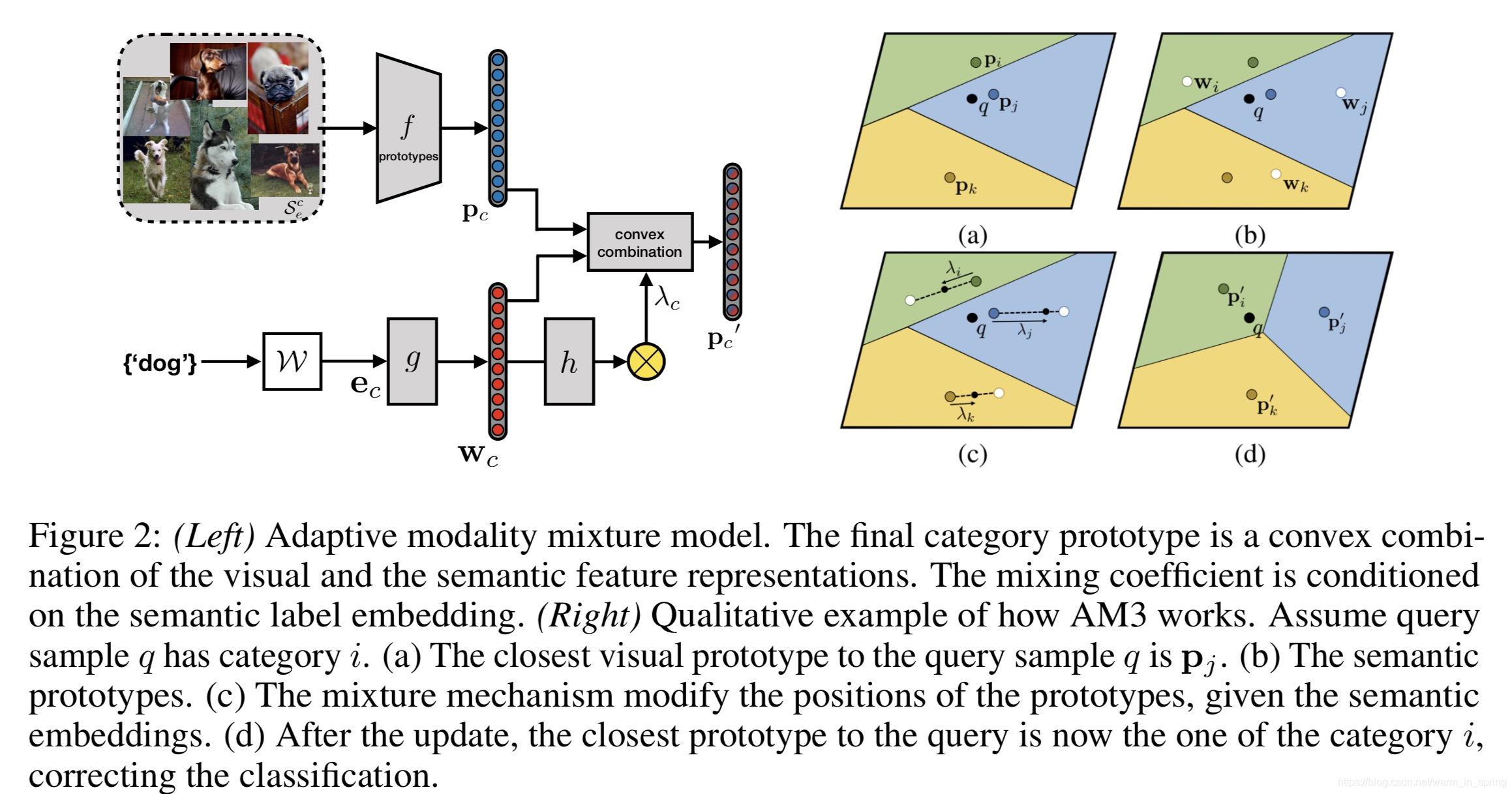
在AM3中,文章增加了基于度量的FSL方法,以结合由词嵌入模型W学习的语言结构(pre-trained on unsupervised large text corpora),在所有类别中包含了label embeddings。由于考虑到了label embeddings,AM3对每个类修改了原型表达(prototype representation)。有上图(左)就可以看出AM3将视觉和语义特征表达的凸组合形成最终的类原型(category prototype),参数化表示为:

### Skeleton-Based Action Recognition Using Adaptive Cross-Form Learning In the realm of skeleton-based action recognition, adaptive cross-form learning represents a sophisticated approach that integrates multiple modalities to enhance performance. This method leverages both spatial and temporal information from skeletal data while adapting dynamically across different forms or representations. The core concept involves constructing an end-to-end trainable framework where features extracted from joint coordinates are transformed into various intermediate representations such as graphs or sequences[^1]. These diverse forms capture distinct aspects of human motion patterns effectively: - **Graph Representation**: Models interactions between joints by treating them as nodes connected via edges representing bones. - **Sequence Modeling**: Treats each frame's pose estimation results as elements within time-series data suitable for recurrent neural networks (RNN). Adaptive mechanisms allow seamless switching among these forms based on their suitability at different stages during training/inference processes. Specifically designed modules learn when and how much weight should be assigned to specific transformations ensuring optimal utilization of available cues without overfitting any single modality. For implementation purposes, one might consider employing Graph Convolutional Networks (GCNs) alongside Long Short-Term Memory units (LSTMs). GCNs excel in capturing structural dependencies present within graph structures derived from skeletons; meanwhile LSTMs handle sequential modeling tasks efficiently handling long-range dependencies found along video frames' timelines. ```python import torch.nn as nn class AdaptiveCrossFormModule(nn.Module): def __init__(self): super(AdaptiveCrossFormModule, self).__init__() # Define components responsible for processing individual form types here def forward(self, input_data): # Implement logic determining which transformation path(s) will process 'input_data' pass def train_model(model, dataset_loader): criterion = nn.CrossEntropyLoss() optimizer = ... # Initialize appropriate optimization algorithm for epoch in range(num_epochs): running_loss = 0.0 for inputs, labels in dataset_loader: outputs = model(inputs) loss = criterion(outputs, labels) optimizer.zero_grad() loss.backward() optimizer.step() running_loss += loss.item() ```
评论
添加红包

请填写红包祝福语或标题

红包个数最小为10个

红包金额最低5元

当前余额3.43前往充值 >
需支付:10.00
成就一亿技术人!
领取后你会自动成为博主和红包主的粉丝 规则
hope_wisdom
发出的红包
实付
使用余额支付
点击重新获取
扫码支付
钱包余额 0

抵扣说明:

1.余额是钱包充值的虚拟货币,按照1:1的比例进行支付金额的抵扣。
2.余额无法直接购买下载,可以购买VIP、付费专栏及课程。

余额充值



