



一、介绍
1、概念
加密中的另一个概念是哈希。哈希与传统加密不同。前面的对称加密和非对称加密都可以从密文再回到原文。哈希是一种单向算法,无法轻易撤消。又称消息摘要( Message Digest )或数字摘要 Digital Digest )。
2、特点
- 它是一个唯一对应一个消息或文本的固定长度的值,它由一个单向Hash加密函数对消息进行作用而产生
- 使用数字摘要生成的值是不可以篡改的,为了保证文件或者值的安全
- 消息摘要是单向、不可逆的
3、常见算法
无论输入的消息有多长,计算出来的消息摘要的长度总是固定的。例如应用MD5算法摘要的消息有128个比特位,用SHA-1算法摘要的消息最终有160比特位的输出。
只要输入的消息不同,对其进行摘要以后产生的摘要消息也必不相同;但相同的输入必会产生相同的输出。
(1)MD5
摘要结果16个字节, 转16进制后32个字节
(2)SHA1
摘要结果20个字节, 转16进制后40个字节
(3)SHA256
摘要结果32个字节, 转16进制后64个字节
(4) SHA512
摘要结果64个字节, 转16进制后128个字节
4、通用方法
这几种算法的实现方法都差不多,有三种方法可以实现
(1)MessageDigest
这种方法要复杂一点,需要手动转成16进制,其他几种不需要手动转
 MessageDigest digest = MessageDigest.getInstance(algorithm);
        byte[] bytes = input.getBytes();
        digest.update(bytes);
        byte[] hashedBytes = digest.digest();
        System.out.println("密文的字节长度:"+hashedBytes.length);
        StringBuilder hexString = new StringBuilder();
        for (byte b : hashedBytes) {
            String hex = Integer.toHexString(0xFF & b);
            if (hex.length() == 1) {
                hexString.append('0');
            }
            hexString.append(hex);
        }

        String hashedData = hexString.toString();
(2) DigestUtils
String hashedData = new DigestUtils(algorithm).digestAsHex(input);
(3) HashFunction
HashFunction hashFunc = Hashing.xxx();
        HashCode hash = hashFunc.hashString(input, StandardCharsets.UTF_8);
        String hashData= hash.toString();
5、示例
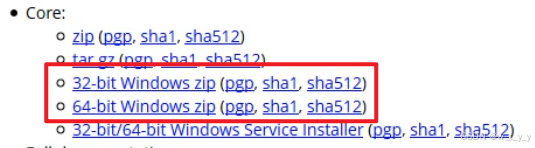
百度搜索 tomcat ,进入官网下载 ,会经常发现有 sha1,sha512 , 这些都是数字摘要。

二、MD5
1、实现方法
方法一:MessageDigest
使用MessageDigest
/**
	 * getMD5
	 * @param message message
	 * @param code code
	 * @return MD5
	 */
	public static String getMD5(String message,String code) {
		String md5str = "";
		try {
			//1 创建一个提供信息摘要算法的对象,初始化为md5算法对象
			MessageDigest md = MessageDigest.getInstance("MD5");

			//2 将消息变成byte数组
			byte[] input = message.getBytes(code);

			//3 计算后获得字节数组,这就是那128位了
			byte[] buff = md.digest(input);

			//4 把数组每一字节(一个字节占八位)换成16进制连成md5字符串
			md5str = bytesToHex(buff);

		} catch (Exception e) {
			e.printStackTrace();
		}
		return md5str;
	}
 public static MessageDigest getInstance(String algorithm)
    throws NoSuchAlgorithmException {
        try {
            Object[] objs = Security.getImpl(algorithm, "MessageDigest",
                                             (String)null);
            if (objs[0] instanceof MessageDigest) {
                MessageDigest md = (MessageDigest)objs[0];
                md.provider = (Provider)objs[1];
                return md;
            } else {
                MessageDigest delegate =
                    new Delegate((MessageDigestSpi)objs[0], algorithm);
                delegate.provider = (Provider)objs[1];
                return delegate;
            }
        } catch(NoSuchProviderException e) {
            throw new NoSuchAlgorithmException(algorithm + " not found");
        }
    }
String sig = MD5Util.getMD5(unCodeStr.toString(), "UTF-8");
方法二:DigestUtils
使用MessageDigest和DigestUtils都可以,使用DigestUtils代码更简洁:
import com.baomidou.mybatisplus.core.toolkit.StringUtils;
import lombok.extern.slf4j.Slf4j;
import org.springframework.util.DigestUtils;

import java.security.MessageDigest;
import java.security.NoSuchAlgorithmException;
import java.util.Base64;

@Slf4j
public class Md5Util {

    public static void main(String[] args) throws NoSuchAlgorithmException {
        String input = "测试wtyy666";
        String md5 = DigestUtils.md5DigestAsHex(input.getBytes());
        System.out.println(md5);
    }

    public static String toMd5(String msg) {
        if (StringUtils.isBlank(msg)) {
            return null;
        }
        return DigestUtils.md5DigestAsHex(msg.getBytes());
    }
}

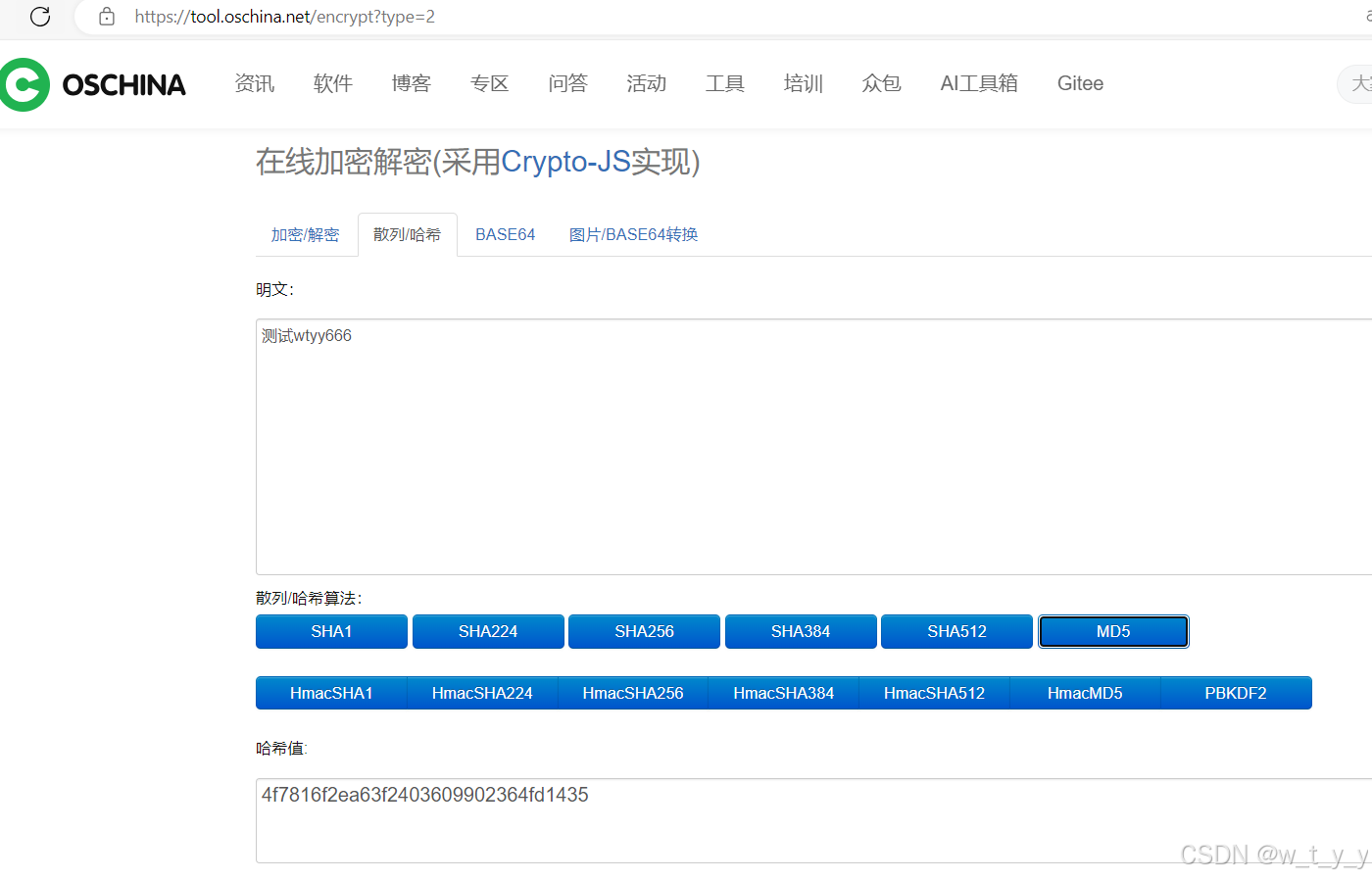
测试与在线生成的一致:
方法三:HashFunction
使用guava包下的方法,
 HashFunction hashFunc = Hashing.md5();
        HashCode hash = hashFunc.hashString(input, StandardCharsets.UTF_8);
        String hexDigest = hash.toString();
        System.out.println("方法3:"+hexDigest);
可以看到和DigestUtils生成的一致
import com.baomidou.mybatisplus.core.toolkit.StringUtils;
import com.google.common.hash.HashCode;
import com.google.common.hash.HashFunction;
import com.google.common.hash.Hashing;
import lombok.extern.slf4j.Slf4j;
import org.springframework.util.DigestUtils;

import java.nio.charset.StandardCharsets;
import java.security.MessageDigest;
import java.security.NoSuchAlgorithmException;
import java.util.Base64;

@Slf4j
public class Md5Util {

    public static void main(String[] args) throws NoSuchAlgorithmException {
        String input = "测试wtyy666";
        String md5 = DigestUtils.md5DigestAsHex(input.getBytes());
        System.out.println("方法2:"+md5);

        HashFunction hashFunc = Hashing.md5();
        HashCode hash = hashFunc.hashString(input, StandardCharsets.UTF_8);
        String hexDigest = hash.toString();
        System.out.println("方法3:"+hexDigest);
    }

    public static String toMd5(String msg) {
        if (StringUtils.isBlank(msg)) {
            return null;
        }
        return DigestUtils.md5DigestAsHex(msg.getBytes());
    }
}
方法2:4f7816f2ea63f2403609902364fd1435
方法3:4f7816f2ea63f2403609902364fd1435
三、SHA-1
1、实现方法
方法一:MessageDigest
使用MessageDigest,步骤为:
(1)创建一个MessageDigest对象
(2)将待加密的数据转换为字节数组
(3)通过MessageDigest对象对字节数组进行加密
(4)获取加密后的字节数组
(5)将加密后的字节数组转换为十六进制字符串,在线消息摘要使用的就是16进制
import java.security.MessageDigest;
import java.security.NoSuchAlgorithmException;

public class Sha1Util {

    public static void main(String[] args) throws NoSuchAlgorithmException {
        String input = "测试wtyy666";
        String pwd = toSha1(input);
        System.out.println(pwd);
    }

    public static String toSha1(String input) throws NoSuchAlgorithmException {
        MessageDigest digest = MessageDigest.getInstance("SHA-1");
        byte[] bytes = input.getBytes();
        digest.update(bytes);
        byte[] hashedBytes = digest.digest();

        StringBuilder hexString = new StringBuilder();
        for (byte b : hashedBytes) {
            String hex = Integer.toHexString(0xFF & b);
            if (hex.length() == 1) {
                hexString.append('0');
            }
            hexString.append(hex);
        }

        String hashedData = hexString.toString();
        return hashedData;
    }
}

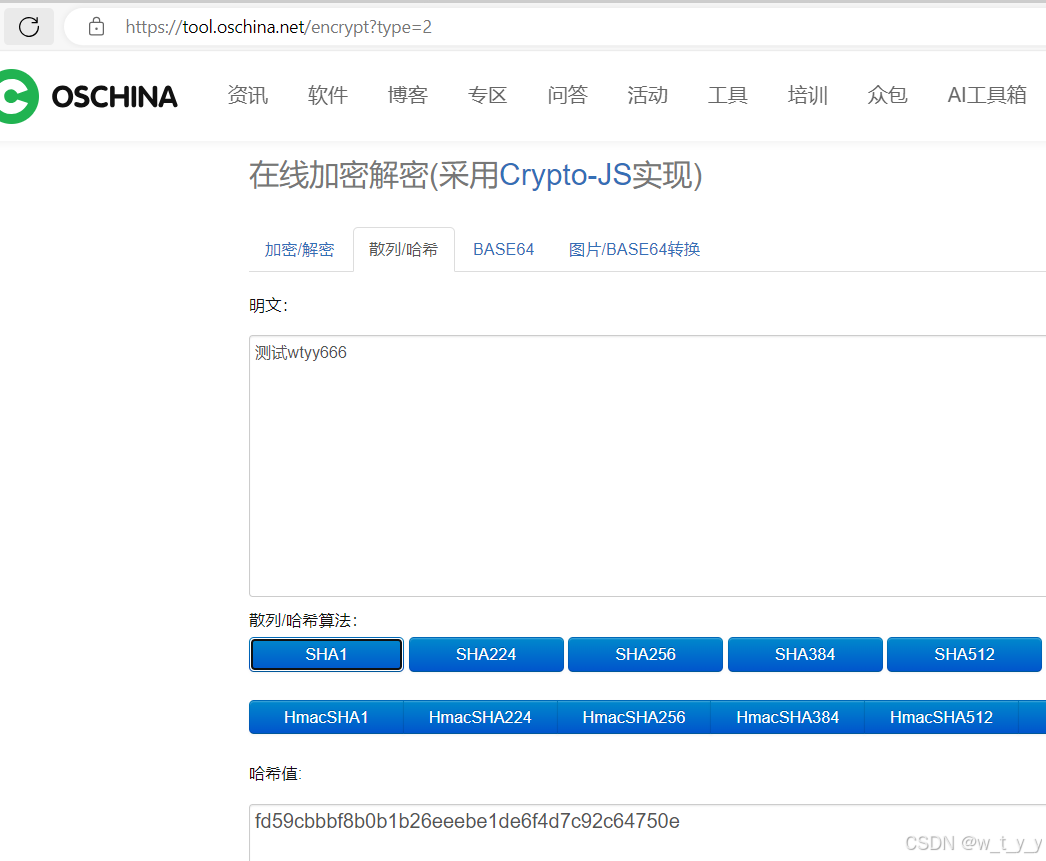
与在线平台生成的一致:
方法二:DigestUtils
String hashed_message = new DigestUtils("SHA-1").digestAsHex(input);
方法三:HashFunction
使用guava包下的方法,
        HashFunction hashFunc = Hashing.sha1();
        HashCode hash = hashFunc.hashString(input, StandardCharsets.UTF_8);
        String hexDigest = hash.toString();
可以看到生成的一致:
package com.bit.demo.secret;

import com.google.common.hash.HashCode;
import com.google.common.hash.HashFunction;
import com.google.common.hash.Hashing;
import org.apache.commons.codec.digest.DigestUtils;

import java.nio.charset.StandardCharsets;
import java.security.MessageDigest;
import java.security.NoSuchAlgorithmException;

public class Sha1Util {

    public static void main(String[] args) throws NoSuchAlgorithmException {
        String input = "测试wtyy666";
        String pwd = toSha1(input);
        System.out.println("方法1:"+pwd);
        //方法2
        HashFunction hashFunc = Hashing.sha1();
        HashCode hash = hashFunc.hashString(input, StandardCharsets.UTF_8);
        String hexDigest = hash.toString();
        System.out.println("方法2:"+hexDigest);
        //方法3
        String hashed_message = new DigestUtils("SHA-1").digestAsHex(input);
        System.out.println("方法3:"+hashed_message);
    }

    public static String toSha1(String input) throws NoSuchAlgorithmException {
        MessageDigest digest = MessageDigest.getInstance("SHA-1");
        byte[] bytes = input.getBytes();
        digest.update(bytes);
        byte[] hashedBytes = digest.digest();

        StringBuilder hexString = new StringBuilder();
        for (byte b : hashedBytes) {
            String hex = Integer.toHexString(0xFF & b);
            if (hex.length() == 1) {
                hexString.append('0');
            }
            hexString.append(hex);
        }

        String hashedData = hexString.toString();
        return hashedData;
    }
}
方法1:fd59cbbbf8b0b1b26eeebe1de6f4d7c92c64750e
方法2:fd59cbbbf8b0b1b26eeebe1de6f4d7c92c64750e
方法3:fd59cbbbf8b0b1b26eeebe1de6f4d7c92c64750e
四、SHA-256
1、实现方法
同上面的SHA-1:
方法一:MessageDigest
import java.security.MessageDigest;
import java.security.NoSuchAlgorithmException;

public class Sha256Util {

    public static void main(String[] args) throws NoSuchAlgorithmException {
        String input = "测试wtyy666";
        String pwd = toSha1(input);
        System.out.println(pwd);
    }

    public static String toSha1(String input) throws NoSuchAlgorithmException {
        MessageDigest digest = MessageDigest.getInstance("SHA-256");
        byte[] bytes = input.getBytes();
        digest.update(bytes);
        byte[] hashedBytes = digest.digest();

        StringBuilder hexString = new StringBuilder();
        for (byte b : hashedBytes) {
            String hex = Integer.toHexString(0xFF & b);
            if (hex.length() == 1) {
                hexString.append('0');
            }
            hexString.append(hex);
        }

        String hashedData = hexString.toString();
        return hashedData;
    }
}

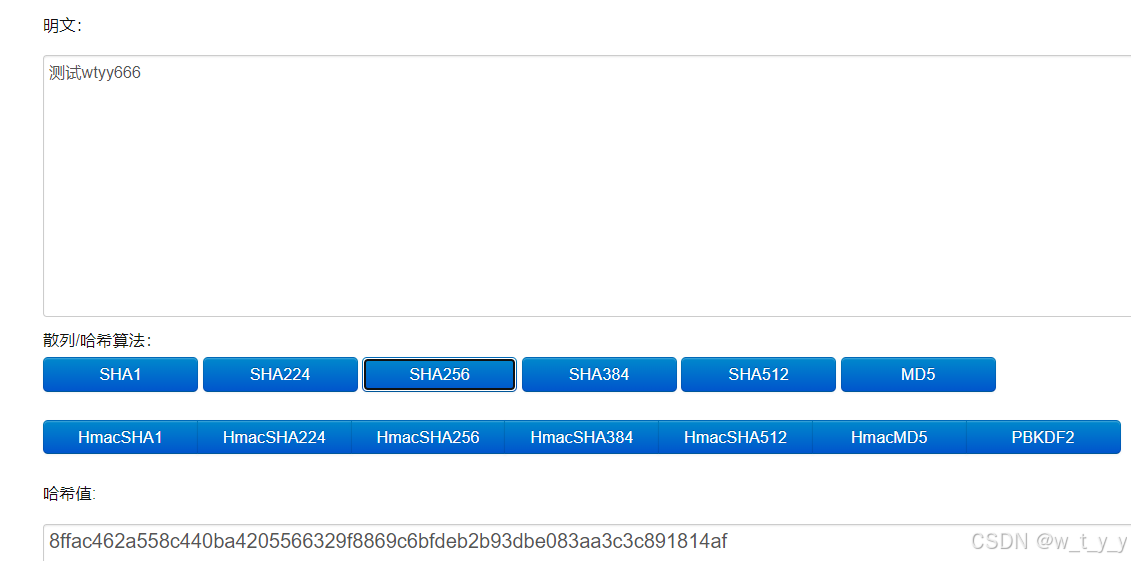
和在线平台生成的一致:
方法二:DigestUtils
String hashed_message = new DigestUtils("SHA-256").digestAsHex(input);
方法三
使用guava包下的方法,可以看到和上面生成的一致
package com.bit.demo.secret;

import com.google.common.hash.HashCode;
import com.google.common.hash.HashFunction;
import com.google.common.hash.Hashing;
import org.apache.commons.codec.digest.DigestUtils;

import java.nio.charset.StandardCharsets;
import java.security.MessageDigest;
import java.security.NoSuchAlgorithmException;

public class Sha256Util {

    public static void main(String[] args) throws NoSuchAlgorithmException {
        String input = "测试wtyy666";
        String pwd = toSha1(input);
        System.out.println("方法1:"+pwd);
        //方法2
        String hashed_message = new DigestUtils("SHA-256").digestAsHex(input);
        System.out.println("方法2:"+hashed_message);
        //方法3
        HashFunction hashFunc = Hashing.sha256();
        HashCode hash = hashFunc.hashString(input, StandardCharsets.UTF_8);
        String hexDigest = hash.toString();
        System.out.println("方法3:"+hexDigest);
    }

    public static String toSha1(String input) throws NoSuchAlgorithmException {
        MessageDigest digest = MessageDigest.getInstance("SHA-256");
        byte[] bytes = input.getBytes();
        digest.update(bytes);
        byte[] hashedBytes = digest.digest();

        StringBuilder hexString = new StringBuilder();
        for (byte b : hashedBytes) {
            String hex = Integer.toHexString(0xFF & b);
            if (hex.length() == 1) {
                hexString.append('0');
            }
            hexString.append(hex);
        }

        String hashedData = hexString.toString();
        return hashedData;
    }
}
方法1:8ffac462a558c440ba4205566329f8869c6bfdeb2b93dbe083aa3c3c891814af
方法2:8ffac462a558c440ba4205566329f8869c6bfdeb2b93dbe083aa3c3c891814af
方法3:8ffac462a558c440ba4205566329f8869c6bfdeb2b93dbe083aa3c3c891814af
五、SHA-512
1、实现方法
也是和前面类似
方法一:MessageDigest
import java.security.MessageDigest;
import java.security.NoSuchAlgorithmException;

public class Sha512Util {

    public static void main(String[] args) throws NoSuchAlgorithmException {
        String input = "测试wtyy666";
        String pwd = toSha1(input);
        System.out.println(pwd);
        System.out.println("16进制长度:"+pwd.length());
    }

    public static String toSha1(String input) throws NoSuchAlgorithmException {
        MessageDigest digest = MessageDigest.getInstance("SHA-512");
        byte[] bytes = input.getBytes();
        digest.update(bytes);
        byte[] hashedBytes = digest.digest();
        System.out.println("密文的字节长度:"+hashedBytes.length);
        StringBuilder hexString = new StringBuilder();
        for (byte b : hashedBytes) {
            String hex = Integer.toHexString(0xFF & b);
            if (hex.length() == 1) {
                hexString.append('0');
            }
            hexString.append(hex);
        }

        String hashedData = hexString.toString();
        return hashedData;
    }
}
密文的字节长度:64
3412fb7c2c59dd49daddac1d3de5e10616f4a2aaa6357419b9c3b0b6bec7fac9daac9d8d9ef20c1ee4313f3ece290aa68d7fe92fb559ac125cb4b80d0c45116f
16进制长度:128
和在线平台生成的一致。

方法二:DigestUtils
String hashed_message = new DigestUtils("SHA-512").digestAsHex(input);
方法三
使用guava包下的方法,可以看到和上面生成的一致
package com.bit.demo.secret;

import com.google.common.hash.HashCode;
import com.google.common.hash.HashFunction;
import com.google.common.hash.Hashing;
import org.apache.commons.codec.digest.DigestUtils;

import java.nio.charset.StandardCharsets;
import java.security.MessageDigest;
import java.security.NoSuchAlgorithmException;

public class Sha512Util {

    public static void main(String[] args) throws NoSuchAlgorithmException {
        String input = "测试wtyy666";
        String pwd = toSha1(input);
        System.out.println("方法1:"+pwd);
        System.out.println("16进制长度:"+pwd.length());
        //方法2
        String hashed_message = new DigestUtils("SHA-512").digestAsHex(input);
        System.out.println("方法2:"+hashed_message);
        //方法3
        HashFunction hashFunc = Hashing.sha512();
        HashCode hash = hashFunc.hashString(input, StandardCharsets.UTF_8);
        String hexDigest = hash.toString();
        System.out.println("方法3:"+hexDigest);
    }

    public static String toSha1(String input) throws NoSuchAlgorithmException {
        MessageDigest digest = MessageDigest.getInstance("SHA-512");
        byte[] bytes = input.getBytes();
        digest.update(bytes);
        byte[] hashedBytes = digest.digest();
        System.out.println("密文的字节长度:"+hashedBytes.length);
        StringBuilder hexString = new StringBuilder();
        for (byte b : hashedBytes) {
            String hex = Integer.toHexString(0xFF & b);
            if (hex.length() == 1) {
                hexString.append('0');
            }
            hexString.append(hex);
        }

        String hashedData = hexString.toString();
        return hashedData;
    }
}
密文的字节长度:64
方法1:3412fb7c2c59dd49daddac1d3de5e10616f4a2aaa6357419b9c3b0b6bec7fac9daac9d8d9ef20c1ee4313f3ece290aa68d7fe92fb559ac125cb4b80d0c45116f
16进制长度:128
方法2:3412fb7c2c59dd49daddac1d3de5e10616f4a2aaa6357419b9c3b0b6bec7fac9daac9d8d9ef20c1ee4313f3ece290aa68d7fe92fb559ac125cb4b80d0c45116f
方法3:3412fb7c2c59dd49daddac1d3de5e10616f4a2aaa6357419b9c3b0b6bec7fac9daac9d8d9ef20c1ee4313f3ece290aa68d7fe92fb559ac125cb4b80d0c45116f
六、获取文件消息摘要
import com.sun.org.apache.xml.internal.security.utils.Base64;
import com.sun.scenario.effect.impl.sw.sse.SSEBlend_SRC_OUTPeer;
import sun.misc.BASE64Decoder;

import java.io.ByteArrayOutputStream;
import java.io.FileInputStream;
import java.security.MessageDigest;

public class DigestDemo {

    public static void main(String[] args) throws Exception{
        String input = "aa";
        String algorithm = "MD5";

        // sha1 可以实现秒传功能
        String sha1 = getDigestFile("apache-tomcat-9.0.10-windows-x64.zip", "SHA-1");
        System.out.println(sha1);

        String sha512 = getDigestFile("apache-tomcat-9.0.10-windows-x64.zip", "SHA-512");
        System.out.println(sha512);

        String md5 = getDigest("aa", "MD5");
        System.out.println(md5);

        String md51 = getDigest("aa ", "MD5");
        System.out.println(md51);
    }

    private static String getDigestFile(String filePath, String algorithm) throws Exception{
        FileInputStream fis = new FileInputStream(filePath);
        int len;
        byte[] buffer = new byte[1024];
        ByteArrayOutputStream baos = new ByteArrayOutputStream();
        while ( (len =  fis.read(buffer))!=-1){
            baos.write(buffer,0,len);
        }
        // 获取消息摘要对象
        MessageDigest messageDigest = MessageDigest.getInstance(algorithm);
        // 获取消息摘要
        byte[] digest = messageDigest.digest(baos.toByteArray());
        System.out.println("密文的字节长度:"+digest.length);
        return toHex(digest);
    }

    private static String getDigest(String input, String algorithm) throws Exception{
        MessageDigest messageDigest = MessageDigest.getInstance(algorithm);
        byte[] digest = messageDigest.digest(input.getBytes());
        System.out.println("密文的字节长度:"+digest.length);
        return toHex(digest);
    }

    private static String toHex(byte[] digest) {
        //        System.out.println(new String(digest));
        // 消息摘要进行表示的时候,是用16进制进行表示
        StringBuilder sb = new StringBuilder();
        for (byte b : digest) {
            // 转成16进制

            String s = Integer.toHexString(b & 0xff);
            // 保持数据的完整性,前面不够的用0补齐
            if (s.length()==1){
                s="0"+s;
            }
            sb.append(s);
        }
        System.out.println("16进制数据的长度:"+ sb.toString().getBytes().length);
        return sb.toString();
    }
}
运行结果 ,获取 sha-1 和 sha-512 的值

查看 tomcat 官网上面 sha-1 和 sha-512 的值:

使用 sha-1 算法,可以实现秒传功能,不管如何修改文件的名字,最后得到的值是一样的
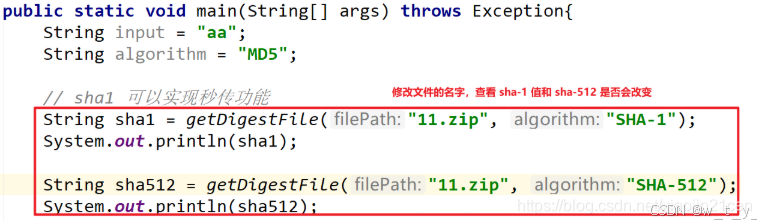
运行结果 ,获取 sha-1 和 sha-512 的值:
 如果原文修改了,那么sha-1值 就会不一样
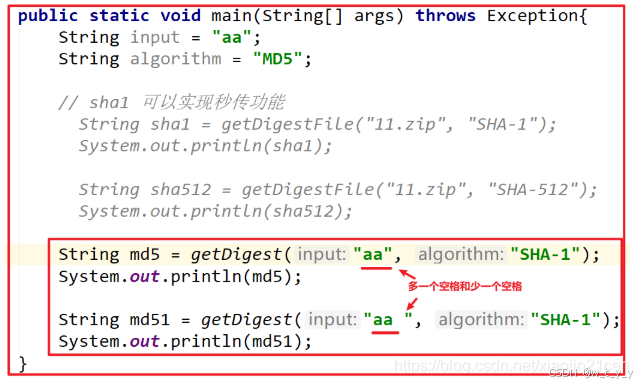

import java.math.BigInteger;
import java.nio.charset.StandardCharsets;
...
BigInteger sumOfUTFValues = new BigInteger("0");
byte[] bytes = message.getBytes(StandardCharsets.UTF_8);
for (int i=0; i<bytes.length; i++){
    BigInteger bigIntByte = BigInteger.valueOf(bytes[i]);
    BigInteger appendedValue = bigIntByte.multiply(PRIME.pow(i+1));
    sumOfUTFValues = sumOfUTFValues.add(appendedValue);
}
import java.math.BigInteger;
...
public static String fixedLength(BigInteger hashValue) {
    String strHashValue = String.valueOf(hashValue);
    int count = HASH_LENGTH + 1 - strHashValue.length();
    for(int i=1; i<count; i++){
        BigInteger bigIntIndex = BigInteger.valueOf(i);
        strHashValue += String.valueOf(hashValue.mod(bigIntIndex));
    }
    return strHashValue.substring(0,HASH_LENGTH);
}
import java.security.SecureRandom;
import com.google.common.io.BaseEncoding;
...
SecureRandom rand = new SecureRandom();
byte[] buffer = new byte[32];
rand.nextBytes(buffer);
String salt = BaseEncoding.base16().lowerCase().encode(buffer);





 扫一扫
扫一扫


 3486
3486

 被折叠的 条评论
为什么被折叠?
被折叠的 条评论
为什么被折叠?
 到【灌水乐园】发言





