

How to Set Classpath for Java on Windows and Linux

本文详细介绍了Java中Classpath的概念、工作原理及设置方法,并通过实例解释了如何解决常见的Classpath问题。

http://javarevisited.blogspot.com/2011/01/how-classpath-work-in-java.html


What is CLASSPATH in Java 
Classpath in Java is path to directory or list of directory which is used by ClassLoaders to find and load class in Java program. Classpath can be specified using CLASSPATH environment variable which is case insensitive, -cp or -classpath command line option or Class-Path attribute in manifest.mf file inside JAR file in Java.  In this Java tutorial we will learn What is Classpath in Java, how Java resolve classpath and How Classpath works in Java along side How to set classpath for Java in windows and UNIX environment.  I have experience in finance and insurance domain and Java is heavily used in this domain for writing sophisticated Equity, Fixed income trading applications. Most of these investment banks has written test as part of there core Java interviewquestions and I always find at least one question related to CLASSPATH in Java on those interviews. Java CLASSPATH is one of the most important concepts in Java,  but,  I must say mostly overlooked. This should be the first thing you should learn while writing Java programs because without correct understanding of Classpath in Java you can't understand how Java locates your class files. Also don't confuse Classpath with PATH in Java, which is another environment variable used to find java binaries located in JDK installation directory, also known as JAVA_HOME. Main difference between PATH and CLASSPATH is that former is used to locate Java commands while later is used to locate Java class files.

So let’s start with basic and then we will see some example and improvisation of Classpath in Java. In fact CLASSPATH is an environment variable which is used by Java Virtual Machine to locate user defined classes. As I said In this tutorial we will see How to setup classpath for java in windows and Linux , java -classpath example in different scenario and use of java -classpath or java -cp.


Setting Java Classpath in Windows

In order to set Classpath for Java in Windows (any version either Windows XP,  Windows 2000 or  Windows 7) you need to specify value of environment  variable  CLASSPATH, name of this variable is not case sensitive and it doesn’t matter if name of your  environment variable is Classpath, CLASSPATH or classpath in Java.

Here is  Step by Step guide for setting Java Classpath in Windows:
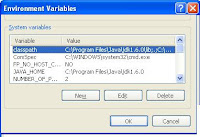
  1. How to se Java Classpath in windows and Unix Linux
  2. Go to Environment variable window in Windows by pressing "Windows + Pause “-->Advanced -->Environment variable " or you can go from right click on my computer than choosing properties and then Advanced and then Environment variable this will open Environment variable window in windows.

  3. Now specify your environment variable CLASSPATH and put the value of your JAVA_HOME\lib and also include current directory by including (dot or period sign).

  4. Now to check the value of Java classpath in windows type "echo %CLASSPATH" in your DOS command prompt and it will show you the value of directory which are included in CLASSPATH.

    You can also set classpath in windows by using DOS command like :

    set CLASSPATH=%CLASSPATH%;JAVA_HOME\lib;
    This way you can set classpath in Windows XP, windows 2000 or Windows 7 and 8, as they all come with command prompt.


Setting Java Classpath in UNIX or Linux

To set Classpath for Java In Linux you can simply  export CLASSPATH="your classpath" from either your  .bash_profile or .bashrc script which will run whenever you login into your Linux or Unix Machine. Now to check value of Java CLASSPATH in Linux type "echo ${CLASSPATH}" this will print value of  Classpath in command prompt. By using export command you can set classpath for Java in Unix, Linux, Solaris, IBM AIX or any other UNIX operating system. I hope this example for setting classpath in Java will enable to set classpath by yourself let me know if you face any problem while setting up classpath in Java


Overriding Classpath in Java

You can override classpath in Java, defined by environment  variable CLASSPATH by providing option "-cp" or "-classpath" while  running Java program and this is the best way to have different classpath for different Java application running on same Unix or Windows machine, standard way to define classpath for Java application is creating start-up script for Java program and set classpath there as shown below :

CLASSPATH=/home/tester/classes
java -cp $CLASSPATH Test

By default Java CLASSPATH points to current directory denoted by "." and it will look for any class only in current directory.


Different example of using Classpath in Java

In case you have multiple directories defined in CLASSPATH variable, Java will look for a class starting from first directory and only look second directory in case it did not find the specified class in first directory. This is extremely useful feature of Classpath in java to understand and it’s very useful while  debugging Java application or  patch release kind of stuff. Let’s see   java -classpath example


I have set my classpath environment variable as  CLASSPATH=/home/tester/first:/home/tester/second Now I have Test class of different version in both first and second directory. When I give a command  "java Test" What will happen ? Which Test class would be picked? Since  JVM search directory in the order they have listed in CLASSPATH variable it will first go to the "first" directory and if it finds Test.class over there it will not go to /home/tester/second directory. Now if you delete Test.class from /home/tester/first directory it will go to /home/tester/second directory and will pick  Test.class from there.


I have used this feature of Java Classpath to test my patch releases, we used to have a folder called "patch" listed as first element in Java CLASSPATH and any point of time we want to put any debug statement or want to test any bug we just modify Java source file , compile it and generate class file and put that inside patch folder instead of  creating JAR file and releasing whole new Java application. This is very handy if you are working in a large project where you don't have  development environment setup in Windows and your project only runs on Unix server. This approach is much faster than  remote debugging Java application in Eclipse


Its also worth noting that when you use the   java -jar command line option to run your Java program as an  executable JAR, then the CLASSPATH environment variable will be ignored, and also the -cp and -classpath switches will be ignored. In this case you can set your Java classpath in the META-INF/MANIFEST.MF file by using the Class-Path attribute. In short  Class-pathattribute in manifest file overrides classpath specified by -cp, -classpath or CLASSPATH environment variable.


Now a common question if I have my CLASSPATH variable pointing to  current directory "." and I have class called "Test" inside package "testing" and with below directory structure C:\project\testing\Test.class in my computer.

What will happen if I run command "java Test" from directory "C:\project\testing\"? will it run?
No it will not run it will give you :
Exception in thread "main" java.lang.NoClassDefFoundError: Test
Since name of the class is not Test, instead it’s  testing.Test even though your classpath is set to current directory.

Now what will happen if I give command  java testing.Test from C:\project\testing\ it will again not run and give error?

Exception in thread "main" java.lang.NoClassDefFoundError: testing/Test

Why because now it looking for class called Test which is in package testing, starting from current directory "." but don't find it since there is no directory called "testing after this path "C:\project\testing\".

To run it successfully you need to go back to directory  C:\project and now run 
C:\project>java testing.Test  and It will run successfully because of Classpath issues i prefer to use Eclipse rather than  running Java program from command prompt


Errors related to Classpath in Java

If you are working in Java you must have faced some errors and exception related to classpath in java, two most common issues related to java classpath is  ClassNotFoundException and  NoClassDefFoundError. I have seen that many Java developer tries to solve this error by trial and error; they just don’t look beyond the hood and try to understand what the reason for these java classpath related errors is. They often misunderstood that these two errors are same also. 

Here is the reason of these Java classpath errors : 

ClassNotFoundException is an Exception and will be thrown when Java program dynamically tries to load a Java class at Runtime and don’t find corresponding class file on classpath. Two keyword here “dynamically” and “runtime”. Classic example of these errors is whey you try to load JDBC driver by using Class.forname(“driver name”) and greeted with java.lang.ClassNotFoundException: com.mysql.jdbc.Driver. So this error essentially comes when Java try to load a class using forName() or by loadClass() method of ClassLoader. Key thing to note is that presence of that class on Java classpath is not checked on compile time. So even if those classes are not present on Java classpath your program will compile successfully and only fail when you try to run.


On the other hand NoClassDefFoundError is an Error and more critical than ClassNotFoundException which is an exception and recoverable.  NoClassDefFoundError comes when a particular class was present in Java Classpath during compile time but not available during run-time. Classic example of this error is using log4j.jar for logging purpose and forgot to include log4j.jar on classpath in java during run-time. to read more about logging in Java see . Keyword here is,   class was present at compile time but not available on run-time.  This is normally occurring due to any method invocation on a particular class which is part of library and not available on classpath in Java. This is also asked as common interview questions as   

What is difference between NoClassDefFoundError and ClassNotFoundException Exception in Java”   or
“When do you see NoClassDefFoundError and ClassNotFoundException Exception in Java”. By the way NoClassDefFoundError can also comes due to various other reason like static initializer failure or class not visible to Classloaders in J2EE environment. Read 3 ways to resolve NoClassDefFoundError in Java for complete details.


Summary of CLASSPATH in Java

1.       Classpath in Java is  an environment variable used by Java Virtual machine to locate or find   class files in Java during class loading.

2.      You can  override value of Classpath in Java defined by environment variable CLASSPATH by providing  JVM command line option –cp or –classpath while running your application.

3.      If two classes with same name exist in Java Classpath then  the class which comes earlier in Classpath will be picked by Java Virtual Machine.

4.       By default CLASSPATH in Java points to current directory denoted by "." and it will look for any class only in current directory.

5.      When you use the  -jar command line  option to  run your program as an executable JAR, then the Java  CLASSPATH environment variable will be ignored, and also the  -cp and -classpath switches will be ignored and In this case you can set your java classpath in the  META-INF/MANIFEST.MF file by using the Class-Path attribute.

6.       In Unix of Linux Java Classpath contains names of directory with  colon “:” separated , On Windows Java Classpath will be   semi colon “;” separated while if you defined java classpath in Manifest file those will be  space separated.

7.       You can check value of classpath in java inside your application by looking at following system property  “java.class.path”  System.getProperty("java.class.path")

Class-Path attribute is used to contain classpath inside manifest file. Also make sure that your manifest file must end with a blank line (carriage return or new line) , here is an example of java classpath in manifest file.

Main-Class: com.classpathexample.Demo_Classpath
Class-Path: lib/tibco.jar lib/log4j.jar


8.       It’s also important to note that  path specified in manifest file is not absolute instead  they are relative from application jar’s path. For example in above if your application jar file is in C:\test directory you must need a lib directory inside test and tibco.jar and log4j.jar inside that.

9.        ClassNotFoundException is an Exception and will be thrown when Java program dynamically tries to load a particular Class at Runtime and don’t find that on Java classpath due to result of Class.forName() or loadClass() method invocation.

10.  NoClassDefFoundError comes when a particular class was present in Java Classpath during compile time but not available during runtime on Classpath in Java.

I hope you find this  Java Classpath tutorial useful , please let me know if you have any doubt or any question related to  "How to set classpath for java" and I would be happy to answer :) keep learning. Your suggestions and comments are always welcome.  If you like to read UNIX command tips you may find   10 tips of using find command in Linux ,  10 tips to increase speed on Unix command and  10 basic networking Commands in Unix useful. That's all on What is Classpath in Java, How Classpath works in Java, How to set Classpath in Java on Windows and Linux and how to deal with Classpath issues in Java.


Related post:


Read more:  http://javarevisited.blogspot.com/2011/01/how-classpath-work-in-java.html#ixzz3aZDwasZZ

Language support for Javafor Visual Studio Code Visual Studio Marketplace Installs Join the chat at https://gitter.im/redhat-developer/vscode-java Build Status License Provides Java ™ language support via Eclipse ™ JDT Language Server, which utilizes Eclipse ™ JDT, M2Eclipse and Buildship. Quick Start Install the Extension On the following platforms, the extension should activate without any setup : win32-x64, darwin-x64, darwin-arm64, linux-x64, linux-arm64. If on another platform, or using the "universal" version, you can set a Java Development Kit. It must be Java 21 or above. Optionally, download and install a Java Development Kit for your project (Java 1.8 or above is supported). See Project JDKs for more details Extension is activated when you first access a Java file Recognizes projects with Maven or Gradle build files in the directory hierarchy. Features screencast Supports code from Java 1.8 to Java 24 Maven pom.xml project support Gradle project support (with experimental Android project import support) Standalone Java files support As-you-type reporting of parsing and compilation errors Code completion Code/Source actions / Refactoring Javadoc hovers Organize imports triggered manually or on save when pasting code into a java file with Ctrl+Shift+v (Cmd+Shift+v on Mac). Type search Code outline Code folding Code navigation Code lens (references/implementations) Highlights Code formatting (on-type/selection/file) Code snippets Annotation processing support (automatic for Maven projects) Semantic selection Diagnostic tags Call Hierarchy Type Hierarchy To launch and debug your Java programs, it's recommended you install Java Debug Extension for Visual Studio Code. See the changelog for the latest release. You might also find useful information in the project Wiki. Setting the JDK Java Tooling JDK Now that Java extension will publish platform specific versions, it will embed a JRE for supported platforms such as win32-x64, linux-x64, linux-arm64, darwin-x64, darwin-arm64. The embedded JRE is used to launch the Language Server for Java. Users are only responsible for configuring Project JDKs to compile your Java projects. The following part is only kept for the universal version without embedded JRE. The tooling JDK will be used to launch the Language Server for Java. And by default, will also be used to compile your projects. Java 21 is the minimum required version. The path to the Java Development Kit can be specified by the java.jdt.ls.java.home setting in VS Code settings (workspace/user settings). If not specified, it is searched in the following order until a JDK meets current minimum requirement. the JDK_HOME environment variable the JAVA_HOME environment variable on the current system path Project JDKs If you need to compile your projects against a different JDK version, it's recommended you configure the java.configuration.runtimes property in your user settings, eg: "java.configuration.runtimes": [ { "name": "JavaSE-1.8", "path": "/path/to/jdk-8", }, { "name": "JavaSE-11", "path": "/path/to/jdk-11", }, { "name": "JavaSE-24", "path": "/path/to/jdk-24", "default": true }, ] The default runtime will be used when you open standalone Java files. Available commands The following commands are available: Switch to Standard Mode: switches the Java Language Server to Standard mode. This command is only available when the Java Language Server is in LightWeight mode. Java: Reload Projects (Shift+Alt+U): It forces project configuration / classpath updates (eg. dependency changes or Java compilation level), according to the project build descriptor. Java: Import Java Projects into Workspace: detects and imports all the Java projects into the Java Language Server workspace. Java: Open Java Language Server Log File: opens the Java Language Server log file, useful for troubleshooting problems. Java: Open Java Extension Log File: opens the Java extension log file, useful for troubleshooting problems. Java: Open All Log Files: opens both the Java Language Server log file and the Java extension log file. Java: Force Java Compilation (Shift+Alt+B): manually triggers compilation of the workspace. Java: Rebuild Projects: manually triggers a full build of the selected projects. Java: Open Java Formatter Settings: opens the Eclipse formatter settings. Creates a new settings file if none exists. Java: Clean Java Language Server Workspace: cleans the Java language server workspace. Java: Attach Source: attaches a jar/zip source to the currently opened binary class file. This command is only available in the editor context menu. Java: Add Folder to Java Source Path: adds the selected folder to its project source path. This command is only available in the file explorer context menu and only works for unmanaged folders. Java: Remove Folder from Java Source Path: removes the selected folder from its project source path. This command is only available in the file explorer context menu and only works for unmanaged folders. Java: List All Java Source Paths: lists all the Java source paths recognized by the Java Language Server workspace. Java: Show Build Job Status: shows the Java Language Server job status in Visual Studio Code terminal. Java: Go to Super Implementation: goes to the super implementation for the current selected symbol in editor. Java: Restart Java Language Server: restarts the Java language server. Supported VS Code settings The following settings are supported: java.home : Deprecated, please use 'java.jdt.ls.java.home' instead. Absolute path to JDK home folder used to launch the Java Language Server. Requires VS Code restart. java.jdt.ls.lombokSupport.enabled: Whether to enable lombok support. Defaults to true. java.jdt.ls.vmargs : Extra VM arguments used to launch the Java Language Server. Requires VS Code restart. java.errors.incompleteClasspath.severity : Specifies the severity of the message when the classpath is incomplete for a Java file. Supported values are ignore, info, warning, error. java.trace.server : Traces the communication between VS Code and the Java language server. java.configuration.updateBuildConfiguration : Specifies how modifications on build files update the Java classpath/configuration. Supported values are disabled (nothing happens), interactive (asks about updating on every modification), automatic (updating is automatically triggered). java.configuration.maven.userSettings : Path to Maven's user settings.xml. java.configuration.checkProjectSettingsExclusions: Deprecated, please use 'java.import.generatesMetadataFilesAtProjectRoot' to control whether to generate the project metadata files at the project root. And use 'files.exclude' to control whether to hide the project metadata files from the file explorer. Controls whether to exclude extension-generated project settings files (.project, .classpath, .factorypath, .settings/) from the file explorer. Defaults to false. java.referencesCodeLens.enabled : Enable/disable the references code lenses. java.implementationCodeLens : Enable/disable the implementations code lens for the provided categories. java.signatureHelp.enabled : Enable/disable signature help support (triggered on (). java.signatureHelp.description.enabled : Enable/disable to show the description in signature help. Defaults to false. java.contentProvider.preferred : Preferred content provider (see 3rd party decompilers available in vscode-java-decompiler). java.import.exclusions : Exclude folders from import via glob patterns. Use ! to negate patterns to allow subfolders imports. You have to include a parent directory. The order is important. java.import.gradle.enabled : Enable/disable the Gradle importer. Specify the Gradle distribution used by the Java extension: java.import.gradle.wrapper.enabled: Use Gradle from the 'gradle-wrapper.properties' file. Defaults to true. java.import.gradle.version: Use Gradle from the specific version if the Gradle wrapper is missing or disabled. java.import.gradle.home: Use Gradle from the specified local installation directory or GRADLE_HOME if the Gradle wrapper is missing or disabled and no 'java.import.gradle.version' is specified. java.import.gradle.arguments: Arguments to pass to Gradle. java.import.gradle.jvmArguments: JVM arguments to pass to Gradle. java.import.gradle.user.home: setting for GRADLE_USER_HOME. java.import.gradle.offline.enabled: Enable/disable the Gradle offline mode. Defaults to false. java.import.maven.enabled : Enable/disable the Maven importer. java.autobuild.enabled : Enable/disable the 'auto build'. java.maxConcurrentBuilds: Set max simultaneous project builds. java.completion.enabled : Enable/disable code completion support. java.completion.guessMethodArguments : Specify how the arguments will be filled during completion. Defaults to auto. auto: Use off only when using Visual Studio Code - Insiders, other platform will defaults to insertBestGuessedArguments. off: Method arguments will not be inserted during completion. insertParameterNames: The parameter names will be inserted during completion. insertBestGuessedArguments: The best guessed arguments will be inserted during completion according to the code context. java.completion.filteredTypes: Defines the type filters. All types whose fully qualified name matches the selected filter strings will be ignored in content assist or quick fix proposals and when organizing imports. For example 'java.awt.*' will hide all types from the awt packages. java.completion.favoriteStaticMembers : Defines a list of static members or types with static members. java.completion.importOrder : Defines the sorting order of import statements. java.format.enabled : Enable/disable the default Java formatter. java.format.settings.url : Specifies the url or file path to the Eclipse formatter xml settings. java.format.settings.profile : Optional formatter profile name from the Eclipse formatter settings. java.format.comments.enabled : Includes the comments during code formatting. java.format.onType.enabled : Enable/disable on-type formatting (triggered on ;, } or <return>). java.foldingRange.enabled: Enable/disable smart folding range support. If disabled, it will use the default indentation-based folding range provided by VS Code. java.maven.downloadSources: Enable/disable download of Maven source artifacts as part of importing Maven projects. java.maven.updateSnapshots: Force update of Snapshots/Releases. Defaults to false. java.codeGeneration.hashCodeEquals.useInstanceof: Use 'instanceof' to compare types when generating the hashCode and equals methods. Defaults to false. java.codeGeneration.hashCodeEquals.useJava7Objects: Use Objects.hash and Objects.equals when generating the hashCode and equals methods. This setting only applies to Java 7 and higher. Defaults to false. java.codeGeneration.useBlocks: Use blocks in 'if' statements when generating the methods. Defaults to false. java.codeGeneration.generateComments: Generate method comments when generating the methods. Defaults to false. java.codeGeneration.toString.template: The template for generating the toString method. Defaults to ${object.className} [${member.name()}=${member.value}, ${otherMembers}]. java.codeGeneration.toString.codeStyle: The code style for generating the toString method. Defaults to STRING_CONCATENATION. java.codeGeneration.toString.skipNullValues: Skip null values when generating the toString method. Defaults to false. java.codeGeneration.toString.listArrayContents: List contents of arrays instead of using native toString(). Defaults to true. java.codeGeneration.toString.limitElements: Limit number of items in arrays/collections/maps to list, if 0 then list all. Defaults to 0. java.selectionRange.enabled: Enable/disable Smart Selection support for Java. Disabling this option will not affect the VS Code built-in word-based and bracket-based smart selection. java.showBuildStatusOnStart.enabled: Automatically show build status on startup, defaults to notification. notification: Show the build status via progress notification. terminal: Show the build status via terminal. off: Do not show any build status. For backward compatibility, this setting also accepts boolean value, where true has the same meaning as notification and false has the same meaning as off. java.project.outputPath: A relative path to the workspace where stores the compiled output. Only effective in the WORKSPACE scope. The setting will NOT affect Maven or Gradle project. java.project.referencedLibraries: Configure glob patterns for referencing local libraries to a Java project. java.completion.maxResults: Maximum number of completion results (not including snippets). 0 (the default value) disables the limit, all results are returned. In case of performance problems, consider setting a sensible limit. java.configuration.runtimes: Map Java Execution Environments to local JDKs. java.server.launchMode: Standard: Provides full features such as intellisense, refactoring, building, Maven/Gradle support etc. LightWeight: Starts a syntax server with lower start-up cost. Only provides syntax features such as outline, navigation, javadoc, syntax errors. The lightweight mode won't load thirdparty extensions, such as java test runner, java debugger, etc. Hybrid: Provides full features with better responsiveness. It starts a standard language server and a secondary syntax server. The syntax server provides syntax features until the standard server is ready. And the syntax server will be shutdown automatically after the standard server is fully ready. Default launch mode is Hybrid. Legacy mode is Standard java.sources.organizeImports.starThreshold: Specifies the number of imports added before a star-import declaration is used, default is 99. java.sources.organizeImports.staticStarThreshold: Specifies the number of static imports added before a star-import declaration is used, default is 99. java.imports.gradle.wrapper.checksums: Defines allowed/disallowed SHA-256 checksums of Gradle Wrappers. java.project.importOnFirstTimeStartup: Specifies whether to import the Java projects, when opening the folder in Hybrid mode for the first time. Supported values are disabled (never imports), interactive (asks to import or not), automatic (always imports). Default to automatic. java.project.importHint: Enable/disable the server-mode switch information, when Java projects import is skipped on startup. Defaults to true. java.import.gradle.java.home: Specifies the location to the JVM used to run the Gradle daemon. java.project.resourceFilters: Excludes files and folders from being refreshed by the Java Language Server, which can improve the overall performance. For example, ["node_modules",".git"] will exclude all files and folders named 'node_modules' or '.git'. Pattern expressions must be compatible with java.util.regex.Pattern. Defaults to ["node_modules",".git"]. java.templates.fileHeader: Specifies the file header comment for new Java file. Supports configuring multi-line comments with an array of strings, and using ${variable} to reference the predefined variables. java.templates.typeComment: Specifies the type comment for new Java type. Supports configuring multi-line comments with an array of strings, and using ${variable} to reference the predefined variables. java.references.includeAccessors: Include getter, setter and builder/constructor when finding references. Default to true. java.configuration.maven.globalSettings : Path to Maven's global settings.xml. java.configuration.maven.lifecycleMappings : Path to Maven's lifecycle mappings xml. java.eclipse.downloadSources : Enable/disable download of Maven source artifacts for Eclipse projects. java.references.includeDecompiledSources : Include the decompiled sources when finding references. Default to true. java.project.sourcePaths: Relative paths to the workspace where stores the source files. Only effective in the WORKSPACE scope. The setting will NOT affect Maven or Gradle project. java.typeHierarchy.lazyLoad: Enable/disable lazy loading the content in type hierarchy. Lazy loading could save a lot of loading time but every type should be expanded manually to load its content. java.codeGeneration.insertionLocation: Specifies the insertion location of the code generated by source actions. Defaults to afterCursor. afterCursor: Insert the generated code after the member where the cursor is located. beforeCursor: Insert the generated code before the member where the cursor is located. lastMember: Insert the generated code as the last member of the target type. java.codeGeneration.addFinalForNewDeclaration: Whether to generate the 'final' modifer for code actions that create new declarations. Defaults to none. none: Do not generate final modifier fields: Generate 'final' modifier only for new field declarations variables: Generate 'final' modifier only for new variable declarations all: Generate 'final' modifier for all new declarations java.settings.url : Specifies the url or file path to the workspace Java settings. See Setting Global Preferences java.symbols.includeSourceMethodDeclarations : Include method declarations from source files in symbol search. Defaults to false. java.quickfix.showAt : Show quickfixes at the problem or line level. java.configuration.workspaceCacheLimit : The number of days (if enabled) to keep unused workspace cache data. Beyond this limit, cached workspace data may be removed. java.import.generatesMetadataFilesAtProjectRoot : Specify whether the project metadata files(.project, .classpath, .factorypath, .settings/) will be generated at the project root. Defaults to false. java.inlayHints.parameterNames.enabled: Enable/disable inlay hints for parameter names. Supported values are: none(disable parameter name hints), literals(Enable parameter name hints only for literal arguments) and all(Enable parameter name hints for literal and non-literal arguments). Defaults to literals. java.compile.nullAnalysis.nonnull: Specify the Nonnull annotation types to be used for null analysis. If more than one annotation is specified, then the topmost annotation will be used first if it exists in your project dependencies. This setting will be ignored if java.compile.nullAnalysis.mode is set to disabled. java.compile.nullAnalysis.nullable: Specify the Nullable annotation types to be used for null analysis. If more than one annotation is specified, then the topmost annotation will be used first if it exists in your project dependencies. This setting will be ignored if java.compile.nullAnalysis.mode is set to disabled. java.compile.nullAnalysis.nonnullbydefault: Specify the NonNullByDefault annotation types to be used for null analysis. If more than one annotation is specified, then the topmost annotation will be used first if it exists in your project dependencies. This setting will be ignored if java.compile.nullAnalysis.mode is set to disabled. java.import.maven.offline.enabled: Enable/disable the Maven offline mode. Defaults to false. java.codeAction.sortMembers.avoidVolatileChanges: Reordering of fields, enum constants, and initializers can result in semantic and runtime changes due to different initialization and persistence order. This setting prevents this from occurring. Defaults to true. java.jdt.ls.protobufSupport.enabled: Specify whether to automatically add Protobuf output source directories to the classpath. Note: Only works for Gradle com.google.protobuf plugin 0.8.4 or higher. Defaults to true. java.jdt.ls.androidSupport.enabled: [Experimental] Specify whether to enable Android project importing. When set to auto, the Android support will be enabled in Visual Studio Code - Insiders. Note: Only works for Android Gradle Plugin 3.2.0 or higher. Defaults to auto. java.completion.postfix.enabled: Enable/disable postfix completion support. Defaults to true. java.completion.chain.enabled: Enable/disable chain completion support. Defaults to false. java.completion.matchCase: Specify whether to match case for code completion. Defaults to firstLetter. java.compile.nullAnalysis.mode: Specify how to enable the annotation-based null analysis. Supported values are disabled (disable the null analysis), interactive (asks when null annotation types are detected), automatic (automatically enable null analysis when null annotation types are detected). Defaults to interactive. java.cleanup.actionsOnSave: Deprecated, please use 'java.cleanup.actions' instead. The list of clean ups to be run on the current document when it's saved. Clean ups can automatically fix code style or programming mistakes. Click here to learn more about what each clean up does. java.cleanup.actions: The list of clean ups to be run on the current document when it's saved or when the cleanup command is issued. Clean ups can automatically fix code style or programming mistakes. Click here to learn more about what each clean up does. java.saveActions.cleanup: Enable/disable cleanup actions on save. java.import.gradle.annotationProcessing.enabled: Enable/disable the annotation processing on Gradle projects and delegate to JDT APT. Only works for Gradle 5.2 or higher. java.sharedIndexes.enabled: [Experimental] Specify whether to share indexes between different workspaces. Defaults to auto and the shared indexes is automatically enabled in Visual Studio Code - Insiders. auto on off java.sharedIndexes.location: Specifies a common index location for all workspaces. See default values as follows: Windows: First use "$APPDATA\\.jdt\\index", or "~\\.jdt\\index" if it does not exist macOS: "~/Library/Caches/.jdt/index" Linux: First use "$XDG_CACHE_HOME/.jdt/index", or "~/.cache/.jdt/index" if it does not exist java.refactoring.extract.interface.replace: Specify whether to replace all the occurrences of the subtype with the new extracted interface. Defaults to true. java.import.maven.disableTestClasspathFlag : Enable/disable test classpath segregation. When enabled, this permits the usage of test resources within a Maven project as dependencies within the compile scope of other projects. Defaults to false. java.configuration.maven.defaultMojoExecutionAction : Specifies default mojo execution action when no associated metadata can be detected. Defaults to ignore. java.completion.lazyResolveTextEdit.enabled: [Experimental] Enable/disable lazily resolving text edits for code completion. Defaults to true. java.edit.validateAllOpenBuffersOnChanges: Specifies whether to recheck all open Java files for diagnostics when editing a Java file. Defaults to false. java.editor.reloadChangedSources: Specifies whether to reload the sources of the open class files when their source jar files are changed. Defaults to ask. ask: Ask to reload the sources of the open class files auto: Automatically reload the sources of the open class files manual: Manually reload the sources of the open class files java.edit.smartSemicolonDetection.enabled: Defines the smart semicolon detection. Defaults to false. java.configuration.detectJdksAtStart: Automatically detect JDKs installed on local machine at startup. If you have specified the same JDK version in java.configuration.runtimes, the extension will use that version first. Defaults to true. java.completion.collapseCompletionItems: Enable/disable the collapse of overloaded methods in completion items. Overrides java.completion.guessMethodArguments. Defaults to false. java.diagnostic.filter: Specifies a list of file patterns for which matching documents should not have their diagnostics reported (eg. '**/Foo.java'). java.search.scope: Specifies the scope which must be used for search operation like Find Reference Call Hierarchy Workspace Symbols java.jdt.ls.javac.enabled: [Experimental] Specify whether to enable Javac-based compilation in the language server. Requires running this extension with Java 24. Defaults to off. java.completion.engine: [Experimental] Select code completion engine. Defaults to ecj. java.references.includeDeclarations: Include declarations when finding references. Defaults to true java.jdt.ls.appcds.enabled : [Experimental] Enable Java AppCDS (Application Class Data Sharing) for improvements to extension activation. When set to auto, AppCDS will be enabled in Visual Studio Code - Insiders, and for pre-release versions. Semantic Highlighting Semantic Highlighting fixes numerous syntax highlighting issues with the default Java Textmate grammar. However, you might experience a few minor issues, particularly a delay when it kicks in, as it needs to be computed by the Java Language server, when opening a new file or when typing. Semantic highlighting can be disabled for all languages using the editor.semanticHighlighting.enabled setting, or for Java only using language-specific editor settings. Troubleshooting Check the status of the language tools on the lower right corner (marked with A on image below). It should show ready (thumbs up) as on the image below. You can click on the status and open the language tool logs for further information in case of a failure. status indicator Read the troubleshooting guide for collecting informations about issues you might encounter. Report any problems you face to the project. Contributing This is an open source project open to anyone. Contributions are extremely welcome! For information on getting started, refer to the CONTRIBUTING instructions. Continuous Integration builds can be installed from http://download.jboss.org/jbosstools/jdt.ls/staging/. Download the most recent java-<version>.vsix file and install it by following the instructions here. Stable releases are archived under http://download.jboss.org/jbosstools/static/jdt.ls/stable/. Also, you can contribute your own VS Code extension to enhance the existing features by following the instructions here. Feedback Have a question? Start a discussion on GitHub Discussions, File a bug in GitHub Issues, Chat with us on Gitter, Tweet us with other feedback. License EPL 2.0, See LICENSE for more information.
09-21
#!/usr/bin/env sh ############################################################################## ## ## sdkmanager start up script for Linux ## ############################################################################## # Attempt to set APP_HOME # Resolve links: $0 may be a link PRG="$0" # Need this for relative symlinks. while [ -h "$PRG" ] ; do ls=`ls -ld "$PRG"` link=`expr "$ls" : '.*-> \(.*\)$'` if expr "$link" : '/.*' > /dev/null; then PRG="$link" else PRG=`dirname "$PRG"`"/$link" fi done SAVED="`pwd`" cd "`dirname \"$PRG\"`/.." >/dev/null APP_HOME="`pwd -P`" cd "$SAVED" >/dev/null APP_NAME="sdkmanager" APP_BASE_NAME=`basename "$0"` # Add default JVM options here. You can also use JAVA_OPTS and SDKMANAGER_OPTS to pass JVM options to this script. DEFAULT_JVM_OPTS='-Dcom.android.sdklib.toolsdir=$APP_HOME' # Use the maximum available, or set MAX_FD != -1 to use that value. MAX_FD="maximum" warn () { echo "$*" } die () { echo echo "$*" echo exit 1 } # OS specific support (must be 'true' or 'false'). cygwin=false msys=false darwin=false nonstop=false case "`uname`" in CYGWIN* ) cygwin=true ;; Darwin* ) darwin=true ;; MINGW* ) msys=true ;; NONSTOP* ) nonstop=true ;; esac CLASSPATH=$APP_HOME/lib/sdkmanager-classpath.jar # Determine the Java command to use to start the JVM. if [ -n "$JAVA_HOME" ] ; then if [ -x "$JAVA_HOME/jre/sh/java" ] ; then # IBM's JDK on AIX uses strange locations for the executables JAVACMD="$JAVA_HOME/jre/sh/java" else JAVACMD="$JAVA_HOME/bin/java" fi if [ ! -x "$JAVACMD" ] ; then die "ERROR: JAVA_HOME is set to an invalid directory: $JAVA_HOME Please set the JAVA_HOME variable in your environment to match the location of your Java installation." fi else JAVACMD="java" which java >/dev/null 2>&1 || die "ERROR: JAVA_HOME is not set and no 'java' command could be found in your PATH. Please set the JAVA_HOME variable in your environment to match the location of your Java installation." fi # Increase the maximum file descriptors if we can. if [ "$cygwin" = "false" -a "$darwin" = "false" -a "$nonstop" = "false" ] ; then MAX_FD_LIMIT=`ulimit -H -n` if [ $? -eq 0 ] ; then if [ "$MAX_FD" = "maximum" -o "$MAX_FD" = "max" ] ; then MAX_FD="$MAX_FD_LIMIT" fi ulimit -n $MAX_FD if [ $? -ne 0 ] ; then warn "Could not set maximum file descriptor limit: $MAX_FD" fi else warn "Could not query maximum file descriptor limit: $MAX_FD_LIMIT" fi fi # For Darwin, add options to specify how the application appears in the dock if $darwin; then GRADLE_OPTS="$GRADLE_OPTS \"-Xdock:name=$APP_NAME\" \"-Xdock:icon=$APP_HOME/media/gradle.icns\"" fi # For Cygwin, switch paths to Windows format before running java if $cygwin ; then APP_HOME=`cygpath --path --mixed "$APP_HOME"` CLASSPATH=`cygpath --path --mixed "$CLASSPATH"` JAVACMD=`cygpath --unix "$JAVACMD"` # We build the pattern for arguments to be converted via cygpath ROOTDIRSRAW=`find -L / -maxdepth 1 -mindepth 1 -type d 2>/dev/null` SEP="" for dir in $ROOTDIRSRAW ; do ROOTDIRS="$ROOTDIRS$SEP$dir" SEP="|" done OURCYGPATTERN="(^($ROOTDIRS))" # Add a user-defined pattern to the cygpath arguments if [ "$GRADLE_CYGPATTERN" != "" ] ; then OURCYGPATTERN="$OURCYGPATTERN|($GRADLE_CYGPATTERN)" fi # Now convert the arguments - kludge to limit ourselves to /bin/sh i=0 for arg in "$@" ; do CHECK=`echo "$arg"|egrep -c "$OURCYGPATTERN" -` CHECK2=`echo "$arg"|egrep -c "^-"` ### Determine if an option if [ $CHECK -ne 0 ] && [ $CHECK2 -eq 0 ] ; then ### Added a condition eval `echo args$i`=`cygpath --path --ignore --mixed "$arg"` else eval `echo args$i`="\"$arg\"" fi i=$((i+1)) done case $i in (0) set -- ;; (1) set -- "$args0" ;; (2) set -- "$args0" "$args1" ;; (3) set -- "$args0" "$args1" "$args2" ;; (4) set -- "$args0" "$args1" "$args2" "$args3" ;; (5) set -- "$args0" "$args1" "$args2" "$args3" "$args4" ;; (6) set -- "$args0" "$args1" "$args2" "$args3" "$args4" "$args5" ;; (7) set -- "$args0" "$args1" "$args2" "$args3" "$args4" "$args5" "$args6" ;; (8) set -- "$args0" "$args1" "$args2" "$args3" "$args4" "$args5" "$args6" "$args7" ;; (9) set -- "$args0" "$args1" "$args2" "$args3" "$args4" "$args5" "$args6" "$args7" "$args8" ;; esac fi # Escape application args save () { for i do printf %s\\n "$i" | sed "s/'/'\\\\''/g;1s/^/'/;\$s/\$/' \\\\/" ; done echo " " } APP_ARGS=$(save "$@") # Collect all arguments for the java command, following the shell quoting and substitution rules eval set -- $DEFAULT_JVM_OPTS $JAVA_OPTS $SDKMANAGER_OPTS -classpath "\"$CLASSPATH\"" com.android.sdklib.tool.sdkmanager.SdkManagerCli "$APP_ARGS" # by default we should be in the correct project dir, but when run from Finder on Mac, the cwd is wrong if [ "$(uname)" = "Darwin" ] && [ "$HOME" = "$PWD" ]; then cd "$(dirname "$0")" fi JAVA_VER=$($JAVACMD -version 2>&1 | awk -F '"' '/version/ {print $2}' | awk -F '.' '{sub("^$", "0", $2); print $1$2}') if test "$JAVA_VER" -lt 170 && [ -z "${SKIP_JDK_VERSION_CHECK}" ]; then FRIENDLY_JAVA_VER=$($JAVACMD -version 2>&1 | awk -F '"' '/version/ {print $2}' ) echo "This tool requires JDK 17 or later. Your version was detected as $FRIENDLY_JAVA_VER." echo "To override this check, set SKIP_JDK_VERSION_CHECK." exit 1 fi exec "$JAVACMD" "$@"
最新发布
10-01
评论
添加红包

请填写红包祝福语或标题

红包个数最小为10个

红包金额最低5元

当前余额3.43前往充值 >
需支付:10.00
成就一亿技术人!
领取后你会自动成为博主和红包主的粉丝 规则
hope_wisdom
发出的红包
实付
使用余额支付
点击重新获取
扫码支付
钱包余额 0

抵扣说明:

1.余额是钱包充值的虚拟货币,按照1:1的比例进行支付金额的抵扣。
2.余额无法直接购买下载,可以购买VIP、付费专栏及课程。

余额充值


