



 本文介绍了一个经典的最优匹配问题,通过寻找每个人到每个房子的最短路径,实现所有人进入不同房子的最低成本。使用了匈牙利算法进行求解。
Going Home
| Time Limit: 1000MS | Memory Limit: 65536K | |
| Total Submissions: 17793 | Accepted: 9070 |
Description
On a grid map there are n little men and n houses. In each unit time, every little man can move one unit step, either horizontally, or vertically, to an adjacent point. For each little man, you need to pay a $1 travel fee for every
step he moves, until he enters a house. The task is complicated with the restriction that each house can accommodate only one little man.
Your task is to compute the minimum amount of money you need to pay in order to send these n little men into those n different houses. The input is a map of the scenario, a '.' means an empty space, an 'H' represents a house on that point, and am 'm' indicates there is a little man on that point.
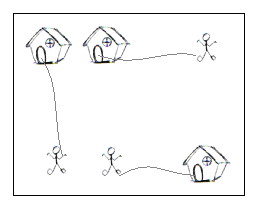
You can think of each point on the grid map as a quite large square, so it can hold n little men at the same time; also, it is okay if a little man steps on a grid with a house without entering that house.
Your task is to compute the minimum amount of money you need to pay in order to send these n little men into those n different houses. The input is a map of the scenario, a '.' means an empty space, an 'H' represents a house on that point, and am 'm' indicates there is a little man on that point.
You can think of each point on the grid map as a quite large square, so it can hold n little men at the same time; also, it is okay if a little man steps on a grid with a house without entering that house.
Input
There are one or more test cases in the input. Each case starts with a line giving two integers N and M, where N is the number of rows of the map, and M is the number of columns. The rest of the input will be N lines describing
the map. You may assume both N and M are between 2 and 100, inclusive. There will be the same number of 'H's and 'm's on the map; and there will be at most 100 houses. Input will terminate with 0 0 for N and M.
Output
For each test case, output one line with the single integer, which is the minimum amount, in dollars, you need to pay.
Sample Input
2 2
.m
H.
5 5
HH..m
.....
.....
.....
mm..H
7 8
...H....
...H....
...H....
mmmHmmmm
...H....
...H....
...H....
0 0
Sample Output
2
10
28
题意:有n个人n个房子,开始时每个人都不在房子内,让每个人走一步需要消耗1元,每个房子里只能装一个人,人可以站在房子所在的点但不进入房子,也可以很多人站在一个点,要求让所有人都进到房子里的最小花费。
思路:求出每个人到每个房子的花费,令X集合为所有人的集合,Y集合为所有房子的集合,原问题就转化成了二分图的最优匹配。(坑爹的变量名居然和math库冲突了。。。)
代码:
#include<iostream>
#include<cstdio>
//#include<cmath>
#include<algorithm>
#include<cstring>
#include<string>
#include<vector>
#include<queue>
#include<ctype.h>
#include<bitset>
#include<map>
# pragma comment (linker,"/STACK:16777216")

using namespace std;

const int MAXN = 205;
const int INF  = 2100000000;
const double esp = 1e-9;

class Point
{
    public:
    int row, col;
};
Point man[MAXN];
Point house[MAXN];

int xn, yn;
int n, m;
int mat[MAXN][MAXN];
bool visx[MAXN], visy[MAXN];
int slack[MAXN];
int link[MAXN];
int lx[MAXN], ly[MAXN];

bool find(int x)
{
    visx[x] = 1;
    for(int i = 1; i < yn; i++)
    {
        if(!visy[i] && mat[x][i] != 0)
        {
            int temp = lx[x] + ly[i] - mat[x][i];

            if(temp == 0)
            {
                visy[i] = 1;
                if(!link[i] || find(link[i]))
                {
                    link[i] = x;
                    return 1;
                }
            }
            else
            {
                slack[i] = min(slack[i], temp);
            }
        }
    }
    return 0;
}

void km()
{
    memset(ly, 0, sizeof(ly));

    for(int i = 1; i < xn; i++)
    {
        lx[i] = -INF;
        for(int j = 1; j < yn; j++)
        {
            lx[i] = max(lx[i], mat[i][j]);
        }
    }

    for(int i = 1; i < xn; i++)
    {
        memset(slack, 127, sizeof(slack));
        while(1)
        {
            memset(visy, 0, sizeof(visy));
            memset(visx, 0, sizeof(visx));

            if(find(i)) break;

            int d = INF;
            for(int j = 1; j < yn; j++)
            if(!visy[j]) d = min(d, slack[j]);

            for(int j = 1; j < xn; j++)
            {
                if(visx[j]) lx[j] -= d;
            }

            for(int j = 1; j < yn; j++)
            {
                if(visy[j]) ly[j] += d;
                else
                {
                    slack[j] -= d;
                }
            }
        }
    }

}

int main()
{
    //freopen("C:/Users/zts/Desktop/in.txt", "r", stdin);
    while(cin >> n >> m && n)
    {
        xn = yn = 1;
        memset(link, 0, sizeof(link));
        memset(mat, -127, sizeof(mat));

        char temp;
        for(int i = 1; i <= n; i++)
        {
            for(int j = 1; j <= m; j++)
            {
                cin >> temp;
                if(temp == 'm') man[xn].row = i, man[xn].col = j, xn++;
                else if(temp == 'H') house[yn].row = i, house[yn].col = j, yn++;
            }
        }

        for(int i = 1; i < xn; i++)
        {
            for(int j = 1; j < yn; j++)
            {
                mat[i][j] = -(abs(man[i].row - house[j].row) + abs(man[i].col - house[j].col));
            }
        }

        km();

        int ans = 0;

        for(int i = 1; i < yn; i++)
        {
            if(link[i] != 0)
            {
                ans += mat[link[i]][i];
            }
        }

        cout << -ans << endl;
    }

        return 0;
}





 扫一扫
扫一扫


 1996
1996

 被折叠的 条评论
为什么被折叠?
被折叠的 条评论
为什么被折叠?
 到【灌水乐园】发言





