

Machine Learning Yearning28~30

本文介绍了如何通过绘制学习曲线来评估模型的偏差和方差,并据此判断是否需要更多训练数据。通过对比训练误差和测试误差,我们可以了解当前模型的状态,并决定是否继续增加数据。

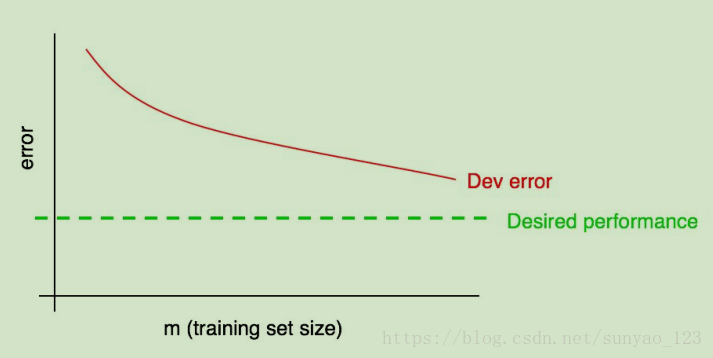
1.通过画学习曲线来观察。学习曲线:横坐标是不同数量的训练样本,纵坐标是dev set的error。随着训练样本的增加,error降低。一般来说,我们有一个期望误差率,希望网络能够达到。比如:人类的误差率;直觉上任务应该达到的误差率;长期目标需要达到的误差率。
这里写图片描述
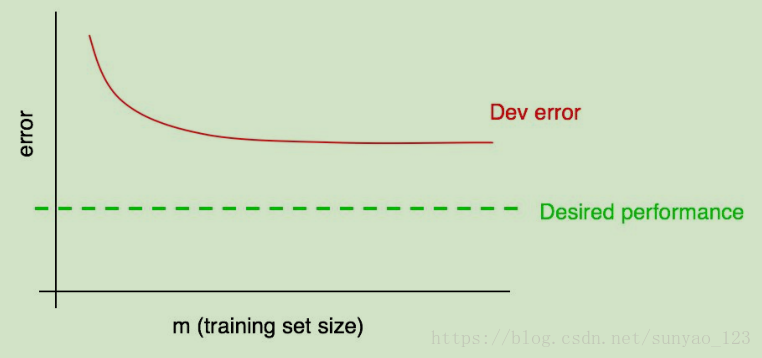
通过观察上述曲线,可以推断还需要多少训练样本才能达到期望误差率。但是如果误差曲线最后是平的:
这里写图片描述
那么,通过增加训练数据是不能够达到我们的要求的。通过这个曲线,我们就不需要去花费精力收集数据。
如果仅仅看dev集误差率,很难推断使用更多的数据,这个误差率最终达到什么程度,这个时候,我们就可以使用训练误差。

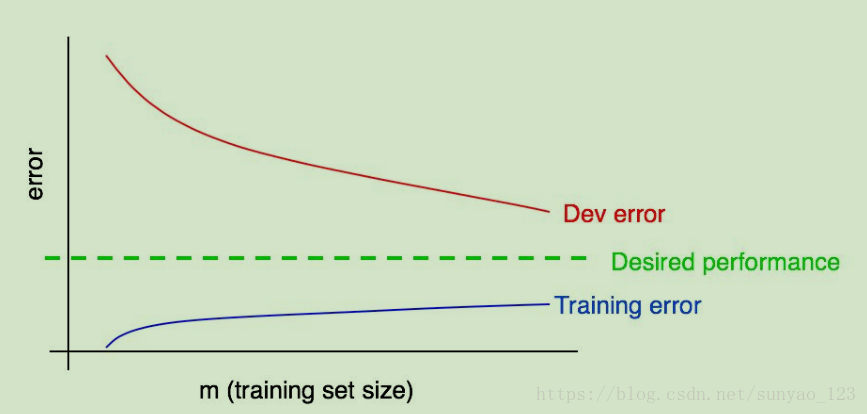
2.我们的测试误差随着训练数据的增多而下降,但是训练误差会随着训练数据的增加而增加。
这里写图片描述
虽然训练误差在增长,但是小于测试误差。
上边说,如果测试误差随着训练数据的增加基本不在下降,那么单单通过测试误差不能确定增加训练数据是否使得测试误差达到什么程度。因为可能是测试集的问题(比如测试集较小,这个曲线噪声较大)。
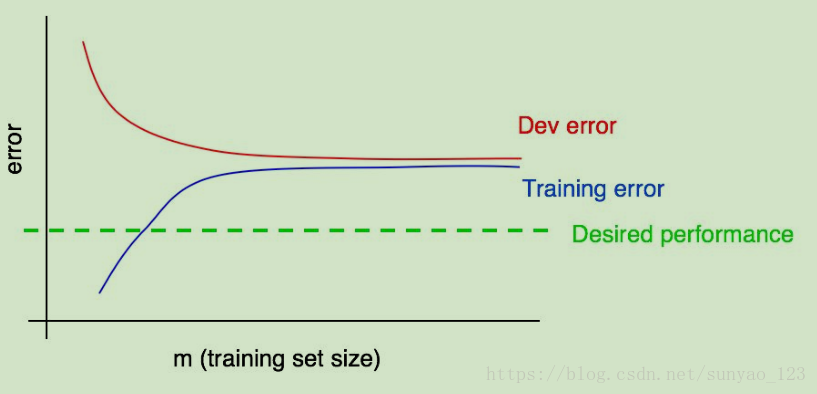
如果图是这样的:
这里写图片描述
我们就可以自信的说,增加训练数据永远不能降低测试误差,因为训练误差高于期望误差,网络已经是高bias。由于测试误差和训练误差接近,variance较低。
当然这些分析有一个前提是:一般来说,训练误差小于测试误差。
所以最好画出完整的(使用所有的训练数据)训练,测试误差曲线。

Table of Contents (draft) Why Machine Learning Strategy 4 ........................................................................................... How to use this book to help your team 6 ................................................................................ Prerequisites and Notation 7 .................................................................................................... Scale drives machine learning progress 8 ................................................................................ Your development and test sets 11 ............................................................................................ Your dev and test sets should come from the same distribution 13 ........................................ How large do the dev/test sets need to be? 15 .......................................................................... Establish a single-number evaluation metric for your team to optimize 16 ........................... Optimizing and satisficing metrics 18 ..................................................................................... Having a dev set and metric speeds up iterations 20 ............................................................... When to change dev/test sets and metrics 21 .......................................................................... Takeaways: Setting up development and test sets 23 .............................................................. Build your first system quickly, then iterate 25 ........................................................................ Error analysis: Look at dev set examples to evaluate ideas 26 ................................................ Evaluate multiple ideas in parallel during error analysis 28 ................................................... If you have a large dev set, split it into two subsets, only one of which you look at 30 ........... How big should the Eyeball and Blackbox dev sets be? 32 ...................................................... Takeaways: Basic error analysis 34 .......................................................................................... Bias and Variance: The two big sources of error 36 ................................................................. Examples of Bias and Variance 38 ............................................................................................ Comparing to the optimal error rate 39 ................................................................................... Addressing Bias and Variance 41 .............................................................................................. Bias vs. Variance tradeoff 42 ..................................................................................................... Techniques for reducing avoidable bias 43 .............................................................................. Techniques for reducing Variance 44 ....................................................................................... Error analysis on the training set 46 ........................................................................................ Diagnosing bias and variance: Learning curves 48 ................................................................. Plotting training error 50 .......................................................................................................... Interpreting learning curves: High bias 51 ............................................................................... Interpreting learning curves: Other cases 53 .......................................................................... Plotting learning curves 55 ....................................................................................................... Why we compare to human-level performance 58 .................................................................. How to define human-level performance 60 ........................................................................... Surpassing human-level performance 61 ................................................................................ Why train and test on different distributions 63 ...................................................................... Page!2 Machine Learning Yearning-Draft V0.5 Andrew NgWhether to use all your data 65 ................................................................................................ Whether to include inconsistent data 67 .................................................................................. Weighting data 68 .................................................................................................................... Generalizing from the training set to the dev set 69 ................................................................ Addressing Bias and Variance 71 ............................................................................................. Addressing data mismatch 72 ................................................................................................... Artificial data synthesis 73 ........................................................................................................ The Optimization Verification test 76 ...................................................................................... General form of Optimization Verification test 78 ................................................................... Reinforcement learning example 79 ......................................................................................... The rise of end-to-end learning 82 ........................................................................................... More end-to-end learning examples 84 .................................................................................. Pros and cons of end-to-end learning 86 ................................................................................ Learned sub-components 88 .................................................................................................... Directly learning rich outputs 89 .............................................................................................. Error Analysis by Parts 93 ....................................................................................................... Beyond supervised learning: What’s next? 94 ......................................................................... Building a superhero team - Get your teammates to read this 96 ........................................... Big picture 98 ............................................................................................................................ Credits 99
评论 1
成就一亿技术人!
拼手气红包6.0元
还能输入1000个字符
 
红包 添加红包
表情包 插入表情
 条评论被折叠 查看
添加红包

请填写红包祝福语或标题

红包个数最小为10个

红包金额最低5元

当前余额3.43前往充值 >
需支付:10.00
成就一亿技术人!
领取后你会自动成为博主和红包主的粉丝 规则
hope_wisdom
发出的红包
实付
使用余额支付
点击重新获取
扫码支付
钱包余额 0

抵扣说明:

1.余额是钱包充值的虚拟货币,按照1:1的比例进行支付金额的抵扣。
2.余额无法直接购买下载,可以购买VIP、付费专栏及课程。

余额充值


