


 文章介绍了实值效用函数如何简化消费者理论中的偏好关系分析,强调了效用函数的连续性和不变性,以及边际效用和边际替代率的概念,通过实例说明了它们在商品组合比较中的应用。
From Preference Relation to Utility Function.
A real-valued utility function is then defined to represent the preference relation≿\succsim≿ and thus simplifies the analysis of many problems in consumer theory.
It has been proved that any binary relation that is complete, transitive, and continuous can be represented by a continuous real-valued utility function.[Barten and Böhm (1982). The classic reference is Debreu (1954).]
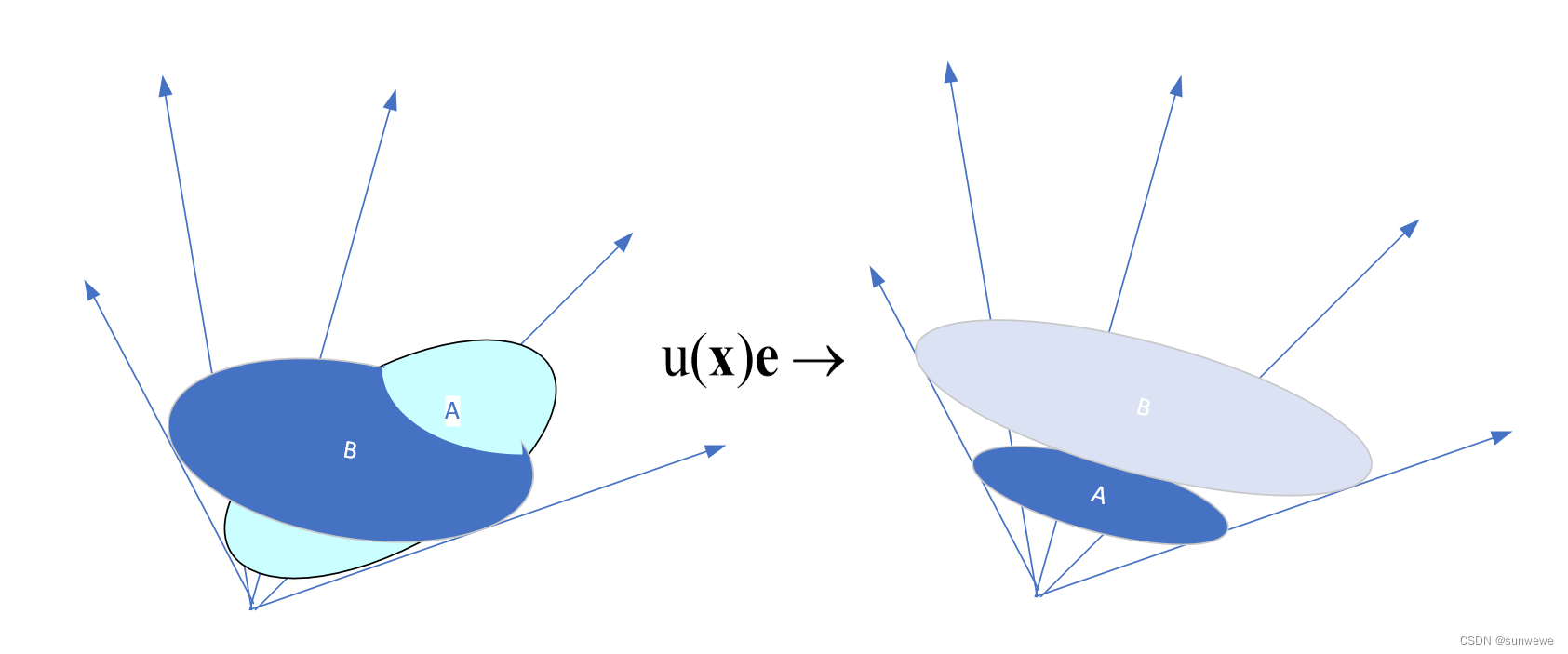
u(x)e∼x u(\mathbf{x})\mathbf{e}\sim\mathbf{x} u(x)e∼x
Equation1 provides a method to explains how the utility function works to maintain the preference relation. For any x\mathbf{x}x, which is a bundle of commodities, a number (utility) is assigned to it and the homogenous bundles of commodities u(x)eu(\mathbf{x})\mathbf{e}u(x)e then can be compared with each other at a more easy basis.
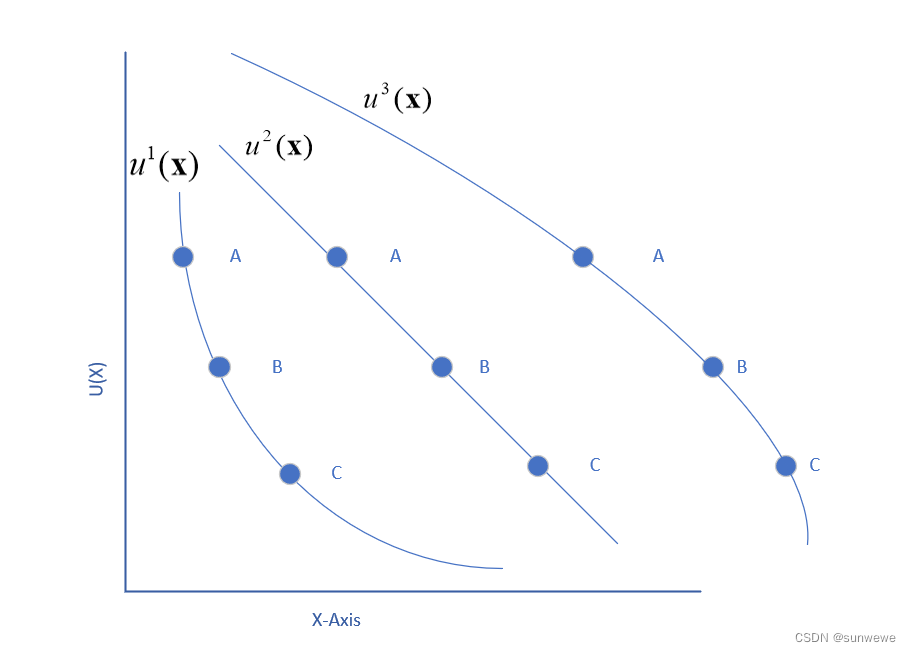
Then, we can use u(x)u(\mathbf{x})u(x) in a single axis to represent the preference relation.
x1≿x2⟺u(x1)≥u(x2)
\mathbf{x}^1\succsim\mathbf{x}^2\Longleftrightarrow u(\mathbf{x^1})\geq u(\mathbf{x}^2)
x1≿x2⟺u(x1)≥u(x2)
Concerning utility functions, they play the same function if they do the same ordering to the bundles of the commodities. People sometimes say the utility function is invariant to positive monotonic transform.
For a utility function, the Marginal Utility of good iii is the first-order derivative of u(x)u(\mathbf{x})u(x) with respect to xi\mathbf{x}_ixi.
MUxi=∂u(x)∂xi
MU_{\mathbf{x_i}}=\frac{\partial u(\mathbf{x})}{\partial \mathbf{x_i}}
MUxi=∂xi∂u(x)
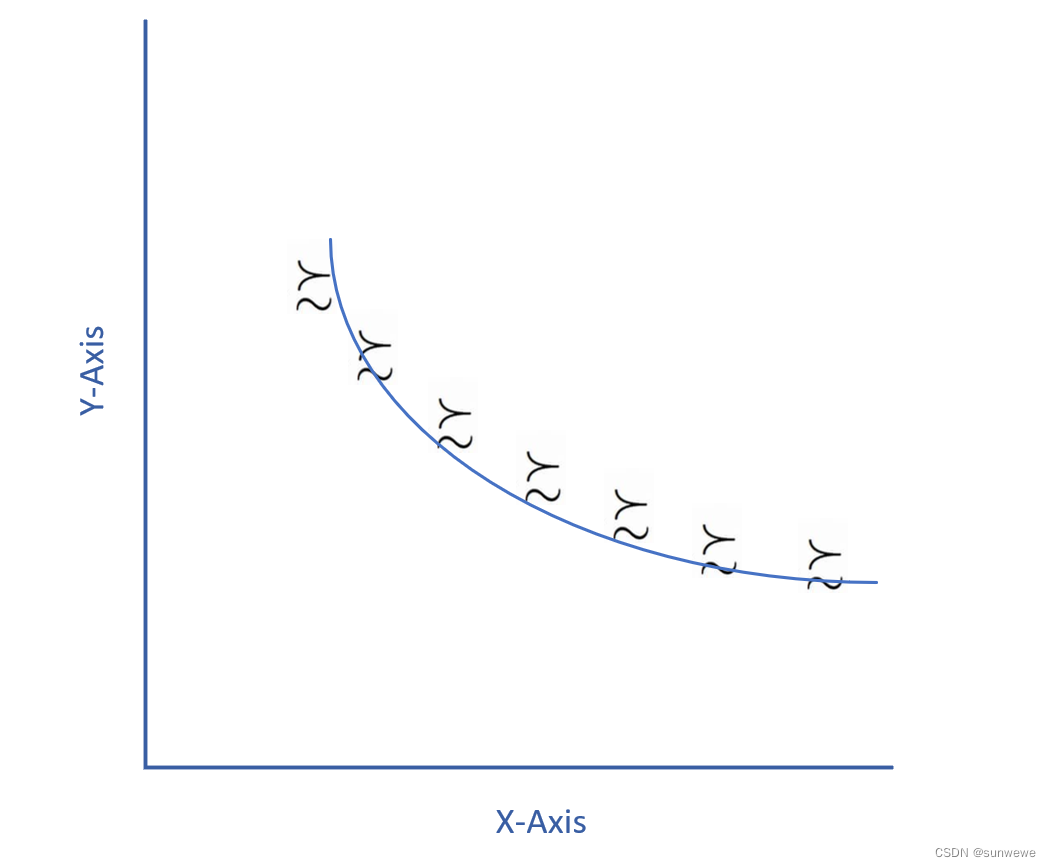
Take the example of a bundle of two goods<x1,x2><x_1, x_2><x1,x2>, if set u(x)u(\mathbf{x})u(x) as a constant value ccc, that is u(x1,f(x1))=cu(x_1,f(x_1))=cu(x1,f(x1))=c, the line of x2=f(x1)x_2=f(x_1)x2=f(x1) in x1,x2x_1, x_2x1,x2 planes can be drawn and the line is what we call the indifference line.
And the marginal rate of substitution(MRS) is defined as:
MRS12(x11,x21)≡∣f′(x11)∣=−f′(x11)
MRS_{12}(x_1^1,x_2^1)\equiv|f'(x_1^1)|=-f'(x_1^1)
MRS12(x11,x21)≡∣f′(x11)∣=−f′(x11)
As u(x1,f(x1))=cu(x_1,f(x_1))=cu(x1,f(x1))=c, its derivative with respect to x1x_1x1 must be 000.
∂u(x11,f(x11))∂x11+∂u(x11,f(x11))∂f(x11)f′(x11)=0
\frac{\partial u(x_1^1,f(x_1^1))}{\partial x_1^1}+\frac{\partial u(x_1^1,f(x_1^1))}{\partial f(x_1^1)}f'(x_1^1)=0
∂x11∂u(x11,f(x11))+∂f(x11)∂u(x11,f(x11))f′(x11)=0
Combine the last two equations, we define the MRS as:
MRS12(x1)=∂u(x1)/∂x11∂u(x1)/∂x21
MRS_{12}(\mathbf{x}^1)=\frac{\partial u(\mathbf{x}^1)/\partial\mathbf{x_1^1}}{\partial u(\mathbf{x}^1)/\partial\mathbf{x_2^1}}
MRS12(x1)=∂u(x1)/∂x21∂u(x1)/∂x11





 扫一扫
扫一扫


 2948
2948

 被折叠的 条评论
为什么被折叠?
被折叠的 条评论
为什么被折叠?
 到【灌水乐园】发言





