


 文章描述了一个关于骑士在不同尺寸棋盘上移动的问题,要求找出一条路径使骑士能访问每个方格一次。提出了使用深度优先搜索(DFS)策略来解决这个问题,并讨论了如何通过定义结构体优化DFS算法。给出了代码示例和处理不同起点的可能性。
骑士之旅
描述
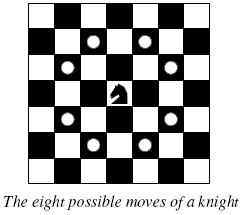
背景 骑士厌倦了一次又一次地看到相同的黑白方块,并决定环游世界。每当骑士移动时,它在一个方向上是两个正方形,一个垂直于这个方向的正方形。骑士的世界是他赖以生存的棋盘。我们的骑士生活在一个棋盘上,棋盘的面积比普通的 8 * 8 棋盘小,但它仍然是矩形的。你能帮助这位冒险的骑士制定旅行计划吗?
问题 找到一条路径,让骑士访问每个方块一次。骑士可以在棋盘的任何方块上开始和结束。
输入
输入以第一行的正整数 n 开头。以下行包含 n 个测试用例。
每个测试用例由一行组成,其中包含两个正整数 p 和 q,使得 1 <= p * q <= 26。
这表示一个 p * q 棋盘,其中 p 描述有多少个不同的平方数 1, . . . , p 存在,q 描述存在多少个不同的方格字母。
这些是拉丁字母表的第一个q字母:A。
输出
每个方案的输出都以包含"Scenario #i:"的行开头,其中 i 是从 1 开始的方案编号。
然后打印一行,其中包含按字典顺序排列的第一条路径,该路径访问棋盘的所有方块,骑士移动后跟一条空线。
路径应通过连接所访问的方块的名称在一行上给出。每个方格名称由一个大写字母后跟一个数字组成。 如果不存在这样的路径,则应在一行上输出不可能。
示例输入
3
1 1
2 3
4 3
示例输出
Scenario #1: A1 Scenario #2: impossible Scenario #3: A1B3C1A2B4C2A3B1C3A4B2C4
大致题意,给定一个棋盘的大小,骑士从任意点出发,访问棋盘上每一个点一次,有无这种可能
这题只是需要输出方法和可能性,那么可以用DFS,但是开始点是不确定的,所以有可能需要换开始点
但是这有一个显而易见的问题,从四个角落开始的话就是端点,端点的好处就是只能向外出,而除端点外的点开始的话。。。好吧,也不是不可能
打表
dx = [1, 1, -1, -1, 2, 2, -2, -2]
dy = [2, -2, 2, -2, 1, -1, 1, -1]
DFS
def DFS(x, y, a, b, t):
    if t >= a * b:
        print("路径是:")
    for i in range(8):
        xx = x + dx[i]
        yy = y + dy[i]
        if temp[xx][yy]:
            continue
        temp[xx][yy] = True
        DFS(xx, yy, a, b, t + 1)
        temp[xx][yy] = False
既然DFS需要传递这么多参数,再加上需要输出路径,为何不定义一个结构体呢?
结构体
class node:
    def __init__(self, x, y, t, action, points):
        self.x = x
        self.y = y
        self.t = t
        self.action = action
        self.points = points
DFS2.0
def DFS2(f):
    if f.t >= a * b:
        print(len(f.action))
        print(f.action)
        exit(0)
        #如果需要将所有方案输出可以用
        #return
    for i in range(8):
        xx = f.x + dx[i]
        yy = f.y + dy[i]
        if xx >= a or yy >= b:
            continue
        if xx < 0 or yy < 0:
            continue
        if temp[xx][yy]:
            continue
        temp[xx][yy] = True
        newnode = node(xx, yy, f.t + 1, [], [])
        newnode.action = copy.deepcopy(f.action)
        newnode.action.append(i)
        newnode.points = copy.deepcopy(f.points)
        newnode.points.append([xx + 1, yy + 1])
        DFS2(newnode)
        temp[xx][yy] = False
main
if __name__ == '__main__':
    a, b = map(int, input().split())

    for i in range(a):
        for j in range(b):
            #每次调用DFS前都需要将棋盘初始化
            #1.初始化temp记录有无走过
            temp = [[False for i in range(b)]for i in range(a)]
            temp[i][j] = True
            #DFS(i, j, a, b, 1)
            node1 = node(i, j, 1, [0], [[i + 1, j + 1]])
            DFS2(node1)
因为a, b是定义在main中的变量,在其他函数中可以访问到!
用deepcopy记得import copy
完整代码
import copy class node: def __init__(self, x, y, t, action, points): self.x = x self.y = y self.t = t self.action = action self.points = points def DFS2(f): if f.t >= a * b: print(len(f.action)) print(f.action) print(f.points) exit(0) #return for i in range(8): xx = f.x + dx[i] yy = f.y + dy[i] if xx >= a or yy >= b: continue if xx < 0 or yy < 0: continue if temp[xx][yy]: continue temp[xx][yy] = True newnode = node(xx, yy, f.t + 1, [], []) newnode.action = copy.deepcopy(f.action) newnode.action.append(i) newnode.points = copy.deepcopy(f.points) newnode.points.append([xx + 1, yy + 1]) DFS2(newnode) temp[xx][yy] = False if __name__ == '__main__': a, b = map(int, input().split()) dx = [1, 1, -1, -1, 2, 2, -2, -2] dy = [2, -2, 2, -2, 1, -1, 1, -1] for i in range(a): for j in range(b): # 每次调用DFS前都需要将棋盘初始化 # 1.初始化temp记录有无走过 temp = [[False for i in range(b) ]for i in range(a)] temp[i][j] = True # DFS(i, j, a, b, 1) node1 = node(i, j, 1, [0], [[i + 1, j + 1]]) DFS2(node1)
此代码输出
4 3 #输入
12 #步数
[0, 4, 6, 1, 4, 6, 1, 0, 7, 5, 2, 7] #每次的方案
[[1, 1], [3, 2], [1, 3], [2, 1], [4, 2], [2, 3], [3, 1], [4, 3], [2, 2], [4, 1], [3, 3], [1, 2]] #每次的地方





 扫一扫
扫一扫


 256
256


 到【灌水乐园】发言



