





 本文介绍了一个关于雷达安装的算法问题,旨在寻找覆盖多个岛屿所需的最少雷达数量。通过计算每个岛屿对应的雷达覆盖范围,并采用区间覆盖算法,实现了最优解。
Radar Installation
| Time Limit: 1000MS | Memory Limit: 10000K | |
| Total Submissions: 75460 | Accepted: 16897 |
Description
Assume the coasting is an infinite straight line. Land is in one side of coasting, sea in the other. Each small island is a point locating in the sea side. And any radar installation, locating on the coasting, can only cover d distance, so an island in the sea can be covered by a radius installation, if the distance between them is at most d.
We use Cartesian coordinate system, defining the coasting is the x-axis. The sea side is above x-axis, and the land side below. Given the position of each island in the sea, and given the distance of the coverage of the radar installation, your task is to write a program to find the minimal number of radar installations to cover all the islands. Note that the position of an island is represented by its x-y coordinates.
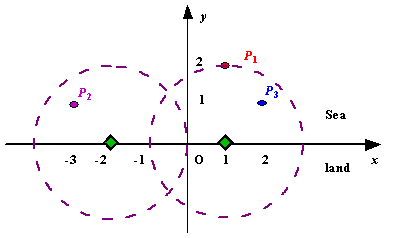
Figure A Sample Input of Radar Installations
We use Cartesian coordinate system, defining the coasting is the x-axis. The sea side is above x-axis, and the land side below. Given the position of each island in the sea, and given the distance of the coverage of the radar installation, your task is to write a program to find the minimal number of radar installations to cover all the islands. Note that the position of an island is represented by its x-y coordinates.
Figure A Sample Input of Radar Installations
Input
The input consists of several test cases. The first line of each case contains two integers n (1<=n<=1000) and d, where n is the number of islands in the sea and d is the distance of coverage of the radar installation. This is followed by n lines each containing two integers representing the coordinate of the position of each island. Then a blank line follows to separate the cases.
The input is terminated by a line containing pair of zeros
The input is terminated by a line containing pair of zeros
Output
For each test case output one line consisting of the test case number followed by the minimal number of radar installations needed. "-1" installation means no solution for that case.
Sample Input
3 2
1 2
-3 1
2 1

1 2
0 2

0 0
Sample Output
Case 1: 2
Case 2: 1
Source
题意:
有好多小岛屿,你需要在 x 轴布防雷达,了解动态,用来保护自己的领土捍卫自己的主权。
给定岛屿个数以及雷达的布防最大半径,求出雷达的最少安排。
没有满足方案输出 -1 。
参考思路:
首先以每个小岛屿的坐标为圆心,给定的雷达作用范围为半径画圆,与 x 轴的两个交点之间就是可以布控雷达的范围。
对各个交点按照左交点升序排列;
参考代码:
#include<stdio.h>
#include<stdlib.h>
#include<string.h>
#include<math.h>
#include<algorithm>
#define MYDD 1103

using namespace std;

struct Q {
	double x;
	double y;
	double left;
	double right;
} island[MYDD];

bool cmp_left(Q x,Q y) {
	return x.left<y.left;
}

int MIN(int x,int y) {
	return x<y? x:y;
}

int main() {
	double d;
	int n,v=1;
	while(scanf("%d%lf",&n,&d)&&(n||d)) {

		int flag=0;//记录是否有 d < island[j].y 有:flag=1
		for(int j=0; j<n; j++) {
			scanf("%lf%lf",&island[j].x,&island[j].y);
			island[j].left=island[j].x-sqrt(d*d-island[j].y*island[j].y);//左端点
			island[j].right=island[j].x+sqrt(d*d-island[j].y*island[j].y);//右端点
			if(d<island[j].y||d<0)//存在距离坐标轴有 y > d
				flag=1;
			if(island[j].y<0)//存在在海洋上的状态
				flag=1;
		}

		printf("Case %d: ",v++);
		if(flag) {
			puts("-1");
			continue;
		}

		sort(island,island+n,cmp_left);

		/*	double right=island[0].right;
				int ans=1,k=1;
				for(int j=1; j<n; j++) {
					if(island[j].right>right) {
						ans++;
						k=j;
						right=island[j].right;
					}
			 	}*/

		int ans=1;
		double temp=island[0].right;
		for(int i=0; i<n-1; i++)
			if(island[i+1].left>temp) {
				temp=island[i+1].right;
				ans++;
			} else if(island[i+1].right<temp)
				temp=island[i+1].right;

		printf("%d\n",ans);
	}
	return 0;
}

/*


3 2
1 2
-3 1
2 1

4 2
1 2
-3 1
2 1
3 -1
-1

8 5
2 4
-4 4
-3 3
-3 1
-3 0
-1 0
0 5
6 0
3


*/





 扫一扫
扫一扫


 被折叠的 条评论
为什么被折叠?
被折叠的 条评论
为什么被折叠?
 到【灌水乐园】发言





