


文章目录
AAC 组成
AAC音频格式:是⼀种由MPEG-4标准定义的有损⾳频压缩格式
ADTS:是AAC音频的传输流格式
AAC音频文件的每一帧由ADTS Header和AAC Audio Data组成
每⼀帧的ADTS的头⽂件都包含了⾳频的采样率,声道,帧⻓度等信息等,⼀般情况下ADTS的头信息都是7个字节,分为2部分:
adts_fixed_header(); // 固定头信息
adts_variable_header(); // 可变头信息
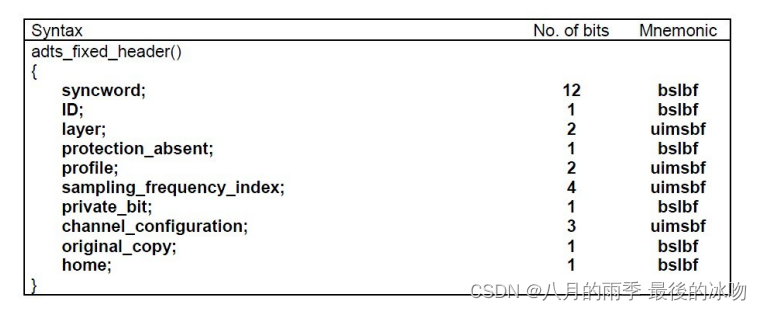
adts_fixed_header():
syncword :同步头 总是0xFFF, all bits must be 1,代表着⼀个ADTS帧的开始
Layer:always: ‘00’ 总是一字节的0
protection_absent:表示是否误码校验。
profile:表示使⽤哪个级别的AAC
adts_variable_header():
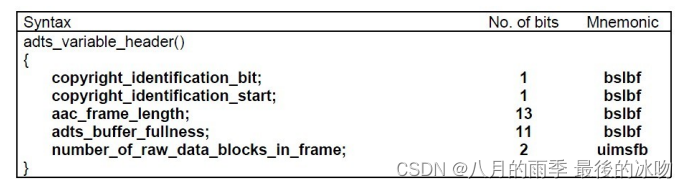
frame_length : ⼀个ADTS帧的⻓度包括ADTS头和AAC原始流
size(head) + size(AACFrame)
adts_buffer_fullness:0x7FF 说明是码率可变的码流
说number_of_raw_data_blocks_in_frame : 值为 0, 表示说ADTS帧中有⼀个AAC数据块
函数分析
读aac帧
函数: int av_read_frame(AVFormatContext *s, AVPacket *pkt);
先定义AVPacket pkt对象,初始化,在while循环中读取数据帧
 	AVPacket pkt;
 // 初始化packet
    av_init_packet(&pkt);
	while (av_read_frame(ifmt_ctx, &pkt) >=0 ) {
	//...
}
写aac帧
c标准库fopen创建文件aac文件,通过fwrite写文件,因为av_read_frame读取内容不包含head,所以需要先写adts head,再写adts data ,为完整一帧aac数据。
	FILE *aac_fd = NULL;
	aac_fd = fopen(aac_filename, "wb");
	while(av_read_frame(ifmt_ctx, &pkt) >=0) {
		char adts_header_buf[7] = {0};
		fwrite(adts_header_buf, 1, 7, aac_fd);
		fwrite( pkt.data, 1, pkt.size, aac_fd);
		// ...
	}
aac的head参数设置
根据ADTS的head表设置变量值,如设置syncword变量值
如,syncword 值为 0xFFF, 需要2个字节的空间, 一个指针为4个字节,字节排序为大端序(数据的地位字节放到内存的高位地址)
int adts_header(char * const p_adts_header, const int data_length,
const int profile, const int samplerate,
const int channels)
/*
p _adts_header: 输出的ADTS头缓冲区
data_length: AAC原始数据长度
profile: AAC编码配置(如LC、HE等)
samplerate: 采样率
channels: 声道数
*/
{
int sampling_frequency_index = 3; // 默认使用48000hz
int adtsLen = data_length + 7;
int frequencies_size = sizeof(sampling_frequencies) / sizeof(sampling_frequencies[0]);
int i = 0;
for(i = 0; i < frequencies_size; i++)
{
if(sampling_frequencies[i] == samplerate)
{
sampling_frequency_index = i;
break;
}
}
if(i >= frequencies_size)
{
printf("unsupport samplerate:%d\n", samplerate);
return -1;
}
p_adts_header[0] = 0xff; //syncword:0xfff 高8bits
p_adts_header[1] = 0xf0; //syncword:0xfff 低4bits
p_adts_header[1] |= (0 << 3); //MPEG Version:0 for MPEG-4,1 for MPEG-2 1bit
p_adts_header[1] |= (0 << 1); //Layer:0 2bits
p_adts_header[1] |= 1; //protection absent:1 1bit
p_adts_header[2] = (profile)<<6; //profile:profile 2bits
p_adts_header[2] |= (sampling_frequency_index & 0x0f)<<2; //sampling frequency index:sampling_frequency_index 4bits
p_adts_header[2] |= (0 << 1); //private bit:0 1bit
p_adts_header[2] |= (channels & 0x04)>>2; //channel configuration:channels 高1bit
p_adts_header[3] = (channels & 0x03)<<6; //channel configuration:channels 低2bits
p_adts_header[3] |= (0 << 5); //original:0 1bit
p_adts_header[3] |= (0 << 4); //home:0 1bit
p_adts_header[3] |= (0 << 3); //copyright id bit:0 1bit
p_adts_header[3] |= (0 << 2); //copyright id start:0 1bit
p_adts_header[3] |= ((adtsLen & 0x1800) >> 11); //frame length:value 高2bits
p_adts_header[4] = (uint8_t)((adtsLen & 0x7f8) >> 3); //frame length:value 中间8bits
p_adts_header[5] = (uint8_t)((adtsLen & 0x7) << 5); //frame length:value 低3bits
p_adts_header[5] |= 0x1f; //buffer fullness:0x7ff 高5bits
p_adts_header[6] = 0xfc; //11111100 //buffer fullness:0x7ff 低6bits
// number_of_raw_data_blocks_in_frame:
// 表示ADTS帧中有number_of_raw_data_blocks_in_frame + 1个AAC原始帧。
return 0;
}
char * const p_adts_header;
// syncword :同步头 总是0xFFF
p_adts_header[0] = 0xff;
//syncword:0xfff 高8bits
p_adts_header[1] = 0xf0;
//syncword:0xfff 低4bits
ADTS头结构解析(7字节)
第1字节 (0-7位)
p_adts_header[0] = 0xff;         // 同步字高8位: 0xFF
p_adts_header[1] = 0xf0;         // 同步字低4位: 0xF
p_adts_header[1] |= (0 << 3);    // MPEG版本: 0=MPEG-4
p_adts_header[1] |= (0 << 1);    // Layer: 0
p_adts_header[1] |= 1;           // 无CRC保护: 1
第2字节 (8-15位)
p_adts_header[2] = (profile)<<6;            // AAC配置
p_adts_header[2] |= (sampling_frequency_index & 0x0f)<<2; // 采样率索引
p_adts_header[2] |= (0 << 1);               // 私有位: 0
p_adts_header[2] |= (channels & 0x04)>>2;   // 声道配置高1位
第3字节 (16-23位)
p_adts_header[3] = (channels & 0x03)<<6;    // 声道配置低2位
p_adts_header[3] |= (0 << 5);               // 原始位: 0
p_adts_header[3] |= (0 << 4);               // 家庭位: 0
p_adts_header[3] |= (0 << 3);               // 版权ID位: 0
p_adts_header[3] |= (0 << 2);               // 版权开始位: 0
p_adts_header[3] |= ((adtsLen & 0x1800) >> 11); // 帧长度高2位
第4-6字节 (24-47位)
p_adts_header[4] = (adtsLen & 0x7f8) >> 3;  // 帧长度中间8位
p_adts_header[5] = (adtsLen & 0x7) << 5;    // 帧长度低3位
p_adts_header[5] |= 0x1f;                   // 缓冲区充盈度高5位
p_adts_header[6] = 0xfc;                    // 缓冲区充盈度低6位
关键特性说明
采样率查找
将实际采样率映射到ADTS标准定义的索引值,例如:
- 44100 Hz → 索引4
- 48000 Hz → 索引3
帧长度计算
公式:
adtsLen = data_length + 7
包含ADTS头部的总长度,需拆分为高、中、低位存储。
声道配置
声道数(如双声道=2)需拆分为高低位:
- 高1位存储在
p_adts_header[2]的bit 0 - 低2位存储在
p_adts_header[3]的bit 7-6
缓冲区设置
固定值0x7FF(二进制11111111111),表示可变比特率(VBR)。
通过p_adts_header[5]和p_adts_header[6]组合实现:
p_adts_header[5] |= 0x1f;  // 高5位: 0b11111
p_adts_header[6] = 0xfc;   // 低6位: 0b111111
注:代码中0x1f和0xfc的位运算需确保与其他字段不冲突。
完成代码
用于从多媒体文件中提取AAC音频流并添加ADTS头的C程序
#include <stdio.h>
#include <libavutil/log.h>
#include <libavformat/avio.h>
#include <libavformat/avformat.h>
#define ADTS_HEADER_LEN 7;
const int sampling_frequencies[] = {
96000, // 0x0
88200, // 0x1
64000, // 0x2
48000, // 0x3
44100, // 0x4
32000, // 0x5
24000, // 0x6
22050, // 0x7
16000, // 0x8
12000, // 0x9
11025, // 0xa
8000 // 0xb
// 0xc d e f是保留的
};
int adts_header(char * const p_adts_header, const int data_length,
const int profile, const int samplerate,
const int channels)
{
int sampling_frequency_index = 3; // 默认使用48000hz
int adtsLen = data_length + 7;
int frequencies_size = sizeof(sampling_frequencies) / sizeof(sampling_frequencies[0]);
int i = 0;
for(i = 0; i < frequencies_size; i++)
{
if(sampling_frequencies[i] == samplerate)
{
sampling_frequency_index = i;
break;
}
}
if(i >= frequencies_size)
{
printf("unsupport samplerate:%d\n", samplerate);
return -1;
}
p_adts_header[0] = 0xff; //syncword:0xfff 高8bits
p_adts_header[1] = 0xf0; //syncword:0xfff 低4bits
p_adts_header[1] |= (0 << 3); //MPEG Version:0 for MPEG-4,1 for MPEG-2 1bit
p_adts_header[1] |= (0 << 1); //Layer:0 2bits
p_adts_header[1] |= 1; //protection absent:1 1bit
p_adts_header[2] = (profile)<<6; //profile:profile 2bits
p_adts_header[2] |= (sampling_frequency_index & 0x0f)<<2; //sampling frequency index:sampling_frequency_index 4bits
p_adts_header[2] |= (0 << 1); //private bit:0 1bit
p_adts_header[2] |= (channels & 0x04)>>2; //channel configuration:channels 高1bit
p_adts_header[3] = (channels & 0x03)<<6; //channel configuration:channels 低2bits
p_adts_header[3] |= (0 << 5); //original:0 1bit
p_adts_header[3] |= (0 << 4); //home:0 1bit
p_adts_header[3] |= (0 << 3); //copyright id bit:0 1bit
p_adts_header[3] |= (0 << 2); //copyright id start:0 1bit
p_adts_header[3] |= ((adtsLen & 0x1800) >> 11); //frame length:value 高2bits
p_adts_header[4] = (uint8_t)((adtsLen & 0x7f8) >> 3); //frame length:value 中间8bits
p_adts_header[5] = (uint8_t)((adtsLen & 0x7) << 5); //frame length:value 低3bits
p_adts_header[5] |= 0x1f; //buffer fullness:0x7ff 高5bits
p_adts_header[6] = 0xfc; //11111100 //buffer fullness:0x7ff 低6bits
// number_of_raw_data_blocks_in_frame:
// 表示ADTS帧中有number_of_raw_data_blocks_in_frame + 1个AAC原始帧。
return 0;
}
int main(int argc, char *argv[])
{
int ret = -1;
char errors[1024];
char *in_filename = NULL;
char *aac_filename = NULL;
FILE *aac_fd = NULL;
int audio_index = -1;
int len = 0;
AVFormatContext *ifmt_ctx = NULL;
AVPacket pkt;
// 设置打印级别
av_log_set_level(AV_LOG_DEBUG);
if(argc < 3)
{
av_log(NULL, AV_LOG_DEBUG, "the count of parameters should be more than three!\n");
return -1;
}
in_filename = argv[1]; // 输入文件
aac_filename = argv[2]; // 输出文件
if(in_filename == NULL || aac_filename == NULL)
{
av_log(NULL, AV_LOG_DEBUG, "src or dts file is null, plz check them!\n");
return -1;
}
aac_fd = fopen(aac_filename, "wb");
if (!aac_fd)
{
av_log(NULL, AV_LOG_DEBUG, "Could not open destination file %s\n", aac_filename);
return -1;
}
// 打开输入文件
if((ret = avformat_open_input(&ifmt_ctx, in_filename, NULL, NULL)) < 0)
{
av_strerror(ret, errors, 1024);
av_log(NULL, AV_LOG_DEBUG, "Could not open source file: %s, %d(%s)\n",
in_filename,
ret,
errors);
return -1;
}
// 获取解码器信息
if((ret = avformat_find_stream_info(ifmt_ctx, NULL)) < 0)
{
av_strerror(ret, errors, 1024);
av_log(NULL, AV_LOG_DEBUG, "failed to find stream information: %s, %d(%s)\n",
in_filename,
ret,
errors);
return -1;
}
// dump媒体信息
av_dump_format(ifmt_ctx, 0, in_filename, 0);
// 初始化packet
av_init_packet(&pkt);
// 查找audio对应的steam index
audio_index = av_find_best_stream(ifmt_ctx, AVMEDIA_TYPE_AUDIO, -1, -1, NULL, 0);
if(audio_index < 0)
{
av_log(NULL, AV_LOG_DEBUG, "Could not find %s stream in input file %s\n",
av_get_media_type_string(AVMEDIA_TYPE_AUDIO),
in_filename);
return AVERROR(EINVAL);
}
// 打印AAC级别
printf("audio profile:%d, FF_PROFILE_AAC_LOW:%d\n",
ifmt_ctx->streams[audio_index]->codecpar->profile,
FF_PROFILE_AAC_LOW);
if(ifmt_ctx->streams[audio_index]->codecpar->codec_id != AV_CODEC_ID_AAC)
{
printf("the media file no contain AAC stream, it's codec_id is %d\n",
ifmt_ctx->streams[audio_index]->codecpar->codec_id);
goto failed;
}
// 读取媒体文件,并把aac数据帧写入到本地文件
while(av_read_frame(ifmt_ctx, &pkt) >=0 )
{
if(pkt.stream_index == audio_index)
{
char adts_header_buf[7] = {0};
adts_header(adts_header_buf, pkt.size,
ifmt_ctx->streams[audio_index]->codecpar->profile,
ifmt_ctx->streams[audio_index]->codecpar->sample_rate,
ifmt_ctx->streams[audio_index]->codecpar->channels);
fwrite(adts_header_buf, 1, 7, aac_fd); // 写adts header , ts流不适用,ts流分离出来的packet带了adts header
len = fwrite( pkt.data, 1, pkt.size, aac_fd); // 写adts data
if(len != pkt.size)
{
av_log(NULL, AV_LOG_DEBUG, "warning, length of writed data isn't equal pkt.size(%d, %d)\n",
len,
pkt.size);
}
}
av_packet_unref(&pkt);
}
failed:
// 关闭输入文件
if(ifmt_ctx)
{
avformat_close_input(&ifmt_ctx);
}
if(aac_fd)
{
fclose(aac_fd);
}
return 0;
}





 扫一扫
扫一扫


 被折叠的 条评论
为什么被折叠?
被折叠的 条评论
为什么被折叠?
 到【灌水乐园】发言





