 Few-Shot NER综述:方法、挑战与突破



 本文总结了Few-shot Named Entity Recognition的研究,探讨了如何通过原型学习、噪声监督预训练和自训练应对NER中的少量标注问题。研究发现,噪声监督预训练在5-shot情况下表现最优,而自训练有效利用了未标记数据。三种方法结合可提升实际应用中的性能。
Few-Shot Named Entity Recognition: A Comprehensive Study
最近发现读论文get idea有点困难,不如参考大佬的笔记来做做总结,今天主要总结一下few-shot NER,这是一篇few-shot NER的综述《Few-Shot Named Entity Recognition: A Comprehensive Study》
1. Motivation
NER一种经典的方法是在PLM提供的表示之上添加一个线性分类器,并在域标签上使用交叉熵目标来微调整个模型,该方法很简单,且在几个基准上提供了强有力的结果。
但即使有了这些PLM,构建NER系统仍然是一项劳动密集型、耗时的任务。注释大量的域内标记标记语料库,需要丰富的领域知识和专家经验。然而,这与现实世界的应用程序场景形成了对比,后者只有非常有限数量的标记数据可用于新域。因此本文研究了一个具有挑战性但实际的研究问题:few-shot NER。本文做法如下:
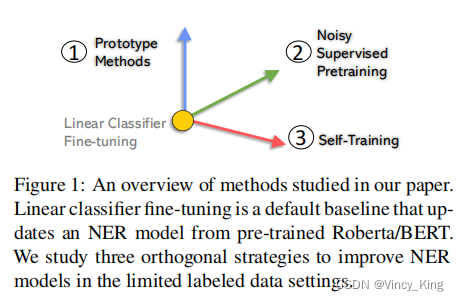
- 创建原型作为不同实体类型的表示,并通过最近邻标准分配标签(we create prototypes as the representations for different entity types, and assign labels via the nearest neighbor criterion)
- 不断地使用带有噪声标签的web数据进行预训练,这些数据可以大量使用,以提高NER的准确性和鲁棒性(we continuously pre-train PLMs using web data with noisy labels that is available in much larger quantities to improve NER accuracy and robustness)
- 使用未标记的域内标记,使用自训练来预测它们的软标签,并结合有限的标记数据进行半监督学习。(we employ unlabeled in-domain tokens to predict their soft labels using self-training, and perform semi-supervised learning in conjunction with the limited labeled data)
2. Contribution
- 第一次对前人很少研究的few-shot NER方面进行了系统的研究,并提出了三种不同的方案及其组合。(We present the first systematic study for few-shot NER, a problem that is previously little explored in the literature. Three distinctive schemes and their combinations are investigated.)
- 对来自不同领域的10个公共NER数据集对这些方案进行了综合比较。(We perform comprehensive comparisons of these schemes on 10 public NER datasets from different domains.)
- 与现有的在少镜头和无训练的NER设置上的方法相比,本文所提出的方案简单且实现了SoTA性能。(Compared with existing methods on few-shot and training-free NER settings , the proposed schemes achieve SoTA performance despite their simplicity.)
3. Background on Few-shot NER
3.1 Few-shot NER
一个序列标注任务,输入长度为 T , X = [ x 1 , x 2 , . . . , x T ] T,X=[x_1,x_2,...,x_T] T,X=[x1,x2,...,xT],输出为相应的 T T T长度标记序列 Y = [ y 1 , y 2 , . . . , y T ] , y ∈ Y Y=[y_1,y_2,...,y_T],y∈Y Y=[y1,y2,...,y
 最低0.47元/天 解锁文章






 扫一扫
扫一扫


 被折叠的 条评论
为什么被折叠?
被折叠的 条评论
为什么被折叠?
 到【灌水乐园】发言





