






 本文介绍如何使用OpenCV与YoloV3或YoloV4进行目标检测,包括在CPU和GPU上运行模型的方法。通过示例代码展示了从加载模型到后处理的全过程,并比较了不同设备上的检测效果。
#include <iostream>
#include <opencv2/opencv.hpp>
#include <fstream>
#include <sstream>
#include <iostream>

#include <opencv2/dnn.hpp>
#include <opencv2/imgproc.hpp>
#include <opencv2/highgui.hpp>
using namespace cv;
using namespace dnn;
using namespace std;

string pro_dir = "E:/vs2017Project/shareHW/shareHW/";


void coreM()
{

	Mat src = imread("15.png");

	imshow("Output", src);

	Mat Gray;
	cvtColor(src, Gray, 6);
	imshow("Gray", Gray);


	for (int i = 0; i < src.rows; i++)
	{
		for (int j = 0; j < src.cols; j++)
		{
			src.at<Vec3b>(i, j)[0] = 255;
			src.at<Vec3b>(i, j)[1] = 0;
			src.at<Vec3b>(i, j)[2] = 0;
		}
	}
	imshow("BGR", src);


	waitKey(0);
}

void imgprocM()
{
	Mat src = imread("lena.jpg");
	Mat src1 = src.clone();
	Mat dst, edge, gray;
	imshow("src", src);

	dst.create(src1.size(), src1.type());
	dst = Scalar::all(0);

	cvtColor(src1, gray, COLOR_BGR2GRAY);


	blur(gray, edge, Size(3, 3));


	Canny(edge, edge, 3, 9, 3);

	imshow("edge", edge);


	src1.copyTo(dst, edge);

	imshow("Ч��ͼ", dst);

	waitKey(0);

}

// Initialize the parameters
float confThreshold = 0.5; // Confidence threshold
float nmsThreshold = 0.4;  // Non-maximum suppression threshold
int inpWidth = 416;  // Width of network's input image
int inpHeight = 416; // Height of network's input image
vector<string> classes;

// Remove the bounding boxes with low confidence using non-maxima suppression
void postprocess(Mat& frame, const vector<Mat>& out);
// Draw the predicted bounding box
void drawPred(int classId, float conf, int left, int top, int right, int bottom, Mat& frame);
// Get the names of the output layers
vector<String> getOutputsNames(const Net& net);

void detect_image(string image_path, string modelWeights, string modelConfiguration, string classesFile);
void detect_video(string video_path, string modelWeights, string modelConfiguration, string classesFile);

void dnnM()
{
	// Give the configuration and weight files for the model
	String modelConfiguration = pro_dir + "cfg/yolov3_coco.cfg";
	String modelWeights = pro_dir + "cfg/yolov3_coco.weights";
	string classesFile = pro_dir + "data/models/yolov3/coco.names";
	string image_path = pro_dir + "data/images/bird.jpg";
	//detect_image(image_path, modelWeights, modelConfiguration, classesFile);
	string video_path = "12.avi";
	detect_video(video_path, modelWeights, modelConfiguration, classesFile);
}

int main()
{
	// coreM();
	// imgprocM();

	dnnM();

	return 0;
}


void detect_image(string image_path, string modelWeights, string modelConfiguration, string classesFile) {
	// Load names of classes
	ifstream ifs(classesFile.c_str());
	string line;
	while (getline(ifs, line)) classes.push_back(line);

	// Load the network
	Net net = readNetFromDarknet(modelConfiguration, modelWeights);
	net.setPreferableBackend(DNN_BACKEND_OPENCV);
	net.setPreferableTarget(DNN_TARGET_OPENCL);

	// Open a video file or an image file or a camera stream.
	string str, outputFile;
	cv::Mat frame = cv::imread(image_path);
	// Create a window
	static const string kWinName = "Deep learning object detection in OpenCV";
	namedWindow(kWinName, WINDOW_NORMAL);

	// Stop the program if reached end of video
	// Create a 4D blob from a frame.
	Mat blob;
	blobFromImage(frame, blob, 1 / 255.0, Size(inpWidth, inpHeight), Scalar(0, 0, 0), true, false);

	//Sets the input to the network
	net.setInput(blob);

	// Runs the forward pass to get output of the output layers
	vector<Mat> outs;
	net.forward(outs, getOutputsNames(net));

	// Remove the bounding boxes with low confidence
	postprocess(frame, outs);
	// Put efficiency information. The function getPerfProfile returns the overall time for inference(t) and the timings for each of the layers(in layersTimes)
	vector<double> layersTimes;
	double freq = getTickFrequency() / 1000;
	double t = net.getPerfProfile(layersTimes) / freq;
	string label = format("Inference time for a frame : %.2f ms", t);
	putText(frame, label, Point(0, 15), FONT_HERSHEY_SIMPLEX, 0.5, Scalar(0, 0, 255));
	// Write the frame with the detection boxes
	imshow(kWinName, frame);
	cv::waitKey(30);
}

void detect_video(string video_path, string modelWeights, string modelConfiguration, string classesFile) {
	string outputFile = "./yolo_out_cpp.avi";;
	// Load names of classes
	ifstream ifs(classesFile.c_str());
	string line;
	while (getline(ifs, line)) classes.push_back(line);

	// Load the network
	Net net = readNetFromDarknet(modelConfiguration, modelWeights);
	net.setPreferableBackend(DNN_BACKEND_OPENCV);
	net.setPreferableTarget(DNN_TARGET_CPU);


	// Open a video file or an image file or a camera stream.
	VideoCapture cap;
	//VideoWriter video;
	Mat frame, blob;

	try {
		// Open the video file
		ifstream ifile(video_path);
		if (!ifile) throw("error");
		cap.open(video_path);
	}
	catch (...) {
		cout << "Could not open the input image/video stream" << endl;
		return;
	}

	static const string kWinName = "Deep learning object detection in OpenCV";
	namedWindow(kWinName, WINDOW_NORMAL);

	while (waitKey(1) < 0)
	{
		// get frame from the video
		cap >> frame;

		// Stop the program if reached end of video
		if (frame.empty()) {
			cout << "Done processing !!!" << endl;
			cout << "Output file is stored as " << outputFile << endl;
			waitKey(3000);
			break;
		}
		// Create a 4D blob from a frame.
		blobFromImage(frame, blob, 1 / 255.0, Size(inpWidth, inpHeight), Scalar(0, 0, 0), true, false);

		//Sets the input to the network
		net.setInput(blob);

		// Runs the forward pass to get output of the output layers
		vector<Mat> outs;
		net.forward(outs, getOutputsNames(net));

		// Remove the bounding boxes with low confidence
		postprocess(frame, outs);

		// Put efficiency information. The function getPerfProfile returns the overall time for inference(t) and the timings for each of the layers(in layersTimes)
		vector<double> layersTimes;
		double freq = getTickFrequency() / 1000;
		double t = net.getPerfProfile(layersTimes) / freq;
		double FPS = 1 / (t / 1000);
		string label = format("FPS : %.2f", FPS);
		rectangle(frame, Size(0,0), Size(120, 20),Scalar(0, 0, 0), -1);
		putText(frame, label, Point(0, 15), FONT_HERSHEY_SIMPLEX, 0.5, Scalar(255, 255, 255),2);

		// Write the frame with the detection boxes
		Mat detectedFrame;
		frame.convertTo(detectedFrame, CV_8U);
		//video.write(detectedFrame);
		imshow(kWinName, frame);

	}
	cap.release();
}

// Remove the bounding boxes with low confidence using non-maxima suppression
void postprocess(Mat& frame, const vector<Mat>& outs)
{
	vector<int> classIds;
	vector<float> confidences;
	vector<Rect> boxes;

	for (size_t i = 0; i < outs.size(); ++i)
	{
		// Scan through all the bounding boxes output from the network and keep only the
		// ones with high confidence scores. Assign the box's class label as the class
		// with the highest score for the box.
		float* data = (float*)outs[i].data;
		for (int j = 0; j < outs[i].rows; ++j, data += outs[i].cols)
		{
			Mat scores = outs[i].row(j).colRange(5, outs[i].cols);
			Point classIdPoint;
			double confidence;
			// Get the value and location of the maximum score
			minMaxLoc(scores, 0, &confidence, 0, &classIdPoint);
			if (confidence > confThreshold)
			{
				int centerX = (int)(data[0] * frame.cols);
				int centerY = (int)(data[1] * frame.rows);
				int width = (int)(data[2] * frame.cols);
				int height = (int)(data[3] * frame.rows);
				int left = centerX - width / 2;
				int top = centerY - height / 2;

				classIds.push_back(classIdPoint.x);
				confidences.push_back((float)confidence);
				boxes.push_back(Rect(left, top, width, height));
			}
		}
	}

	// Perform non maximum suppression to eliminate redundant overlapping boxes with
	// lower confidences
	vector<int> indices;
	NMSBoxes(boxes, confidences, confThreshold, nmsThreshold, indices);
	for (size_t i = 0; i < indices.size(); ++i)
	{
		int idx = indices[i];
		Rect box = boxes[idx];
		drawPred(classIds[idx], confidences[idx], box.x, box.y,
			box.x + box.width, box.y + box.height, frame);
	}
}

// Draw the predicted bounding box
void drawPred(int classId, float conf, int left, int top, int right, int bottom, Mat& frame)
{
	//Draw a rectangle displaying the bounding box
	rectangle(frame, Point(left, top), Point(right, bottom), Scalar(255, 178, 50), 3);

	//Get the label for the class name and its confidence
	string label = format("%.2f", conf);
	if (!classes.empty())
	{
		CV_Assert(classId < (int)classes.size());
		label = classes[classId] + ":" + label;
	}

	//Display the label at the top of the bounding box
	int baseLine;
	Size labelSize = getTextSize(label, FONT_HERSHEY_SIMPLEX, 0.5, 1, &baseLine);
	top = max(top, labelSize.height);
	rectangle(frame, Point(left, top - round(1.5*labelSize.height)), Point(left + round(1.5*labelSize.width), top + baseLine), Scalar(255, 255, 255), FILLED);
	putText(frame, label, Point(left, top), FONT_HERSHEY_SIMPLEX, 0.75, Scalar(0, 0, 0), 1);
}

// Get the names of the output layers
vector<String> getOutputsNames(const Net& net)
{
	static vector<String> names;
	if (names.empty())
	{
		//Get the indices of the output layers, i.e. the layers with unconnected outputs
		vector<int> outLayers = net.getUnconnectedOutLayers();

		//get the names of all the layers in the network
		vector<String> layersNames = net.getLayerNames();

		// Get the names of the output layers in names
		names.resize(outLayers.size());
		for (size_t i = 0; i < outLayers.size(); ++i)
			names[i] = layersNames[outLayers[i] - 1];
	}
	return names;
}下面代码可以使用GPU或CPU调用YoloV3或者YoloV4,使用opencv是440版本,需要自己编译GPU版本。参考
#include <fstream>
#include <sstream>

#include <opencv2/dnn.hpp>
#include <opencv2/imgproc.hpp>
#include <opencv2/highgui.hpp>

using namespace cv;
using namespace dnn;

float confThreshold, nmsThreshold;
std::vector<std::string> classes;

void postprocess(Mat& frame, const std::vector<Mat>& out, Net& net);
void drawPred(int classId, float conf, int left, int top, int right, int bottom, Mat& frame);
void runningYoloV3();


int main(int argc, char** argv)
{
	runningYoloV3();
	return 0;
}

void runningYoloV3() {
	// 根据选择的检测模型文件进行配置
	confThreshold = 0.5;
	nmsThreshold = 0.4;
	float scale = 0.00392;
	Scalar mean = { 0,0,0 };
	bool swapRB = true;
	int inpWidth = 416;
	int inpHeight = 416;

	String modelPath = "./cfg/yolov3_coco.weights";   //"./cfg/yolov4_coco.weights"
	String configPath = "./cfg/yolov3_coco.cfg";      //"./cfg/yolov4_coco.weights"
	String classesFile = "./data/coco.names";
	String framework = "";

	// cpu
	//int backendId = cv::dnn::DNN_BACKEND_OPENCV;
	//int targetId = cv::dnn::DNN_TARGET_CPU;

	// gpu
	int backendId = cv::dnn::DNN_BACKEND_CUDA;
	int targetId = cv::dnn::DNN_TARGET_CUDA;


	// Open file with classes names.
	if (!classesFile.empty()) {
		const std::string& file = classesFile;
		std::ifstream ifs(file.c_str());
		if (!ifs.is_open())
			CV_Error(Error::StsError, "File " + file + " not found");
		std::string line;
		while (std::getline(ifs, line)) {
			classes.push_back(line);
		}
	}


	// Load a model.
	Net net = readNet(modelPath, configPath, framework);
	net.setPreferableBackend(backendId);
	net.setPreferableTarget(targetId);


	std::vector<String> outNames = net.getUnconnectedOutLayersNames();

	// Create a window
	static const std::string kWinName = "YoloV3 detect result";

	// Open a video file or an image file or a camera stream.
	VideoCapture cap;
	cap.open(0);

	// Process frames.
	Mat frame, blob;
	while (waitKey(1) < 0) {
		cap >> frame;
		if (frame.empty()) {
			waitKey();
			break;
		}

		double start_time = (double)cv::getTickCount();

		// Create a 4D blob from a frame.
		Size inpSize(inpWidth > 0 ? inpWidth : frame.cols,
			inpHeight > 0 ? inpHeight : frame.rows);
		blobFromImage(frame, blob, scale, inpSize, mean, swapRB, false);

		// Run a model.
		net.setInput(blob);
		if (net.getLayer(0)->outputNameToIndex("im_info") != -1)  // Faster-RCNN or R-FCN
		{
			resize(frame, frame, inpSize);
			Mat imInfo = (Mat_<float>(1, 3) << inpSize.height, inpSize.width, 1.6f);
			net.setInput(imInfo, "im_info");
		}

		std::vector<Mat> outs;
		net.forward(outs, outNames);
		postprocess(frame, outs, net);

		double end_time = (double)cv::getTickCount();
		double fps = cv::getTickFrequency() / (end_time - start_time);
		double spend_time = (end_time - start_time) / cv::getTickFrequency();
		std::string FPS = "FPS:" + cv::format("%.2f", fps) + "  spend time:" + cv::format("%.2f", spend_time * 1000) + "ms";
		putText(frame, FPS, Point(0, 15), FONT_HERSHEY_SIMPLEX, 0.5, Scalar(0, 255, 0));

		// Put efficiency information.
		//std::vector<double> layersTimes;
		//double freq = getTickFrequency() / 1000;
		//double t = net.getPerfProfile(layersTimes) / freq;
		//std::string label = format("Inference time: %.2f ms", t);
		//putText(frame, label, Point(0, 15), FONT_HERSHEY_SIMPLEX, 0.5, Scalar(0, 255, 0));

		imshow(kWinName, frame);
	}
}

void postprocess(Mat& frame, const std::vector<Mat>& outs, Net& net)
{
	static std::vector<int> outLayers = net.getUnconnectedOutLayers();
	static std::string outLayerType = net.getLayer(outLayers[0])->type;

	std::vector<int> classIds;
	std::vector<float> confidences;
	std::vector<Rect> boxes;
	if (net.getLayer(0)->outputNameToIndex("im_info") != -1)  // Faster-RCNN or R-FCN
	{
		// Network produces output blob with a shape 1x1xNx7 where N is a number of
		// detections and an every detection is a vector of values
		// [batchId, classId, confidence, left, top, right, bottom]
		CV_Assert(outs.size() == 1);
		float* data = (float*)outs[0].data;
		for (size_t i = 0; i < outs[0].total(); i += 7) {
			float confidence = data[i + 2];
			if (confidence > confThreshold) {
				int left = (int)data[i + 3];
				int top = (int)data[i + 4];
				int right = (int)data[i + 5];
				int bottom = (int)data[i + 6];
				int width = right - left + 1;
				int height = bottom - top + 1;
				classIds.push_back((int)(data[i + 1]) - 1);  // Skip 0th background class id.
				boxes.push_back(Rect(left, top, width, height));
				confidences.push_back(confidence);
			}
		}
	}
	else if (outLayerType == "DetectionOutput") {
		// Network produces output blob with a shape 1x1xNx7 where N is a number of
		// detections and an every detection is a vector of values
		// [batchId, classId, confidence, left, top, right, bottom]
		CV_Assert(outs.size() == 1);
		float* data = (float*)outs[0].data;
		for (size_t i = 0; i < outs[0].total(); i += 7) {
			float confidence = data[i + 2];
			if (confidence > confThreshold) {
				int left = (int)(data[i + 3] * frame.cols);
				int top = (int)(data[i + 4] * frame.rows);
				int right = (int)(data[i + 5] * frame.cols);
				int bottom = (int)(data[i + 6] * frame.rows);
				int width = right - left + 1;
				int height = bottom - top + 1;
				classIds.push_back((int)(data[i + 1]) - 1);  // Skip 0th background class id.
				boxes.push_back(Rect(left, top, width, height));
				confidences.push_back(confidence);
			}
		}
	}
	else if (outLayerType == "Region") {
		for (size_t i = 0; i < outs.size(); ++i) {
			// Network produces output blob with a shape NxC where N is a number of
			// detected objects and C is a number of classes + 4 where the first 4
			// numbers are [center_x, center_y, width, height]
			float* data = (float*)outs[i].data;
			for (int j = 0; j < outs[i].rows; ++j, data += outs[i].cols) {
				Mat scores = outs[i].row(j).colRange(5, outs[i].cols);
				Point classIdPoint;
				double confidence;
				minMaxLoc(scores, 0, &confidence, 0, &classIdPoint);
				if (confidence > confThreshold) {
					int centerX = (int)(data[0] * frame.cols);
					int centerY = (int)(data[1] * frame.rows);
					int width = (int)(data[2] * frame.cols);
					int height = (int)(data[3] * frame.rows);
					int left = centerX - width / 2;
					int top = centerY - height / 2;

					classIds.push_back(classIdPoint.x);
					confidences.push_back((float)confidence);
					boxes.push_back(Rect(left, top, width, height));
				}
			}
		}
	}
	else
		CV_Error(Error::StsNotImplemented, "Unknown output layer type: " + outLayerType);

	std::vector<int> indices;
	NMSBoxes(boxes, confidences, confThreshold, nmsThreshold, indices);
	for (size_t i = 0; i < indices.size(); ++i) {
		int idx = indices[i];
		Rect box = boxes[idx];
		drawPred(classIds[idx], confidences[idx], box.x, box.y,
			box.x + box.width, box.y + box.height, frame);
	}
}

void drawPred(int classId, float conf, int left, int top, int right, int bottom, Mat& frame)
{
	rectangle(frame, Point(left, top), Point(right, bottom), Scalar(0, 255, 0));

	std::string label = format("%.2f", conf);
	if (!classes.empty()) {
		CV_Assert(classId < (int)classes.size());
		label = classes[classId] + ": " + label;
	}

	int baseLine;
	Size labelSize = getTextSize(label, FONT_HERSHEY_SIMPLEX, 0.5, 1, &baseLine);

	top = max(top, labelSize.height);
	rectangle(frame, Point(left, top - labelSize.height),
		Point(left + labelSize.width, top + baseLine), Scalar::all(255), FILLED);
	putText(frame, label, Point(left, top), FONT_HERSHEY_SIMPLEX, 0.5, Scalar());
}
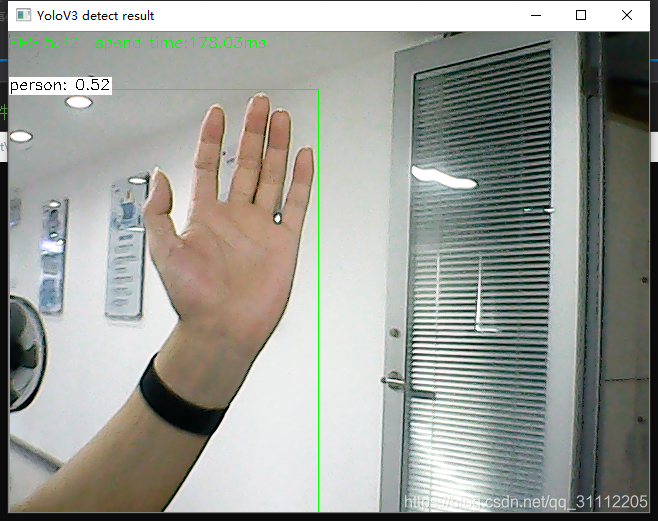
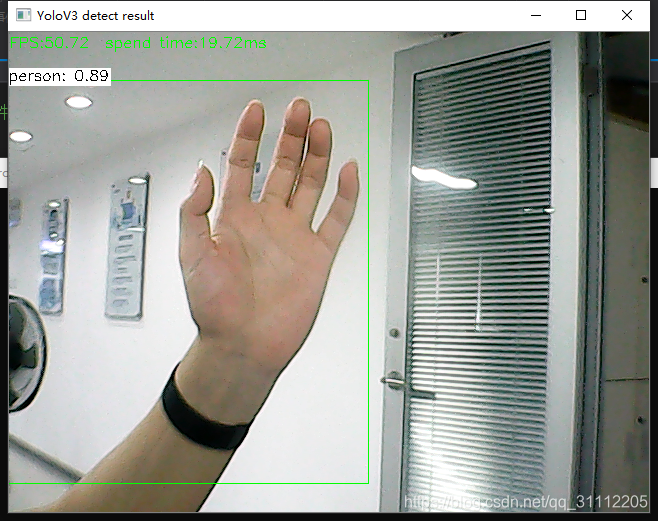
结果:
|
|






 扫一扫
扫一扫


 2243
2243


 到【灌水乐园】发言



