


 本文探讨了AVL树的自我平衡特性及其实现方式,并通过实例展示了如何进行节点插入、旋转调整及高度更新。文章还介绍了如何判断AVL树是否为完整二叉树,包括级序遍历的输出和完整性检查。
1123 Is It a Complete AVL Tree (30分)
An AVL tree is a self-balancing binary search tree. In an AVL tree, the heights of the two child subtrees of any node differ by at most one; if at any time they differ by more than one, rebalancing is done to restore this property. Figures 1-4 illustrate the rotation rules.
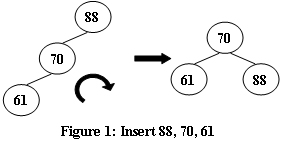
Now given a sequence of insertions, you are supposed to output the level-order traversal sequence of the resulting AVL tree, and to tell if it is a complete binary tree.
Input Specification:
Each input file contains one test case. For each case, the first line contains a positive integer N (≤ 20). Then N distinct integer keys are given in the next line. All the numbers in a line are separated by a space.
Output Specification:
For each test case, insert the keys one by one into an initially empty AVL tree. Then first print in a line the level-order traversal sequence of the resulting AVL tree. All the numbers in a line must be separated by a space, and there must be no extra space at the end of the line. Then in the next line, print YES if the tree is complete, or NO if not.
Sample Input 1:
5
88 70 61 63 65
Sample Output 1:
70 63 88 61 65
YES
Sample Input 2:
8
88 70 61 96 120 90 65 68
Sample Output 2:
88 65 96 61 70 90 120 68
NO
#include<bits/stdc++.h>
using namespace std;
vector<int> vi;
bool flag=true;
struct node{
	int val,height;
	node *lc,*rc;
	node(int v){
		val=v;
		height=1;
		lc=NULL;
		rc=NULL;
	}
};
int getHeight(node *root){
	if(root==NULL)return 0;
	else return root->height;
}
void updateHeight(node *&root){
	root->height=max(getHeight(root->lc),getHeight(root->rc))+1;
}
int getBalanceFactor(node *root){
	return getHeight(root->lc)- getHeight(root->rc);
}
void L(node *&root){
	node *temp =root->rc;
	root->rc=temp->lc;
	temp->lc=root;
	updateHeight(root);
	updateHeight(temp);
	root = temp;
}
void R(node *&root){
	node *temp=root->lc;
	root->lc=temp->rc;
	temp->rc=root;
	updateHeight(root);
	updateHeight(temp);
	root=temp;
}
void insert(int v,node *&root){
	if(root==NULL){
		root=new node(v);
		return;
	}
	if(v==root->val){
		return;
	}else if(v < root->val){
		insert(v,root->lc);
		updateHeight(root);
		if(getBalanceFactor(root)==2){
			if(getBalanceFactor(root->lc)==1){
				R(root);
			}else if(getBalanceFactor(root->lc)==-1){
				L(root->lc);
				R(root);
			}
		}
	}else{
		insert(v,root->rc);//往右子树插入
		updateHeight(root);
		if(getBalanceFactor(root) == -2){
			if(getBalanceFactor(root->rc) == -1){//RR型
				L(root);
			}
			else if(getBalanceFactor(root->rc) == 1){//RL型
				R(root->rc);
				L(root);
			}
		}
	}
}
node *create(vector<int> &vi){
    node*root = NULL;
    for(int i=0;i<vi.size();i++){
    	insert(vi[i],root);
	}
	return root;
}
void lev(node *root){
	if(root==NULL)return;
	queue<node*> q;
	q.push(root);
	bool cc=true;
	while(!q.empty()){
		node* now = q.front();
		if(cc){
			cout<<now->val;
			cc=false;
		}else 	cout<<" "<<now->val;
		q.pop();
		if(now->lc!=NULL) q.push(now->lc);
		if(now->rc!=NULL) q.push(now->rc);
	}
}
bool dfs(node *root){
	if(root==NULL)return false;
	queue<node*> q;
	q.push(root);
	while(!q.empty()){
		node *now = q.front();
		q.pop();
		if(now->lc&&now->rc){
			q.push(now->lc);
			q.push(now->rc);
		}else if(now->lc==NULL && now->rc) {
			return false;
		}else {
			 if(now->rc==NULL && now->lc)q.push(now->lc);
			 while(!q.empty()){
                        node *p = q.front(); q.pop();
                        if(p->lc || p->rc)
                        return false;
             }
		}
	}
	return true;
}
int main(){
	int k,n;
	cin>>n;
	for(int i=0;i<n;i++){
		cin>>k;
		vi.push_back(k);
	}
	node *root = create(vi);
    lev(root);
    cout<<endl;

    if(dfs(root))cout<<"YES";
    else cout<<"NO";
	return 0;
}





 扫一扫
扫一扫


 715
715

 被折叠的 条评论
为什么被折叠?
被折叠的 条评论
为什么被折叠?
 到【灌水乐园】发言





