


 本文深入解析了Curve25519在有限域2^255-19内的并行计算方法,包括使用AVX2指令集进行的FieldElement表示和运算,以及基于Extend twisted坐标系的double和add算法。通过分析,揭示了如何将串行算法转化为高效的并行计算方案。
1. 引言
Curve25519 Field Element在有限域
2
255
−
19
2^{255}-19
2255−19域内,采用64bit 串行计算时,采用的是5个FieldElement51元素来表示一个Element;若采用32-bit AVX2并行计算,则每个Element由10个FieldElement2526元素来表示。
即对于某Curve25519 Field Element a,对应的32-bit AVX2表示为(其中
若
i
%
2
=
=
0
,
a
i
<
2
26
<
2
32
;
e
l
s
e
a
i
<
2
25
<
2
32
若\ i\%2==0,\ a_i<2^{26}<2^{32}; else\ a_i<2^{25}<2^{32}
若 i%2==0, ai<226<232;else ai<225<232):
| a 9 a_9 a9 | a 8 a_8 a8 | a 7 a_7 a7 | a 6 a_6 a6 | a 5 a_5 a5 | a 4 a_4 a4 | a 3 a_3 a3 | a 2 a_2 a2 | a 1 a_1 a1 | a 0 a_0 a0 |
|---|
/// Given an array of wide coefficients, reduce them to a `FieldElement2625x4`.
    ///
    /// # Postconditions
    ///
    /// The coefficients of the result are bounded with \\( b < 0.007 \\).
    #[inline]
    fn reduce64(mut z: [u64x4; 10]) -> FieldElement2625x4 {
        // These aren't const because splat isn't a const fn
        let LOW_25_BITS: u64x4 = u64x4::splat((1 << 25) - 1);
        let LOW_26_BITS: u64x4 = u64x4::splat((1 << 26) - 1);

        // Carry the value from limb i = 0..8 to limb i+1
        let carry = |z: &mut [u64x4; 10], i: usize| {
            debug_assert!(i < 9);
            if i % 2 == 0 {
                // Even limbs have 26 bits
                z[i + 1] = z[i + 1] + (z[i] >> 26);
                z[i] = z[i] & LOW_26_BITS;
            } else {
                // Odd limbs have 25 bits
                z[i + 1] = z[i + 1] + (z[i] >> 25);
                z[i] = z[i] & LOW_25_BITS;
            }
        };

        // Perform two halves of the carry chain in parallel.
        carry(&mut z, 0); carry(&mut z, 4);
        carry(&mut z, 1); carry(&mut z, 5);
        carry(&mut z, 2); carry(&mut z, 6);
        carry(&mut z, 3); carry(&mut z, 7);
        // Since z[3] < 2^64, c < 2^(64-25) = 2^39,
        // so    z[4] < 2^26 + 2^39 < 2^39.0002
        carry(&mut z, 4); carry(&mut z, 8);
        // Now z[4] < 2^26
        // and z[5] < 2^25 + 2^13.0002 < 2^25.0004 (good enough)

        // Last carry has a multiplication by 19.  In the serial case we
        // do a 64-bit multiplication by 19, but here we want to do a
        // 32-bit multiplication.  However, if we only know z[9] < 2^64,
        // the carry is bounded as c < 2^(64-25) = 2^39, which is too
        // big.  To ensure c < 2^32, we would need z[9] < 2^57.
        // Instead, we split the carry in two, with c = c_0 + c_1*2^26.

        let c = z[9] >> 25;
        z[9] = z[9] & LOW_25_BITS;
        let mut c0: u64x4 = c & LOW_26_BITS; // c0 < 2^26;
        let mut c1: u64x4 = c >> 26;         // c1 < 2^(39-26) = 2^13;

        unsafe {
            use core::arch::x86_64::_mm256_mul_epu32;
            let x19 = u64x4::splat(19);
            c0 = _mm256_mul_epu32(c0.into_bits(), x19.into_bits()).into_bits(); // c0 < 2^30.25
            c1 = _mm256_mul_epu32(c1.into_bits(), x19.into_bits()).into_bits(); // c1 < 2^17.25
        }

        z[0] = z[0] + c0; // z0 < 2^26 + 2^30.25 < 2^30.33
        z[1] = z[1] + c1; // z1 < 2^25 + 2^17.25 < 2^25.0067
        carry(&mut z, 0); // z0 < 2^26, z1 < 2^25.0067 + 2^4.33 = 2^25.007

        // The output coefficients are bounded with
        //
        // b = 0.007  for z[1]
        // b = 0.0004 for z[5]
        // b = 0      for other z[i].
        //
        // So the packed result is bounded with b = 0.007.
        FieldElement2625x4([
            repack_pair(z[0].into_bits(), z[1].into_bits()),
            repack_pair(z[2].into_bits(), z[3].into_bits()),
            repack_pair(z[4].into_bits(), z[5].into_bits()),
            repack_pair(z[6].into_bits(), z[7].into_bits()),
            repack_pair(z[8].into_bits(), z[9].into_bits()),
        ])
    }
2. vector (a,b,c,d)表示
根据博客CPU指令集——AVX2第四节内容有:


所以有:
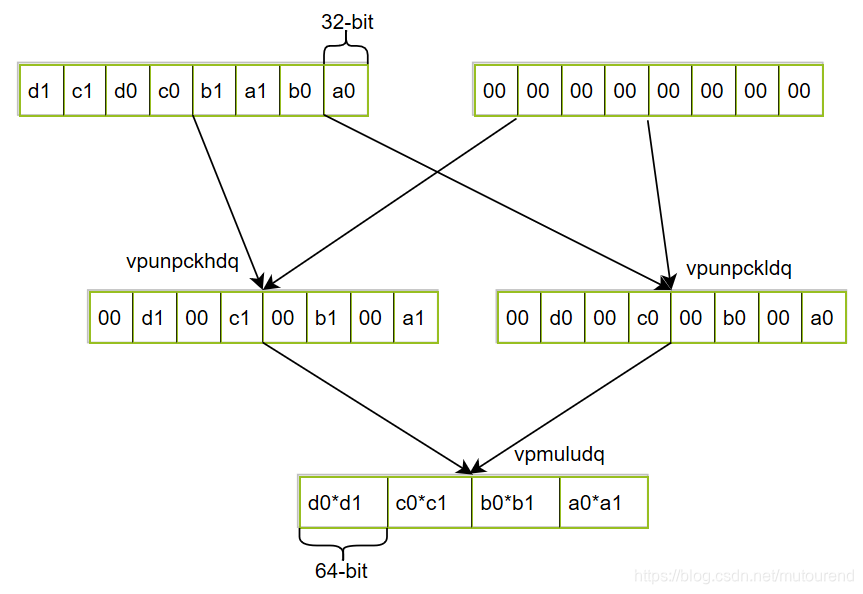
对于4 field elements vector
(
a
,
b
,
c
,
d
)
(a,b,c,d)
(a,b,c,d)可以
[
u
32
×
8
;
5
]
[u32\times8;5]
[u32×8;5]数组(以little-endian形式)来表示:
(
a
0
,
b
0
,
a
1
,
b
1
,
c
0
,
d
0
,
c
1
,
d
1
)
(a_0,b_0,a_1,b_1,c_0,d_0,c_1,d_1)
(a0,b0,a1,b1,c0,d0,c1,d1)
(
a
2
,
b
2
,
a
3
,
b
3
,
c
2
,
d
2
,
c
3
,
d
3
)
(a_2,b_2,a_3,b_3,c_2,d_2,c_3,d_3)
(a2,b2,a3,b3,c2,d2,c3,d3)
(
a
4
,
b
4
,
a
5
,
b
5
,
c
4
,
d
4
,
c
5
,
d
5
)
(a_4,b_4,a_5,b_5,c_4,d_4,c_5,d_5)
(a4,b4,a5,b5,c4,d4,c5,d5)
(
a
6
,
b
6
,
a
7
,
b
7
,
c
6
,
d
6
,
c
7
,
d
7
)
(a_6,b_6,a_7,b_7,c_6,d_6,c_7,d_7)
(a6,b6,a7,b7,c6,d6,c7,d7)
(
a
8
,
b
8
,
a
9
,
b
9
,
c
8
,
d
8
,
c
9
,
d
9
)
(a_8,b_8,a_9,b_9,c_8,d_8,c_9,d_9)
(a8,b8,a9,b9,c8,d8,c9,d9)
亦即对于4 field elements vector ( a , b , c , d ) (a,b,c,d) (a,b,c,d),可以FieldElement2625x4表示为:
/// A vector of four field elements.
///
/// Each operation on a `FieldElement2625x4` has documented effects on
/// the bounds of the coefficients.  This API is designed for speed
/// and not safety; it is the caller's responsibility to ensure that
/// the post-conditions of one operation are compatible with the
/// pre-conditions of the next.
#[derive(Clone, Copy, Debug)]
pub struct FieldElement2625x4(pub(crate) [u32x8; 5]);
根据FieldElement2625x4与vector
(
a
,
b
,
c
,
d
)
(a,b,c,d)
(a,b,c,d)之间的相互转换需借助unpack_pair函数和repack_pair函数:
/// Unpack 32-bit lanes into 64-bit lanes:
/// ```ascii,no_run
/// (a0, b0, a1, b1, c0, d0, c1, d1)
/// ```
/// into
/// ```ascii,no_run
/// (a0, 0, b0, 0, c0, 0, d0, 0)
/// (a1, 0, b1, 0, c1, 0, d1, 0)
/// ```
#[inline(always)]
fn unpack_pair(src: u32x8) -> (u32x8, u32x8) {
    let a: u32x8;
    let b: u32x8;
    let zero = i32x8::new(0, 0, 0, 0, 0, 0, 0, 0);
    unsafe {
        use core::arch::x86_64::_mm256_unpackhi_epi32;
        use core::arch::x86_64::_mm256_unpacklo_epi32;
        a = _mm256_unpacklo_epi32(src.into_bits(), zero.into_bits()).into_bits();
        b = _mm256_unpackhi_epi32(src.into_bits(), zero.into_bits()).into_bits();
    }
    (a, b)
}
/// Repack 64-bit lanes into 32-bit lanes:
/// ```ascii,no_run
/// (a0, 0, b0, 0, c0, 0, d0, 0)
/// (a1, 0, b1, 0, c1, 0, d1, 0)
/// ```
/// into
/// ```ascii,no_run
/// (a0, b0, a1, b1, c0, d0, c1, d1)
/// ```
#[inline(always)]
fn repack_pair(x: u32x8, y: u32x8) -> u32x8 {
    unsafe {
        use core::arch::x86_64::_mm256_blend_epi32;
        use core::arch::x86_64::_mm256_shuffle_epi32;

        // Input: x = (a0, 0, b0, 0, c0, 0, d0, 0)
        // Input: y = (a1, 0, b1, 0, c1, 0, d1, 0)

        let x_shuffled = _mm256_shuffle_epi32(x.into_bits(), 0b11_01_10_00);
        let y_shuffled = _mm256_shuffle_epi32(y.into_bits(), 0b10_00_11_01);

        // x' = (a0, b0,  0,  0, c0, d0,  0,  0)
        // y' = ( 0,  0, a1, b1,  0,  0, c1, d1)

        return _mm256_blend_epi32(x_shuffled, y_shuffled, 0b11001100).into_bits();
    }
}
3. 对于Extend twisted坐标系表示的点 ( X 1 , Y 1 , Z 1 , T 1 ) (X_1,Y_1,Z_1,T_1) (X1,Y1,Z1,T1)的double/add运算
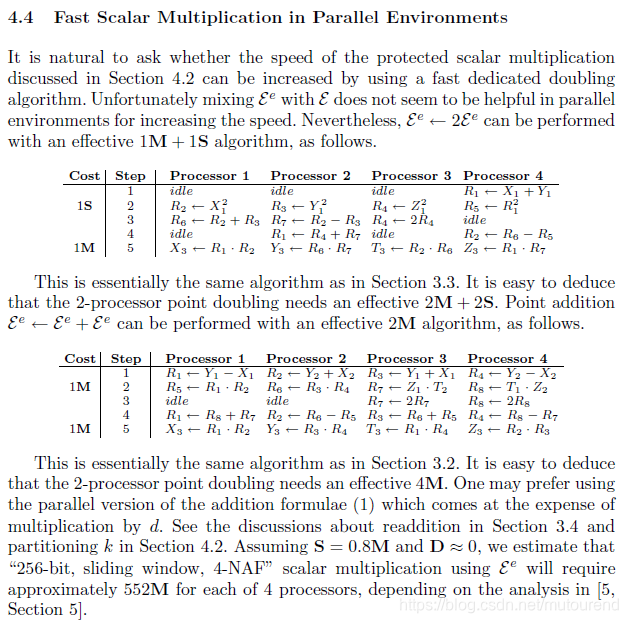
根据论文《Twisted Edwards Curves Revisited》中有相应的串行和并行运算算法:
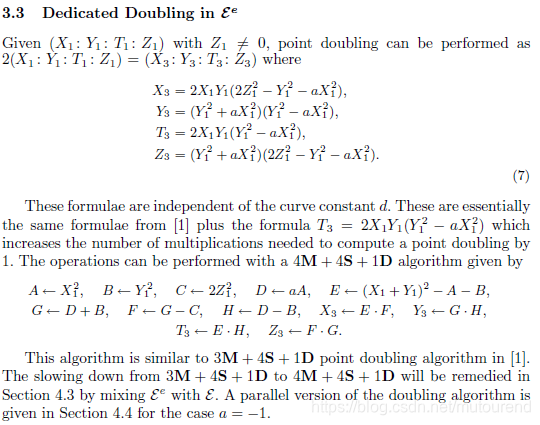
3.1 对于Extend twisted坐标系表示的点 ( X 1 , Y 1 , Z 1 , T 1 ) (X_1,Y_1,Z_1,T_1) (X1,Y1,Z1,T1)的double运算
double算法与实际代码实现中的映射关系为:
R
6
=
R
2
+
R
3
=
S
1
+
S
2
=
S
5
R_6=R_2+R_3=S_1+S_2=S_5
R6=R2+R3=S1+S2=S5
R
7
=
R
2
−
R
3
=
S
1
−
S
2
=
S
6
R_7=R_2-R_3=S_1-S_2=S_6
R7=R2−R3=S1−S2=S6
R
1
=
R
4
+
R
7
=
2
S
3
+
S
1
−
S
2
=
S
8
R_1=R_4+R_7=2S_3+S_1-S_2=S_8
R1=R4+R7=2S3+S1−S2=S8
R
2
=
R
6
−
R
5
=
S
1
+
S
2
−
S
4
=
S
9
R_2=R_6-R_5=S_1+S_2-S_4=S_9
R2=R6−R5=S1+S2−S4=S9
对应地有:
(
S
9
,
0
,
S
6
,
0
,
S
6
,
0
,
S
9
,
0
)
v
p
m
u
l
u
d
q
(
S
8
,
0
,
S
5
,
0
,
S
8
,
0
,
S
5
,
0
)
=
(
S
8
∗
S
9
,
S
6
∗
S
5
,
S
6
∗
S
8
,
S
9
∗
S
5
)
=
(
X
3
,
Y
3
,
Z
3
,
T
3
)
(S_9,0,S_6,0,S_6,0,S_9,0)\ vpmuludq\ (S_8,0,S_5,0,S_8,0,S_5,0)=(S_8*S_9,S_6*S_5,S_6*S_8,S_9*S_5)=(X_3,Y_3,Z_3,T_3)
(S9,0,S6,0,S6,0,S9,0) vpmuludq (S8,0,S5,0,S8,0,S5,0)=(S8∗S9,S6∗S5,S6∗S8,S9∗S5)=(X3,Y3,Z3,T3)
根据博客curve25519-dalek中field reduce原理分析可知,radix为25.5时有:
∵
2
255
∗
x
10
≡
19
m
o
d
(
2
255
−
19
)
,
w
h
e
n
x
=
1.
\because 2^{255}*x^{10} \equiv 19 \quad mod \quad (2^{255}-19), when\ x=1.
∵2255∗x10≡19mod(2255−19),when x=1.
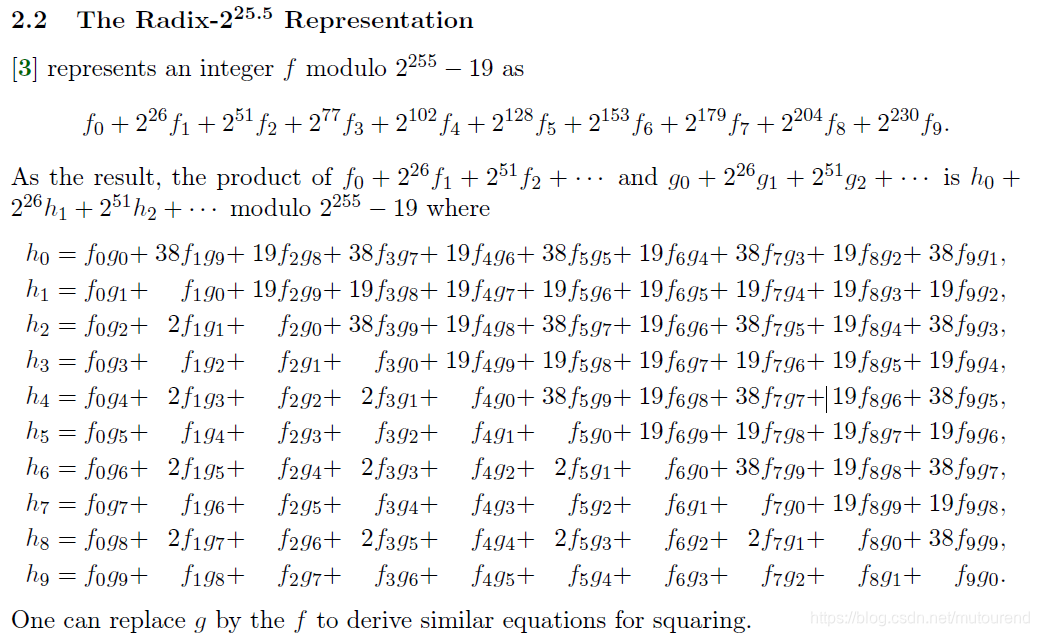
以及博客Curve25519 Field域2^255-19内的快速运算,以radix-25.5为例,符合avx2并行计算的设计。对于一个FieldElement,可表示为:
f
=
f
0
+
f
1
2
26
x
+
f
2
2
51
x
2
+
f
3
2
77
x
3
+
f
4
2
102
x
4
+
f
5
2
128
x
5
+
f
6
2
153
x
6
+
f
7
2
179
x
7
+
f
8
2
204
x
8
+
f
9
2
230
x
9
f=f_0+f_12^{26}x+f_22^{51}x^2+f_32^{77}x^3+f_42^{102}x^4+f_52^{128}x^5+f_62^{153}x^6+f_72^{179}x^7+f_82^{204}x^8+f_92^{230}x^9
f=f0+f1226x+f2251x2+f3277x3+f42102x4+f52128x5+f62153x6+f72179x7+f82204x8+f92230x9
g
=
g
0
+
g
1
2
26
x
+
g
2
2
51
x
2
+
g
3
2
77
x
3
+
g
4
2
102
x
4
+
g
5
2
128
x
5
+
g
6
2
153
x
6
+
g
7
2
179
x
7
+
g
8
2
204
x
8
+
g
9
2
230
x
9
g=g_0+g_12^{26}x+g_22^{51}x^2+g_32^{77}x^3+g_42^{102}x^4+g_52^{128}x^5+g_62^{153}x^6+g_72^{179}x^7+g_82^{204}x^8+g_92^{230}x^9
g=g0+g1226x+g2251x2+g3277x3+g42102x4+g52128x5+g62153x6+g72179x7+g82204x8+g92230x9
根据论文《Sandy2x: New Curve25519 Speed Records》有:
3.2 对于Extend twisted坐标系表示的点 ( X 1 , Y 1 , Z 1 , T 1 ) , ( X 2 , Y 2 , Z 2 , T 2 ) (X_1,Y_1,Z_1,T_1),(X_2,Y_2,Z_2,T_2) (X1,Y1,Z1,T1),(X2,Y2,Z2,T2)的add运算
论文《Twisted Edwards Curves Revisited》并行运算算法设计运行在不同的处理器上,实际软件实现并不可行,因为不同处理器之间的同步效率导致的延时不可接受。(The reason may be that HWCD08 describe their formulas as operating on four independent processors, which would make a software implementation impractical: all of the operations are too low-latency to effectively synchronize.)
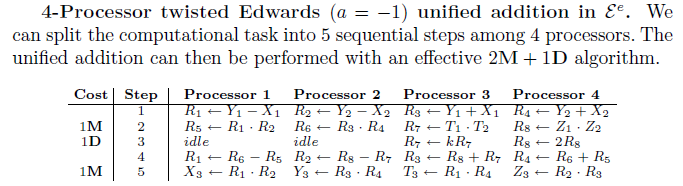
https://doc-internal.dalek.rs/curve25519_dalek/backend/vector/index.html中对以上算法进行了进一步梳理:
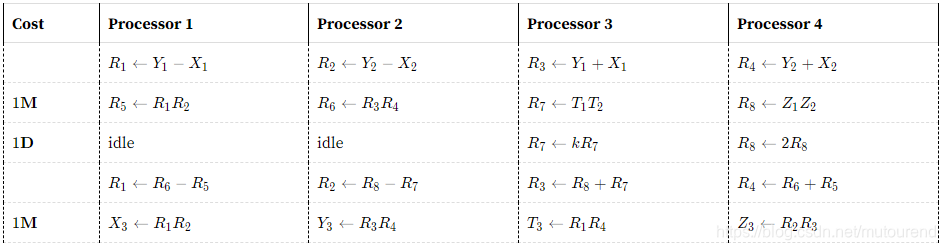
其中的M和S分别表示乘法和平方运算,D表示与曲线系数的乘法运算,如上图的
k
=
2
d
k=2d
k=2d。对于Curve25519的曲线表示为:
−
x
2
+
y
2
=
1
+
d
x
2
y
2
,
d
=
−
(
121665
/
121666
)
,
q
=
2
255
−
19
-x^2+y^2=1+dx^2y^2, d=-(121665/121666),q=2^{255}-19
−x2+y2=1+dx2y2,d=−(121665/121666),q=2255−19。
其中的M和S具有很好的一致性,适于扩展至vector并行计算。
k
=
2
d
k=2d
k=2d也可转换为以4个元素的vector表示:
k
=
2
d
=
k
0
+
2
n
k
1
+
2
2
n
k
2
+
2
3
n
k
3
k=2d=k_0+2^nk_1+2^{2n}k_2+2^{3n}k_3
k=2d=k0+2nk1+22nk2+23nk3,这样就可以直接并行计算
k
i
∗
R
7
k_i*R_7
ki∗R7。
当
d
=
d
1
d
2
=
−
121665
121666
d=\frac{d_1}{d_2}=\frac{-121665}{121666}
d=d2d1=121666−121665时,以下坐标表示等价:
(
R
5
,
R
6
,
2
d
1
d
2
R
7
,
2
R
8
)
←
(
d
2
R
5
,
d
2
R
6
,
2
d
1
R
7
,
2
d
2
R
8
)
(R_5,R_6,2\frac{d_1}{d_2}R_7,2R_8)\leftarrow(d_2R_5,d_2R_6,2d_1R_7,2d_2R_8)
(R5,R6,2d2d1R7,2R8)←(d2R5,d2R6,2d1R7,2d2R8)
由此可知,上述的D运算也可转换为与
(
121666
,
121666
,
2
∗
121665
,
2
∗
121666
)
(121666,121666,2*121665,2*121666)
(121666,121666,2∗121665,2∗121666)(注意其中的
2
∗
121666
<
2
18
2*121666<2^{18}
2∗121666<218,其中的每个元素都可存储在32-bit空间内)的并行运算。
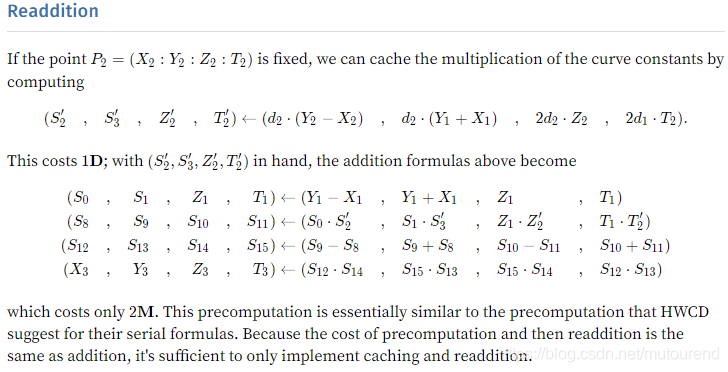
参考资料:
[1] https://doc-internal.dalek.rs/curve25519_dalek/backend/vector/avx2/index.html
[2] CPU指令集——AVX2
[3] Extended twisted Edwards curve坐标系及相互转换
[4] curve25519-dalek中field reduce原理分析
[5] Curve25519 Field域2^255-19内的快速运算
[6] https://doc-internal.dalek.rs/curve25519_dalek/backend/vector/index.html





 扫一扫
扫一扫


 1059
1059

 被折叠的 条评论
为什么被折叠?
被折叠的 条评论
为什么被折叠?
 到【灌水乐园】发言





