





o1模型
o1是什么
OpenAI发布新模型o1系列,可以实现复杂推理,旨在花更多时间思考,然后再做出响应。这些模型可以推理复杂的任务并解决比以前的科学、编码和数学模型更难的问题。
o1模型是没有开源的,而且没有相关论文,但是我们可以通过其他资料来了解这一个模型。
大模型智能的本质
- 快思考——聪明
回答一些通用的问题,相关的模型有gpt4 、通义、Llama等,速度与难度无关
- 慢思考——智慧
通过拆解、反思、推理、验证,来解决复杂的问题,推理速度与难度相关
因此可以说:
-
o1和gpt4:代表两条不同的技术路线,并没有谁替代谁一说
-
4o:GPT4+多模态,提升感知能力,本质上还是 gpt4 这一套
o1提升模型能力的方法
一个比较直接的想法是:把算力花在它的pretain阶段,给模型注入更多数理逻辑的预训练知识。
但是,当我们研读openai o1的技术报告时,我们会发现,它把这个算力更多地用在了2个地方:
- 用在了 rlhf 的训练上(post training)
- 用在了模型的推理阶段上(Test/Inferece)
优化推理输入
思维链的问题
之前,大模型解决复杂问题的能力:思维链(COT),一步一步引导
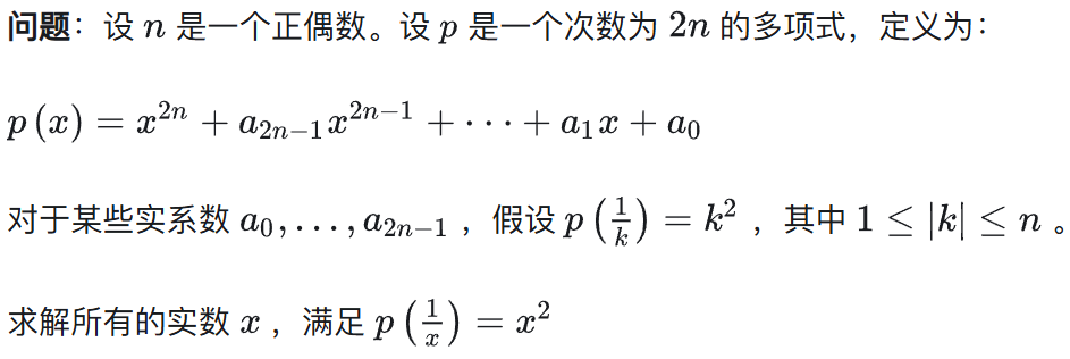
思维链的特点
- **迭代式问题解决:**模型首先定义函数,然后逐步探索相关表达式,将复杂方程分解为更简单的组成部分,反映了一种结构化和有条理的方法。
- **关键思维指标:**使用"Therefore"表示结论,"Alternatively"探索不同路径,"Wait"表示反思,以及"Let me compute"过渡到计算,突出了模型的推理阶段。
- **递归和反思方法:**模型经常重新评估和验证中间结果,使用递归结构确保一致性,这在严谨的数学推理中很典型。
- **假设探索:**模型测试不同的假设,随着获得更多信息而调整其方法,展示了推理过程中的灵活性。
- **结论和验证:**最后,模型解方程并验证结果,强调在完成之前验证结论的重要性。
这种大段提示词在应用上的矛盾点:用答案解决答案(如果写这么多提示词说明本来就会这道题了,如果不会就写不出提示词)
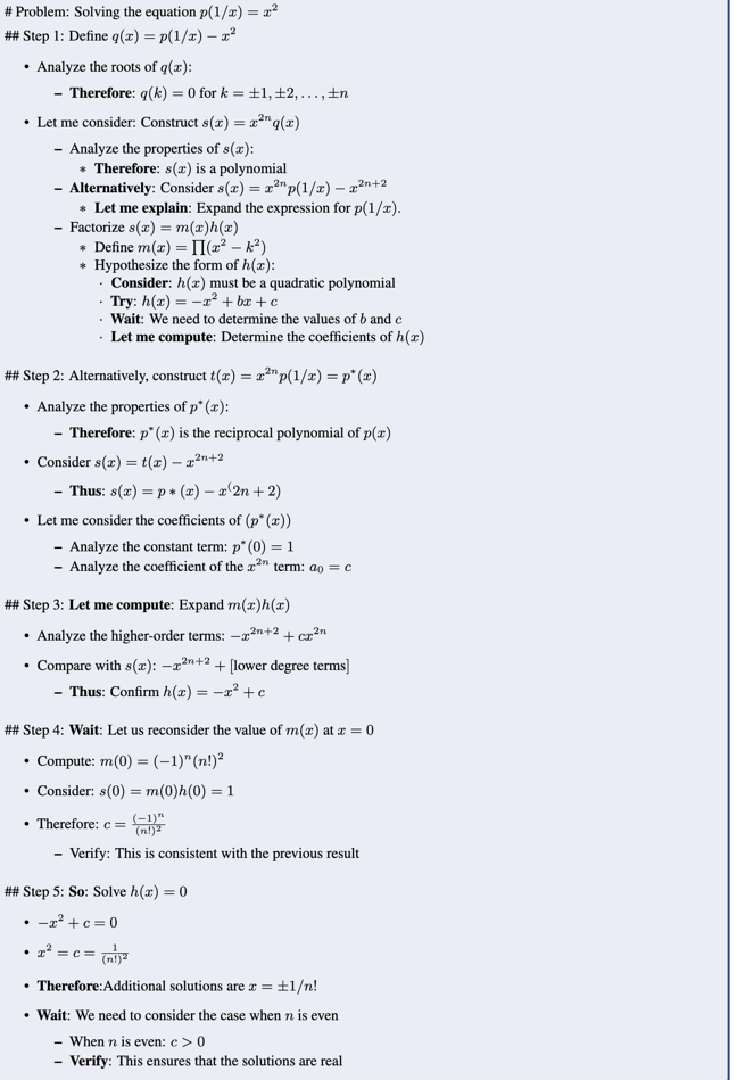
思维链的难点
- 需要人工写
- 思考中间过程错误,全都错
解决方法
-
大模型生成思维链
-
中间过程校正
打分模型
模型不断生成各个步骤,然后用一个相对较小的模型进行打分,如果打分过低,就重新生成
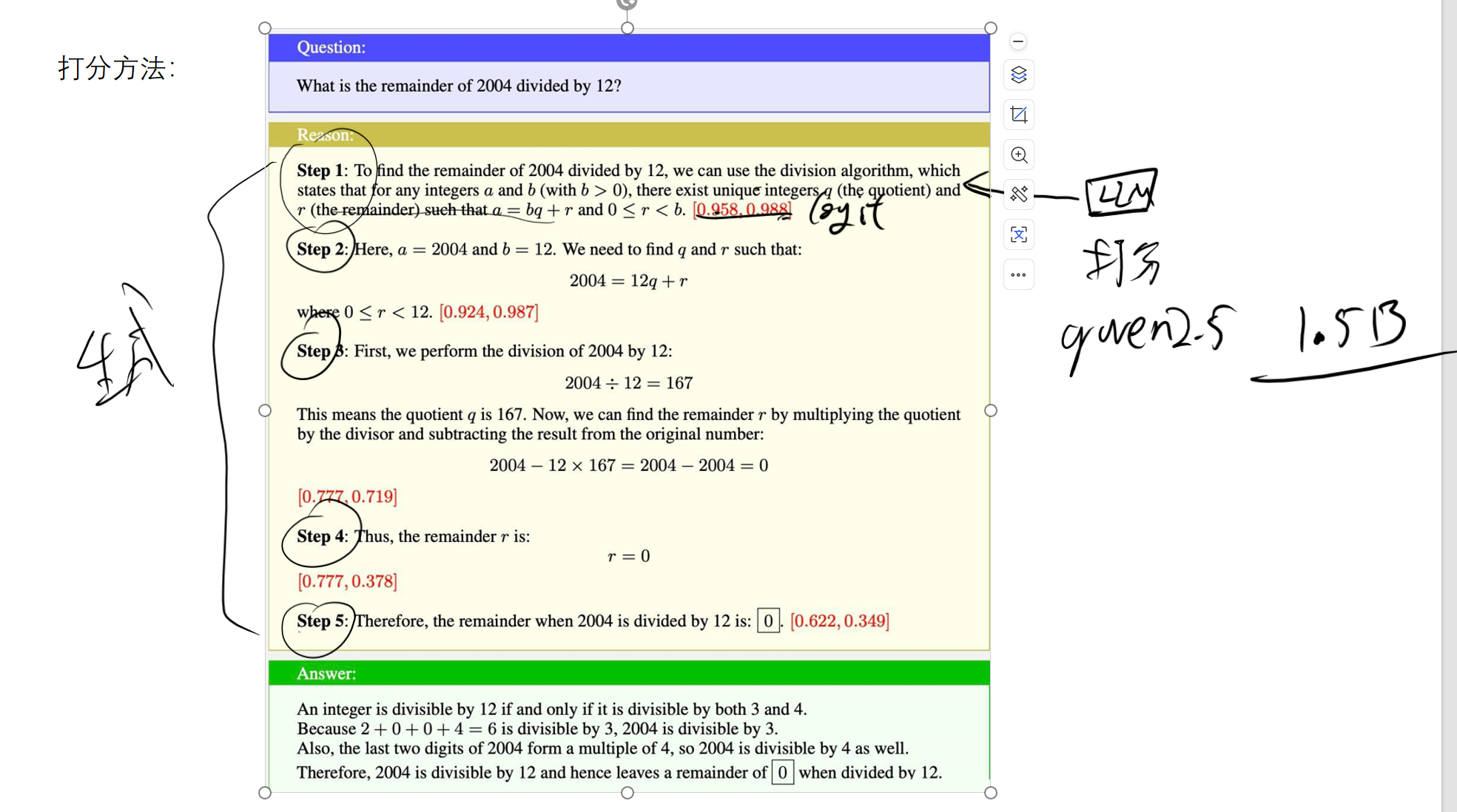
为了训练 PRM,我们需要一份为每个步骤分类(正确或错误)的标签数据。与 ORM 相比,PRM 可以提供更详细和可靠的反馈。但是 PRM 对数据要求极高,需要为每个步骤构建标签,非常耗时耗力。
北京大学开源的数据集 Math-Shepherd,包含了 400k 个步骤级别的正确性标签
label中每一个 step 后面:+ 表示正确;- 表示错误(本质是一个二分类)
{
"input": "For how many digits $C$ is the positive three-digit number $1C3$ a multiple of 3? Step 1: To be a multiple of 3, the sum of the digits of a number must be divisible by 3. \u043a\u0438\nStep 2: The sum of the digits of $1C3$ is $1 + C + 3 = 4 + C$. \u043a\u0438\nStep 3: So I need to find how many values of $C$ make $4 + C$ a multiple of 3. \u043a\u0438\nStep 4: One way to do this is to list all the multiples of 3 that are between 4 and 7, inclusive, and see which ones have a digit C that makes them match. \u043a\u0438\nStep 5: The multiples of 3 that are between 4 and 7 are 4, 7, 10, 13, 16, 19, and 22. \u043a\u0438\nStep 6: I can eliminate 4 and 7, since they have different digits. \u043a\u0438\nStep 7: For 10, 13, and 16, the only digit that works is 1, since 3 does not match. \u043a\u0438\nStep 8: For 19, the only digit that works is 9, since 0, 1, 2, and 7 do not match. \u043a\u0438\nStep 9: For 22, the only digit that works is 2, since 0, 1, 7, and 9 do not match. \u043a\u0438\nStep 10: So the only possible values of C that make $1C3$ a multiple of 3 are 1, 9, and 2. \u043a\u0438\nStep 11: These are the only digits that make $1C3$ a multiple of 3, since any other digit would make the sum not divisible by 3. \u043a\u0438\nStep 12: Therefore, the answer is 3. The answer is: 3 \u043a\u0438",

"label": "For how many digits $C$ is the positive three-digit number $1C3$ a multiple of 3? Step 1: To be a multiple of 3, the sum of the digits of a number must be divisible by 3. +\nStep 2: The sum of the digits of $1C3$ is $1 + C + 3 = 4 + C$. +\nStep 3: So I need to find how many values of $C$ make $4 + C$ a multiple of 3. +\nStep 4: One way to do this is to list all the multiples of 3 that are between 4 and 7, inclusive, and see which ones have a digit C that makes them match. +\nStep 5: The multiples of 3 that are between 4 and 7 are 4, 7, 10, 13, 16, 19, and 22. +\nStep 6: I can eliminate 4 and 7, since they have different digits. +\nStep 7: For 10, 13, and 16, the only digit that works is 1, since 3 does not match. +\nStep 8: For 19, the only digit that works is 9, since 0, 1, 2, and 7 do not match. +\nStep 9: For 22, the only digit that works is 2, since 0, 1, 7, and 9 do not match. +\nStep 10: So the only possible values of C that make $1C3$ a multiple of 3 are 1, 9, and 2. +\nStep 11: These are the only digits that make $1C3$ a multiple of 3, since any other digit would make the sum not divisible by 3. +\nStep 12: Therefore, the answer is 3. The answer is: 3 +",
"task": "MATH"
}

{
"input": "Janet pays $40/hour for 3 hours per week of clarinet lessons and $28/hour for 5 hours a week of piano lessons. How much more does she spend on piano lessons than clarinet lessons in a year? Step 1: Janet spends 3 hours + 5 hours = <<3+5=8>>8 hours per week on music lessons. \u043a\u0438\nStep 2: She spends 40 * 3 = <<40*3=120>>120 on clarinet lessons per week. \u043a\u0438\nStep 3: She spends 28 * 5 = <<28*5=140>>140 on piano lessons per week. \u043a\u0438\nStep 4: Janet spends 120 + 140 = <<120+140=260>>260 on music lessons per week. \u043a\u0438\nStep 5: She spends 260 * 52 = <<260*52=13520>>13520 on music lessons in a year. The answer is: 13520 \u043a\u0438",

"label": "Janet pays $40/hour for 3 hours per week of clarinet lessons and $28/hour for 5 hours a week of piano lessons. How much more does she spend on piano lessons than clarinet lessons in a year? Step 1: Janet spends 3 hours + 5 hours = <<3+5=8>>8 hours per week on music lessons. +\nStep 2: She spends 40 * 3 = <<40*3=120>>120 on clarinet lessons per week. +\nStep 3: She spends 28 * 5 = <<28*5=140>>140 on piano lessons per week. +\nStep 4: Janet spends 120 + 140 = <<120+140=260>>260 on music lessons per week. +\nStep 5: She spends 260 * 52 = <<260*52=13520>>13520 on music lessons in a year. The answer is: 13520 -",

"task": "GSM8K“
}
训练方式
对输入的特殊标识符位置进行预测(例如76325),预测结果表示正确(488,+)或者错误(481,-)
mask将特殊位置给掩盖住
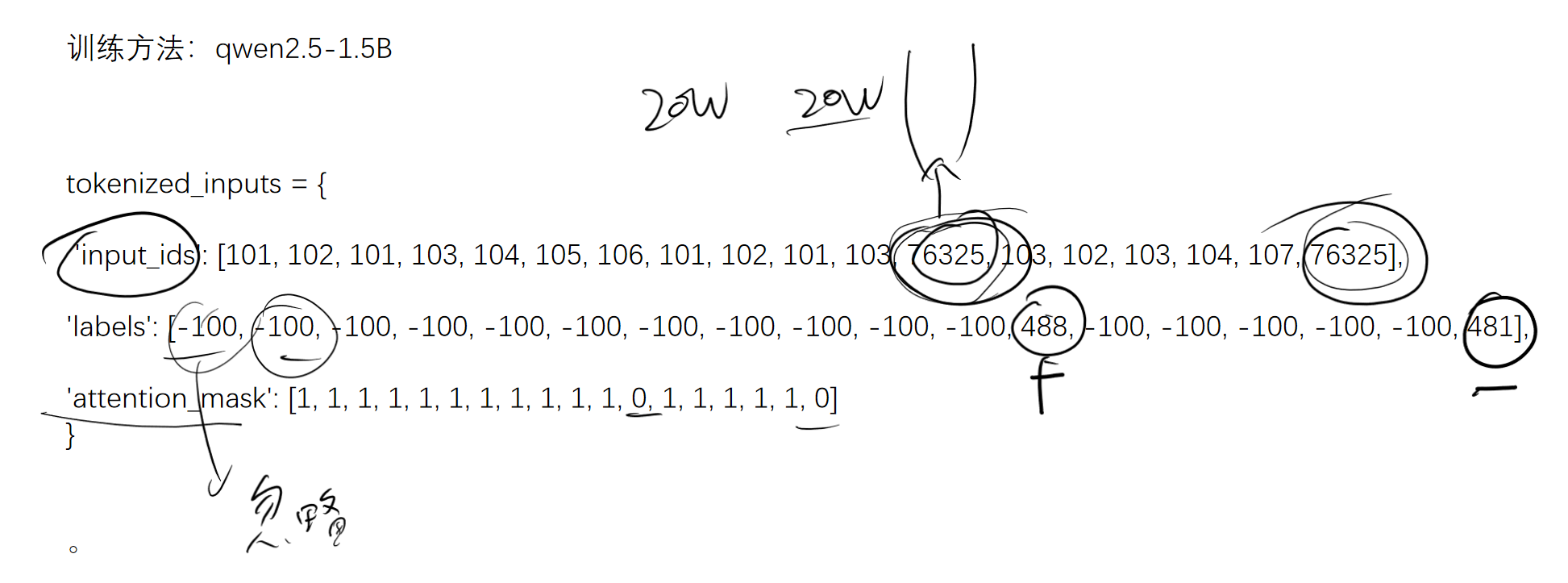
推理方式
针对每一步进行打分
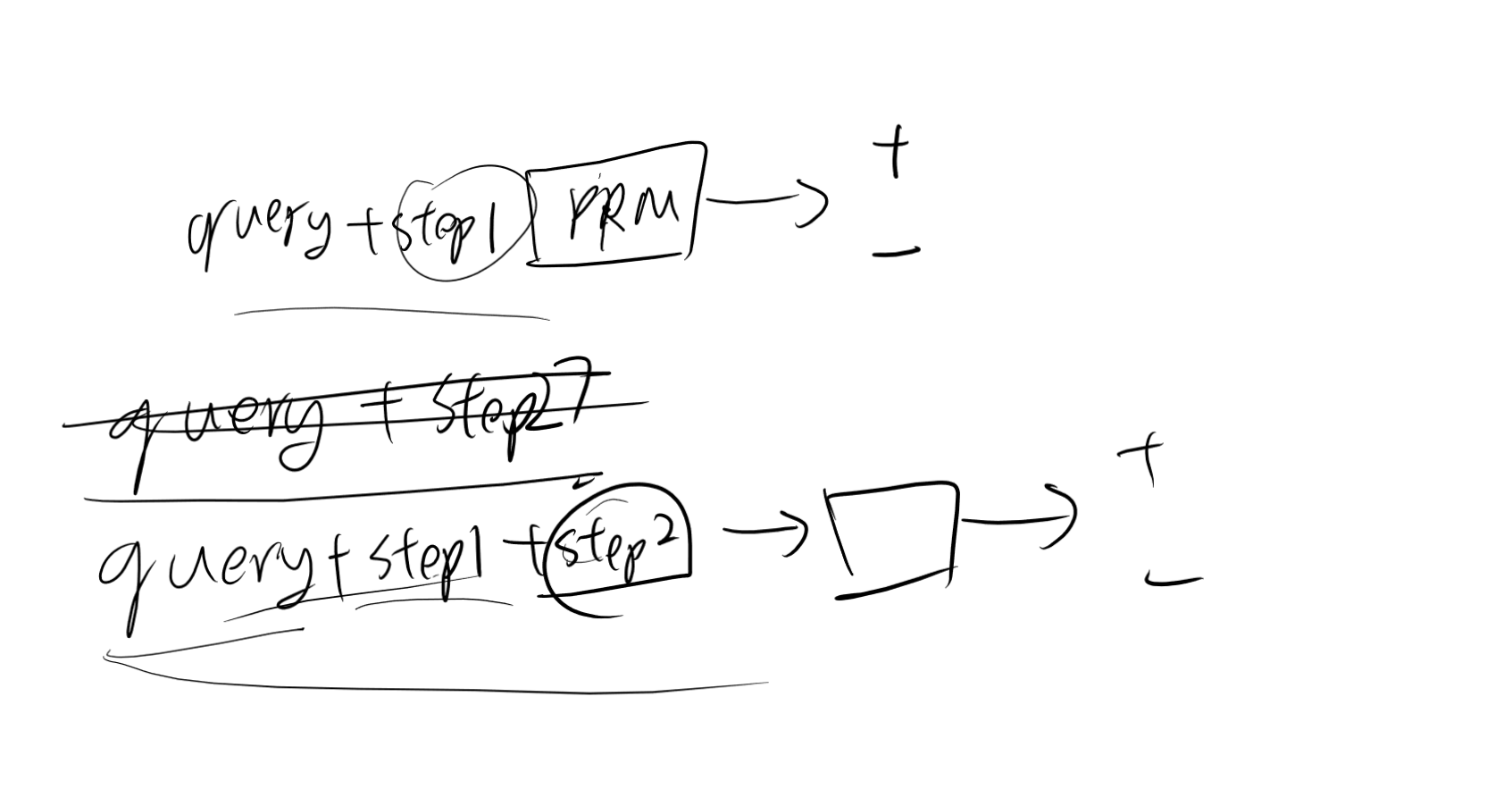
指导推理
相关模型
- 模型1:qwen2.5 14B 用于产生思维链和答案
- 模型2:PRM模型,基于qwen2.5 1.5B进行训练
搜索方式
- Best-of-N:粗粒度,整体计算完成后,选出最优
- Beam Search:细粒度,每一步选出 top K 个最优进行比较
- Lookahead Search:每一步都保留所有情况,向前走若干步,选出分数较高的step然后保留

打分方式
- 连乘式(prod):PRM会对每个step进行打分(离散标签下,这个得分表示概率)。我们将所有steps的得分相乘,用于表示整体的分数
- 最小式(min):取所有steps中最小的得分作为整体得分。这是因为从直觉上,steps有一步出错,整个逻辑链就很可能出问题。所以我们取最坏的情况作为整体得分。
- 最后一步式(last step):当你训练PRM时,你肯定不是把单个step喂给PRM让它去做打分,而是把全部steps一起喂给它,让他们拥有上下文关系(PRM需要根据前面的steps去判断当前step的得分)。所以理论上,你取last step的得分,也可以反映出整体得分。
prod和min都是 openAl 在《let’s verify step by step》中探索过的方法,last step则是deepmind在本文中使用的方法。这些方法间没有绝对好坏之分,取决于你是如何设计整个训练过程的。我们在这里只强调“需要制定出一种规则,能够将PRM的单步打分映射成整体打分。”
如何选择搜索方式
- 搜索的效果(也即模型的推理效果)受到搜索预算和问题难度的限制,我们是在这些限制中去选择合适的搜索方法。
- 当搜索预算较小,问题较难时,更适合beam search方法,但要注意超参的调整
- 当搜索预算较大,问题较简单时,更适合best-of-N方法
- 当PRM训练得足够好时,更复杂的搜索方法(例如lookahead search)的表现可能并不好
- 当问题特别困难时,test-time scaling law的作用可能有限,这时可能有必要重新审视pretrain阶段,通过加/调整数据比例,扩张模型规模等等方式,给pretrain模型十注入更多的相关知识。
蒙特卡洛树搜索算法(MCTS)
多臂老虎机
假设有若干个黑盒,每个黑盒里面抽取后得分分别在 M1, M2, M3, M4… 附近晃动
现在只有 T 次抽取机会,如何使得总的分数最高?

很容易想到通过如下方式进行抽样,但是都有自己的缺陷:
- 纯随机(Random):每次随机选一个摇臂进行摇动。(劣势:能算个期望收益,但收益不是最大的。)
- 仅探索(Exploration-only):每个摇臂摇动T/K次。相当于每个摇臂摇动的次数都一样。(劣势:浪费次数在收益较差的摇臂上)
- 仅利用(Exploitation-only):首先对每个摇臂摇动一次,记录收益。随后对剩余的 T-K 次机会全部摇收益最大的摇臂。(劣势:摇动一次记录的收益随机性太强,不可靠)
可以使用强化学习的方式进行抽样,边应用边学习
单轮优化
一开始均匀抽取,然后使用如下公式进行抽取:
U
C
B
j
=
X
ˉ
j
+
C
2
l
n
N
C
N
j
UCB_j=\bar{X}_j+C\sqrt{\frac{2lnN_C}{N_j}}
UCBj=Xˉj+CNj2lnNC
其中:
X
ˉ
j
\bar{X}_j
Xˉj 表示已经
j
j
j 号样本已经抽样的平均分,
N
c
N_c
Nc 表示总访问次数,
N
j
{N_j}
Nj 表示第
j
j
j 号样本样本访问的次数
基于以下两个因素进行考量:
- 平均得分(利用),平均得分体现了样本的总体水平
- 访问次数低的会有附加分(探索),访问较低时时对于平均分的计算可能不准
但是多臂老虎机有个要求:即时反馈
但是并不是所有场景都有即时反馈,例如对于下棋:只有当下完以后复盘才能知道当前步下得好不好
对于不能即时反馈的场景:
- 最后错的,不一定每步都错
- 最后对的,不一定每步都对
多轮优化
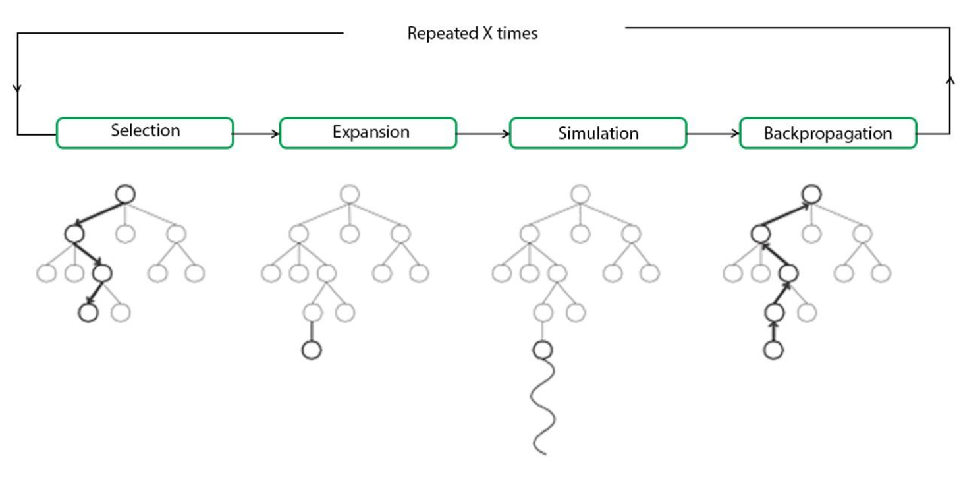
使用 蒙特卡罗树搜索(Monte Carlo Tree Search,MCTS)
优点:搜索空间无穷大,无法穷举
步骤:
-
选择(Selection)
从根节点R开始,递归地选择最优子节点(通过UCB,后续节点选择展开讲解),直到到达叶子节点L。
-
探索(Expansion)
如果L不是终止节点(即它没有结束游戏),则创建一或多个子节点并从中随机选择一个子节点C进行探索。
-
模拟/仿真(Simulation、Rollout)
从C运行一个模拟的rollout,直到获得一个结果。(后续节点模拟会举例子展开讲解如何模拟)
-
反传(Backpropagation)
用模拟结果(终止节点的代价或游戏的终局分数)更新当前的移动序列,更新模拟路径中节点的奖励均值和被访问次数。注意,反传的过程中,每个节点必须包含两个重要的信息:基于模拟结果的估计值和它被访问的次数。
写在后面
以上内容是根据卢博士课程整理
相关内容参考:https://www.bilibili.com/video/BV1rGBZYeETy
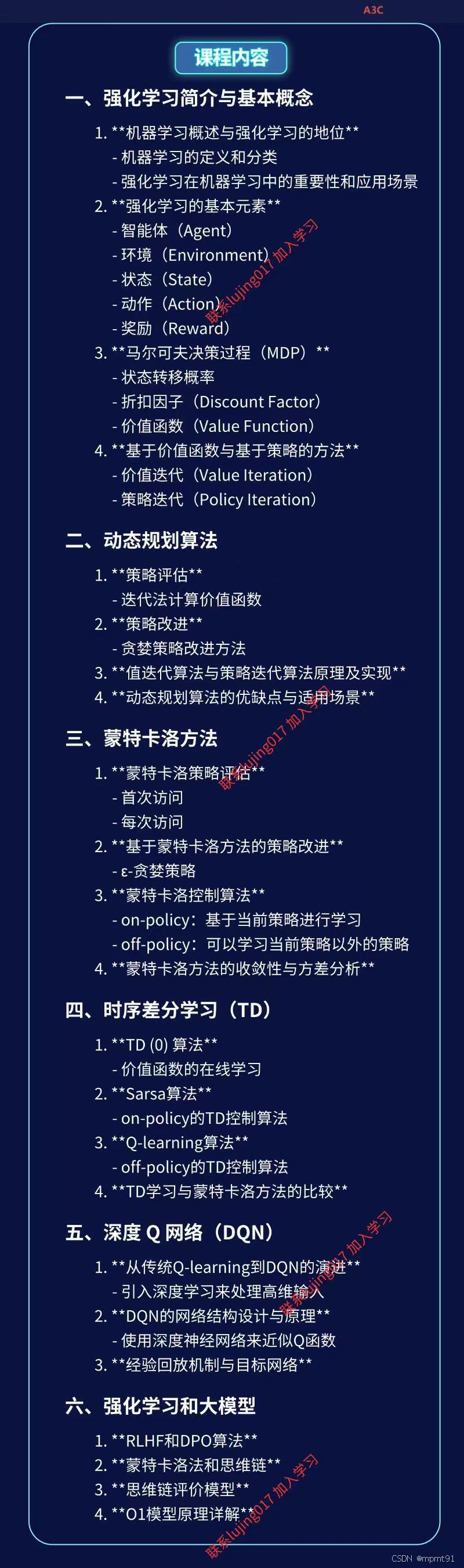
目前他的新课强化学习课程正在筹备中,大纲如下





 扫一扫
扫一扫


 1809
1809

 被折叠的 条评论
为什么被折叠?
被折叠的 条评论
为什么被折叠?
 到【灌水乐园】发言





