



多头注意力机制的代码逻辑
主要参考:<从零开始大模型>
整体结构如图:
https://www.processon.com/view/link/689d8bc94f0dbc7fcf49883f?cid=689d873239b7227d867825c8
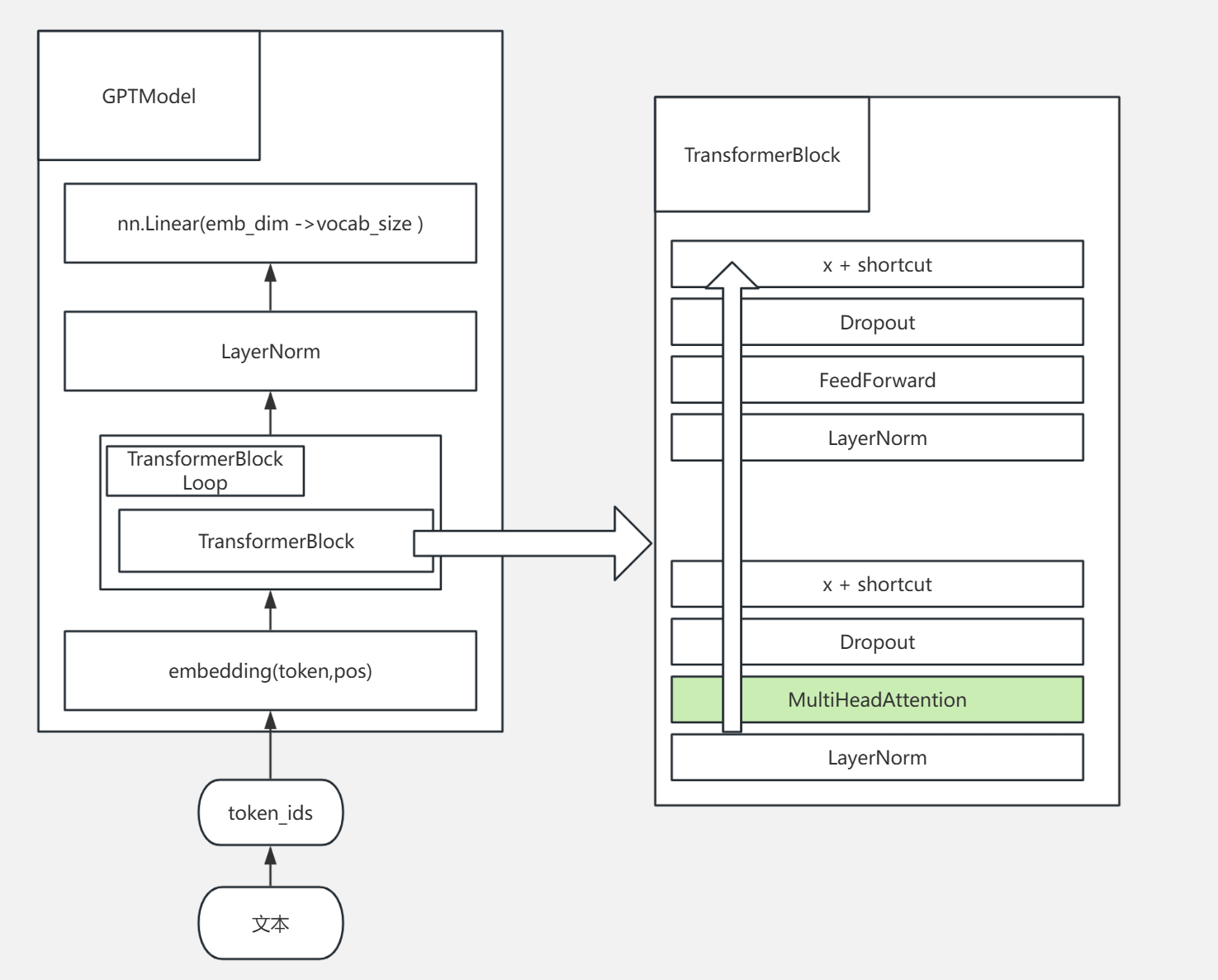
当前文章主要介绍上面的, token_ids, embedding和MultiHeadAttention模块.
名词说明
词汇表: 总token的表,如<token: token_id>,词汇表长Voc_length
token: 词汇, 不一定是一个词,是tokenizer.encode()返回
context_length/n, 最大输入长度(token数)
emb_dim = 嵌入向量的维度[…]
qkv 权重, 被训练的权重, 形状上一般是 (emb_dim, emb_dim)的方阵,这里用到区分: (emb_dim, qkv_out_dim)
权重: 就是神经网络的参数,比大模型里的7B 就是 70亿个这样的权重参数
文本输入相关
1, 输入文本
2, 转成token,再转成向量矩阵(n, emb_dim),
(1), token_embedding 权重矩阵形状: (Voc_lengthemb_dim) 是训练生成的
(2), pos_embedding 权重矩阵形状: (context_lengthemb_dim) 是训练生成的
→ out_embedding 形状: (context_length*emb_dim)
这一步是把输入文本转成向量, 每个token是一个向量,一段话则是一个二维矩阵, embedding 不是通过矩阵乘法获得,而是检索到对应的和,如token_id 是12, 则取token_embedding 中的 第12行的emb_dim.
转成token需要词汇表映射(tokenize), 可以找很多现成的,
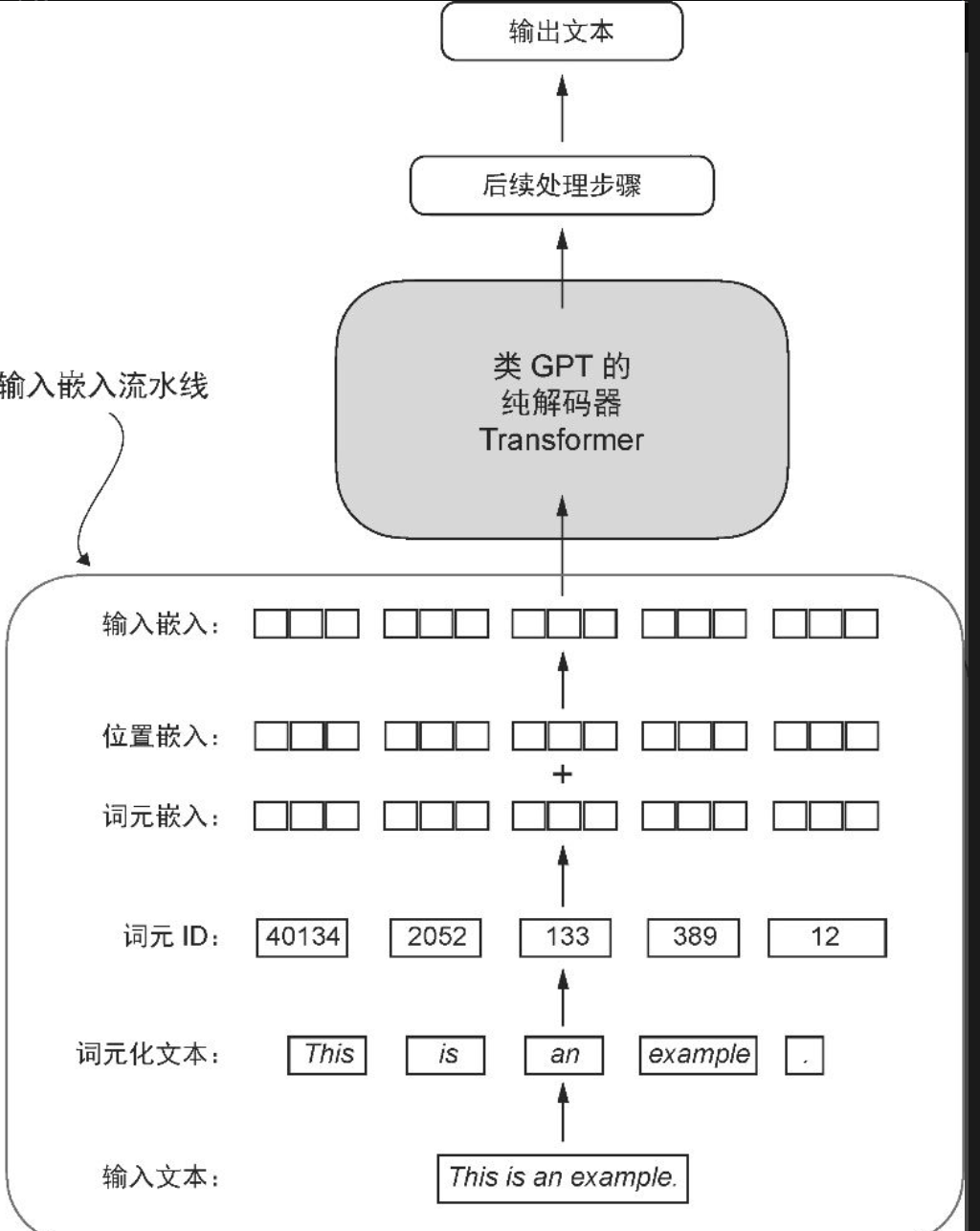
token相关代码大概是如下
tokenid:
    tokenizer = tiktoken.get_encoding("gpt2")
    encoded = tokenizer.encode(start_context)
    encoded_tensor = torch.tensor(encoded).unsqueeze(0)  # 转成pytorch张量
embedding相关
class GPTModel(nn.Module):
    def __init__(self, cfg):
        super().__init__()
        self.tok_emb = nn.Embedding(cfg["vocab_size"], cfg["emb_dim"])  # 初始化embedding参数
        self.pos_emb = nn.Embedding(cfg["context_length"], cfg["emb_dim"])
        self.drop_emb = nn.Dropout(cfg["drop_rate"])

        # todo 注意力层,
        # todo LayerNorm

        # 输出
        self.out_head = nn.Linear(cfg["emb_dim"], cfg["vocab_size"], bias=False)

    def forward(self, in_idx):
        batch_size, seq_len = in_idx.shape
        tok_embeds = self.tok_emb(in_idx)  # 即token_embedding
        pos_embeds = self.pos_emb(torch.arange(seq_len, device=in_idx.device))
        x = tok_embeds + pos_embeds  # Shape [batch_size, num_tokens, emb_size]

        # todo 扔给注意力层&LayerNorm, 输入是x, 输出也是x

        logits = self.out_head(x) # 输出
        return logits
LayerNorm 是归一化技术,主要用于稳定训练过程、加速收敛并提升模型性,
注意力模块相关
3, 初始化q,k,v权重,并得到qkv向量
然后用上面的输入矩阵output_emb (context_length,emb_dim) @ qkv 权重(emb_dim, qkv_out_dim) 分别得到 q,k,v向量
4, 得到注意力分数(attn_weight)
注意力分数是每个token的q各token的k, 即(1qkv_out_dim) @ 转置(nqkv_out_dim) 得到 (1n),
则注意力矩阵 是(n*n) 的方阵, 注意力分数再 softmax 得到 注意力权重矩阵,
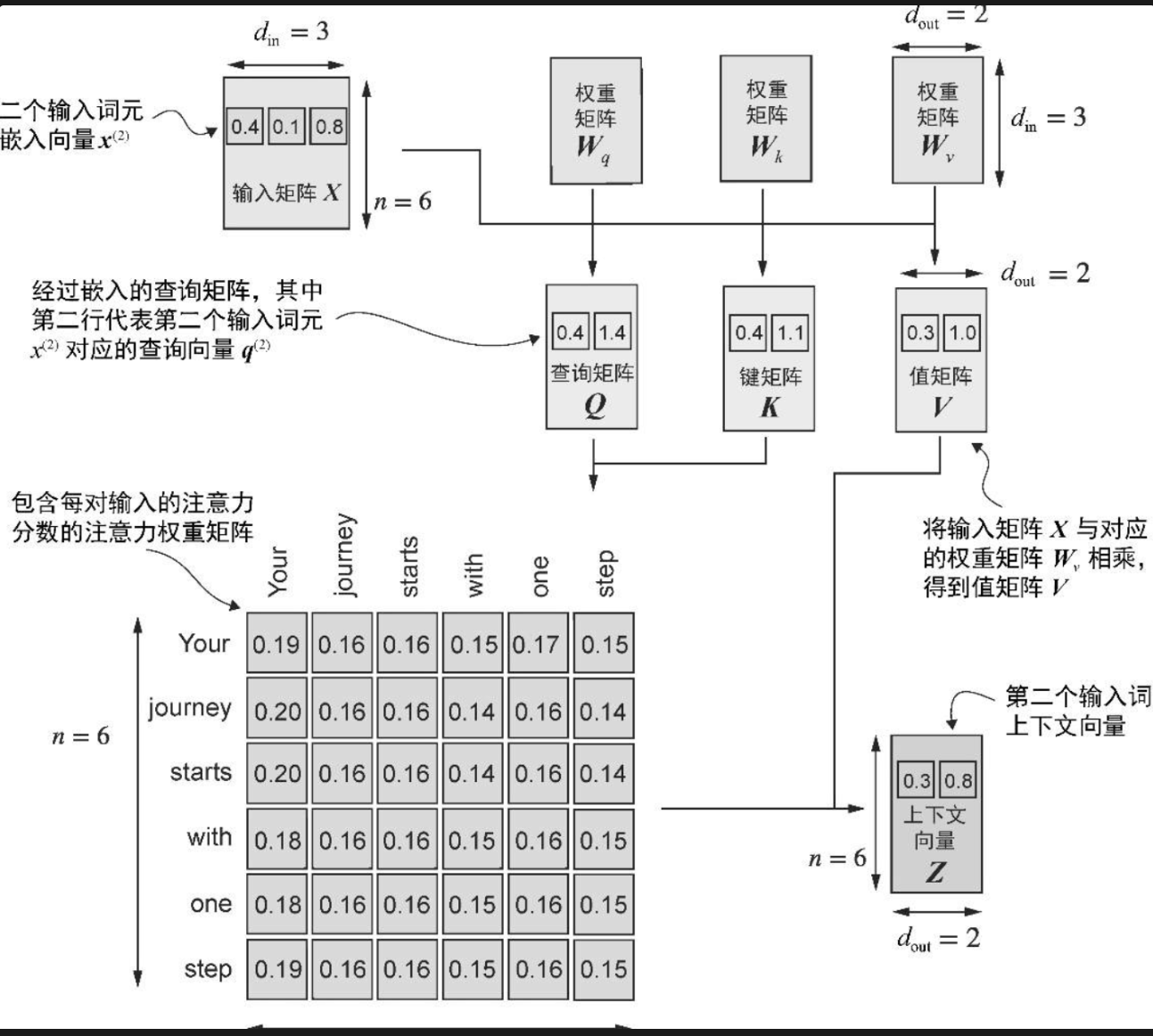
5, 得到上下文向量(context_vec)
attn_weight @ v向量矩阵, 即 (n, n) @ (n, qkv_out_dim) = (n, qkv_out_dim)
6, 训练时,要mask 和 drop_out, 针对 attn_weight, 另外上面矩阵计算时要留意 batch的处理.
上面(3-6)逻辑的参考代码:
class CausalAttention(nn.Module):

    def __init__(self, d_in, d_out, context_length,
                 dropout, qkv_bias=False):
        super().__init__()
        self.d_out = d_out
        self.W_query = nn.Linear(d_in, d_out, bias=qkv_bias)
        self.W_key   = nn.Linear(d_in, d_out, bias=qkv_bias)
        self.W_value = nn.Linear(d_in, d_out, bias=qkv_bias)
        self.dropout = nn.Dropout(dropout) # New
        self.register_buffer('mask', torch.triu(torch.ones(context_length, context_length), diagonal=1)) # New

    def forward(self, x):
        b, num_tokens, d_in = x.shape # New batch dimension b
        # For inputs where `num_tokens` exceeds `context_length`, this will result in errors
        # in the mask creation further below.
        # In practice, this is not a problem since the LLM (chapters 4-7) ensures that inputs
        # do not exceed `context_length` before reaching this forward method.
        keys = self.W_key(x)
        queries = self.W_query(x)
        values = self.W_value(x)

        attn_scores = queries @ keys.transpose(1, 2) # Changed transpose
        attn_scores.masked_fill_(  # New, _ ops are in-place
            self.mask.bool()[:num_tokens, :num_tokens], -torch.inf)  # `:num_tokens` to account for cases where the number of tokens in the batch is smaller than the supported context_size
        attn_weights = torch.softmax(
            attn_scores / keys.shape[-1]**0.5, dim=-1
        )
        attn_weights = self.dropout(attn_weights) # New

        context_vec = attn_weights @ values
        return context_vec

torch.manual_seed(123)

context_length = batch.shape[1]
ca = CausalAttention(d_in, d_out, context_length, 0.0)

context_vecs = ca(batch)
多头注意力
7, 多头注意力的逻辑
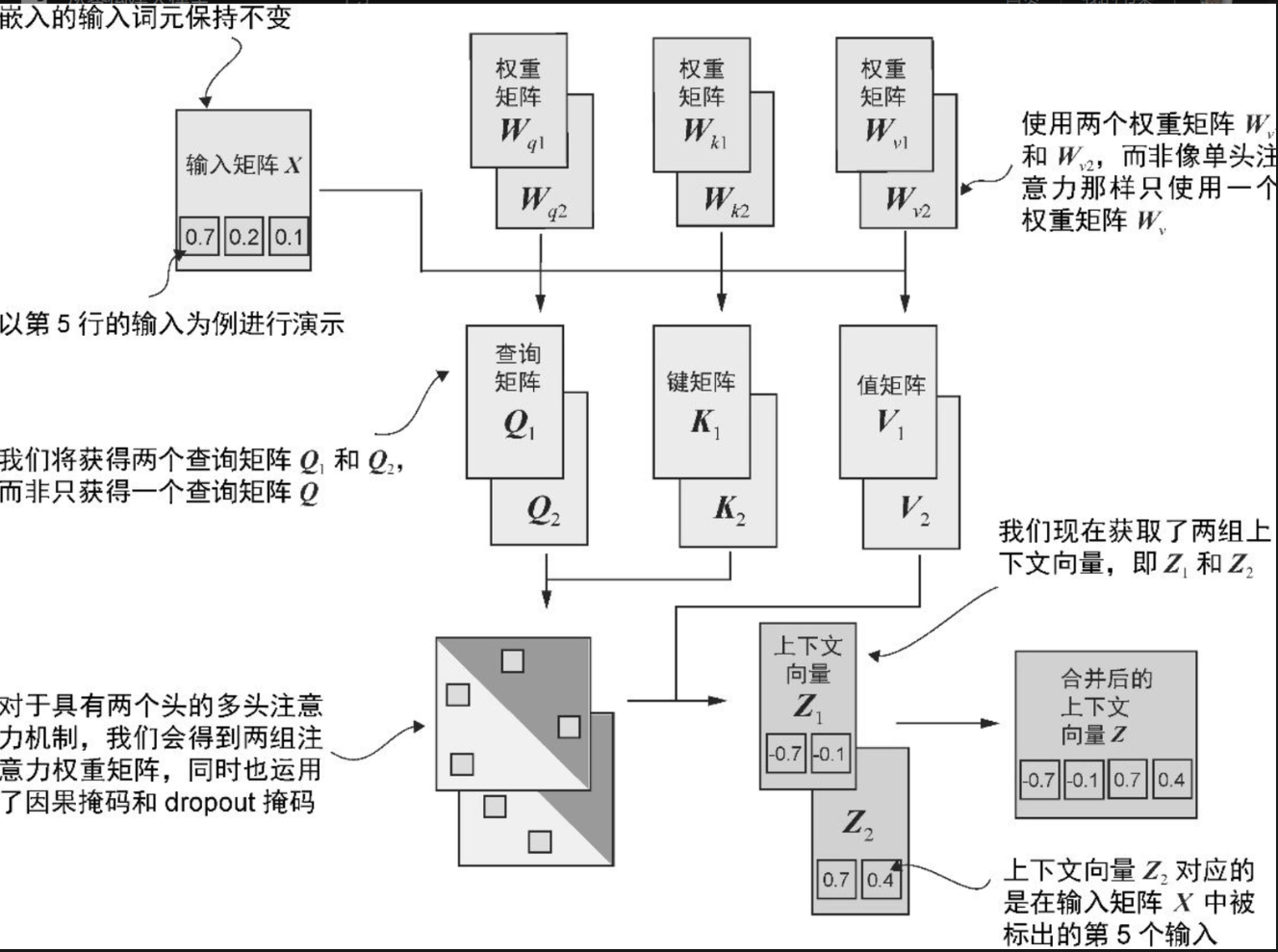
上面(3-7)的代码如下:
class MultiHeadAttention(nn.Module):
    def __init__(self, d_in, d_out, context_length, dropout, num_heads, qkv_bias=False):
        super().__init__()
        assert (d_out % num_heads == 0), \
            "d_out must be divisible by num_heads"  # 整除

        self.d_out = d_out
        self.num_heads = num_heads  # 多少个头
        self.head_dim = d_out // num_heads # Reduce the projection dim to match desired output dim

        self.W_query = nn.Linear(d_in, d_out, bias=qkv_bias)
        self.W_key = nn.Linear(d_in, d_out, bias=qkv_bias)
        self.W_value = nn.Linear(d_in, d_out, bias=qkv_bias)

        self.out_proj = nn.Linear(d_out, d_out)  # Linear layer to combine head outputs
        self.dropout = nn.Dropout(dropout)
        self.register_buffer(
            "mask",
            torch.triu(torch.ones(context_length, context_length),
                       diagonal=1)
        )

    def forward(self, x):
        b, num_tokens, d_in = x.shape
        # As in `CausalAttention`, for inputs where `num_tokens` exceeds `context_length`,
        # this will result in errors in the mask creation further below.
        # In practice, this is not a problem since the LLM (chapters 4-7) ensures that inputs
        # do not exceed `context_length` before reaching this forwar

        keys = self.W_key(x) # Shape: (b, num_tokens, d_out)
        queries = self.W_query(x)
        values = self.W_value(x)

        # 要把 head_num 加到矩阵中:
        # We implicitly split the matrix by adding a `num_heads` dimension
        # Unroll last dim: (b, num_tokens, d_out) -> (b, num_tokens, num_heads, head_dim)
        keys = keys.view(b, num_tokens, self.num_heads, self.head_dim)
        values = values.view(b, num_tokens, self.num_heads, self.head_dim)
        queries = queries.view(b, num_tokens, self.num_heads, self.head_dim)

        # Transpose: (b, num_tokens, num_heads, head_dim) -> (b, num_heads, num_tokens, head_dim), 即转置一下, 让num_tokens, head_dim 放最后用于后台的@操作
        keys = keys.transpose(1, 2)
        queries = queries.transpose(1, 2)
        values = values.transpose(1, 2)

        # Compute scaled dot-product attention (aka self-attention) with a causal mask
        attn_scores = queries @ keys.transpose(2, 3)  # Dot product for each head

        # Original mask truncated to the number of tokens and converted to boolean
        mask_bool = self.mask.bool()[:num_tokens, :num_tokens]

        # Use the mask to fill attention scores
        attn_scores.masked_fill_(mask_bool, -torch.inf)

        attn_weights = torch.softmax(attn_scores / keys.shape[-1]**0.5, dim=-1)
        attn_weights = self.dropout(attn_weights)

        # Shape: (b, num_tokens, num_heads, head_dim)
        context_vec = (attn_weights @ values).transpose(1, 2)

        # Combine heads, where self.d_out = self.num_heads * self.head_dim
        context_vec = context_vec.contiguous().view(b, num_tokens, self.d_out)
        context_vec = self.out_proj(context_vec) # optional projection

        return context_vec

torch.manual_seed(123)
batch_size, context_length, d_in = batch.shape
d_out = 2
mha = MultiHeadAttention(d_in, d_out, context_length, 0.0, num_heads=2)

context_vecs = mha(batch)

print(context_vecs)
print("context_vecs.shape:", context_vecs.shape)






 扫一扫
扫一扫


 2808
2808

 被折叠的 条评论
为什么被折叠?
被折叠的 条评论
为什么被折叠?
 到【灌水乐园】发言





