



 超级会员免费看
本文从一个常见的生活场景入手:参加开卷考试。我们通常会采用以下两种作答策略:
方法一: 对于熟悉的题目,直接快速作答;对于不熟悉的题目,快速翻阅参考书,找到相关部分,在脑海中整理分类和总结后,再在试卷上作答。
方法二: 每一个题目都需要参考书本进行解答。先找到相关部分,在脑海中进行整合和总结后,再到试卷上书写答案。
显然,方法一更受考生青睐,是首选方法。方法二不仅耗时,还有可能引入无关的或错误的信息,导致出现混淆和错误,甚至在考生原本擅长的领域也不例外。
然而,方法二是经典的 RAG (检索->整合->生成)流程 [1],而方法一则代表 Self-RAG 流程[2],本文将进一步探讨这个问题。
01 Overview
图 1 将 RAG 和 Self-RAG[2] 的主要流程进行了比较:
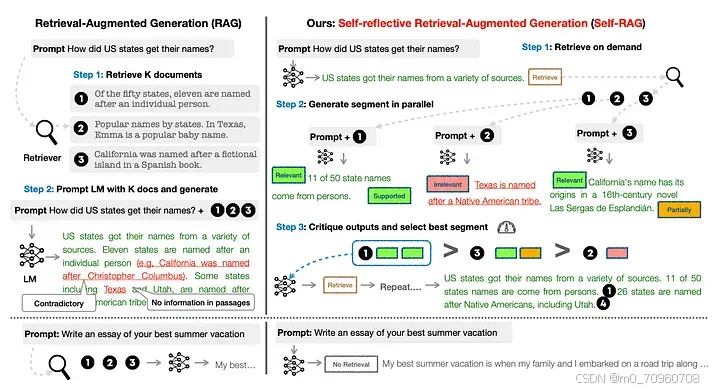
图 1:Overview of Self-RAG 。Self-RAG(右)的主要功能为检索(retrieve)、评判(critique)和生成(generate),使生成的文本内容不仅通顺流畅,而且与事实知识相符,并且可以追溯到原始知识源。资料来源:https://arxiv.org/pdf/2310.11511.pdf
Self-RAG 主要由三大步骤组成:
按需检索(Retrieval as Needed) : 当模型需要检索信息时,例如查询"美国各州的名字是怎么来的?"(图 1 右上方)时,模型输出中会包含一个 [Retrieve] token,表示需要检索与 Query 相关的内容。相反,当被要求写 “写一篇主题为 ‘记忆中深刻的暑假’ 的文章”(图 1 右下方)时,模型会选择直接生成答案,无需进行检索。
以并行方式生成内容(Parallel Generation) : 模型会同时使用提示词(prompt)和检索到的内容来生成模型输出。在整个过程中,有三种 reflection tokens (译者注:用于指示模型在生成过程中应该执行哪些操作、效果如何的token,比如前文的 [Retrieve]。)会显示检索内容的相关性如何。
内容的评估和选择: 对步骤 2 中生成的内容进行评估,并选择最佳文档段落作为输出。
请注意,上述模型是经过特殊训练的,其训练过程将在本文后续部分进行讨论。
02 Reflection Tokens 的介绍
如图 2 所示,与 RAG 相比,self-RAG 框架的不同之处在于它在生成过程中使用了 reflection tokens 进行更精确的控制。
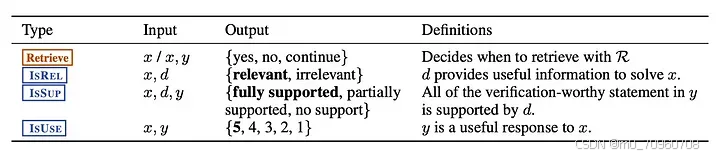
图 2:Self-RAG 中使用的四种 reflection tokens 。每种类型都使用多个 tokens 来表示其输出值(output)。底部三行是三类 critique tokens ,粗体字表示这一类中最理想的 critique tokens 。x、y、d 分别表示输入(input)、输出(output)和相关段落(relevant passage)。来源:Self-RAG[2]
一般来说,self-RAG 会做出四种不同的判断:
[Retrieve] : 决策过程,决定是否从资源 R 中检索额外信息。
[IsREL] : 相关性检查,确定给定数据 d 是否包含解决问题 x 所需的信息。
[IsSUP] : 验证过程,检查数据 d 中是否有依据支持所生成回复 y 中的内容。
[IsUSE] : 输出结果是分数数值(数值范围 1-5 ),其中 5 代表所生成的回复对问题的解决有用程度最高。
在 RAG 系统中,检索是一个必须进行的固定步骤,无论条件如何,都要进行检索。相比之下,self-RAG 引入了 reflective tokens ,使 LLM 更具适应性(adaptable)和智能性(intelligent)。在文本生成过程中,如果 LLM 遇到了需要额外信息支持的不确定区域,它会在遇到 reflective token 时暂停执行文本生成任务,系统会执行一次快速而精确的信息检索操作,最后 LLMs 会利用新获取的信息继续完成当前的文本生成任务。
03 Code Explanation 通过解读代码了解 self-RAG
为了直观地理解 Self-RAG 过程,我们需要首先查看、检查代码,然后详细讨论模型的训练过程。
Self-RAG 这种技术是开源的[3],知名的开源 Python 库 Langchain[4] 和 LlamaIndex 都分别实现了 Self-RAG 功能。本文将以 LlamaIndex 库中 Self-RAG 的具体技术实现[5]作为参考进行说明。
3.1 环境配置
首先,进行环境配置。
(base) Florian@instance-1:~$ conda create -n llamaindex python=3.11
(base) Florian@instance-1:~$ conda activate llamaindex
(llamaindex) Florian@instance-1:~$ pip install llama-index
(llamaindex) Florian@instance-1:~$ pip install huggingface-hub
(llamaindex) Florian@instance-1:~$ huggingface-cli login
1
2
3
4
5
6
7
8
9
10
安装完成后,LlamaIndex 的版本信息如下,请确认:
llama-index 0.10.20
llama-index-core 0.10.20.post2
1
2
3
下载论文提供的 Llama2-7B 模型,模型大小约为 4.08G。
(llamaindex) Florian@instance-1:~$ huggingface-cli download m4r1/selfrag_llama2_7b-GGUF selfrag_llama2_7b.q4_k_m.gguf --local-dir "YOUR_DOWNLOAD_MODEL_DIR" --local-dir-use-symlinks False
(llamaindex) Florian@instance-1:~$ ls "YOUR_DOWNLOAD_MODEL_DIR"
selfrag_llama2_7b.q4_k_m.gguf
1
2
3
4
3.2 测试代码
测试代码如下。首次执行时需要下载 SelfRAGPack[5]。
import os
os.environ["OPENAI_API_KEY"] = "YOUR_OPENAI_API_KEY"
from llama_index.core import Document, VectorStoreIndex
from llama_index.core.retrievers import VectorIndexRetriever
from llama_index.core.readers import SimpleDirectoryReader
from pathlib import Path
# Option: download SelfRAGPack
# The first execution requires the download of SelfRAGPack.
# Subsequent executions can comment this out.
from llama_index.core.llama_pack import download_llama_pack
download_llama_pack(
"SelfRAGPack",
"./self_rag_pack")
from llama_index.packs.self_rag import SelfRAGQueryEngine
# The directory where the Llama2 model was previously downloaded and saved.
download_dir = "YOUR_DOWNLOAD_MODEL_DIR"
# Create testing documents
documents = [
Document(
text="A group of penguins, known as a 'waddle' on land, shuffled across the Antarctic ice, their tuxedo-like plumage standing out against the snow."
),
Document(
text="Emperor penguins, the tallest of all penguin species, can dive deeper than any other bird, reaching depths of over 500 meters."
),
Document(
text="Penguins' black and white coloring is a form of camouflage called countershading; from above, their black back blends with the ocean depths, and from below, their white belly matches the bright surface."
),
Document(
text="Despite their upright stance, penguins are birds that cannot fly; their wings have evolved into flippers, making them expert swimmers."
),
Document(
text="The fastest species, the Gentoo penguin, can swim up to 36 kilometers per hour, using their flippers and streamlined bodies to slice through the water."
),
Document(
text="Penguins are social birds; many species form large colonies for breeding, which can number in the tens of thousands."
),
Document(
text="Intriguingly, penguins have excellent hearing and rely on distinct calls to identify their mates and chicks amidst the noisy colonies."
),
Document(
text="The smallest penguin species, the Little Blue Penguin, stands just about 40 cm tall and is found along the coastlines of southern Australia and New Zealand."
),
Document(
text="During the breeding season, male Emperor penguins endure the harsh Antarctic winter for months, fasting and incubating their eggs, while females hunt at sea."
),
Document(
text="Penguins consume a variety of seafood; their diet mainly consists of fish, squid, and krill, which they catch on their diving expeditions."
),
]
index = VectorStoreIndex.from_documents(documents)
# Setup a simple retriever
retriever = VectorIndexRetriever(
index=index,
similarity_top_k=10,
)
model_path = Path(download_dir) / "selfrag_llama2_7b.q4_k_m.gguf"
query_engine = SelfRAGQueryEngine(str(model_path), retriever, verbose=True)
# No retreival example
response = query_engine.query("Which genre the book pride and prejudice?")
# Retreival example
response = query_engine.query("How tall is the smallest penguins?")
1
2
3
4
5
6
7
8
9
10
11
12
13
14
15
16
17
18
19
20
21
22
23
24
25
26
27
28
29
30
31
32
33
34
35
36
37
38
39
40
41
42
43
44
45
46
47
48
49
50
51
52
53
54
55
56
57
58
59
60
61
62
63
64
65
66
67
68
69
70
71
72
73
测试代码运行结果如下(大部分 llama_cpp 的调试信息已被删除):
...
...
Model metadata: {'tokenizer.ggml.add_eos_token': 'false', 'tokenizer.ggml.eos_token_id': '2', 'general.architecture': 'llama', 'llama.rope.freq_base': '10000.000000', 'llama.context_length': '4096', 'general.name': 'LLaMA v2', 'tokenizer.ggml.add_bos_token': 'true', 'llama.embedding_length': '4096', 'llama.feed_forward_length': '11008', 'llama.attention.layer_norm_rms_epsilon': '0.000010', 'llama.rope.dimension_count': '128', 'tokenizer.ggml.bos_token_id': '1', 'llama.attention.head_count': '32', 'llama.block_count': '32', 'llama.attention.head_count_kv': '32', 'general.quantization_version': '2', 'tokenizer.ggml.model': 'llama', 'general.file_type': '15'}
Using fallback chat format: None
llama_print_timings: load time = 4887.53 ms
llama_print_timings: sample time = 11.29 ms / 22 runs ( 0.51 ms per token, 1947.76 tokens per second)
llama_print_timings: prompt eval time = 4887.46 ms / 24 tokens ( 203.64 ms per token, 4.91 tokens per second)
llama_print_timings: eval time = 5883.27 ms / 21 runs ( 280.16 ms per token, 3.57 tokens per second)
llama_print_timings: total time = 10901.84 ms / 45 tokens
Final answer: The book "Pride and Prejudice" is a romantic novel by Jane Austen.
...
...
llama_print_timings: load time = 4887.53 ms
llama_print_timings: sample time = 11.74 ms / 20 runs ( 0.59 ms per token, 1703.29 tokens per second)
llama_print_timings: prompt eval time = 7473.66 ms / 37 tokens ( 201.99 ms per token, 4.95 tokens per second)
llama_print_timings: eval time = 5414.34 ms / 19 runs ( 284.96 ms per token, 3.51 tokens per second)
llama_print_timings: total time = 13076.88 ms / 56 tokens
Input: ### Instruction:
How tall is the smallest penguins?
### Response:
[Retrieval]<paragraph>Penguins consume a variety of seafood; their diet mainly consists of fish, squid, and krill, which they catch on their diving expeditions.</paragraph>
Prediction: [Relevant]The height of the smallest penguin species can vary depending on the species.[No support / Contradictory][Utility:5]
Score: 1.4213598342974367
10/10 paragraphs done
End evaluation
Selected the best answer: [Relevant]The smallest penguin species is the Little Blue Penguin (also known as the Fairy Penguin), which can grow to be around 40 centimeters (16 inches) in height.[Fully supported][Utility:5]
Final answer: The smallest penguin species is the Little Blue Penguin (also known as the Fairy Penguin), which can grow to be around 40 centimeters (16 inches) in height.
1
2
3
4
5
6
7
8
9
10
11
12
13
14
15
16
17
18
19
20
21
22
23
24
25
26
27
28
29
30
我们可以看到,第一个 query 不需要执行检索操作,而第二个 query 已进行了检索操作并进行了输出内容的评估。
理解测试代码的关键在于弄清楚类 SelfRAGQueryEngine[6] 的实现,现在我们来深入探讨一下这个类。
3.3 类 SelfRAGQueryEngine
首先来看看构造函数[7],它主要用于使用 llama_cpp 加载 Llama2-7B 模型。
class SelfRAGQueryEngine(CustomQueryEngine):
"""Simple short form self RAG query engine."""
llm: Any = Field(default=None, description="llm")
retriever: BaseRetriever = Field(default=None, description="retriever")
generate_kwargs: Dict = Field(default=None, description="llm generation arguments")
verbose: bool = Field(default=True, description="Verbose.")
def __init__(
self,
model_path: str,
retriever: BaseRetriever,
verbose: bool = False,
model_kwargs: Dict = None,
generate_kwargs: Dict = None,
**kwargs: Any,
) -> None:
"""Init params."""
super().__init__(verbose=verbose, **kwargs)
model_kwargs = model_kwargs or _MODEL_KWARGS
self.generate_kwargs = generate_kwargs or _GENERATE_KWARGS
try:
from llama_cpp import Llama
except ImportError:
raise ImportError(_IMPORT_ERROR_MSG)
self.llm = Llama(model_path=model_path, verbose=verbose, **model_kwargs)
self.retriever = retriever
1
2
3
4
5
6
7
8
9
10
11
12
13
14
15
16
17
18
19
20
21
22
23
24
25
26
27
接下来,我们将介绍处理 query 的相关函数[8]。其主要流程如图 3 所示:
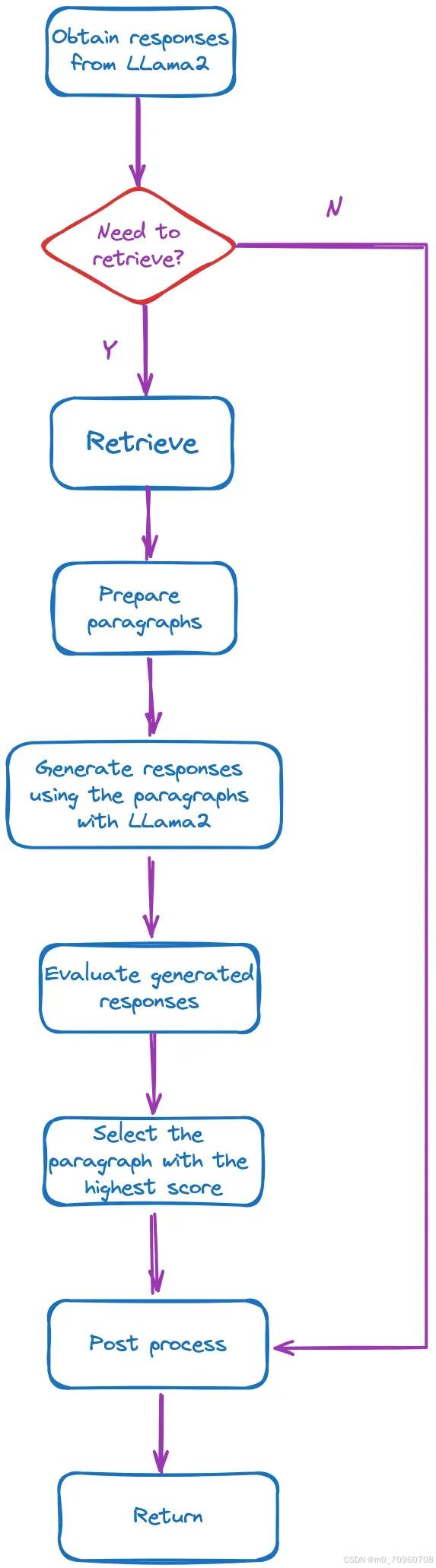
图 3:query 处理功能的主要流程。图片由作者提供。
关键部分已作注释,以便读者更好地理解。
def custom_query(self, query_str: str) -> Response:
"""Run self-RAG."""
# Obtain responses using the Llama2 model.
response = self.llm(prompt=_format_prompt(query_str), **_GENERATE_KWARGS)
answer = response["choices"][0]["text"]
source_nodes = []
# Determine if a retrieval is necessary.
if "[Retrieval]" in answer:
if self.verbose:
print_text("Retrieval required\n", color="blue")
# The step 1 of Figure 1, retrieve as needed.
documents = self.retriever.retrieve(query_str)
if self.verbose:
print_text(f"Received: {len(documents)} documents\n", color="blue")
paragraphs = [
_format_prompt(query_str, document.node.text) for document in documents
]
if self.verbose:
print_text("Start evaluation\n", color="blue")
# Step 2 and 3 in Figure 1, generate in parallel and evaluate
# (the code does not implement parallelism)
critic_output = self._run_critic(paragraphs)
paragraphs_final_score = critic_output.paragraphs_final_score
llm_response_per_paragraph = critic_output.llm_response_per_paragraph
source_nodes = critic_output.source_nodes
if self.verbose:
print_text("End evaluation\n", color="blue")
# Select the paragraph with the highest score and return it.
best_paragraph_id = max(
paragraphs_final_score, key=paragraphs_final_score.get
)
answer = llm_response_per_paragraph[best_paragraph_id]
if self.verbose:
print_text(f"Selected the best answer: {answer}\n", color="blue")
answer = _postprocess_answer(answer)
if self.verbose:
print_text(f"Final answer: {answer}\n", color="green")
return Response(response=str(answer), source_nodes=source_nodes)
1
2
3
4
5
6
7
8
9
10
11
12
13
14
15
16
17
18
19
20
21
22
23
24
25
26
27
28
29
30
31
32
33
34
35
36
37
38
39
40
41
42
43
44
45
从代码中可以看到,图 1 中的三个步骤都有所体现。然而,LlamaIndex 的 self-RAG 功能并未实现并行化。感兴趣的读者可以查看 self._run_critic 函数了解更多信息,该函数也处理与各种 reflection tokens 相对应的分数。
04 如何训练 Llama2–7B 模型
我们以前曾多次使用过 Llama2-7B 模型,本文来探讨一下如何获取和训练该模型。
4.1 训练目标
使语言模型能够生成包含 reflection tokens 的文本。
4.2 两个模型
在训练过程中,需要使用两个模型:批判模型(critic model) C 和生成模型(generator model) M。批判模型 C 主要生成 M 所需的已经标注好的用于有监督学习任务的数据(supervision data)。
然而,在推理过程中,只需使用模型 M,不需要批判模型 C。
4.3 批判模型 C
批判模型(critic model)经过训练可生成 reflection tokens 。使用该模型是为了在任务输出中能够离线插入 reflection tokens ,从而更新训练语料库(training corpus)。
手动为每个文本段落标注 reflection tokens 的成本非常高。Self-RAG 利用 GPT-4 根据不同 reflection token 的定义、输入和输出,为每个 reflection token 分配唯一的特定指令,从而高效地完成数据标注任务。例如,[retrieval] token 会指导模型在进行内容评估时是否需要检索外部文档。
获得训练数据 D_critic 后,我们就可以基于传统的、基于条件的语言模型(standard conditional language model)构建用于训练机器学习模型的目标函数,如下所示:

批判模型 C 可以用任何预训练的语言模型进行初始化和进一步微调。 例如,它可以直接使用与生成模型相同的预训练模型(如Llama 2 7B)进行初始化。
4.4 生成模型 M
图 4 显示了在 Self-RAG 框架中如何收集用于训练生成模型(Generator)的 supervision data(译者注:已经标注好的用于有监督学习任务的数据) 。给定一对输入输出(x, y),self-RAG 使用检索器和批判模型对原始的模型输出 y 进行标注,从而创建 supervision data(译者注:已经标注好的用于有监督学习任务的数据) 。对于 y 中的每个段落 yt(yt ∈ y):
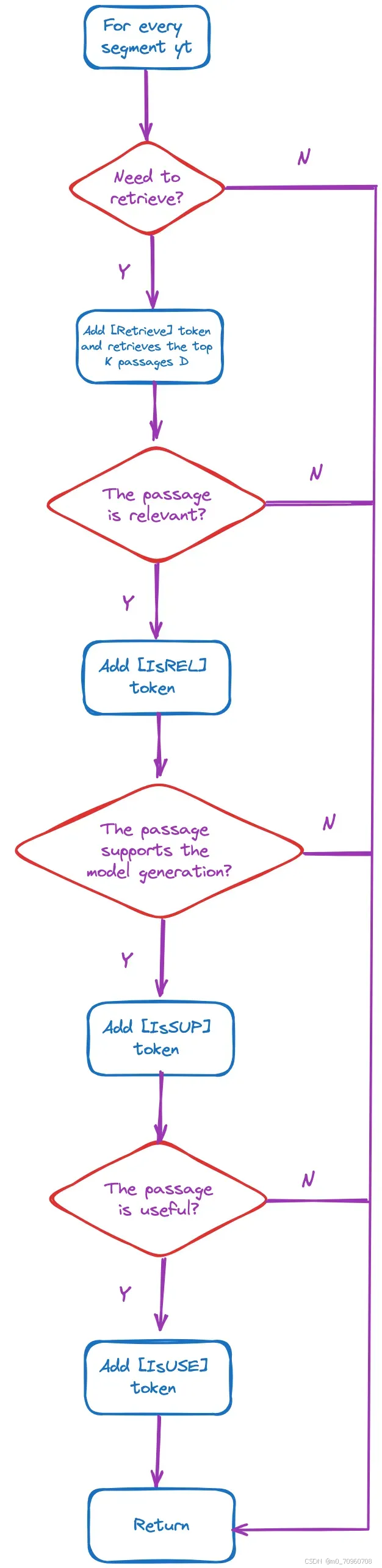
图4:收集生成模型(generator)的训练数据。图中的每次条件判断都是通过批判模型 C 执行的。该图片由作者提供,灵感来源于 Self-RAG[2] section 3.2.2 。
请注意,图 4 中的每次条件判断都是通过批判模型 C 执行的。获得的训练数据如图 5 所示:
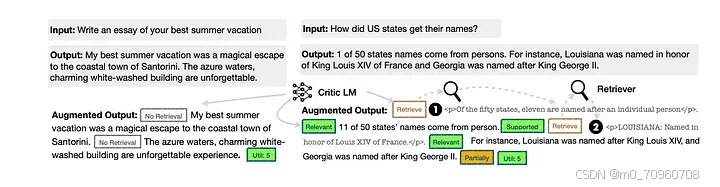
图 5:Self-RAG 训练示例。左边的例子不需要进行外部检索,而右边的例子需要检索外部文档,因此插入了相关文档段落。来源:Self-RAG[2]。
获得训练数据 D_gen 后,我们就可以构建用于训练语言模型的 standard next-token prediction objective function (译者注:"Standard"指这是语言模型训练中最普遍、最基础的目标函数形式。"Next-token prediction"指的是该函数的目标是预测序列中的下一个token(词元),"Objective function"即目标函数,可能是损失函数等内容。)啦,如下所示:
生成模型 M 需要预测的不仅仅是输出内容,还包括 reflection tokens 。
05 作者对 self-RAG 的见解和思考
总体来看,self-RAG 为 RAG 技术的增强和优化提供了一种全新的视角。不过,这种技术需要更复杂的训练流程,并且在内容生成阶段(generation phase) 融入了一些特殊机制,不仅生成目标输出文本,还会生成多种类型的反馈标签,并在生成时根据这些标签执行多个判断操作,这样会不可避免地会增加推理成本 。可能会严重影响重视实时性能要求的项目。
此外,该框架还有很大的优化空间。为激发进一步的讨论和创新,这里有一些建议:
如何优化 reflection tokens 。 Self-RAG 设计了四种 reflection tokens 。除了 [Retrieve] token 之外,其他三个([IsREL]、[IsSUP]、[IsUSE])都有一定的相似性。可以考虑使用更少的 reflection tokens ,或者设计表示其他语义的 reflection tokens ,这可能是一个值得探索的优化方向。
为什么批判模型(critic model)要使用大语言模型(LLM)呢? 我认为这可能是由于像[IsUSE]这样的 token 严重依赖于常识性知识。判断某个回答的有用,是一项较小的模型可能也能够胜任的任务。然而,这些较小的模型通常仅学习了特定的训练数据,缺乏全面的知识。因此,使用LLM作为批判模型(critic model)是有道理的。
批判模型(critic model)模型大小的选择。 我们已经在 7B 和 13B 的模型上对 Self-RAG 进行了测试,结果非常出色。但是,如果我们切换到较小尺寸的 LLM,比如 3B ,会观察到哪些差异?同样,如果我们过渡到使用更大的 LLM ,比如 33B ,我们又能预见到多大的系统性能提升呢?
为什么不使用基于人类反馈的强化学习(RLHF)呢? 该论文建议在特定任务示例数据(task examples)上训练目标语言模型。然后使用离线但是批判模型对这些数据进行增强(使用 reflection tokens),与 RLHF 相比,训练成本大大降低。此外,self-RAG 中的 reflection tokens 使得在推理阶段的内容生成可控,而 RLHF 专注于在训练期间与人类的偏好对齐。不过,论文中没有包含任何与 RLHF 相关的对比实验。
06 Conclusion
本文从一个直观的生活场景(开卷考试)入手,介绍了 self-RAG 技术的基本流程,并辅以代码解释。文章还分享了作者的一些见解和思考。
如果你对 RAG(检索增强生成) 技术非常感兴趣,欢迎浏览、分享本系列其他文章。 : )





 扫一扫
扫一扫


 1249
1249

 被折叠的 条评论
为什么被折叠?
被折叠的 条评论
为什么被折叠?
 到【灌水乐园】发言





