



 本文详细介绍了Python中集合的交集方法intersection()的使用方法,包括语法、参数说明及返回值解析。通过多个实例演示了如何求两个或多个集合的交集,并展示了使用&运算符实现相同功能的方法。
Python Set intersection()
转自:https://www.programiz.com/python-programming/methods/set/intersection
The intersection() method returns a new set with elements that are common to all sets.
The intersection of two or more sets is the set of elements which are common to all sets. For example:
A = {1, 2, 3, 4}
B = {2, 3, 4,  9}
C = {2, 4, 9 10}

Then,
A∩B = B∩A ={2, 3, 4}
A∩C = C∩A ={2, 4}
B∩C = C∩B ={2, 4, 9}

A∩B∩C = {2, 4}
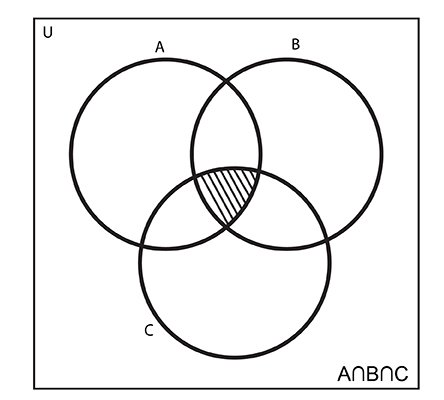
The syntax of intersection() in Python is:
A.intersection(*other_sets)
intersection() Parameters
The intersection() allows arbitrary number of arguments (sets).
Note: * is not part of the syntax. It is used to indicate that the method allows arbitrary number of arguments.
Return Value from Intersection()
The intersection() method returns the intersection of set A with all the sets (passed as argument).
If argument is not passed to intersection(), it returns a shallow copy the set (A).
Example 1: How intersection() works?
1
2
3
4
5
6
7
8
A = {2, 3, 5, 4}
B = {2, 5, 100}
C = {2, 3, 8, 9, 10}
print(B.intersection(A))
print(B.intersection(C))
print(A.intersection(C))
print(C.intersection(A, B))
Run
When you run the program, the output will be:
{2, 5}
{2}
{2, 3}
{2}
More Examples
1
2
3
4
5
6
7
8
9
A = {100, 7, 8}
B = {200, 4, 5}
C = {300, 2, 3}
D = {100, 200, 300}
print(A.intersection(D))
print(B.intersection(D))
print(C.intersection(D))
print(A.intersection(B, C, D))
Run
When you run the program, the output will be:
{100}
{200}
{300}
set()
You can also find the intersection of sets using & operator
Example 3: Set Intersection Using & operator
1
2
3
4
5
6
7
8
9
10
11
A = {100, 7, 8}
B = {200, 4, 5}
C = {300, 2, 3, 7}
D = {100, 200, 300}
print(A & C)
print(A & D)
print(A & C & D)
print(A & B & C & D)
Run
When you run the program, the output will be:
{7}
{100}
set()
set()





 扫一扫
扫一扫


 635
635

 被折叠的 条评论
为什么被折叠?
被折叠的 条评论
为什么被折叠?
 到【灌水乐园】发言





