



 本文精选LeetCode中经典的链表题目,包括节点交换、删除倒数第N个节点、寻找链表交点及环的入口等,通过示例详细解析了双指针、虚拟头结点等技巧的应用。
Day 1 | 704. Binary Search | 27. Remove Element | 35. Search Insert Position | 34. First and Last Position of Element in Sorted Array
Day 2 | 977. Squares of a Sorted Array | 209. Minimum Size Subarray Sum | 59. Spiral Matrix II
Day 3 | 203. Remove Linked List Elements | 707. Design Linked List | 206. Reverse Linked List
Directory
LeetCode 24. Swap Nodes in Pairs
Solution:
/**
 * Definition for singly-linked list.
 * public class ListNode {
 *     int val;
 *     ListNode next;
 *     ListNode() {}
 *     ListNode(int val) { this.val = val; }
 *     ListNode(int val, ListNode next) { this.val = val; this.next = next; }
 * }
 */
class Solution {
    public ListNode swapPairs(ListNode head) {
        ListNode dummy = new ListNode(0, head);
        ListNode pre = dummy;
        ListNode temp = null;
        while(pre.next != null && pre.next.next!=null){
            pre.next = head.next;
            temp = head.next.next;
            head.next.next = head;
            head.next = temp;
            pre = head;
            head = head.next;
        }
        return dummy.next;
    }
}
Thoughts:
- According to the following image, we successfully change the positions of
aandb: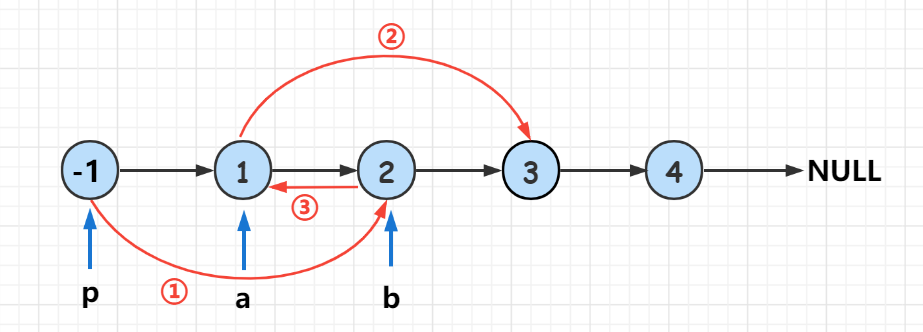
- define a dummy head
p - let
ppoint tob - let
bpoint toa - let
apoint to3
- define a dummy head
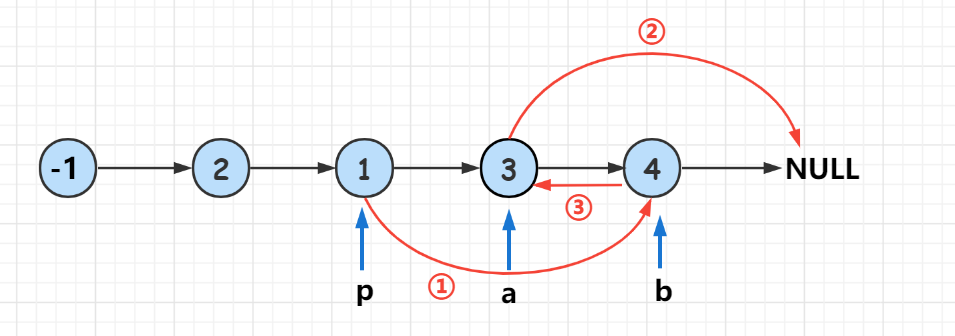
- Then let
pbecomeaand letabecome the next node ofa, repeat the above procedures.
LeetCode 19. Remove Nth Node From End of List
Solution:
/**
 * Definition for singly-linked list.
 * public class ListNode {
 *     int val;
 *     ListNode next;
 *     ListNode() {}
 *     ListNode(int val) { this.val = val; }
 *     ListNode(int val, ListNode next) { this.val = val; this.next = next; }
 * }
 */
class Solution {
    public ListNode removeNthFromEnd(ListNode head, int n) {
        ListNode dummy = new ListNode(0, head);
        ListNode fast = dummy;
        ListNode slow = dummy;
        // As long as there is a difference of n nodes between the fast and slow pointers.
        for(int i = 0; i < n; i++)
            fast = fast.next;

        while(fast.next!=null){
            fast = fast.next;
            slow = slow.next;
        }
        // At this time, the `slow` pointer's position is the previous position of the element to be deleted.
        slow.next = slow.next.next;
        return dummy.next;
    }
}
Thoughts:
- Let the
fastnode move forward n steps. - Let
fastandslowmove on them together until thefastnode arrives at the end of the linked list. - At this time, the
slowpointer’s position is the previous position of the element to be deleted. - Finally, delete the next node of the
slownode.
LeetCode 160. Intersection of Two Linked Lists
Solution:
/**
 * Definition for singly-linked list.
 * public class ListNode {
 *     int val;
 *     ListNode next;
 *     ListNode(int x) {
 *         val = x;
 *         next = null;
 *     }
 * }
 */
public class Solution {
    public ListNode getIntersectionNode(ListNode headA, ListNode headB) {
        ListNode curA = headA;
        ListNode curB = headB;
        int lenA = 0;
        int lenB = 0;
        // calculate the length of linkedlist A
        while(curA != null){
            curA = curA.next;
            lenA++;
        }
        // calculate the length of linkedlist B
        while(curB != null){
            curB = curB.next;
            lenB++;
        }
        curA = headA;
        curB = headB;
        int gap = 0;
        // calculate the gap and move the pointer of the longer linked list until it aligns with the start position of the other linked list.
        if(lenA > lenB){
            gap = lenA - lenB;
            while(gap-- > 0)
                curA = curA.next;
        }
        else{
            gap = lenB - lenA;
            while(gap-- > 0)
                curB = curB.next;
        }
        while(curA !=null){
            if(curA == curB)
                return curA;
            curA = curA.next;
            curB = curB.next;
        }
        return null;
    }
}
Thoughts:
- Calculate the length of two linked lists
- Calculate the gap between the length of two linked lists.
- Move the pointer of the longer linked list until it aligns with the start position of the other linked list.
- Compare
curAwithcurB. If they are identical, return the point of intersection. Otherwise, move on them forward.
LeetCode 142. Linked List Cycle II
Solution:
/**
 * Definition for singly-linked list.
 * class ListNode {
 *     int val;
 *     ListNode next;
 *     ListNode(int x) {
 *         val = x;
 *         next = null;
 *     }
 * }
 */
public class Solution {
    public ListNode detectCycle(ListNode head) {
        ListNode slow = head;
        ListNode fast = head;
        while(fast != null && fast.next != null){
            slow = slow.next;
            fast = fast.next.next;
            if(slow == fast){   // exist a ring
                ListNode index1 = slow;
                ListNode index2 = head;
                while(index1 != index2){
                    index1 = index1.next;
                    index2 = index2.next;
                }
                if(index1 == index2)
                    return index1;
            }

        }
        return null;
    }
}
Thoughts:
- We adopted
Double Pointer Method - Determine whether there is a ring.
- Define a
slowpointer that moves forward one step one time and afastpointer that moves forward two steps one time. - If they meet halfway, it demonstrates that there is a ring.
- Define a
- If there is a ring,how to find the entrance of the ring?
- Suppose the number of nodes from the head node to the ring entry node is
x, the number of the node from the ring entry node to the encountered node isy, the number of the node from the encountered node to the ring entry node isz - A pointer
index1starts from thehead node, and a pointerindex2starts from theencountered node. Each of these pointers moves forwardonestep at one time. When they encounter that is the ring entrance node.
- Suppose the number of nodes from the head node to the ring entry node is





 扫一扫
扫一扫


 1901
1901

 被折叠的 条评论
为什么被折叠?
被折叠的 条评论
为什么被折叠?
 到【灌水乐园】发言





