



Directory
Basics of Array Theory
- Array index start from
0 - Array is a data collection stored in the contiguous memory space
- Because the array’s memory space is contiguous, we must modify the other element address when deleting or adding elements
- We can’t delete array elements, only overwritten
LeetCode 704. Binary Search
Solution:
class Solution {
	// avoid looping when tartget less than nums[0] and bigger than nums[nums.length - 1]
    if(target < nums[0] || target > nums[nums.length-1])
    	return -1;
    public int search(int[] nums, int target) {
        int left = 0;
        int right = nums.length-1;
        // left-closed and right-closed interval
        while(left <= right) {
            int middle = (left + right) >> 1;
            if(nums[middle] > target)
                right = middle - 1;
            else if(nums[middle] < target)
                left = middle + 1;
            else
                return middle;
        }
        return -1;
    }
}
Thoughts:
- Avoid looping when
targetless thannums[0]and bigger thannums[nums.length - 1] - Two greater than signs
>>means move one place to the right.>> 1means divide by 2. - Two less than signs
<<means move one place to the left.<< 1means multiple 2. - The prerequisite of using binary search is an
ordered distinctarray. - We have to follow the
loop invariantprinciple. It means we should do our boundary operation according to the interval’s definition. - We define target in a
left-closed and right-closed interval,that is[left, right]. - We use
left <= rightin the while loop. Becauseleft == rightmakes sense.
LeetCode 27. Remove Element
Solution:
class Solution {
    public int removeElement(int[] nums, int val) {
        int slow = 0;
        for(int fast=0; fast < nums.length; fast++){
            if(nums[fast] != val){
                nums[slow] = nums[fast];
                slow++;
            }
        }
        return slow;
    }
}
Time Complexity: O(n)
Space Complexity: O(1)
Thoughts:
- I adopt the
Two Pointers Method. Complete the work of2 for loopunder1 for loopthrough a slow and a fast point. - The principle of solving this two-pointer question is clarifying the definition of these two pointers.
Fast Point: find elements of the new array that doesn’t contain the targetval.Slow Point: update new array index.
LeetCode 35. Search Insert Position
Solution:
class Solution {
    public int searchInsert(int[] nums, int target) {
        int left = 0;
        int right = nums.length - 1;
        while(left <= right){
            int middle = (left + right) >> 1;
            if(nums[middle] == target)
                return middle;
            else if(nums[middle] > target)
                right = middle - 1;
            else if(nums[middle] < target)
                left = middle + 1;
        }
        return right + 1;
    }
}
Time Complexity:O(log n)
Space Complexity:O(1)
Thoughts:
- If the question says
Given a sorted array of distinct integers, we can consider whether we could useBinary Search. - Accoring to
loop invariantprinciple. We define target in aleft-closed and right-closed interval, that is[left, right] - Insert the target value to the array,there are four situations:
- 1、target value comes before all elements of the array:
[0, -1] - 2、target value is equal to an element in the array: return
middle - 3、target value is in the array:
[left, right],returnright + 1 - 4、target value is behind all elements:
[left, right]:returnright + 1;
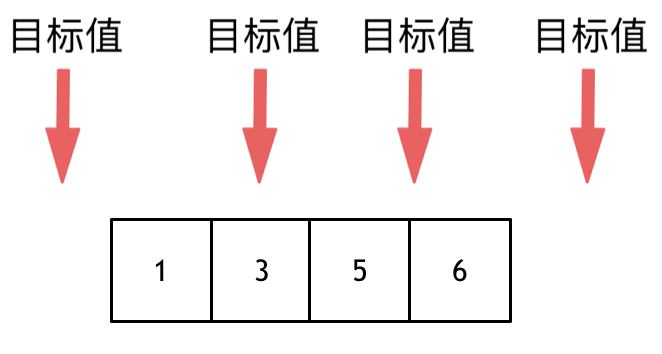
- When left exceeds right, the loop ends. At this time,
leftpoints to the position of the first element larger thantarget, whilerightpoints to the position of the last element smaller thantarget
- 1、target value comes before all elements of the array:
LeetCode 34. First and Last Position of Element in Sorted Array
Solution:
class Solution {
    public int[] searchRange(int[] nums, int target) {
        int rightBorder = getRightBorder(nums, target);
        int leftBorder = getLeftBorder(nums, target);
        // Situation one: `target` in the left or right of the array
        if (rightBorder == -2 || leftBorder == -2)
            return new int[]{-1,-1};
        // Situation three: `target` in the array's range, also in the array.
        if (rightBorder - leftBorder > 1)
            return new int[]{leftBorder + 1, rightBorder - 1};
        // Situation two: `target` in the array's range but not in the array.
        return new int[]{-1, -1};
    }

    int getLeftBorder(int[] nums, int target) {
        int left = 0, right = nums.length - 1;
        int leftBorder = -2;
        while(left <= right) {
            int middle = (left + right) >> 1;
            // update right when nums[middle] == target
            if (nums[middle] >= target) {
                right = middle - 1;
                leftBorder = right;
            } else {
                left = middle + 1;
            }
        }
        return leftBorder;
    }

    int getRightBorder(int[] nums, int target) {
        int left = 0, right = nums.length-1;
        int rightBorder = -2;
        while(left <= right) {
            int middle = (left + right) >> 1;
            if (nums[middle] > target) {
                right = middle -1;
            }
            // update left when nums[middle] == target
            else {
                left = middle + 1;
                rightBorder = left;
            }
        }
        return rightBorder;
    }
}
Thoughts:
- There are three situations:
- Situation one:
targetin the left or right of the array. Like an array{3, 4, 5}, the target is2or6. Should return{-1, -1} - Situation two:
targetin the array’s range but not in the array. Like an array{3, 6, 7}, the target is5. Should return{-1, -1} - Situation three:
targetin the array’s range, also in the array. Like an array{3, 6, 7}, the target is6. Should return{1, 1}.
- Situation one:
- Because of
leftpoints to the position of the first element larger thantarget, whilerightpoints to the position of the last element smaller thantarget. Therefore there must be at least one element between them, which istarget.





 扫一扫
扫一扫


 11万+
11万+


 到【灌水乐园】发言



