



 本文介绍了如何使用Torchtext库处理AG_NEWS数据集,包括数据导入、构建词汇表、创建数据批次、定义模型、训练与验证,最终在测试集上达到了0.907的准确率。

原链接:Text classification with the torchtext library — PyTorch Tutorials 1.11.0+cu102 documentation
(1)导入数据集(经常会出现数据集下载失败的情况),有大佬的网盘:https://pan.baidu.com/s/1Rz_XoaTZWSRiHGOwkACosQ,提取码:j0no
下载完直接放到当前打开jupyter notebook的目录下,地址就到AG_NEWS.data文件夹即可
(现在的版本好像要加上root=‘地址’,不然会报错)
import torch
from torchtext.datasets import AG_NEWS
path = r'E:\Notebook\自然语言处\Text_classification_with_the_torchtext_library\AG_NEWS.data'
train_iter = iter(AG_NEWS(root=path, split='train'))
(2)构建词汇表
from torchtext.data.utils import get_tokenizer #导入分词工具
from torchtext.vocab import build_vocab_from_iterator #使用迭代器构建词表

tokenizer = get_tokenizer('basic_english') #创建分词器对象,采用英文分词
train_iter = AG_NEWS(root=path, split='train')  #获取数据集,并生成迭代器

def yield_tokens(data_iter):
    for _, text in data_iter: #获取每一条的标签label和内容text
        yield tokenizer(text) #对获取内容分词,并返回。yield返回一个迭代器对象

#将未能识别的单词设置为<unk>
vocab = build_vocab_from_iterator(yield_tokens(train_iter), specials=["<unk>"])

#设置<unk>的索引为默认索引,一旦遇到不能识别单词,转为<unk>的索引值
vocab.set_default_index(vocab['<unk>'])
(3)获取每条数据的label和text
text_pipeline = lambda x: vocab(tokenizer(x)) #获取每一条的text的索引表示
label_pipeline = lambda x: int(x) - 1 #获取对应的label

#演示
text_pipeline('here is the an example')
>>> [475, 21, 2, 30, 5297]
label_pipeline('10')
>>> 9
(4)生成批数据和迭代器
offset是定界符的张量,表示文本张量中各个序列的起始索引
label_list:batch中每个文本的标签
text_list:batch的每个文本转换成词汇表的索引
offsets:batch中每个文本的长度
from torch.utils.data import DataLoader
device = torch.device("cuda" if torch.cuda.is_available() else "cpu")

def collate_batch(batch):
    label_list, text_list, offsets = [], [], [0]
    for (_label, _text) in batch:
         label_list.append(label_pipeline(_label))
         processed_text = torch.tensor(text_pipeline(_text), dtype=torch.int64)
         text_list.append(processed_text)
         offsets.append(processed_text.size(0)) #text.size(0)获取text的长度

    label_list = torch.tensor(label_list, dtype=torch.int64)
    offsets = torch.tensor(offsets[:-1]).cumsum(dim=0)
    text_list = torch.cat(text_list)
    return label_list.to(device), text_list.to(device), offsets.to(device)
其中: offsets = torch.tensor(offsets[:-1]).cumsum(dim=0)类似于从第一个数开始(不包括最后一个数),将每个数依次向后累加,得到的新结果再向后累加。10加到20上为30, 30又加到30上成了60(最后的40不算):
(举个栗子)
>>> offsets = [10, 20, 30, 40]
>>> offsets = torch.tensor(offsets[:-1]).cumsum(dim=0)
>>>offsets变成了tensor[10, 30, 60]
在案例中的含义,offsets列表可以记录每一个text的起始位置索引,从0开始,[0, text_index1, text_index2,....],索引之间相减就可以算出每个text的长度。
cat()将多个tensor融合为一个:
text_list:[ tensor([1, 2, 3]) , tensor([4 , 5 , 6]) ]
text_list = torch.cat(text_list) => tensor([1 , 2 , 3 , 4, 5 , 6])
(5)定义模型
from torch import nn

class TextClassificationModel(nn.Module):

    def __init__(self, vocab_size, embed_dim, num_class):
        super(TextClassificationModel, self).__init__()
        self.embedding = nn.EmbeddingBag(vocab_size, embed_dim, sparse=True)
        self.fc = nn.Linear(embed_dim, num_class)
        self.init_weights()

    def init_weights(self):
        initrange = 0.5
        self.embedding.weight.data.uniform_(-initrange, initrange)
        self.fc.weight.data.uniform_(-initrange, initrange)
        self.fc.bias.data.zero_()

    def forward(self, text, offsets):
        embedded = self.embedding(text, offsets)
        return self.fc(embedded)
(6)定义训练和验证
import time

def train(dataloader):
    model.train()
    total_acc, total_count = 0, 0
    log_interval = 500
    start_time = time.time()

    for idx, (label, text, offsets) in enumerate(dataloader):
        optimizer.zero_grad()
        predicted_label = model(text, offsets)
        loss = criterion(predicted_label, label)
        loss.backward()
        torch.nn.utils.clip_grad_norm_(model.parameters(), 0.1)
        optimizer.step()
        total_acc += (predicted_label.argmax(1) == label).sum().item()
        total_count += label.size(0)
        if idx % log_interval == 0 and idx > 0:
            elapsed = time.time() - start_time
            print('| epoch {:3d} | {:5d}/{:5d} batches '
                  '| accuracy {:8.3f}'.format(epoch, idx, len(dataloader),
                                              total_acc/total_count))
            total_acc, total_count = 0, 0
            start_time = time.time()

def evaluate(dataloader):
    model.eval()
    total_acc, total_count = 0, 0

    with torch.no_grad():
        for idx, (label, text, offsets) in enumerate(dataloader):
            predicted_label = model(text, offsets)
            loss = criterion(predicted_label, label)
            total_acc += (predicted_label.argmax(1) == label).sum().item()
            total_count += label.size(0)
    return total_acc/total_count
(7)设置参数,函数,开始训练模型
from torch.utils.data.dataset import random_split
from torchtext.data.functional import to_map_style_dataset
# Hyperparameters
EPOCHS = 10 # epoch
LR = 5  # learning rate
BATCH_SIZE = 64 # batch size for training

criterion = torch.nn.CrossEntropyLoss()
optimizer = torch.optim.SGD(model.parameters(), lr=LR)
scheduler = torch.optim.lr_scheduler.StepLR(optimizer, 1.0, gamma=0.1)
total_accu = None
train_iter, test_iter = AG_NEWS(root=path)
train_dataset = to_map_style_dataset(train_iter)
test_dataset = to_map_style_dataset(test_iter)
num_train = int(len(train_dataset) * 0.95)
split_train_, split_valid_ = \
    random_split(train_dataset, [num_train, len(train_dataset) - num_train])

train_dataloader = DataLoader(split_train_, batch_size=BATCH_SIZE,
                              shuffle=True, collate_fn=collate_batch)
valid_dataloader = DataLoader(split_valid_, batch_size=BATCH_SIZE,
                              shuffle=True, collate_fn=collate_batch)
test_dataloader = DataLoader(test_dataset, batch_size=BATCH_SIZE,
                             shuffle=True, collate_fn=collate_batch)

for epoch in range(1, EPOCHS + 1):
    epoch_start_time = time.time()
    train(train_dataloader)
    accu_val = evaluate(valid_dataloader)
    if total_accu is not None and total_accu > accu_val:
      scheduler.step()
    else:
       total_accu = accu_val
    print('-' * 59)
    print('| end of epoch {:3d} | time: {:5.2f}s | '
          'valid accuracy {:8.3f} '.format(epoch,
                                           time.time() - epoch_start_time,
                                           accu_val))
    print('-' * 59)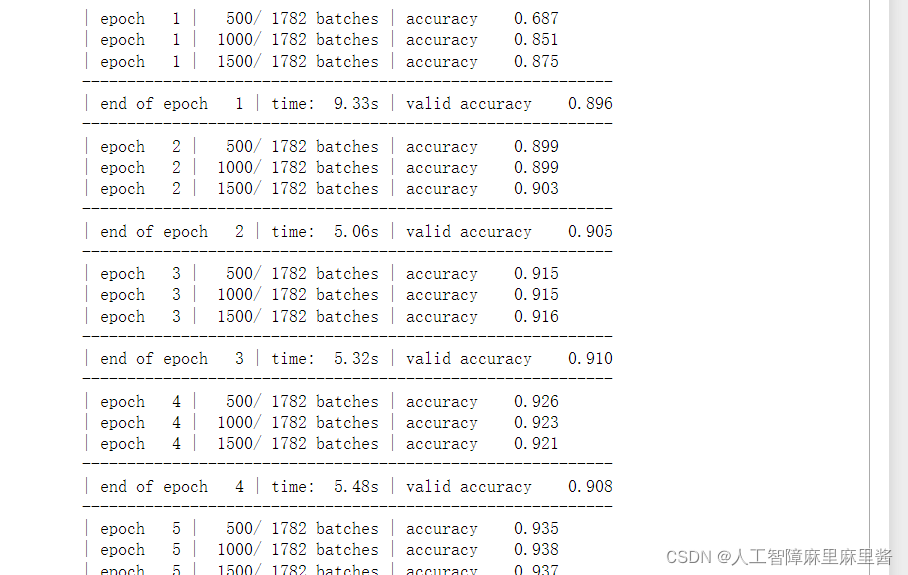
(8)检查测试集的准确率
print('Checking the results of test dataset.')
accu_test = evaluate(test_dataloader)
print('test accuracy {:8.3f}'.format(accu_test))
结果:
Checking the results of test dataset.
test accuracy 0.907
(9)随机测试一篇新闻,进行分类
ag_news_label = {1: "World",
                 2: "Sports",
                 3: "Business",
                 4: "Sci/Tec"}

def predict(text, text_pipeline):
    with torch.no_grad():
        text = torch.tensor(text_pipeline(text))
        output = model(text, torch.tensor([0]))
        return output.argmax(1).item() + 1

ex_text_str = "MEMPHIS, Tenn. – Four days ago, Jon Rahm was \
    enduring the season’s worst weather conditions on Sunday at The \
    Open on his way to a closing 75 at Royal Portrush, which \
    considering the wind and the rain was a respectable showing. \
    Thursday’s first round at the WGC-FedEx St. Jude Invitational \
    was another story. With temperatures in the mid-80s and hardly any \
    wind, the Spaniard was 13 strokes better in a flawless round. \
    Thanks to his best putting performance on the PGA Tour, Rahm \
    finished with an 8-under 62 for a three-stroke lead, which \
    was even more impressive considering he’d never played the \
    front nine at TPC Southwind."

model = model.to("cpu")

print("This is a %s news" %ag_news_label[predict(ex_text_str, text_pipeline)])
结果:
This is a Sports news





 扫一扫
扫一扫


 4514
4514


 到【灌水乐园】发言



