






 本文介绍两种使用深度优先搜索解决数独的方法。方法一通过简单的深度优先搜索递归填充空格;方法二则通过评估每个空格的不确定性来优化搜索过程。
原题网址:https://leetcode.com/problems/sudoku-solver/
Write a program to solve a Sudoku puzzle by filling the empty cells.
Empty cells are indicated by the character '.'.
You may assume that there will be only one unique solution.
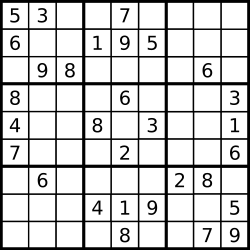
A sudoku puzzle...

...and its solution numbers marked in red.
方法一:深度优先搜索。
public class Solution {
    private boolean[][] rows, cols;
    private boolean[][][] subs;
    private boolean find(char[][] board, int cell) {
        if (cell == 81) return true;
        int row = cell / 9;
        int col = cell % 9;
        int subr = row / 3;
        int subc = col / 3;
        if (board[row][col] != '.') return find(board, cell+1);
        for(int i=0; i<9; i++) {
            if (rows[row][i] || cols[col][i] || subs[subr][subc][i]) continue;
            rows[row][i] = true;
            cols[col][i] = true;
            subs[subr][subc][i] = true;
            board[row][col] = (char)('1' + i);
            if (find(board, cell+1)) return true;
            rows[row][i] = false;
            cols[col][i] = false;
            subs[subr][subc][i] = false;
        }
        board[row][col] = '.';
        return false;
    }
    public void solveSudoku(char[][] board) {
        rows = new boolean[9][9];
        cols = new boolean[9][9];
        subs = new boolean[3][3][9];
        for(int row = 0; row < 9; row ++) {
            for(int col = 0; col < 9; col ++) {
                if (board[row][col] == '.') continue;
                int num = board[row][col]-'1';
                rows[row][num] = true;
                cols[col][num] = true;
                int subr = row / 3;
                int subc = col / 3;
                subs[subr][subc][num] = true;
            }
        }
        find(board, 0);
    }
}
方法二:优先处理确定性高的格子,即剪枝,但比较繁琐。
public class Solution {
    private Cell[] cells;
    private int maxDepth = 0;
    private int[] rowSolved, colSolved;
    private int[][] subSolved;
    private boolean[][] rows, cols;
    private boolean[][][] subs;
    private boolean find(char[][] board, int depth) {
        if (depth == cells.length) return true;
        if (depth == maxDepth+1) {
            int priority = depth;
            for(int i=depth+1; i<cells.length; i++) {
                if (cells[i].uncertainty < cells[priority].uncertainty) priority = i;
            }
            Cell temp = cells[depth];
            cells[depth] = cells[priority];
            cells[priority] = temp;
            maxDepth = depth;
        }
        int row = cells[depth].row;
        int col = cells[depth].col;
        int subr = row / 3;
        int subc = col / 3;
        for(int i=0; i<9; i++) {
            if (rows[row][i] || cols[col][i] || subs[subr][subc][i]) continue;
            rows[row][i] = true;
            cols[col][i] = true;
            subs[subr][subc][i] = true;
            board[row][col] = (char)('1' + i);
            rowSolved[row] ++;
            colSolved[col] ++;
            subSolved[subr][subc] ++;
            if (find(board, depth+1)) return true;
            rows[row][i] = false;
            cols[col][i] = false;
            subs[subr][subc][i] = false;
            rowSolved[row] --;
            colSolved[col] --;
            subSolved[subr][subc] --;
        }
        board[row][col] = '.';
        return false;
    }

    public void solveSudoku(char[][] board) {
        rowSolved = new int[9];
        colSolved = new int[9];
        subSolved = new int[3][3];
        rows = new boolean[9][9];
        cols = new boolean[9][9];
        subs = new boolean[3][3][9];
        int unsolved = 0;
        for(int row = 0; row < 9; row ++) {
            for(int col = 0; col < 9; col ++) {
                if (board[row][col] == '.') {
                    unsolved ++;
                } else {
                    int num = board[row][col]-'1';
                    rows[row][num] = true;
                    cols[col][num] = true;
                    int subr = row / 3;
                    int subc = col / 3;
                    subs[subr][subc][num] = true;
                    rowSolved[row] ++;
                    colSolved[col] ++;
                    subSolved[subr][subc] ++;
                }
            }
        }
        cells = new Cell[unsolved];
        int cpos = 0;
        int priority = -1;
        for(int row = 0; row < 9; row ++) {
            for(int col = 0; col < 9; col ++) {
                if (board[row][col] == '.') {
                    int subr = row / 3;
                    int subc = col / 3;
                    Cell cell = new Cell(row, col, 27-rowSolved[row]-colSolved[col]-subSolved[subr][subc]);
                    if (priority < 0 || cell.uncertainty < cells[priority].uncertainty) priority = cpos;
                    cells[cpos++] = cell;
                }
            }
        }
        Cell temp = cells[0];
        cells[0] = cells[priority];
        cells[priority] = temp;
        find(board, 0);
    }
}
class Cell {
    int row, col;
    int uncertainty;
    Cell(int row, int col, int uncertainty) {
        this.row = row;
        this.col = col;
        this.uncertainty = uncertainty;
    }
}





 扫一扫
扫一扫


 568
568

 被折叠的 条评论
为什么被折叠?
被折叠的 条评论
为什么被折叠?
 到【灌水乐园】发言





