



前面使用线性神经网络softmax 和 多层感知机进行图像分类,本次我们使用LeNet 卷积神经网络进行
训练,期望能捕捉到图像中的图像结构信息,提高识别精度:
import torch
import torchvision
from torchvision import transforms
from torch.utils import data
import time
from torch import nn
from matplotlib import pyplot as plt
from matplotlib_inline import backend_inline
from IPython import display


size = lambda x, *args, **kwargs: x.numel(*args, **kwargs)
reduce_sum = lambda x, *args, **kwargs: x.sum(*args, **kwargs)
argmax = lambda x, *args, **kwargs: x.argmax(*args, **kwargs)
astype = lambda x, *args, **kwargs: x.type(*args, **kwargs)

class Timer:
    """记录多次运行时间"""
    def __init__(self):
        """Defined in :numref:`subsec_linear_model`"""
        self.times = []
        self.start()

    def start(self):
        """启动计时器"""
        self.tik = time.time()

    def stop(self):
        """停止计时器并将时间记录在列表中"""
        self.times.append(time.time() - self.tik)
        return self.times[-1]

    def avg(self):
        """返回平均时间"""
        return sum(self.times) / len(self.times)

    def sum(self):
        """返回时间总和"""
        return sum(self.times)

    def cumsum(self):
        """返回累计时间"""
        return np.array(self.times).cumsum().tolist()

def accuracy(y_hat, y):
    """计算预测正确的数量"""
    if len(y_hat.shape) > 1 and y_hat.shape[1] > 1:
        y_hat = argmax(y_hat, axis=1)
    cmp = astype(y_hat, y.dtype) == y
    return float(reduce_sum(astype(cmp, y.dtype)).cpu())

def evaluate_accuracy(net, data_iter, device=None):
    """计算在指定数据集上模型的精度"""
    metric = Accumulator(2)  # 正确预测数、预测总数
    net.eval()
    with torch.no_grad():
        for X, y in data_iter:
            X, y = X.to(device), y.to(device)
            metric.add(accuracy(net(X), y), size(y))
    return metric[0] / metric[1]

def evaluate_accuracy_gpu(net, data_iter, device=None):
    """计算在指定数据集上模型的精度"""
    if isinstance(net, nn.Module):
        net.eval()
        if not device:
            device = next(iter(net.parameters())).device
    metric = Accumulator(2)  # 正确预测数、预测总数
    net.eval()
    with torch.no_grad():
        for X, y in data_iter:
            if isinstance(X, list):
                X = [x.to(device) for x in X]
            else:
                X = X.to(device)
            y = y.to(device)
            metric.add(accuracy(net(X), y), y.numel())
    return metric[0] / metric[1]
def use_svg_display():
    """使用svg格式在Jupyter中显示绘图

    Defined in :numref:`sec_calculus`"""
    backend_inline.set_matplotlib_formats('svg')

def set_figsize(figsize=(3.5, 2.5)):
    """设置matplotlib的图表大小

    Defined in :numref:`sec_calculus`"""
    use_svg_display()
    plt.rcParams['figure.figsize'] = figsize

def set_axes(axes, xlabel, ylabel, xlim, ylim, xscale, yscale, legend):
    """设置matplotlib的轴

    Defined in :numref:`sec_calculus`"""
    axes.set_xlabel(xlabel)
    axes.set_ylabel(ylabel)
    axes.set_xscale(xscale)
    axes.set_yscale(yscale)
    axes.set_xlim(xlim)
    axes.set_ylim(ylim)
    if legend:
        axes.legend(legend)
    axes.grid()

def plot(X, Y=None, xlabel=None, ylabel=None, legend=None, xlim=None,
         ylim=None, xscale='linear', yscale='linear',
         fmts=('-', 'm--', 'g-.', 'r:'), figsize=(3.5, 2.5), axes=None):
    """绘制数据点

    Defined in :numref:`sec_calculus`"""
    if legend is None:
        legend = []

    set_figsize(figsize)
    axes = axes if axes else plt.gca()

    # 如果X有一个轴,输出True
    def has_one_axis(X):
        return (hasattr(X, "ndim") and X.ndim == 1 or isinstance(X, list)
                and not hasattr(X[0], "__len__"))

    if has_one_axis(X):
        X = [X]
    if Y is None:
        X, Y = [[]] * len(X), X
    elif has_one_axis(Y):
        Y = [Y]
    if len(X) != len(Y):
        X = X * len(Y)
    axes.cla()
    for x, y, fmt in zip(X, Y, fmts):
        if len(x):
            axes.plot(x, y, fmt)
        else:
            axes.plot(y, fmt)
    set_axes(axes, xlabel, ylabel, xlim, ylim, xscale, yscale, legend)

class Animator:
    """在动画中绘制数据"""
    def __init__(self, xlabel=None, ylabel=None, legend=None, xlim=None,
                 ylim=None, xscale='linear', yscale='linear',
                 fmts=('-', 'm--', 'g-.', 'r:'), nrows=1, ncols=1,
                 figsize=(3.5, 2.5)):
        """Defined in :numref:`sec_softmax_scratch`"""
        # 增量地绘制多条线
        if legend is None:
            legend = []
        use_svg_display()
        self.fig, self.axes = plt.subplots(nrows, ncols, figsize=figsize)
        if nrows * ncols == 1:
            self.axes = [self.axes, ]
        # 使用lambda函数捕获参数
        self.config_axes = lambda: set_axes(
            self.axes[0], xlabel, ylabel, xlim, ylim, xscale, yscale, legend)
        self.X, self.Y, self.fmts = None, None, fmts

    def add(self, x, y):
        # 向图表中添加多个数据点
        if not hasattr(y, "__len__"):
            y = [y]
        n = len(y)
        if not hasattr(x, "__len__"):
            x = [x] * n
        if not self.X:
            self.X = [[] for _ in range(n)]
        if not self.Y:
            self.Y = [[] for _ in range(n)]
        for i, (a, b) in enumerate(zip(x, y)):
            if a is not None and b is not None:
                self.X[i].append(a)
                self.Y[i].append(b)
        self.axes[0].cla()
        for x, y, fmt in zip(self.X, self.Y, self.fmts):
            self.axes[0].plot(x, y, fmt)
        self.config_axes()
        display.display(self.fig)
        display.clear_output(wait=True)


class Accumulator:
    """在n个变量上累加"""
    def __init__(self, n):
        self.data = [0.0] * n

    def add(self, *args):
        self.data = [a + float(b) for a, b in zip(self.data, args)]

    def reset(self):
        self.data = [0.0] * len(self.data)

    def __getitem__(self, idx):
        return self.data[idx]

def get_dataloader_workers():
    return 4

def load_data_fashion_mnist(batch_size, resize=None):
    """下载Fashion-MNIST数据集,然后将其加载到内存中"""
    trans = [transforms.ToTensor()]
    if resize:
        trans.insert(0, transforms.Resize(resize))
    trans = transforms.Compose(trans)
    mnist_train = torchvision.datasets.FashionMNIST(
        root="../data", train=True, transform=trans, download=True)
    mnist_test = torchvision.datasets.FashionMNIST(
        root="../data", train=False, transform=trans, download=True)
    return (data.DataLoader(mnist_train, batch_size, shuffle=True,
                            num_workers=get_dataloader_workers()),
            data.DataLoader(mnist_test, batch_size, shuffle=False,
                            num_workers=get_dataloader_workers()))

def train_ch6(net, train_iter, test_iter, num_epochs, lr, device):
    def init_weight(m):
        if type(m) == nn.Linear or type(m) == nn.Conv2d:
            nn.init.xavier_uniform_(m.weight)
    net.apply(init_weight)
    print('training on', device)
    net.to(device)
    optimizer = torch.optim.SGD(net.parameters(), lr=lr)
    loss = nn.CrossEntropyLoss()
    animator = Animator(xlabel='epoch',xlim=[1, num_epochs],legend=['train loss', 'train acc', 'test_acc'])
    timer, num_batches = Timer(), len(train_iter)
    for epoch in range(num_epochs):
        metric = Accumulator(3)
        net.train()
        for i, (X, y) in enumerate(train_iter):
            timer.start()
            optimizer.zero_grad()
            X, y = X.to(device), y.to(device)
            y_hat = net(X)
            l = loss(y_hat, y)
            l.backward()
            optimizer.step()
            with torch.no_grad():
                metric.add(l * X.shape[0], accuracy(y_hat, y),X.shape[0])
            timer.stop()
            train_l = metric[0] / metric[2]
            train_acc = metric[1] / metric[2]
            if (i + 1) % (num_batches //5) == 0 or i == num_batches - 1:
                animator.add(epoch + (i + 1) / num_batches, (train_l, train_acc, None))
        test_acc = evaluate_accuracy_gpu(net, test_iter)
        animator.add(epoch + 1, (None, None, test_acc))
        print(f'epoch {epoch + 1}, train_l={train_l:.5f}, test_acc={test_acc:.5f}')
    print(f'loss {train_l:.3f}, train acc {train_acc:.3f}, test acc {test_acc:.3f}')
    print(f'{metric[2] * num_epochs / timer.sum():.1f} examples/sec on {str(device)}')

def try_gpu():
    if torch.backends.mps.is_available():
        return torch.device("mps")
    elif torch.cuda.is_available():
        return torch.device("cuda")
    else:
        return torch.device("cpu")

device = try_gpu()

net = nn.Sequential(
    nn.Conv2d(1, 6, kernel_size=5, padding=2), nn.Sigmoid(),
    nn.AvgPool2d(kernel_size=2, stride=2),
    nn.Conv2d(6, 16, kernel_size=5), nn.Sigmoid(),
    nn.AvgPool2d(kernel_size=2, stride=2),
    nn.Flatten(),
    nn.Linear(16 * 5 * 5, 120), nn.Sigmoid(),
    nn.Linear(120, 84), nn.Sigmoid(),
    nn.Linear(84, 10)
)

lr, num_epochs = 0.9, 10
batch_size = 256
train_iter, test_iter = load_data_fashion_mnist(batch_size)
timer = Timer()
train_ch6(net, train_iter, test_iter, num_epochs, lr, try_gpu())
print(f'train takes {timer.stop():.2f} sec')
结果如下:
epoch 10, train_l=0.49363, test_acc=0.80840
loss 0.494, train acc 0.812, test acc 0.808
30582.1 examples/sec on mps
train takes 65.80 sec
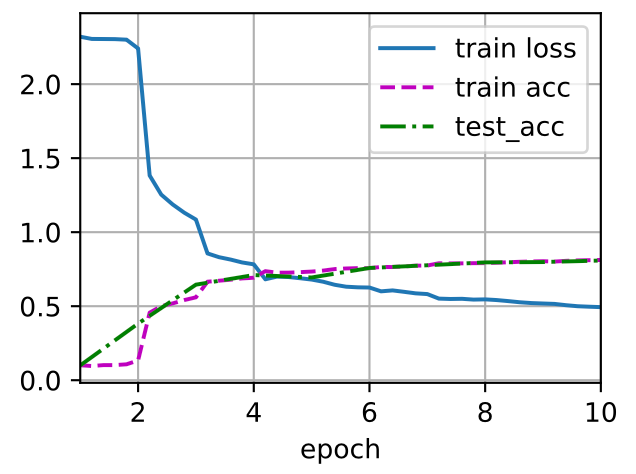
可以看到其准确率并不比线性模型和多层感知机更高。如果想进一步提高准确率,需进一步调整LeNet的参数,如学习率,学习批次,训练次数等,大家自己尝试一下。经过测试,学习率越低,似乎效果更差一些。





 扫一扫
扫一扫


 2342
2342

 被折叠的 条评论
为什么被折叠?
被折叠的 条评论
为什么被折叠?
 到【灌水乐园】发言





