


以下是使用 C++ 实现面向对象编程中类关系的详细解释,包含完整语法和示例:
一、基础类定义
cpp
#include <iostream>
#include <string>
#include <vector>

// 父类 Animal(基类)
class Animal {
protected:
    std::string name;

public:
    explicit Animal(const std::string& name) : name(name) {}

    virtual void speak() const { // 虚函数支持多态
        std::cout << name << " makes a sound" << std::endl;
    }

    virtual ~Animal() = default; // 虚析构函数
};

// 子类 Dog(继承)
class Dog : public Animal {
    std::string breed;

public:
    Dog(const std::string& name, const std::string& breed)
        : Animal(name), breed(breed) {}

    // override 关键字明确表示重写 (C++11+)
    void speak() const override {
        std::cout << name << " barks! (Breed: " << breed << ")" << std::endl;
    }
};
二、建立联系的三种方式
- 继承 (Inheritance)
cpp
// 使用示例
int main() {
    Dog my_dog("Buddy", "Golden Retriever");
    my_dog.speak(); // 输出: Buddy barks! (Breed: Golden Retriever)

    // 多态示例
    Animal* animal = new Dog("Max", "Husky");
    animal->speak(); // 输出: Max barks! (Breed: Husky)
    delete animal;

    return 0;
}
- 组合 (Composition)
cpp
class Engine {
public:
    void start() const {
        std::cout << "Engine starts: Vroom!" << std::endl;
    }
};

class Car {
    std::string model;
    Engine engine; // 组合关系:直接成员对象

public:
    explicit Car(const std::string& model) : model(model) {}

    void drive() {
        engine.start();
        std::cout << model << " is moving" << std::endl;
    }
};

// 使用示例
Car my_car("Tesla Model S");
my_car.drive();
// 输出:
// Engine starts: Vroom!
// Tesla Model S is moving
- 关联 (Association)
cpp
class Course {
    std::string name;

public:
    explicit Course(const std::string& name) : name(name) {}
    const std::string& getName() const { return name; }
};

class Student {
    std::string name;
    std::vector<Course*> courses; // 关联关系:存储指针

public:
    explicit Student(const std::string& name) : name(name) {}

    void enroll(Course* course) {
        courses.push_back(course);
        std::cout << name << " enrolled in " << course->getName() << std::endl;
    }
};

// 使用示例
Course math("Calculus");
Student alice("Alice");
alice.enroll(&math); // 输出: Alice enrolled in Calculus
三、完整示例:多种关系结合
cpp
// 继承 + 组合
class Person {
protected:
    std::string name;

public:
    explicit Person(const std::string& name) : name(name) {}
};

class Computer {
    std::string serial;

public:
    explicit Computer(const std::string& serial) : serial(serial) {}
    const std::string& getSerial() const { return serial; }
};

class Employee : public Person { // 继承
    int id;
    Computer* computer; // 组合关系(通过指针)

public:
    Employee(const std::string& name, int id)
        : Person(name), id(id), computer(nullptr) {}

    void assignComputer(Computer* comp) {
        computer = comp;
    }

    void printInfo() const {
        std::cout << name << " uses computer ";
        if (computer) {
            std::cout << computer->getSerial();
        } else {
            std::cout << "[None]";
        }
        std::cout << std::endl;
    }
};

// 使用
Computer dev_computer("SN123");
Employee john("John Doe", 1001);
john.assignComputer(&dev_computer);
john.printInfo(); // 输出: John Doe uses computer SN123
四、C++ 特有重要特性
- 访问控制
cpp
class MyClass {
private:    // 仅类内可访问
    int secret;

protected:  // 类内和派生类可访问
    int internal;

public:     // 完全公开
    int visible;
};
- 内存管理
cpp
// 推荐使用智能指针管理关联关系
#include <memory>

class Project {
    //...
};

class TeamMember {
    std::shared_ptr<Project> currentProject; // 使用 shared_ptr
};
- 多态实现
cpp
class Shape {
public:
    virtual double area() const = 0; // 纯虚函数
    virtual ~Shape() = default;
};

class Circle : public Shape {
    double radius;
public:
    explicit Circle(double r) : radius(r) {}
    double area() const override {
        return 3.14159 * radius * radius;
    }
};

// 使用基类指针操作派生类
Shape* shape = new Circle(5.0);
std::cout << "Area: " << shape->area() << std::endl;
delete shape;
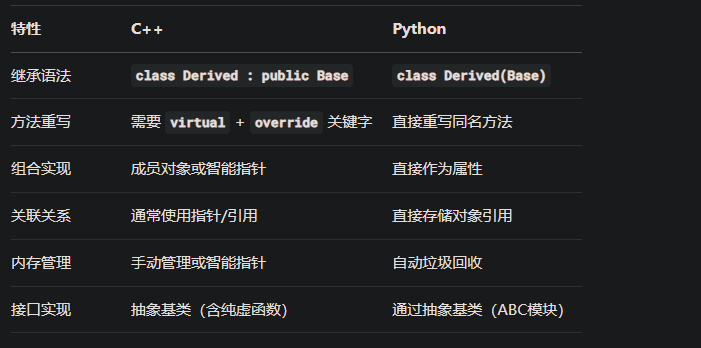
五、关键对比(C++ vs Python)
六、最佳实践建议
继承规范:
使用 public 继承表示 is-a 关系
为多态基类声明虚析构函数
使用 override 关键字明确重写
组合优化:
优先使用对象成员(值语义)
需要动态分配时使用 unique_ptr/shared_ptr
关联管理:
使用裸指针时明确所有权关系
推荐使用弱引用(weak_ptr)避免循环引用
多态控制:
纯虚函数实现接口:virtual void func() = 0;
使用 final 关键字禁止进一步重写
cpp
// 高级示例:接口设计
class Drawable {
public:
    virtual void draw() const = 0;
    virtual ~Drawable() = default;
};

class Circle final : public Drawable { // final 禁止继承
public:
    void draw() const override {
        std::cout << "Drawing a circle" << std::endl;
    }
};
通过合理应用这些技术,可以在 C++ 中构建健壮的面向对象系统,同时兼顾性能和代码清晰度。







 扫一扫
扫一扫


 被折叠的 条评论
为什么被折叠?
被折叠的 条评论
为什么被折叠?
 到【灌水乐园】发言





