


 文章介绍了BARF方法,它将相机姿态细化与NeRF模型优化相结合,采用粗到细的策略提高训练稳定性。BARF解决了原始NeRF中位置编码导致的问题,并能处理不精确的相机位姿,对传统图像配准的理论进行了扩展,适用于3D多帧设置。此外,还提出了分阶段训练位置编码以增强模型拟合能力。
1. 前言
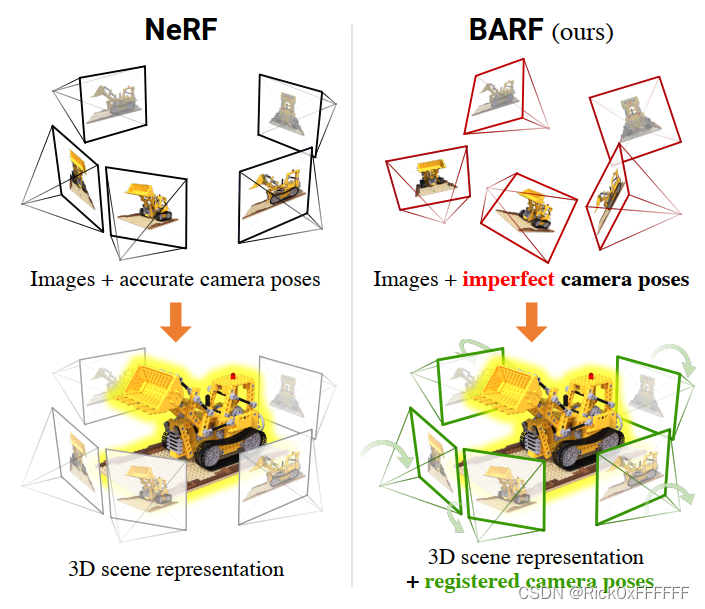
🤮Bundle-Adjustment Neural Radiance Fields提出了一个联合优化粗糙相机位姿与NeRF模型的新问题,并证明了适用于传统图像配准的coarse-to-fine方法也同样适用于NeRF。作者发现原有NeRF的naive position encoding方法会对图像合成产生不良影响。与上文从iNeRF开始学习Pose Refinement的区别是,BARF采用了联合优化的方式,将Pose Refinement这一问题又提升到了新的高度,相信对未来的offline pose estimation将会产生重大意义。
2. Contributions
-
从理论上耦合了pose refinement和 NeRF optimization问题。
-
提出了一种coarse-to-fine的策略来优化NeRF模型, 使训练更稳定。
-
BARF可以利用不准确的相机位姿对场景进行建模表达。
3. Method
3.1 Background
在2D图像中,经典的图像配准描述如下:已知两相邻帧 I 1 \mathcal{I}_1 I1和 I 2 \mathcal{I}_2 I2,要求解出两帧间的位姿变化问题可被形式化的表述为:
min p ∑ x ∥ I 1 ( W ( x ; p ) ) − I 2 ( x ) ∥ 2 2 \min_{\mathbf{p}}\sum_{\mathbf{x}}\Vert \mathcal{I} _1(\mathcal{W}(\mathbf{x};\mathbf{p}))-\mathcal{I}_2(\mathbf{x})\Vert^2_2 pminx∑∥I1(W(x;p))−I2(x)∥22
用神经网络 f : R 2 → R 3 f:\mathbb{R}^2\rightarrow \mathbb{R}^3 f:R2→R3来表示图像,上式被重塑为以下形式:
min p , Θ ∑ x ( ∥ ( f ( x ; Θ ) − I 1 ( x ) ∥ 2 2 + ∥ ( f ( W ( x ; p ) ; Θ ) − I 2 ( x ) ∥ 2 2 ) \min_{\mathbf{p,\Theta}}\sum_{\mathbf{x}}( \Vert(f (\mathbf{x;\Theta} )-\mathcal{I}_1(x)\Vert^2_2+\\ \Vert(f (\mathcal{W}(\mathbf{x;p});\mathbf{\Theta} )-\mathcal{I}_2(x)\Vert^2_2 ) p,Θminx∑(∥(f(x;Θ)−I1(x)∥22+∥(f(W(x;p);Θ)−I2(x)∥22)
或者简化为以下形式:
min p 1 , p 2 , Θ ∑ i = 1 M ∑ x ( ∥ ( f ( W ( x ; p i ) ; Θ ) − I i ( x ) ∥ 2 2 ) \min_{\mathbf{p_1,p_2,\Theta}}\sum^M_{i=1}\sum_{\mathbf{x}}( \Vert(f (\mathcal{W}(\mathbf{x;p}_i);\mathbf{\Theta} )-\mathcal{I}_i(x)\Vert^2_2) p
 最低0.47元/天 解锁文章






 扫一扫
扫一扫


 1201
1201

 被折叠的 条评论
为什么被折叠?
被折叠的 条评论
为什么被折叠?
 到【灌水乐园】发言





