


 文章详细讨论了C++中运算符重载的一些关键点,包括如何重载比较运算符`<`,考虑了日期对象的比较逻辑;在算数运算符`+`和`+=`之间的选择,推荐在`+`中复用`+=`以减少拷贝构造;日期对象相减的实现,处理天数正负的情况;以及前置和后置自增运算符的重载区别。此外,还提到了流运算符`<<`和`>>`的友元函数重载实现。
目录
比较运算符重载
关于 < 重载的判断逻辑
相对简洁的比较逻辑
//注意这里分情况讨论的逻辑
bool Date::operator<(const Date& d) const
{
	if (_year == d._year && _month == d._month)
	{
		return _day < d._day;
	}
	else
	{
		if (_year == d._year)
		{
			return _month < d._month;
		}
		else
		{
			return _year < d._year;
		}
	}
}
- 实现时注意使用以实现的运算符重载**
- 在不改变自身对象成员的情况下,最好加上const**
	bool operator==(const Date& d) const;
	bool operator!=(const Date& d) const;

	bool operator<(const Date& d) const;
	bool operator<=(const Date& d) const;

	bool operator>(const Date& d) const;
	bool operator>=(const Date& d) const;
算数运算符重载
关于复用+还是复用+=
- 在+中复用+=,则使用+时需拷贝构造,而+=时不用
- 若在+=中复用+,则使用+和+=时都需拷贝构造
- 所以最好在+中复用+=,以减少调用拷贝构造
//在+中复用+=,则使用+时需拷贝构造,而+=时不用
//若在+=中复用+,则使用+和+=时都需拷贝构造
//所以最好在+中复用+=,以减少调用拷贝构造
Date Date::operator+(int day) const
{
	/*Date tmp(*this);
	tmp._day += day;
	while (tmp._day > tmp.GetMonthDay())
	{
		tmp._day -= tmp.GetMonthDay();
		++tmp._month;
		if (tmp._month == 13)
		{
			++tmp._year;
			tmp._month = 1;
		}
	}

	return tmp;*/
	Date tmp(*this);
	tmp += day;
	return tmp;
}

Date& Date::operator+=(int day)
{
	_day += day;
	while (_day > GetMonthDay())
	{
		_day -= GetMonthDay();
		++_month;
		if (_month == 13)
		{
			++_year;
			_month = 1;
		}
	}

	//*this = *this + day;
	return *this;
}
关于两个日期对象相减
- 设定大对象和小对象,同时设置flag
- 若预设不对,则交换,flag变-1
- 返回日期差 * flag
//Date 减 Date
int Date::operator-(Date& d) const
{
	int ret = 0;
	int flag = 1;
	Date max = *this;
	Date min = d;
	if (max < min)
	{
		max = d;
		min = *this;
		flag = -1;
	}

	while (min < max)
	{
		min = min + 1;
		++ret;
	}
	return flag * ret;
}
注意考虑天数的正负
当+重载中的天数为负时,增加判断条件,其他同理
Date tmp(*this);
	if (day < 0)
	{
		tmp -= (-day);
	}
	else
	{
		tmp += day;
	}
	return tmp;
    //获取当月天数
	int GetMonthDay() const;
	//日期加减天数
	Date operator+(int day) const;
	Date& operator+=(int day);
	Date operator-(int day) const;
	Date& operator-=(int day);

	//Date 减 Date
	int operator-(Date& d) const;
前置++,后置++ 重载
关于前置++和后置++运算符重载的参数问题
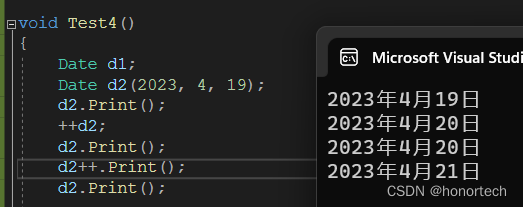
	Date& operator++();
	//++d2;
	Date operator++(int);
	//d2++;
- 前置++
因为是前置++,操作对象在++的后面,且只有一个类对象参数(隐含的参数,不显示),直接匹配 - 后置++
操作对象在++之前,先匹配到隐含参数,第二个占位参数编译器自动匹配,调用时不用主动传递,从而与前置++构成重载
关于++重载函数返回值:
++可能存在连续赋值,如 (d2++)++,故需返回类对象(前置返回引用即可)
--运算符重载同理
流运算符的重载
- 考虑到流运算符的操作数的左右顺序,以及成员函数默认第一个隐含参数为自身对象
- 所以实现流运算符重载时需要借助友元函数实现,从而实现参数顺序同操作数顺序匹配
- 像这样的短小函数可以直接用内联(inline 在.h中定义,或者直接在类中定义)
- ostream和istream是库中定义的类类型
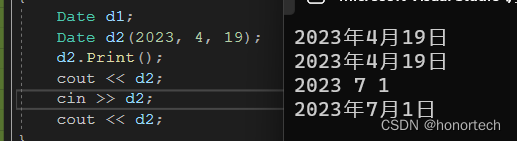
//流提取运算符重载
inline ostream& operator<<(ostream& _cout, const Date& d)
{
	_cout << d._year << "年" << d._month << "月" << d._day << "日" << endl;
	return _cout;
}

inline istream& operator>>(istream& _cin, Date& d)
{
	cin >> d._year >> d._month >> d._day;
	return cin;
}





 扫一扫
扫一扫


 3443
3443


 到【灌水乐园】发言



