


I2C简介
I2C(Inter-Integrated Circuit)总线是一种由PHILIPS公司开发的两线式串行总线,用于连接微控制器及其外围设备。I2C总线产生于在80年代,最初为音频和视频设备开发,如今主要在服务器管理中使用,其中包括单个组件状态的通信。例如管理员可对各个组件进行查询,以管理系统的配置或掌握组件的功能状态,如电源和系统风扇。可随时监控内存、硬盘、网络、系统温度等多个参数,增加了系统的安全性,方便了管理。
I2C工作原理
I2C总线是由数据线SDA和时钟SCL构成的串行总线,可发送和接收数据。在CPU与被控IC之间、IC与IC之间进行双向传送,最高传送速率100kbps。各种被控制电路均并联在这条总线上,但就像电话机一样只有拨通各自的号码才能工作,所以每个电路和模块都有唯一的地址,在信息的传输过程中,I2C总线上并接的每一模块电路既是主控器(或被控器),又是发送器(或接收器),这取决于它所要完成的功能。CPU发出的控制信号分为地址码和控制量两部分,地址码用来选址,即接通需要控制的电路,确定控制的种类;控制量决定该调整的类别(如对比度、亮度等)及需要调整的量。这样,各控制电路虽然挂在同一条总线上,却彼此独立,互不相关。
1. 查看 I2C 源代码
vim 24cxx.h 24cXX.c eeprog.c24cXX.c:
/***************************************************************************
    copyright            : (C) by 2003-2004 Stefano Barbato
    email                : stefano@codesink.org
    $Id: 24cXX.h,v 1.6 2004/02/29 11:05:28 tat Exp $
 *   This program is free software; you can redistribute it and/or modify  *
 *   it under the terms of the GNU General Public License as published by  *
 *   the Free Software Foundation; either version 2 of the License, or     *
 *   (at your option) any later version.                                   *
 *                                                                         *
 ***************************************************************************/

#include <stdio.h>
#include <fcntl.h>
#include <unistd.h>
#include <stdlib.h>
#include <linux/fs.h>
#include <sys/types.h>
#include <sys/ioctl.h>
#include <errno.h>
#include <assert.h>
#include <string.h>
#include "24cXX.h"


static inline __s32 i2c_smbus_access(int file, char read_write, __u8 command,
                                     int size, union i2c_smbus_data *data)
{
	struct i2c_smbus_ioctl_data args;

	args.read_write = read_write;
	args.command = command;
	args.size = size;
	args.data = data;
	return ioctl(file,I2C_SMBUS,&args);
}


static inline __s32 i2c_smbus_write_quick(int file, __u8 value)
{
	return i2c_smbus_access(file,value,0,I2C_SMBUS_QUICK,NULL);
}

static inline __s32 i2c_smbus_read_byte(int file)
{
	union i2c_smbus_data data;
	if (i2c_smbus_access(file,I2C_SMBUS_READ,0,I2C_SMBUS_BYTE,&data))
		return -1;
	else
		return 0x0FF & data.byte;
}

static inline __s32 i2c_smbus_write_byte(int file, __u8 value)
{
	return i2c_smbus_access(file,I2C_SMBUS_WRITE,value,
	                        I2C_SMBUS_BYTE,NULL);
}

static inline __s32 i2c_smbus_read_byte_data(int file, __u8 command)
{
	union i2c_smbus_data data;
	if (i2c_smbus_access(file,I2C_SMBUS_READ,command,
	                     I2C_SMBUS_BYTE_DATA,&data))
		return -1;
	else
		return 0x0FF & data.byte;
}

static inline __s32 i2c_smbus_write_byte_data(int file, __u8 command,
                                              __u8 value)
{
	union i2c_smbus_data data;
	data.byte = value;
	return i2c_smbus_access(file,I2C_SMBUS_WRITE,command,
	                        I2C_SMBUS_BYTE_DATA, &data);
}

static inline __s32 i2c_smbus_read_word_data(int file, __u8 command)
{
	union i2c_smbus_data data;
	if (i2c_smbus_access(file,I2C_SMBUS_READ,command,
	                     I2C_SMBUS_WORD_DATA,&data))
		return -1;
	else
		return 0x0FFFF & data.word;
}

static inline __s32 i2c_smbus_write_word_data(int file, __u8 command,
                                              __u16 value)
{
	union i2c_smbus_data data;
	data.word = value;
	return i2c_smbus_access(file,I2C_SMBUS_WRITE,command,
	                        I2C_SMBUS_WORD_DATA, &data);
}

static inline __s32 i2c_smbus_process_call(int file, __u8 command, __u16 value)
{
	union i2c_smbus_data data;
	data.word = value;
	if (i2c_smbus_access(file,I2C_SMBUS_WRITE,command,
	                     I2C_SMBUS_PROC_CALL,&data))
		return -1;
	else
		return 0x0FFFF & data.word;
}


/* Returns the number of read bytes */
static inline __s32 i2c_smbus_read_block_data(int file, __u8 command,
                                              __u8 *values)
{
	union i2c_smbus_data data;
	int i;
	if (i2c_smbus_access(file,I2C_SMBUS_READ,command,
	                     I2C_SMBUS_BLOCK_DATA,&data))
		return -1;
	else {
		for (i = 1; i <= data.block[0]; i++)
			values[i-1] = data.block[i];
		return data.block[0];
	}
}

static inline __s32 i2c_smbus_write_block_data(int file, __u8 command,
                                               __u8 length, __u8 *values)
{
	union i2c_smbus_data data;
	int i;
	if (length > 32)
		length = 32;
	for (i = 1; i <= length; i++)
		data.block[i] = values[i-1];
	data.block[0] = length;
	return i2c_smbus_access(file,I2C_SMBUS_WRITE,command,
	                        I2C_SMBUS_BLOCK_DATA, &data);
}

/* Returns the number of read bytes */
static inline __s32 i2c_smbus_read_i2c_block_data(int file, __u8 command,
                                                  __u8 *values)
{
	union i2c_smbus_data data;
	int i;
	if (i2c_smbus_access(file,I2C_SMBUS_READ,command,
	                      I2C_SMBUS_I2C_BLOCK_DATA,&data))
		return -1;
	else {
		for (i = 1; i <= data.block[0]; i++)
			values[i-1] = data.block[i];
		return data.block[0];
	}
}

static inline __s32 i2c_smbus_write_i2c_block_data(int file, __u8 command,
                                               __u8 length, __u8 *values)
{
	union i2c_smbus_data data;
	int i;
	if (length > 32)
		length = 32;
	for (i = 1; i <= length; i++)
		data.block[i] = values[i-1];
	data.block[0] = length;
	return i2c_smbus_access(file,I2C_SMBUS_WRITE,command,
	                        I2C_SMBUS_I2C_BLOCK_DATA, &data);
}

/* Returns the number of read bytes */
static inline __s32 i2c_smbus_block_process_call(int file, __u8 command,
                                                 __u8 length, __u8 *values)
{
	union i2c_smbus_data data;
	int i;
	if (length > 32)
		length = 32;
	for (i = 1; i <= length; i++)
		data.block[i] = values[i-1];
	data.block[0] = length;
	if (i2c_smbus_access(file,I2C_SMBUS_WRITE,command,
	                     I2C_SMBUS_BLOCK_PROC_CALL,&data))
		return -1;
	else {
		for (i = 1; i <= data.block[0]; i++)
			values[i-1] = data.block[i];
		return data.block[0];
	}
}

static int i2c_write_1b(struct eeprom *e, __u8 buf)
{
	int r;
	// we must simulate a plain I2C byte write with SMBus functions
	r = i2c_smbus_write_byte(e->fd, buf);
	if(r < 0)
		fprintf(stderr, "Error i2c_write_1b: %s\n", strerror(errno));
	usleep(10);
	return r;
}

static int i2c_write_2b(struct eeprom *e, __u8 buf[2])
{
	int r;
	// we must simulate a plain I2C byte write with SMBus functions
	r = i2c_smbus_write_byte_data(e->fd, buf[0], buf[1]);
	if(r < 0)
		fprintf(stderr, "Error i2c_write_2b: %s\n", strerror(errno));
	usleep(10);
	return r;
}

static int i2c_write_3b(struct eeprom *e, __u8 buf[3])
{
	int r;
	// we must simulate a plain I2C byte write with SMBus functions
	// the __u16 data field will be byte swapped by the SMBus protocol
	r = i2c_smbus_write_word_data(e->fd, buf[0], buf[2] << 8 | buf[1]);
	if(r < 0)
		fprintf(stderr, "Error i2c_write_3b: %s\n", strerror(errno));
	usleep(10);
	return r;
}


#define CHECK_I2C_FUNC( var, label ) \
	do { 	if(0 == (var & label)) { \
		fprintf(stderr, "\nError: " \
			#label " function is required. Program halted.\n\n"); \
		exit(1); } \
	} while(0);

int eeprom_open(char *dev_fqn, int addr, int type, struct eeprom* e)
{
	int funcs, fd, r;
	e->fd = e->addr = 0;
	e->dev = 0;

	fd = open(dev_fqn, O_RDWR);
	if(fd <= 0)
	{
		fprintf(stderr, "Error eeprom_open: %s\n", strerror(errno));
		return -1;
	}

	// get funcs list
	if((r = ioctl(fd, I2C_FUNCS, &funcs) < 0))
	{
		fprintf(stderr, "Error eeprom_open: %s\n", strerror(errno));
		return -1;
	}


	// check for req funcs
	CHECK_I2C_FUNC( funcs, I2C_FUNC_SMBUS_READ_BYTE );
	CHECK_I2C_FUNC( funcs, I2C_FUNC_SMBUS_WRITE_BYTE );
	CHECK_I2C_FUNC( funcs, I2C_FUNC_SMBUS_READ_BYTE_DATA );
	CHECK_I2C_FUNC( funcs, I2C_FUNC_SMBUS_WRITE_BYTE_DATA );
	CHECK_I2C_FUNC( funcs, I2C_FUNC_SMBUS_READ_WORD_DATA );
	CHECK_I2C_FUNC( funcs, I2C_FUNC_SMBUS_WRITE_WORD_DATA );

	// set working device
	if( ( r = ioctl(fd, I2C_SLAVE, addr)) < 0)
	{
		fprintf(stderr, "Error eeprom_open: %s\n", strerror(errno));
		return -1;
	}
	e->fd = fd;
	e->addr = addr;
	e->dev = dev_fqn;
	e->type = type;
	return 0;
}

int eeprom_close(struct eeprom *e)
{
	close(e->fd);
	e->fd = -1;
	e->dev = 0;
	e->type = EEPROM_TYPE_UNKNOWN;
	return 0;
}

#if 0
int eeprom_24c32_write_byte(struct eeprom *e, __u16 mem_addr, __u8 data)
{
	__u8 buf[3] = { (mem_addr >> 8) & 0x00ff, mem_addr & 0x00ff, data };
	return i2c_write_3b(e, buf);
}


int eeprom_24c32_read_current_byte(struct eeprom* e)
{
	ioctl(e->fd, BLKFLSBUF); // clear kernel read buffer
	return i2c_smbus_read_byte(e->fd);
}

int eeprom_24c32_read_byte(struct eeprom* e, __u16 mem_addr)
{
	int r;
	ioctl(e->fd, BLKFLSBUF); // clear kernel read buffer
	__u8 buf[2] = { (mem_addr >> 8) & 0x0ff, mem_addr & 0x0ff };
	r = i2c_write_2b(e, buf);
	if (r < 0)
		return r;
	r = i2c_smbus_read_byte(e->fd);
	return r;
}
#endif


int eeprom_read_current_byte(struct eeprom* e)
{
	ioctl(e->fd, BLKFLSBUF); // clear kernel read buffer
	return i2c_smbus_read_byte(e->fd);
}

int eeprom_read_byte(struct eeprom* e, __u16 mem_addr)
{
	int r;
	ioctl(e->fd, BLKFLSBUF); // clear kernel read buffer
	if(e->type == EEPROM_TYPE_8BIT_ADDR)
	{
		__u8 buf =  mem_addr & 0x0ff;
		r = i2c_write_1b(e, buf);
	} else if(e->type == EEPROM_TYPE_16BIT_ADDR) {
		__u8 buf[2] = { (mem_addr >> 8) & 0x0ff, mem_addr & 0x0ff };
		r = i2c_write_2b(e, buf);
	} else {
		fprintf(stderr, "ERR: unknown eeprom type\n");
		return -1;
	}
	if (r < 0)
		return r;
	r = i2c_smbus_read_byte(e->fd);
	return r;
}

int eeprom_write_byte(struct eeprom *e, __u16 mem_addr, __u8 data)
{
	if(e->type == EEPROM_TYPE_8BIT_ADDR) {
		__u8 buf[2] = { mem_addr & 0x00ff, data };
		return i2c_write_2b(e, buf);
	} else if(e->type == EEPROM_TYPE_16BIT_ADDR) {
		__u8 buf[3] =
			{ (mem_addr >> 8) & 0x00ff, mem_addr & 0x00ff, data };
		return i2c_write_3b(e, buf);
	}
	fprintf(stderr, "ERR: unknown eeprom type\n");
	return -1;
}
24cXX.h
/***************************************************************************
    copyright            : (C) by 2003-2004 Stefano Barbato
    email                : stefano@codesink.org
    $Id: 24cXX.h,v 1.6 2004/02/29 11:05:28 tat Exp $
 ***************************************************************************/

/***************************************************************************
 *                                                                         *
 *   This program is free software; you can redistribute it and/or modify  *
 *   it under the terms of the GNU General Public License as published by  *
 *   the Free Software Foundation; either version 2 of the License, or     *
 *   (at your option) any later version.                                   *
 *                                                                         *
 ***************************************************************************/
#ifndef _24CXX_H_
#define _24CXX_H_
#include <linux/i2c-dev.h>
#include <linux/i2c.h>

#define EEPROM_TYPE_UNKNOWN	0
#define EEPROM_TYPE_8BIT_ADDR	1
#define EEPROM_TYPE_16BIT_ADDR 	2

struct eeprom
{
	char *dev; 	// device file i.e. /dev/i2c-N
	int addr;	// i2c address
	int fd;		// file descriptor
	int type; 	// eeprom type
};

/*
 * opens the eeprom device at [dev_fqn] (i.e. /dev/i2c-N) whose address is
 * [addr] and set the eeprom_24c32 [e]
 */
int eeprom_open(char *dev_fqn, int addr, int type, struct eeprom*);
/*
 * closees the eeprom device [e]
 */
int eeprom_close(struct eeprom *e);
/*
 * read and returns the eeprom byte at memory address [mem_addr]
 * Note: eeprom must have been selected by ioctl(fd,I2C_SLAVE,address)
 */
int eeprom_read_byte(struct eeprom* e, __u16 mem_addr);
/*
 * read the current byte
 * Note: eeprom must have been selected by ioctl(fd,I2C_SLAVE,address)
 */
int eeprom_read_current_byte(struct eeprom *e);
/*
 * writes [data] at memory address [mem_addr]
 * Note: eeprom must have been selected by ioctl(fd,I2C_SLAVE,address)
 */
int eeprom_write_byte(struct eeprom *e, __u16 mem_addr, __u8 data);

#endif
eeprog.c
/***************************************************************************
    copyright            : (C) by 2009 Guangzhou FriendlyaRM, in China
    email                : capbily@163.com
    website                      : arm9.net
 ***************************************************************************/

#include <stdio.h>
#include <fcntl.h>
#include <getopt.h>
#include <unistd.h>
#include <stdlib.h>
#include <errno.h>
#include <string.h>
#include <sys/types.h>
#include <sys/stat.h>
#include "24cXX.h"

#define DEVICE_FILE_STRING "/dev/i2c/0"
#define DEVICE_ADDRESS 0x50

#define usage_if(a) do { do_usage_if( a , __LINE__); } while(0);
void do_usage_if(int b, int line) {
        const static char *eeprog_usage =
                "I2C-24C08(256 bytes) Read/Write Program, ONLY FOR TEST!\n"
                "FriendlyARM Computer Tech. 2009\n";
        if(!b)
                return;
        fprintf(stderr, "%s\n[line %d]\n", eeprog_usage, line);
        exit(1);
}


#define die_if(a, msg) do { do_die_if( a , msg, __LINE__); } while(0);
void do_die_if(int b, char* msg, int line) {
        if(!b)
                return;
        fprintf(stderr, "Error at line %d: %s\n", line, msg);
        fprintf(stderr, "       sysmsg: %s\n", strerror(errno));
        exit(1);
}


static int read_from_eeprom(struct eeprom *e, int addr, int size) {
        int ch, i;
        for(i = 0; i < size; ++i, ++addr) {
                die_if((ch = eeprom_read_byte(e, addr)) < 0, "read error");
                if( (i % 16) == 0 )
                        printf("\n %.4x|  ", addr);
                else if( (i % 8) == 0 )
                        printf("  ");
                printf("%.2x ", ch);
                fflush(stdout);
        }
        fprintf(stderr, "\n\n");
}

static int write_to_eeprom(struct eeprom *e, int addr) {
        int i;
        for(i=0, addr=0; i<256; i++, addr++) {
                if( (i % 16) == 0 )
                        printf("\n %.4x|  ", addr);
                else if( (i % 8) == 0 )
                        printf("  ");
                printf("%.2x ", i);
                fflush(stdout);
                die_if(eeprom_write_byte(e, addr, i), "write error");
        }
        fprintf(stderr, "\n\n");
        return 0;
}

int main(int argc, char** argv) {
        struct eeprom e;
        int op;

        op = 0;

        usage_if(argc != 2 || argv[1][0] != '-' || argv[1][2] != '\0');
        op = argv[1][1];

        //TODO: 将数字改为自己的学号。
        write(STDOUT_FILENO, "APP for 123456789012345 ...\n", strlen("APP for 123456789012345 ...\n"));
        fprintf(stderr, "Open %s with 8bit mode\n", DEVICE_FILE_STRING);
        die_if(eeprom_open(DEVICE_FILE_STRING, DEVICE_ADDRESS, EEPROM_TYPE_8BIT_ADDR, &e) < 0,
                        "unable to open eeprom device file "
                        "(check that the file exists and that it's readable)");
        switch(op) {
        case 'r':
                fprintf(stderr, "  Reading 256 bytes from 0x0\n");
                read_from_eeprom(&e, 0, 256);
                break;
        case 'w':
                fprintf(stderr, "  Writing 0x00-0xff into 24C08 \n");
                write_to_eeprom(&e, 0);
                break;
        default:
                usage_if(1);
                exit(1);
        }
        eeprom_close(&e);

        return 0;
}
2. 编译并运行
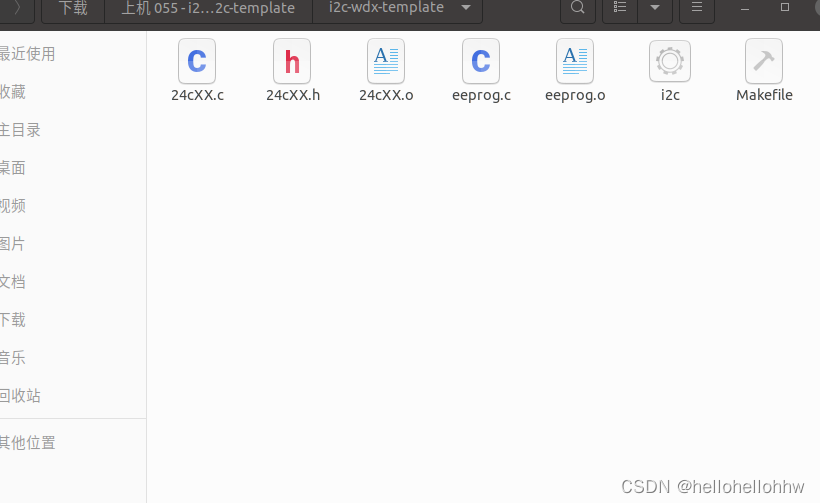
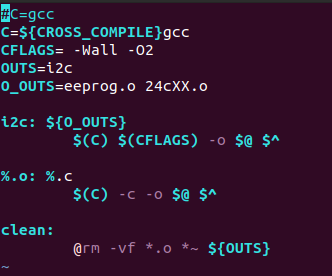
3. 思考题
I2C总线的优点是什么?
(1.)I2C总线只需要一根数据线和一根时钟线两根线,总线接口已经集成在芯片内部,优化主板空间和成本。
(2.)无论总线上有多少设备,都只使用两条线,保持低引脚/信号数
(3.)真正的支持多主机设备,但是同一时刻只允许一台主机
(4.)I2C总线具有低功耗、抗干扰强的优点,传输距离长的特点。
(5.)连接到相同总线的IC 数量只受到总线的最大电容400pF 限制
I2C总线的启动信号和结束信号有什么特点?
启动信号:SCL为高电平时,SDA由高电平向低电平跳变,开始传送数据。
结束信号:SCL为高电平时,SDA由低电平向高电平跳变,结束传送数据。





 扫一扫
扫一扫


 6726
6726

 被折叠的 条评论
为什么被折叠?
被折叠的 条评论
为什么被折叠?
 到【灌水乐园】发言





