



 这篇博客介绍了三种不同的方法来实现从尾到头打印链表节点值:1) 计算链表长度并反向填充数组;2) 使用堆栈保存指针;3) 递归实现。每种方法都通过实例代码详细阐述了其工作原理。
输入一个链表的头节点,从尾到头反过来返回每个节点的值(用数组返回)。
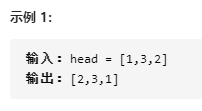
- 方法1
计算链表的长度,反向填充数组
/**
 1. Definition for singly-linked list.
 2. public class ListNode {
 3.     int val;
 4.     ListNode next;
 5.     ListNode(int x) { val = x; }
 6. }
 */
class Solution {
    public int[] reversePrint(ListNode head) {
        ListNode n=head;
        int num=0;
        while(n!=null){
            num++;
            n=n.next;
        }
        int[] a=new int[num];
        n=head;
        for(int i=num-1;i>-1;i--){
            a[i]=n.val;
            n=n.next;
        }
        return a;
    }
}
2、堆栈
保存指针
/**
 * Definition for singly-linked list.
 * public class ListNode {
 *     int val;
 *     ListNode next;
 *     ListNode(int x) { val = x; }
 * }
 */
class Solution {
    public int[] reversePrint(ListNode head) {
        Stack<ListNode> stack=new Stack<ListNode>();
        ListNode n=head;
        while(n!=null){
            stack.push(n);
            n=n.next;
        }
        int size=stack.size();
        int[] a=new int[size];
        for(int i=0; i<size;i++){
            a[i]=stack.pop().val;
        }
        return a;
    }
}
保存数字
/**
 * Definition for singly-linked list.
 * public class ListNode {
 *     int val;
 *     ListNode next;
 *     ListNode(int x) { val = x; }
 * }
 */
class Solution {
    public int[] reversePrint(ListNode head) {
        Stack<Integer> stack=new Stack<Integer>();
        ListNode n=head;
        int c=0;
        while(n!=null){
            stack.push(n.val);
            n=n.next;
            c++;
        }
        int[] a=new int[c];
        for(int i=0; i<c;i++){
            a[i]=stack.pop();
        }
        return a;
    }
}
3、递归
递归和堆栈方法基本都能互换着写
/**
 * Definition for singly-linked list.
 * public class ListNode {
 *     int val;
 *     ListNode next;
 *     ListNode(int x) { val = x; }
 * }
 */
class Solution {
    List<Integer> t=new ArrayList<>();
    // ArrayList<Integer> t=new ArrayList<Integer>();
    public int[] reversePrint(ListNode head) {
        dg(head);
        int size=t.size();
        int[] a=new int[size];
        for(int i=0;i<size;i++){
            a[i]=t.get(i);
        }
        return a;
    }
    void xunhuan(ListNode head){
        if (head==null) return;
        dg(head.next);
        t.add(head.val);
    }
}





 扫一扫
扫一扫


 872
872

 被折叠的 条评论
为什么被折叠?
被折叠的 条评论
为什么被折叠?
 到【灌水乐园】发言





