


0.1.1. 读取图像形式的MNIST #划分为train/test #对数据进行归一化,即0-1之间,数据要变成float类型 #把数据顺序打乱
'''
导入必须的库
'''
import os
from PIL import Image
import numpy as np
import matplotlib.pyplot as plt
from numpy.ma.extras import unique

'''
根据名称整出来训练集、测试集和对应的标签
'''
def load_images_and_split(folder):
    train_images = []
    test_images = []
    test_labels = []
    train_labels = []
    for filename in os.listdir(folder):
        if filename.endswith('.jpg'):
            img_path = os.path.join(folder, filename)
            try:
                img = Image.open(img_path)
                img_array = np.array(img)
                label = filename[-5]

                if 'test' in filename:
                    test_images.append(img_array)
                    try:
                        # 尝试将标签转换为整数
                        test_labels.append(int(label))
                    except ValueError:
                        print(f"Invalid label in {filename}: {label}. Skipping this image.")
                elif 'training' in filename:
                    train_images.append(img_array)
                    try:
                        train_labels.append(int(label))
                    except ValueError:
                        print(f"Invalid label in {filename}: {label}. Skipping this image.")
            except Exception as e:
                print(f"Error loading {img_path}: {e}")

    train_images = np.array(train_images)
    test_images = np.array(test_images)
    train_labels = np.array(train_labels)
    test_labels = np.array(test_labels)

    return train_images, train_labels, test_images, test_labels


'''
数据预处理,展平和归一化部分在这里
'''
def preprocess_data(train_images, test_images):
    # 展平图片数据
    train_images_flat = train_images.reshape(train_images.shape[0], -1)
    test_images_flat = test_images.reshape(test_images.shape[0], -1)

    # 归一化处理
    #注意这次必须要进行归一化,否则在后续前向传播的过程中exp会超出精度
    train_images_normalized = train_images_flat / 255.0
    test_images_normalized = test_images_flat / 255.0

    return train_images_normalized, test_images_normalized

'''
onehot编码方便交叉熵损失计算
'''
def one_hot_encode(labels, num_classes):
    one_hot = np.zeros((labels.shape[0], num_classes))
    one_hot[np.arange(labels.shape[0]), labels] = 1
    return one_hot

'''
检查路径和读取
'''
# image_folder = 'mnist_jpg/mnist_jpg'
image_folder = "E:/Strudy/Data/nearestk/mnist_jpg/mnist_jpg"
train_images, test_images,train_labels,test_labels = load_images_and_split(image_folder)

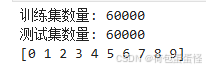
print(f"训练集数量: {len(train_images)}")
print(f"测试集数量: {len(test_images)}")
print(unique(test_labels))
'''
定义评估函数
'''
def two_evaluate_model(test_images, test_labels, weights1, bias1,weights2,bias2,x_row):
    #隐藏
    #本次作业要求使用的是sigmoid激活函数
    #第一层
    hidden_layer=1 / (1 + np.exp(-np.dot(test_images, weights1) + bias1))
    #第二层,注意这里第二层的输出不需要使用任何激活函数
    logits = np.dot(hidden_layer, weights2) + bias2
    y_pred = logits
    predicted_labels = np.argmax(y_pred, axis=1)
    accuracy = np.mean(predicted_labels == test_labels)
    # print(f'Accuracy on the test set: {accuracy * 100}%')

    return accuracy
0.1.2. 参考PPT定义并训练一个两层的神经网络, #定义网络 #损失函数和PPT一致 #中间层激活函数sigmoid
'''
绘图
'''
def drawing(x,y,title):
    plt.plot(x,y)
    plt.title(title)
    plt.show()

'''
SGD
'''
def SGD(test_images_normalized, test_labels, train_images, train_labels, num_classes, num_trials=100, batch_size=100):
    #注意,这里输入的x矩阵(也就是图像)和上次课作业不同,本次使用的小批量梯度下降,也就是随机选取batch_size个图像进行梯度的迭代。X是[batch_size,input_size],最终的y_pred输出的维度是[batch_size,10],可以使用print(batch_images.shape)检验一下

    input_size = train_images.shape[1]

    x_row = [] #这个三个参数纯粹为了画图
    y_loss_row = []
    y_rate_row = []

    # 初始化第一层
    weights1 = np.random.randn(input_size, num_classes)
    bias1 = np.zeros((1, num_classes))

    # 初始化第二层
    weights2 = np.random.randn(num_classes, num_classes)
    bias2 = np.zeros((1, num_classes))

    num_samples = train_images.shape[0]

    for trial in range(num_trials):
        # 随机打乱样本顺序
        permutation = np.random.permutation(num_samples)
        shuffled_images = train_images[permutation]
        shuffled_labels = train_labels[permutation]

        for i in range(0, num_samples, batch_size):
            # 取出一个小批量样本
            batch_images = shuffled_images[i:i + batch_size]
            batch_labels = shuffled_labels[i:i + batch_size]

            # 前向传播
            # 第一层,使用的是sigmoid函数
            hidden_layer = 1 / (1 + np.exp(-np.dot(batch_images, weights1) + bias1))

            #第二层,没有激活函数哦
            y_pred = np.dot(hidden_layer, weights2) + bias2

            # 计算损失,老师课上要求使用的L2损失
            y_true = one_hot_encode(batch_labels, num_classes)
            loss = np.square((y_pred - y_true)**2).sum()

            # 更新参数,也就是上游梯度*当前梯度
            grad_y_pred = 2 * (y_pred - y_true)
            grad_w2 = hidden_layer.T.dot(grad_y_pred) #对于这行代码,grad_y_gred是上游梯度,乘上中间层输出的转置
            grad_b2 = np.sum(grad_y_pred, axis=0, keepdims=True)
            #和老师的ppt上内容不同,我用的是y=wx+b,也就是偏置和权重矩阵是分开来的。
            grad_h = grad_y_pred.dot(weights2.T)
            grad_w1 = batch_images.T.dot(grad_h * hidden_layer * (1 - hidden_layer))#这里用到了sigmoid的求导公式,sigmoid的导数可以用自己表示自己
            grad_b1 = np.sum(grad_h * hidden_layer * (1 - hidden_layer), axis=0, keepdims=True)

            更新参数,跟着负梯度迭代
            weights1 -= 1e-4 * grad_w1
            weights2 -= 1e-4 * grad_w2
            bias1 -= 1e-4 * grad_b1
            bias2 -= 1e-4 * grad_b2

        x_row.append(trial)
        # 计算当前批次的平均损失
        y_loss_row.append(loss)
        acc = two_evaluate_model(test_images_normalized, test_labels, weights1, bias1, weights2, bias2,x_row)
        y_rate_row.append(acc)
        print(f'Trial {trial + 1}, Loss: {loss}')

    drawing(x_row, y_loss_row, 'Loss')
    drawing(x_row, y_rate_row, 'Accuracy')
主函数如下调用
image_folder = "E:/Strudy/Data/nearestk/mnist_jpg/mnist_jpg"
train_images, train_labels, test_images, test_labels = load_images_and_split(image_folder)
train_images_normalized, test_images_normalized = preprocess_data(train_images, test_images)
num_classes = len(np.unique(train_labels))
SGD(test_images_normalized, test_labels,train_images_normalized, train_labels, num_classes)
损失图像: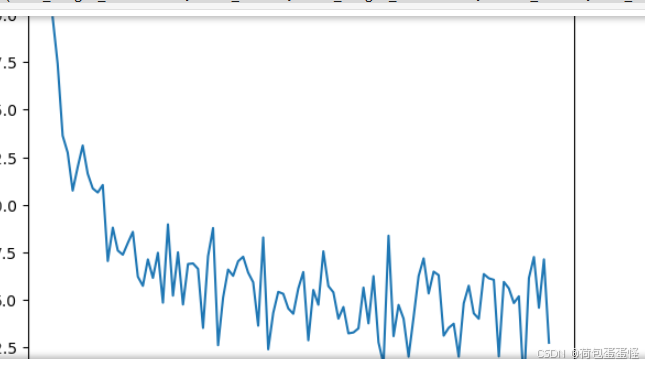
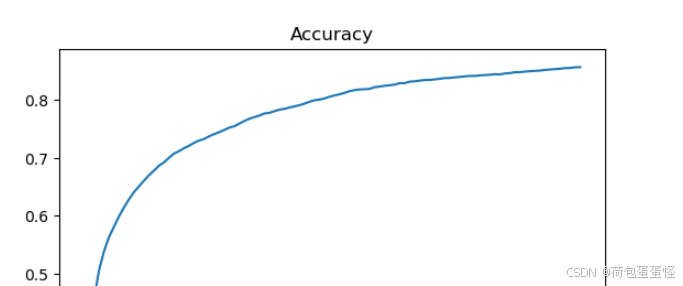
精确度图像:
老师还要求更改epoch和batch_size进行实验,自行修改超参数就可以。
我自己的实验结果是epoch=100和batch_size=100时候的效果最佳。
实验结果分析 1、归一化的重要性:由于本次实验对象维度很大,所以不进行归一化会报错超出float的精度 2、本次实验使用SGD的方法。当batch_size选取为100,进行100次迭代发现实验结果良好,最终准确率是一个平滑的上升曲线,达到了85.7%的精度。 3、扩大batch_size实验发现实验效果很差,并且波动很大。初步猜测是因为迭代次数过少,没有办法学到样本的重要特征。所以在batch_size=1000的基础上扩大epoch=1000,发现实验效果仍然不理想。个人初步认为是样本选取数量变多,但是学习步长太短,更新迭代速率太慢,并且可能陷入了局部最优解。个人在自己电脑跑了一下,发现调整学习率会让准确率提升很多。





 扫一扫
扫一扫


 被折叠的 条评论
为什么被折叠?
被折叠的 条评论
为什么被折叠?
 到【灌水乐园】发言





